
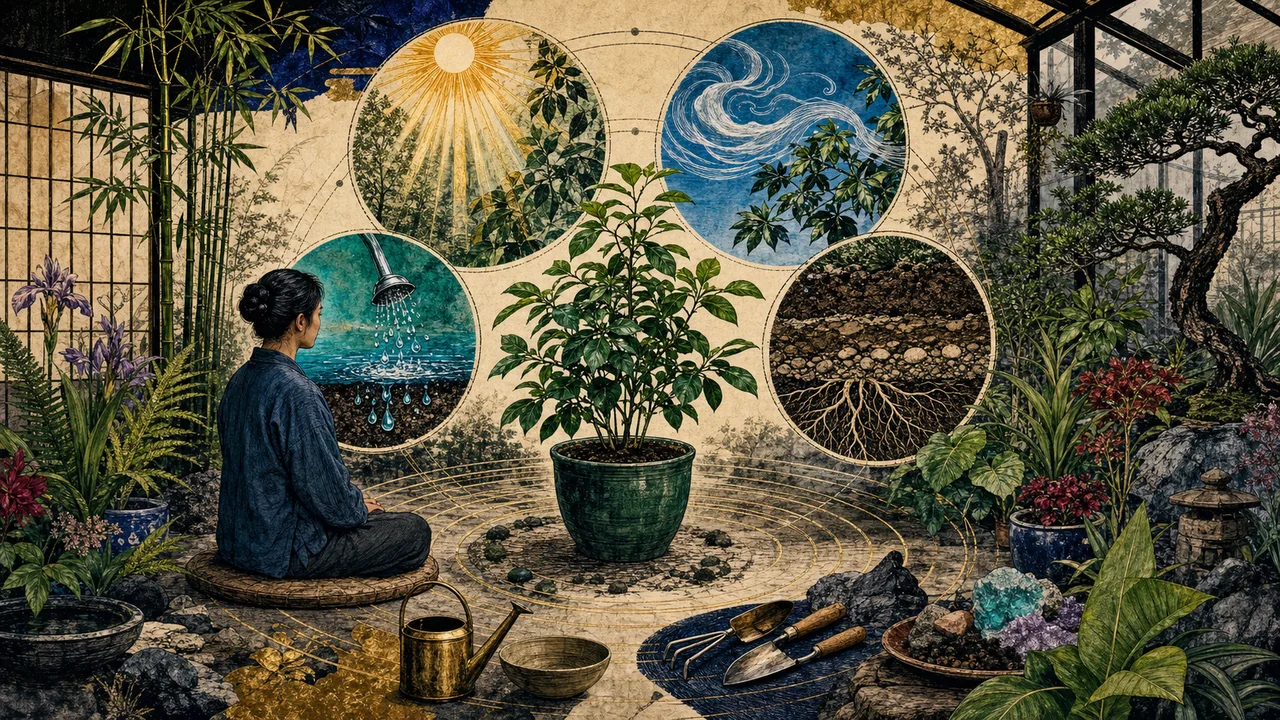
Reiki can be applied to plants because they also have an energetic field, absorb energy from their environment, and respond to the frequencies present where they live. The application is performed through the hands, attention, and intention directed toward the plant's vibrational field.
In this article, you will understand the energetic field of plants, how to prepare for the application, why it is usually performed without physical contact, which areas can receive energy, and the recommended time and frequency.
Continue reading to follow this guidance and apply it to pots, gardens, and trees.
The Energetic Field of Plants
Plants are living beings that continuously receive, transform, and distribute energy. Their roots maintain contact with the earth, their leaves absorb light, and the plant as a whole interacts with water, air, and the frequencies present in its environment.
This field is not isolated from the physical structure. When a plant receives suitable conditions, its energy tends to circulate with greater balance. When it remains in an unfavorable space, suffers damage, or undergoes sudden changes, its field may also show reduced vitality.
Applying Reiki offers an organized frequency to this system. Directed intention establishes the connection and allows energy to be transmitted without the need to physically manipulate the plant. Energetic practices can be directed toward people, animals, plants, and environments because they all have fields that respond to the emitted frequency.
Preparing to Apply Reiki to Plants
Before the application, the Reiki practitioner can observe the plant and the place where it is located. Drooping leaves, dryness, excess moisture, insufficient light, or the presence of insects provide practical information that should not be ignored.
After this observation, the practitioner organizes their own state. A few minutes of silence and breathing help reduce mental distraction and make it possible to establish a clearer intention for the energetic work.
The intention can be directed toward general balance, strengthening the field, or restoring vitality. It is not necessary to create long phrases or try to impose a specific result. The Reiki practitioner offers energy and allows the plant to distribute it according to its structure and needs.
Applying Reiki Without Physical Contact
Reiki can be applied with the hands positioned a few inches from the plant. This distance avoids pressing delicate leaves, breaking branches, damaging flowers, or physically interfering with sensitive species.
The hands can remain on either side of the pot, above the foliage, or close to the area that will receive greater attention. The practitioner keeps their arms relaxed and directs the energy without excessive effort.
Physical contact is unnecessary because the hands function as facilitators of emission. Intention organizes the flow, and the expansion of the field allows energy to reach the recipient without direct touch.
Areas That Can Receive the Application
A complete application can begin at the top of the plant. The hands remain close to the leaves and branches, offering energy to the whole without immediately concentrating on a single area.
The practitioner can then direct attention toward the stem or trunk, which supports the structure and distributes water and nutrients. In this area, the hands can remain parallel, forming a field around the central part of the plant.
The root area can also be worked with through the pot or surrounding soil. The Reiki practitioner positions their hands close to the base and directs the intention toward rooting, stability, and better energetic circulation among the soil, roots, and above-ground parts.
The Duration and Frequency of Applications
An application to plants can last between five and fifteen minutes, depending on the size, condition, and number of specimens receiving Reiki. A small plant generally does not require the same amount of time used for a tree or an entire garden bed.
There is no need to control every minute rigidly. The practitioner can remain until they notice that the flow has decreased, their concentration has begun to disperse, or the time planned for that practice has ended.
Frequency can also vary. Balanced plants can receive Reiki occasionally, while weakened specimens can be worked with for several consecutive days. Consistency is more important than completing one long session and then abandoning the practice entirely.
Applying Reiki to Pots, Gardens, and Trees
With potted plants, the hands can surround the container without touching it, directing energy toward the plant, soil, and roots at the same time. This approach is practical for small species kept indoors.
In gardens and beds, the Reiki practitioner can work in sections or radiate Reiki toward the whole. By expanding the field and maintaining a defined intention, it becomes possible to harmonize several plants without applying Reiki individually to every leaf or stem.
With trees, the application can be performed close to the trunk, visible roots, or crown. The practitioner does not need to physically reach the entire structure because they can use the whole tree as the focus and direct energy toward its complete field.
Applying Reiki to Weakened Plants
A plant may weaken because of too little or too much water, unsuitable lighting, depleted soil, pests, temperature changes, or root damage. Reiki does not automatically identify which of these factors is present.
Before applying energy, it is important to correct the conditions that may be causing the problem. Transmitting Reiki while the plant remains in a pot without drainage or in an environment incompatible with its needs reduces the possibility of recovery.
After the necessary adjustments, the application can act as vibrational support. The Reiki practitioner offers energy to the complete field or concentrates on the most affected areas, maintaining an intention of stability and strengthening without turning the practice into a promise of guaranteed recovery.
Observing Changes After the Application
The response of plants should be observed over time, not only immediately after a session. Changes in the appearance of the leaves, the emergence of new shoots, firmness of the stem, and root development can provide information about their general condition.
However, these changes should not automatically be attributed to Reiki. Water, light, temperature, fertilization, and the natural characteristics of the species also directly influence growth and recovery.
Monitoring becomes clearer when the practitioner observes the plant before and after the application, records dates, and keeps other care stable. In this way, the practice stops depending only on momentary impressions and is performed with greater attention.
Reiki Integrated with Natural Care
Energy does not replace the material elements on which a plant depends. Water, light, soil, space for the roots, and protection from unsuitable conditions remain indispensable foundations for its development.
The application can be integrated into watering, pruning, repotting, or organizing the garden. The Reiki practitioner performs the physical care attentively and then offers energy to harmonize the field of the plant and its environment.
This integration prevents Reiki from being treated as an isolated solution. Energetic practice offers support, while responsible care observes the real needs of each species. Balance occurs when frequency, intention, and concrete actions work coherently.
Frequently Asked Questions
Yes. Reiki can be directed toward the vibrational field of plants, pots, garden beds, trees, and gardens through the hands, attention, and intention.
No. The hands can remain close to the plant, avoiding damage to delicate leaves, flowers, or branches.
It can generally last between five and fifteen minutes, varying according to the size, condition, and number of plants receiving the application.
No. Reiki is vibrational support and does not replace water, light, nutrients, pruning, pest control, or suitable growing conditions.
No. It can offer energetic support, but recovery also depends on the physical, environmental, and natural conditions of each species.
Continue learning with practical guidance
Understanding how Reiki can be applied to plants helps integrate energetic practice, attention, and concrete care more responsibly.
The 21-Day Reiki Self-Treatment Guide organizes these foundations in a clear sequence for those who want to study and practice responsibly.
Discover the complete guide
About the author
Prof. Tibério Z has more than 30 years of experience teaching spirituality, metaphysics, holistic therapies and consciousness development.