
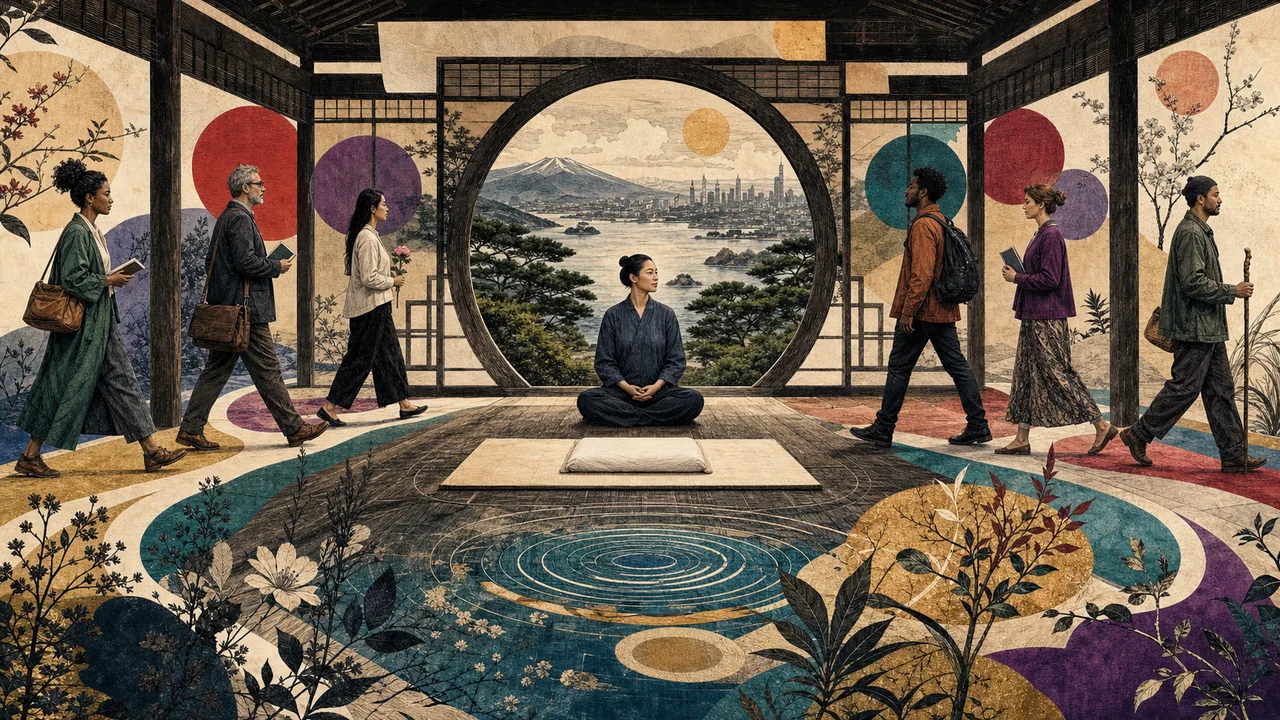
Reiki is not a religion. It is a practice of energy transmission that acts on the vibrational field and promotes the reorganization of the chakras. To better understand this context within the method, this article is part of the complete guide to Reiki for beginners.
In this article, you will understand what characterizes a religion, why Reiki does not fit this definition, what its spiritual dimension is, how the five principles function as guidance for living and how the practice relates to personal faith.
Continue reading to follow these differences and understand how Reiki coexists with distinct traditions.
What characterizes a religion
A religion usually presents an organized view of God, the origin of life, the meaning of existence, death and the relationship between human beings and the sacred. It may have doctrines, texts considered sacred, ceremonies, religious authorities and communities gathered around a shared belief.
In addition, many religions guide their followers regarding behavior, values, devotional practices and ways of relating to the divine. Even when different interpretations exist within the same tradition, there is a religious identity that connects its participants.
Reiki does not have this structure. It has no mandatory doctrine about God, does not determine how a person should understand life after death and does not establish a religious institution to which all practitioners must belong. This difference is fundamental to understanding its nature.
Why Reiki is not a religion
Reiki has no deity of its own, system of worship or promise of salvation. The Reiki practitioner does not need to worship Mikao Usui, the masters of their lineage, the symbols or the energy itself that is used during the application.
Reiki attunement also does not function as a religious conversion. It prepares the student to work with a particular frequency within an energy system. The practitioner learns principles, hand positions, symbols and forms of application, but does not receive a new religious identity.
The symbols used at some levels are not objects of veneration either. They function as vibrational codes that help the mind access, organize and direct specific frequencies. Their function is practical and energetic, not religious.
Reiki's spiritual dimension
Spirituality is related to the way a person understands consciousness, values, the meaning of life and their relationship with something greater than the ego's immediate needs. It can be experienced within a religion, but it can also exist without a formal religious structure.
Reiki participates in this dimension because it does not work only with the physical body. The practice considers the existence of the energy field, chakras and different levels of consciousness, offering the practitioner a direct experience of contact with energy and their own inner state.
This spiritual development is not limited to learning a technique. It involves self-development, expansion of consciousness and increased understanding of oneself and life. Spirituality becomes practical when it changes the way one thinks, feels and acts.
The five principles as guidance for living
The five principles of Reiki guide the practitioner to work each day with anger, worry, gratitude, honesty in work and kindness. They are not commandments accompanied by punishment, but references for observing one's own behavior.
The expression “just for today” shows that the work needs to happen in the present. Instead of promising never to feel anger or fear again, a person focuses on recognizing how these states appear that day and seeks to respond with greater awareness.
These principles also show that Reiki is not limited to application through the hands. A Reiki practitioner can transmit energy regularly and continue sustaining conflict, dishonesty or a lack of responsibility. The practice deepens when the frequency worked with during the session begins to be expressed in everyday conduct.
The relationship between Reiki and personal faith
Reiki does not require a person to abandon their faith. Someone who believes in God may understand Reiki energy as an expression of divine energy, while someone else may interpret it as universal vital energy, vibrational frequency or a force present in nature.
These interpretations do not change the basic procedure of the application. The practitioner concentrates, directs their intention and keeps their hands on or near the body. The frequency does not depend on the use of specific religious language.
It is also not necessary to replace prayer with Reiki or Reiki with prayer. They are different practices, although they can coexist. Prayer establishes a conscious relationship with the sacred according to a person's faith, while Reiki works with energy transmission and organization.
Coexistence with different religious traditions
People from different religions can learn and receive Reiki because the method does not determine which deity must be recognized. Each person preserves their beliefs, rituals and particular way of understanding spirituality.
A Christian can perform Reiki without ceasing to follow the Gospel. A Spiritist can relate it to the study of fluids and passes. A practitioner of Eastern traditions can connect it to the concepts of ki, prana, chakras and vital energy.
This coexistence requires respect. The Reiki practitioner should not use a session to try to convert the recipient, present their religion as superior or attribute beliefs to a client that the client does not hold. Energy work should be conducted clearly while preserving each person's spiritual freedom.
Spiritual practice without dogmatism
A spiritual practice becomes dogmatic when its explanations begin to be presented as truths that no one can question. At this point, the practitioner stops studying and observing their own experience and merely repeats what they have learned.
In Reiki, knowing the tradition and respecting the lineage does not mean preventing questions. The student needs to understand why they perform each procedure, observe the effects of the practice and deepen their knowledge over time. Mechanically repeating symbols and positions does not produce genuine understanding.
Spiritual rigidity can create attachment to fixed beliefs and difficulty welcoming other perspectives. Balanced spirituality develops presence, silence, clarity and confidence based on inner experience, not on the need to impose a single explanation on everyone.
Reiki as direct experience
Religion can transmit teachings through texts, traditions and authorities. In Reiki, an essential part of learning happens through the direct experience of feeling, transmitting and observing energy during practice.
At first, the student may depend on the positions taught and detailed guidance. With continuity, they develop sensitivity to perceive warmth, tingling, pressure, differences in flow and changes in their own mental and emotional state.
This experience does not need to produce extraordinary phenomena. Development may appear as greater presence, calm, the ability to observe thoughts and a clearer perception of emotions. The value of Reiki lies not in proving something to others, but in understanding the process through consistent practice.
Reiki as a path of consciousness and responsibility
The spiritual development provided by Reiki does not remove a person's responsibility for their life. An application can temporarily raise the frequency, but it does not replace decisions, behavioral changes and the effort needed to transform mental and emotional patterns.
The Reiki practitioner also needs to recognize the limits of their role. They do not control the session's outcome, do not know everything about another person's process and should not promise healing. Humility, detachment and respect are important parts of spiritual maturity within the practice.
Vibrational ethics are based on truth, balanced exchange, responsibility and consistency. In this way, Reiki can become a spiritual path when it helps a person expand consciousness and live with greater balance, but it remains an energy practice, not a religion.
Frequently Asked Questions
No. Reiki is an energy practice of Japanese origin. It can have a spiritual dimension, but it does not require conversion, worship, mandatory doctrine or abandonment of one's personal faith.
Yes. People from different religious traditions can practice Reiki, provided they preserve their own faith and understand the method as an energy practice, not as a replacement religion.
No. Some people interpret Reiki energy as a divine expression, while others understand it as universal vital energy. The practice does not depend on a single religious explanation.
No. The symbols function as vibrational and mental resources used in some stages of the practice. They do not need to be venerated or treated as deities.
Yes. Reiki can be spiritual when it promotes awareness, presence, balance and inner responsibility. This does not make it an organized religion.
Continue learning with practical guidance
After understanding that Reiki is not a religion, the next step is to study its foundations with order, clarity and respect for the practice.
The 21-Day Reiki Self-Treatment Guide organizes these foundations in a clear sequence for those who want to study and practice responsibly.
Discover the complete guide
About the author
Prof. Tibério Z has more than 30 years of experience teaching spirituality, metaphysics, holistic therapies and consciousness development.