
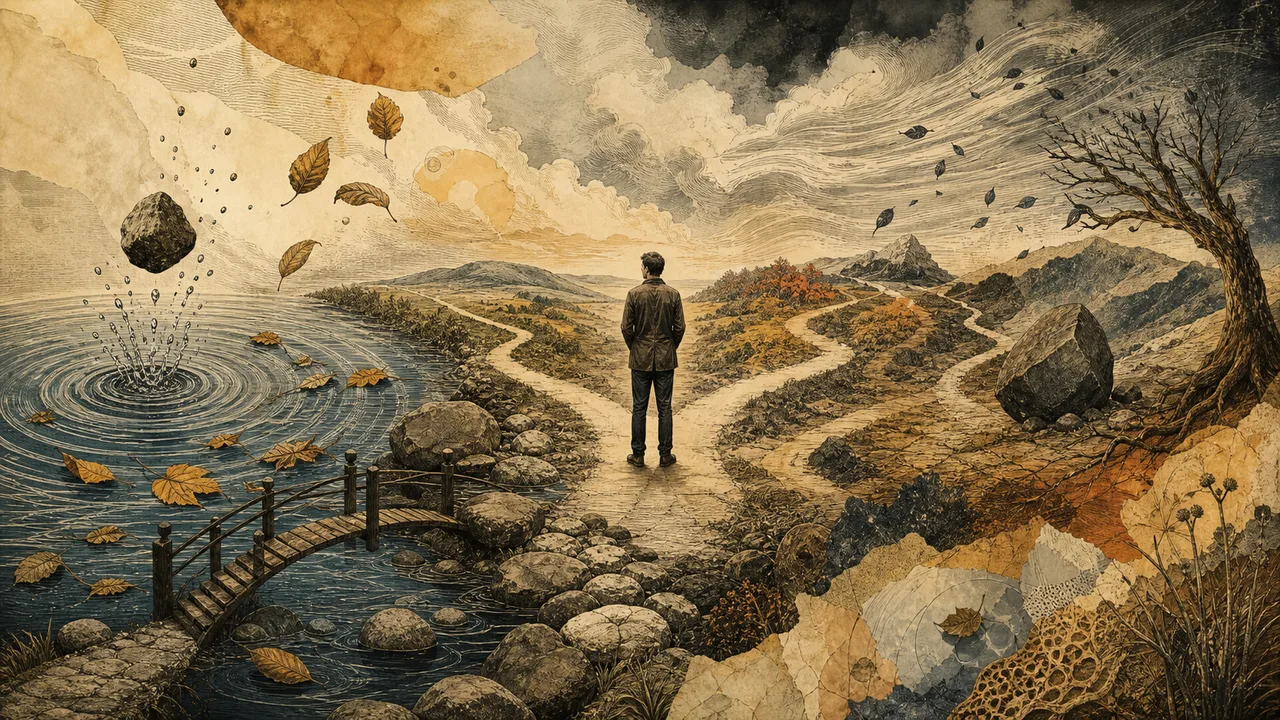
The principle of Cause and Effect teaches that no event arises completely separate from what preceded it. Every thought, feeling, word, choice and action sets forces in motion. These forces produce consequences that may appear immediately or develop over time.
Life is formed by a continuous sequence of causes and effects. What we experience today was influenced by previous movements, while our present attitudes are preparing future experiences. Every effect also becomes a new cause, expanding a chain that involves people, environments and different planes of existence.
This principle approaches the spiritual teaching that each person reaps what they sow. Thoughts and actions are seeds cast into the field of life. Some germinate quickly; others need the right conditions and time. Even when we forget what we planted, we remain connected to the results produced by our choices.
What is the principle of Cause and Effect?
Cause and Effect is the sixth of the seven principles presented in The Kybalion. It teaches that every cause has an effect and that every effect arose from a cause. Nothing happens completely outside universal order, even when we cannot immediately recognize the movement that produced a particular result.
The cause is the force that initiates or participates in forming an experience. The effect is what manifests from it. A decision can produce changes in relationships, work and spiritual life. These results, in turn, influence later choices and begin new movements.
Understanding this principle means abandoning the idea that we live in a reality formed only by isolated events. Everything is connected through sequences of thoughts, emotions, choices and consequences. Every being participates in these sequences, receiving earlier influences and adding new causes to the world.
Why does nothing happen without a cause?
We cannot always follow the entire path leading to a particular event. Many causes began years earlier, involved different people or were silently fed by repeated thoughts and attitudes. When the result appears, we see only its final part and believe it arose unexpectedly.
The Kybalion teaches that what we call chance represents the meeting of causes we do not yet understand. An apparently casual encounter depends on the paths chosen, the times, decisions and movements made by everyone involved before that moment.
This does not mean that we know every existing cause. Reality is formed by countless chains that continually cross. However, our inability to see the entire sequence does not eliminate the relationship between what was set in motion and the effect that later manifested.
How do thoughts plant causes?
Every thought sets a direction in motion. A passing idea may exert little influence, but what is repeated daily begins organizing emotions, expectations and choices. The thought becomes a seed that gains strength every time we return to feed it.
When a person continually thinks they are not capable, they begin interpreting events through that belief. They may avoid opportunities, give up before trying or accept situations below what they could build. The external result is born from a cause that was first strengthened on the mental plane.
The same happens when someone cultivates trust, knowledge and a willingness to act. These thoughts influence decisions, bring opportunities closer and produce new responses to difficulties. Thinking does not replace action, but establishes the inner direction from which actions will be chosen.
How do words and attitudes produce consequences?
Words are causes because they convey thoughts, awaken emotions and change relationships. A word spoken in anger may remain in someone's memory for years. Likewise, guidance, encouragement or an expression of support can change the direction of a life.
Attitudes deepen what words begin. Repeating promises without acting weakens trust, while demonstrating coherence strengthens bonds. Every behavior communicates a frequency and produces effects on the person who performs it, the person who receives it and the shared environment.
No action ends at the exact moment it is performed. Its consequences continue moving thoughts, feelings and decisions in other people. What we do may reach experiences we will never witness directly, demonstrating that one cause can produce effects far beyond our immediate perception.
Why do some effects take time to appear?
Not every seed germinates when it is planted. Some causes quickly encounter the conditions required to produce a result, while others remain in development. The time between an action and its consequence can make it difficult to understand what is actually being built.
A person may repeat harmful habits for years without noticing evident effects. This may lead them to believe that their choices have no consequences. However, the causes continue accumulating force until they encounter conditions that allow them to manifest more clearly in that person's life.
The same occurs with positive causes. Study, discipline, honesty and dedication do not always produce immediate results. For a time, it may seem that nothing is changing. Yet every action strengthens a structure that can manifest when the process reaches sufficient maturity.
What is the relationship between Cause and Effect and karma?
Karma means action and also refers to the consequences produced by actions. The Hermetic principle of Cause and Effect approaches this teaching because both affirm that what we do sets forces in motion and participates in building the experiences we will live.
Karma should not be understood only as punishment. It represents learning, balance and continuity. An action produces a consequence that teaches something to the being who performed it. Through experience, the effect makes it possible to understand the quality of the cause created earlier.
The expression “each person reaps what they sow” summarizes this relationship. Those who plant violence strengthen movements of violence; those who cultivate respect and generosity add these forces to their own path. The harvest may not appear in the expected way, but it retains a relationship with the seeds cast along the journey.
How do destiny and free will act together?
We are born into conditions that we did not consciously choose. We receive a body, a family, a culture and experiences that were already in motion before our arrival. These conditions represent effects of previous causes and form the initial field where we begin our path.
Free will appears in how we respond to what we receive. We cannot immediately change every circumstance, but we can introduce new causes through thoughts, choices and attitudes. Every conscious response changes the direction of the movements that will continue producing effects.
Destiny does not need to be understood as an unchangeable sentence. It represents the continuity of causes already set in motion. As we develop awareness, we stop automatically repeating certain patterns and begin creating different forces capable of gradually changing our path.
Are there individual and collective causes?
Not everything we experience arose only from our personal choices. We participate in families, groups, societies and humanity. We receive effects produced by collective decisions, just as our own attitudes add new causes to the environments of which we are part.
A person may suffer consequences caused by someone else's choices, social structures or collective events. The principle of Cause and Effect should not be used to blame someone for every difficulty they face. We cannot always identify the complete origin of an experience.
Spiritual responsibility consists in observing what we will do with what we receive. Even when we did not create a particular situation, our response introduces new causes. We can increase the suffering, repeat it or transform the experience into learning, awareness and a change of direction.
How can we create new causes to transform life?
Transformation begins by observing the effects that repeat. Similar relationships, recurring difficulties and results that remain the same may reveal causes that are still active. Instead of looking only at the external event, we need to investigate the thoughts, feelings and choices that participate in its formation.
After recognizing the pattern, we need to introduce a different cause. New results do not arise while we continue repeating the same behaviors. Changing the harvest requires changing the seeds, how we care for them and the conditions we provide for their development.
Every conscious thought, responsible word and coherent attitude participates in building the future. We do not control every force in the universe, but we are responsible for what we add to it. When we change the causes we sustain each day, we begin preparing effects more compatible with the life we want to build.
Frequently Asked Questions About the Principle of Cause and Effect
It is the sixth principle presented in The Kybalion and teaches that every cause has an effect and every effect arose from a cause.
Because every event participates in chains formed by previous decisions, movements and conditions, even when we cannot fully recognize them.
Because some causes need to accumulate force and encounter the necessary conditions before their results clearly manifest.
Both affirm that our actions set forces in motion and participate in building the experiences we will live.
By recognizing repeated patterns and introducing thoughts, words, choices and attitudes different from the causes that sustained them.
Continue exploring spiritual knowledge
Understanding Cause and Effect helps us investigate consequences, recognize influences and choose more consciously within present conditions.
Explore our English e-books to continue studying spirituality through clear explanations and practical exercises.
Explore the e-books
About the author
Prof. Tibério Z has more than 30 years of experience teaching spirituality, metaphysics, holistic therapies and consciousness development.