
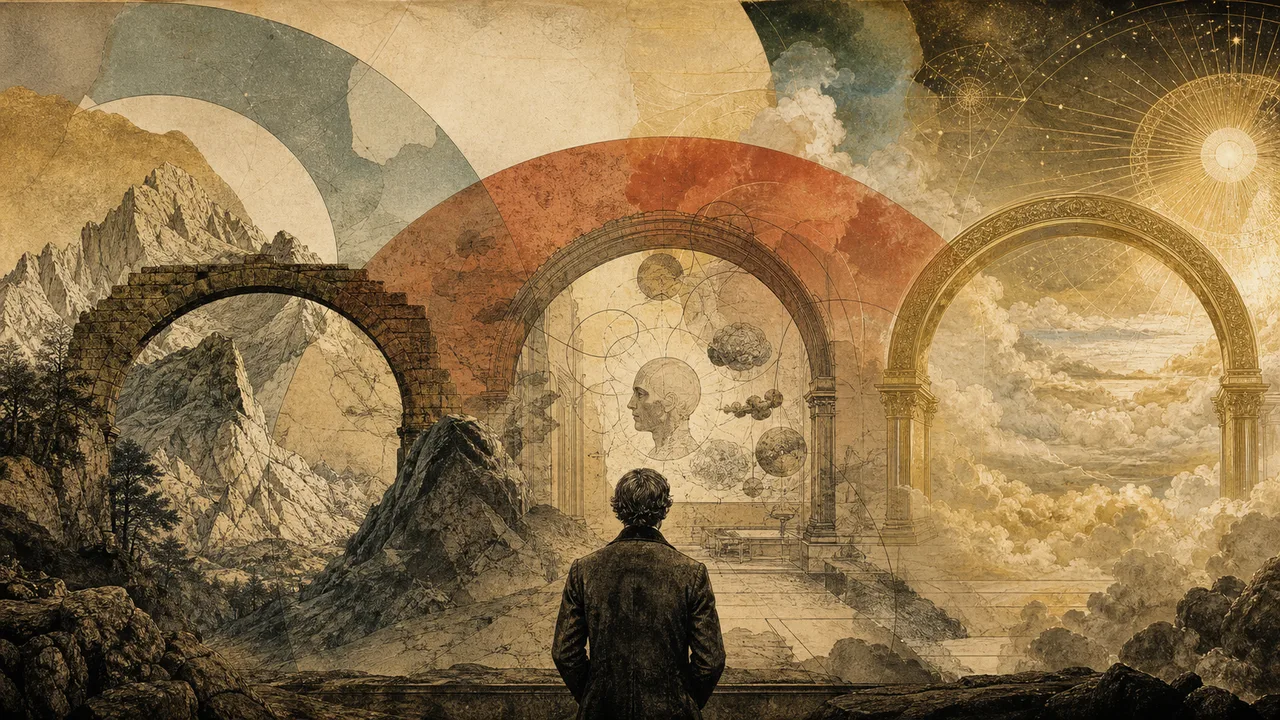
The Principle of Correspondence states that the different planes of reality maintain relationships with one another. Patterns observed on one level can help us understand phenomena on other levels, provided that the comparison preserves the differences among them.
In this article, you will understand where this formulation arose, the meaning of the relationship between what is above and what is below, and its connection with the Emerald Tablet. You will also learn about the concepts of macrocosm and microcosm and the principle's influence on astrology, alchemy, and magic.
Continue reading to learn how to observe correspondences responsibly and distinguish a useful analogy from a hasty conclusion.
What Is the Principle of Correspondence?
The Principle of Correspondence is the second of the seven principles presented by The Kybalion. It states that the different planes of reality maintain relationships with one another. In this way, certain patterns observed on one level could help us understand phenomena that manifest on other levels.
According to the work, there are physical, mental, and spiritual planes, each with its own characteristics. Although they are not considered identical, they would present corresponding structures or laws. Knowledge of one plane could offer useful comparisons for investigating another that is not directly accessible to the senses.
Correspondence does not mean that everything is equal or that any similarity is true. The principle proposes proportional relationships among distinct phenomena. Its use requires observing which characteristics truly recur, which ones change form, and which belong exclusively to the level being analyzed.
Where Did This Formulation of the Principle Arise?
The formulation known as the Principle of Correspondence appears in The Kybalion, published in 1908 under the signature “Three Initiates.” The book presents seven principles as the foundations of its Hermetic philosophy and uses Correspondence to explain the relationships among the different planes of the universe.
The Hermetic treatises of Antiquity do not present an organized list of these seven laws. For this reason, Correspondence, with this name and this position within a system, must be understood as a modern Neo-Hermetic formulation, even though it enters into dialogue with much older ideas.
The principle did not arise completely separate from the Western tradition. Relationships among the human being, the cosmos, the stars, and the different levels of reality already appeared in Platonic, Hermetic, astrological, alchemical, and magical currents. The Kybalion reorganized these themes in more systematic and accessible language.
What Does “As Above, So Below” Mean?
The phrase most closely associated with Correspondence states that what is above has a relationship with what is below. “Above” can indicate the cosmos, the celestial planes, or higher levels of reality. “Below” can represent the earthly world, the human body, or material phenomena.
The idea does not state that the higher plane is an exact copy of the lower one. It suggests that the same order can manifest in different ways. A relationship perceived in the universe could reappear in the human being, but adapted to the particular conditions and limits of human existence.
This principle seeks to lead thought from the known to the unknown. A person observes an accessible phenomenon and uses its structure as a comparison to investigate another that is more difficult to understand. The comparison functions as a philosophical instrument, not as automatic proof that the two phenomena are equivalent.
How Is This Principle Related to the Emerald Tablet?
The phrase about what is above and what is below is connected mainly to the Emerald Tablet, a short alchemical text attributed to Hermes Trismegistus. The work was preserved initially in Arabic sources and later translated into Latin during the Middle Ages.
The Emerald Tablet does not belong to the Greco-Egyptian Corpus Hermeticum. It arose in another textual tradition, especially connected to medieval alchemy. Over time, its statement about the relationship between the higher and the lower became one of the best-known expressions in all of Western Hermeticism.
The Kybalion expanded this idea and presented it as a law applicable to the physical, mental, and spiritual planes. There is therefore a historical connection between Correspondence and the Emerald Tablet, but the modern formulation of the principle is broader than the original content of the alchemical text.
How Does Correspondence Appear in Ancient Hermeticism?
The ancient Hermetic texts present a profound relationship among God, the cosmos, and the human being. The individual is not understood as a creature completely separate from the universe, but as part of a living and integrated order, capable of recognizing within themselves characteristics present in the greater reality.
Some studies describe the Hermetic human being as a microcosm, a small world that brings together dimensions found in the macrocosm. The body belongs to material nature, the soul participates in cosmic forces, and the intellect has a relationship with divine reality.
However, the Corpus Hermeticum does not present this relationship as the second of seven principles. The correspondence between human being and cosmos is embedded in teachings about creation, fate, intellect, and spiritual ascent. Its main purpose is to reveal the human position in the universe and our possibility of returning to the Divine.
What Are Macrocosm and Microcosm?
Macrocosm means the great world: the universe understood as an organized totality. Microcosm means the small world: the human being considered a synthesis or reduced image of that totality. The relationship indicates that the human structure would, to a certain degree, reflect the organization of the cosmos.
This idea does not state that every object existing in the universe is physically inside the body. It establishes functional and symbolic correspondences. Different human regions, capacities, or processes could be related to the elements, stars, and levels present in the cosmic structure.
During the Renaissance, this idea became important to philosophers and magicians such as Cornelius Agrippa. The human being was presented as an intermediary among the material, celestial, and intellectual worlds, bringing together within our constitution characteristics belonging to all these levels.
How Was Correspondence Used to Understand Nature?
Correspondence functioned as a method for organizing relationships among different phenomena. Plants, stones, metals, colors, parts of the body, stars, and psychic qualities were classified according to perceived affinities. These associations made it possible to build systems capable of interpreting nature as an integrated network.
For many ancient, medieval, and Renaissance authors, these relationships were not merely figures of speech. They believed that different objects could share real properties or influences because they occupied corresponding positions within the universal order. This understanding supported different forms of astrology, alchemy, and natural magic.
Knowledge of these relationships required study and observation, but it also depended on the philosophical ideas of each tradition. The same plant could receive different correspondences according to the author, region, or system used. For this reason, there was no universal table accepted by all Hermeticists.
How Did the Principle Influence Astrology, Alchemy, and Magic?
In astrology, the movements and qualities attributed to celestial bodies were related to earthly events and human tendencies. The sky functioned as macrocosm, while individual life would express these influences on a smaller scale. Correspondence helped explain the connection between the two.
In alchemy, transformations of substances could be related to changes in the cosmos and in the alchemist. Separation, purification, dissolution, and reunion were material operations, but they could also receive spiritual interpretations. The laboratory became a space where different levels of transformation were placed in correspondence.
In Renaissance magic, certain plants, stones, music, images, and aromas were believed to share qualities with certain stars. Bringing corresponding elements together at the proper moment could concentrate a celestial influence. This understanding depended on the idea of a living universe interconnected through sympathies and internal relationships.
How Can Correspondence Be Applied in Everyday Life?
In everyday life, Correspondence can be used as a tool for observation. Patterns that appear in thoughts, emotions, relationships, and behaviors can have similar structures. A person may notice, for example, that the same difficulty in setting boundaries manifests in different areas of their experience.
This application does not mean that every external event is an exact reproduction of the inner state. Social problems, illnesses, accidents, and the actions of other people have their own causes. The principle should not be used to hold someone responsible for everything that happens or to replace a concrete analysis of reality.
Correspondence becomes more useful when it produces questions instead of hasty conclusions. Rather than stating that two phenomena are equal, we can investigate what relationships exist between them, where the comparison helps, and where it ceases to work. In this way, the principle encourages reflection without turning analogies into proven facts.
Is Correspondence a Law Proven by Science?
Correspondence belongs to esoteric philosophy and the history of Hermeticism, not to the body of laws established by the natural sciences. There is no scientific proof that the physical, mental, and spiritual planes are governed by universal correspondences exactly as described by The Kybalion.
Science also uses comparisons, models, and similar patterns at different scales. However, each relationship needs to be demonstrated through observation, measurement, and testing. The similarity between two phenomena does not allow us, by itself, to conclude that both have the same cause or obey the same laws.
The principle can be studied as a metaphysical, symbolic, and philosophical proposal. Its responsible application requires distinguishing analogy from evidence, spiritual interpretation from verifiable fact, and similarity from equivalence. This distinction preserves its reflective value without presenting it as a scientific law.
Frequently Asked Questions About the Principle of Correspondence
It is the second principle presented by The Kybalion and states that the different planes of reality maintain relationships with one another.
The familiar formulation appears in The Kybalion, published in 1908 under the signature “Three Initiates.”
It means that the same order can manifest in different ways on the higher and lower levels of reality without making them identical copies.
Macrocosm is the universe as an organized totality, while microcosm is the human being considered a synthesis or reduced image of that totality.
No. It belongs to esoteric philosophy and the history of Hermeticism, not to the body of laws established by the natural sciences.
Continue exploring spirituality and self-knowledge
Understanding Correspondence helps you recognize relationships among body, mind, and spirit without turning similarities into automatic conclusions.
Explore the e-book collection to continue studying spirituality, consciousness and inner transformation from complementary perspectives.
Browse the e-books
About the author
Prof. Tibério Z has more than 30 years of experience teaching spirituality, metaphysics, holistic therapies and consciousness development.