
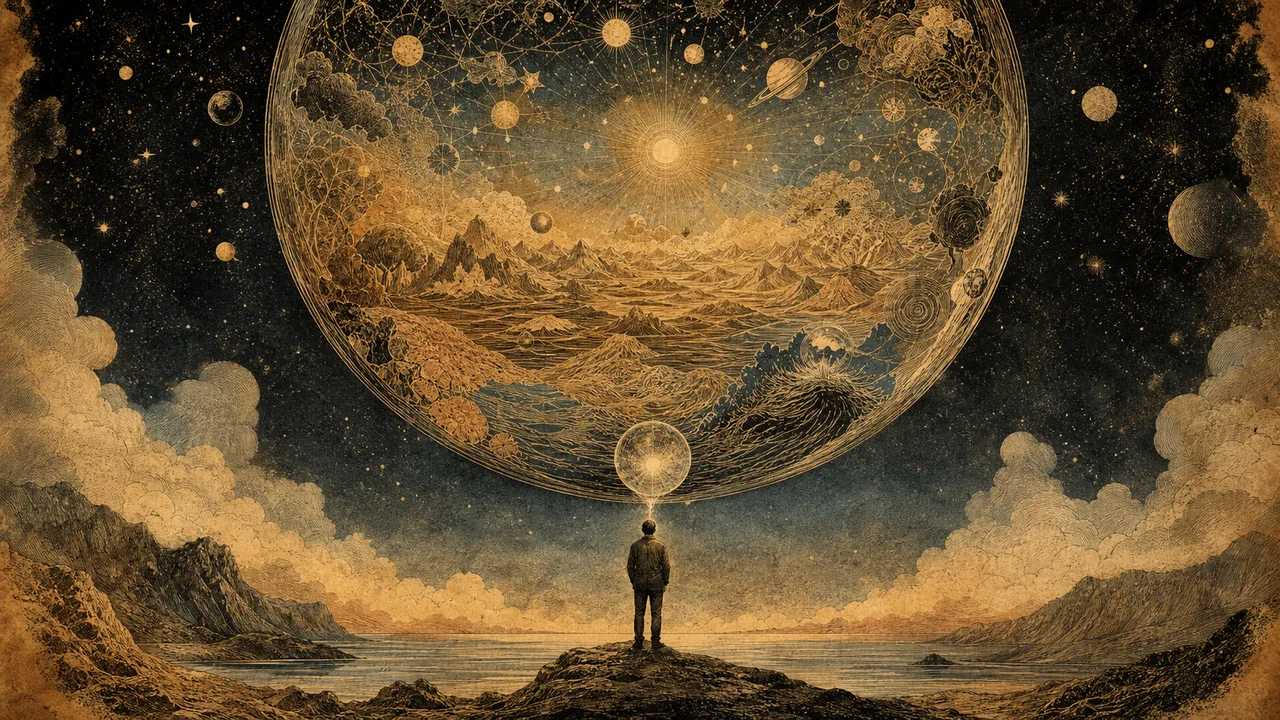
The principle of Mentalism states that the All is Mind and that the universe has a mental nature. This idea was presented by The Kybalion as the first of its seven principles. It concerns the fundamental structure of reality and does not mean that individual thoughts alone create everything that happens.
In this article, you will understand where Mentalism arose, what it means to affirm that the All is Mind and why the universe is called mental. You will also learn the difference between the human mind and the Mind of the All, mental transmutation and the relationship between this principle and ancient Nous.
Continue reading to understand Mentalism responsibly and recognize both the mind's participation in experience and the limits imposed by laws, conditions and other people.
What is the principle of Mentalism?
The principle of Mentalism is the first of the seven principles presented by The Kybalion. It begins with the statement that the All is Mind and that the universe has a mental nature. According to the work, the reality perceived by the senses exists within a universal, infinite and living Mind.
This principle seeks to explain the relationship between fundamental reality and the world formed by matter, energy, life and consciousness. The universe would not be something separate from the All, but a manifestation that remains contained within it. Everything that exists would therefore participate in a greater reality whose nature is described as mental.
The term Mentalism does not merely mean that individual thoughts are important. It presents a metaphysical claim about the very structure of reality. Mind would not be merely a capacity existing within the universe: the entire universe would depend on a mental principle that contains and sustains it.
Where did the principle of Mentalism arise?
The familiar formulation of Mentalism appeared in The Kybalion, a book published in the United States in 1908 under the signature “Three Initiates.” The work organizes seven principles that it presents as the foundations of Hermetic philosophy, beginning with Mentalism and continuing with Correspondence, Vibration, Polarity, Rhythm, Cause and Effect, and Gender.
The book is strongly attributed to William Walker Atkinson, a writer connected to the New Thought movement and American occultism. Its language about mental mastery, the transmutation of thoughts and the practical application of universal laws reflects spiritual debates present between the end of the nineteenth and the beginning of the twentieth century.
Ancient Hermetic texts do not present a list of seven laws or use the principle of Mentalism under that name. Historically, it should therefore be studied as a modern neo-Hermetic formulation, even though it enters into dialogue with older themes related to divine Intellect, the unity of the cosmos and the spiritual origin of reality.
What does it mean to affirm that the All is Mind?
In The Kybalion, the All represents the fundamental reality behind all appearances. It is described as infinite, eternal, absolute and immutable. Its essence, however, would be unknowable to the human mind, which can construct only approximate concepts about what surpasses its limits.
When the book calls the All Mind, it is not referring to an enlarged human personality subject to doubts, forgetfulness and changes in mood. The expression indicates a living, conscious reality infinitely superior to the limited forms of thought experienced by people.
The term Mind therefore functions as a way of thinking about what could not be reduced to matter or a mechanical force. The All would be the origin of life, consciousness and the possibilities of manifestation without possessing the limits found in individual minds.
What does it mean to say that the universe is mental?
The mental universe is presented as a creation that exists within the Mind of the All. The Kybalion uses human mental activity as an analogy: just as a person can form images and worlds in the imagination, the All would manifest the universe without needing to use matter existing outside itself.
The analogy has important limits. Universal creation would not be identical to an unstable or disorganized human dream. It would have its own laws, cycles, structures and relationships. The beings living within it remain subject to the conditions of the plane in which they exist, even if their ultimate origin is regarded as mental.
The Kybalion itself warns against the conclusion that the world can be ignored because it is a mental creation. On the relative plane, the universe should be treated as real, and its laws continue to produce consequences. According to the work, regarding it as an unimportant illusion would be an incomplete and dangerous understanding.
Is the human mind equal to the Mind of the All?
The individual mind participates in the universe but is not presented as identical to the All in scope, power or knowledge. Each person has limited consciousness conditioned by their experiences, body, environment and degree of understanding. The All, by definition, would not be subject to these limitations.
A person lives within the Universal Mind just as an imagined character exists within the mental field of its author. The person does not, however, fully control this field or know all its causes. Their capacity to act encounters limits in laws, other beings and the conditions of the plane in which they live.
This distinction prevents Mentalism from being reduced to the idea that each individual creates all reality alone. The principle affirms the primacy of a Universal Mind, not the omnipotence of personal thought. Human consciousness could learn to act with greater mastery, but it would remain situated within a much broader order.
How does Mentalism change the understanding of experience?
Mentalism draws attention to the mind's participation in how each person perceives and interprets events. Beliefs, memories, expectations and emotional states influence how we read situations, even though they do not alone determine everything that happens in the external world.
Two people may pass through similar circumstances and construct very different internal experiences. One may interpret a particular obstacle as definitive failure, while another regards it as a temporary difficulty. The event has objective conditions, but the way it is understood influences the decisions and responses produced.
In this sense, the principle presents a practical dimension: knowing one's own mental processes makes it possible to reduce automatic reactions and expand the capacity for choice. This does not prove that all reality is literally mental, but it shows why the mind actively participates in human experience and its consequences.
What is mental transmutation?
Mental transmutation is the practice of transforming one state of mind into another. The Kybalion uses the language of alchemy to explain that thoughts, emotions, dispositions and habits can be changed. Instead of transforming base metals into gold, practitioners seek to transform internal conditions regarded as limiting.
This transformation may involve moving from agitation to stability, fear to courage or dispersion to concentration. Students observe their present state, recognize the forces that sustain it and seek to shift their consciousness through attention, will and application of the other principles.
Transmutation does not mean denying emotions or pretending that a problem does not exist. The book itself distinguishes mental mastery from fantasies that ignore the laws of life. The objective would be to use higher capacities to work upon lower tendencies while preserving awareness of concrete conditions and the consequences of actions.
What is the relationship between Mentalism and Nous in ancient Hermeticism?
In ancient Hermetic texts, Nous means Intellect or divine Mind. It represents both a principle related to the origin and order of the cosmos and the capacity through which human beings can attain spiritual knowledge. The awakening of Nous occupies a central position in the Hermetic path of transformation.
In the Poimandres, the first treatise of the Corpus Hermeticum, a divine intelligence reveals teachings to Hermes about creation, human nature and the destiny of the soul. The text describes a transformation of consciousness brought about by knowledge, not the application of a law called Mentalism.
There is common ground because both traditions recognize a mental or intellectual dimension in the origin of reality. The difference lies in their purpose: The Kybalion emphasizes universal laws and mental mastery, while ancient Hermeticism centers on gnosis, purification of the soul, reverence and conscious union with the divine.
Does Mentalism mean that thoughts create any reality?
The principle does not authorize the conclusion that every thought automatically becomes a physical event. People live in a shared world subject to natural laws, social relationships, economic conditions, the actions of third parties and bodily limits. The Kybalion itself states that the laws of the relative plane need to be respected.
Nor would it be coherent to hold someone responsible for illness, accidents, loss or violence under the claim that they mentally created everything they experienced. Thoughts can influence behavior, choices and interpretations, but this does not eliminate the numerous external and collective causes that participate in events.
The claim that reality is fundamentally mental belongs to the field of metaphysics and approaches different forms of philosophical idealism. It is not a conclusion established by the natural sciences. It can be studied as a spiritual interpretation of existence, provided it is not presented as scientific proof.
How can Mentalism be applied responsibly?
Responsible application begins with observing the thoughts, beliefs and reactions that influence everyday life. Practitioners can examine which interpretations increase their confusion, which mental habits repeat and which responses could be replaced by more conscious and appropriate attitudes.
The principle can also encourage the development of attention and inner responsibility. Although a person does not control everything that happens, they can work on how they respond, organize priorities and choose actions. The proposed mastery is not absolute power over the world, but greater conscious participation in one's own experience.
To understand the subject historically, it is important to study The Kybalion as a modern work and compare it with the Corpus Hermeticum and the Asclepius. This distinction makes it possible to benefit from the reflections of Mentalism without attributing to ancient authors a list of principles they did not formulate.
Frequently Asked Questions About the Principle of Mentalism
Its familiar formulation appeared in The Kybalion, a work published in the United States in 1908 under the signature “Three Initiates.”
It means that fundamental reality is supposedly alive and conscious, infinitely superior to the limited forms of thought experienced by people.
No. The individual mind is limited and conditioned, while the All is presented as infinite, eternal and not subject to the same limits.
It is the practice of transforming thoughts, emotions, dispositions and habits by shifting consciousness from one mental state to another.
No. Thoughts influence choices, behaviors and interpretations, but they do not eliminate external causes, collective conditions and the laws of the shared world.
Continue exploring spirituality and self-knowledge
Understanding the difference between the Mind of the All and the individual mind makes it possible to apply Mentalism responsibly, without total blame or fantasies of control.
Explore the e-book collection to continue studying spirituality, consciousness and inner transformation from complementary perspectives.
Browse the e-books
About the author
Prof. Tibério Z has more than 30 years of experience teaching spirituality, metaphysics, holistic therapies and consciousness development.