
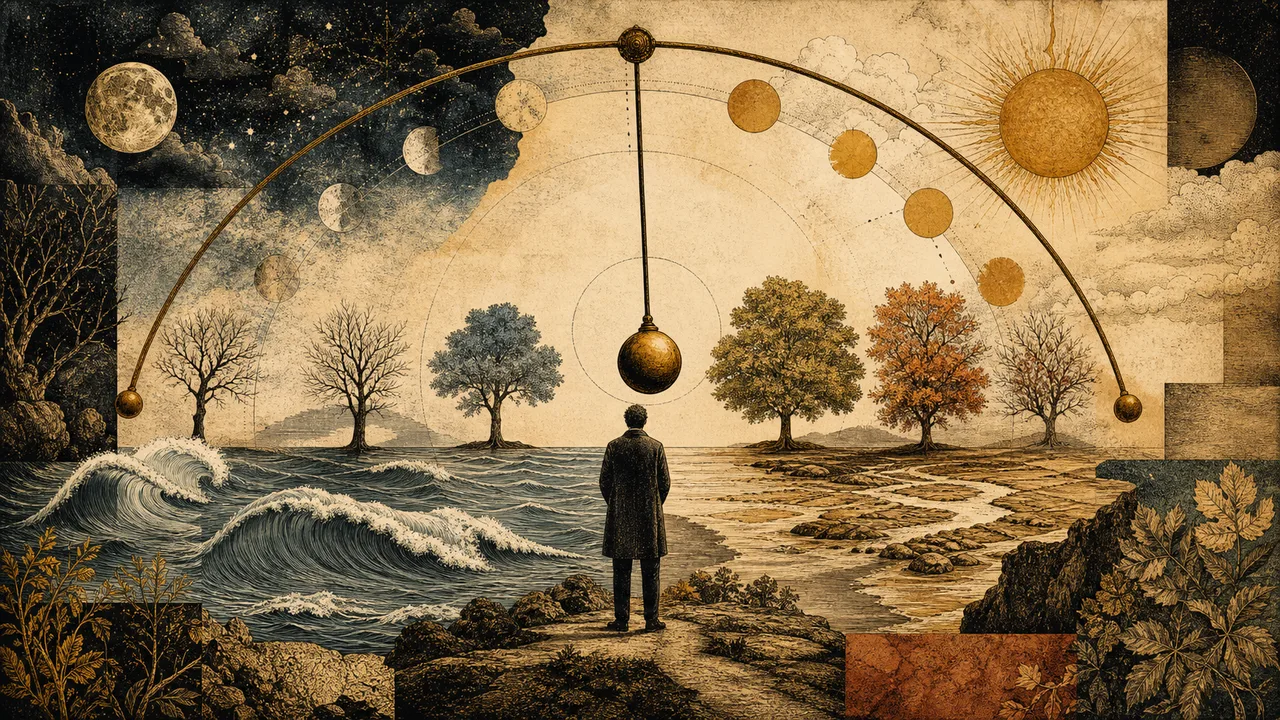
Life does not remain at the same point. Periods of expansion are followed by moments of withdrawal, phases of enthusiasm may give way to introspection, and what grows undergoes transformations before beginning a new cycle.
The principle of Rhythm explains that everything manifests through movements, alternations and oscillations. Nothing remains indefinitely at its highest or lowest point because energy continues circulating between different states, poles and levels of manifestation.
In this article, you will understand how rhythm acts in nature, emotions, thoughts and vibrational frequency. You will also learn why understanding these cycles helps maintain balance without being carried away by the extremes of the pendulum.
What is the principle of Rhythm in Hermeticism?
The principle of Rhythm is the fifth of the seven principles presented in The Kybalion. Its central statement teaches that “everything flows,” that all things have their tides and that everything moves through rise and fall. The image used to represent this process is the swing of a pendulum.
This pendulum should not be understood only as a physical object. It represents the movement between two poles: expansion and contraction, activity and rest, enthusiasm and discouragement, closeness and distance, construction and dissolution.
Rhythm does not interrupt life, but allows it to continue renewing itself. Each movement prepares the conditions for the next. What appears to be a pause may be a period of integration, just as a phase of great movement may represent the manifestation of something prepared earlier.
How does the movement of the pendulum manifest?
The pendulum moves from one side to the other because rhythm manifests between poles. The farther an energy advances in one direction, the greater its tendency may be to return or seek a condition of balance again.
This movement appears in collective events, relationships, decisions and inner states. There are periods when a person feels greater confidence, willingness and clarity. At other times, they may feel a need for silence, review or distance.
Understanding the pendulum prevents us from interpreting every change as defeat. Not every reduction in intensity means that something has ended. Often, the movement has merely changed direction to reorganize energy before a new phase.
Why does life alternate between expansion and withdrawal?
Expansion corresponds to periods when energy moves outward. These are times of creation, communication, achievement, opening paths and manifesting results. A person feels a desire to act, develop projects and occupy new spaces.
Withdrawal corresponds to inward movement. It makes it possible to evaluate experiences, recover strength, understand lessons and leave behind what no longer accompanies the next cycle. Without this period, expansion could become exhaustion and dispersion.
The problem arises when a person accepts only one part of rhythm. They want to remain continuously in growth, productivity, enthusiasm and movement. However, expansion itself needs pauses so energy can be assimilated and directed correctly.
What is the relationship between rhythm, vibration and polarity?
Rhythm is directly related to the principles of vibration and polarity. Vibration shows that everything is in motion, while polarity explains that this movement can occur between different degrees of the same nature.
Rhythm describes the passage between these degrees. An emotion does not remain at the same intensity forever. It may increase, reach a certain point, decrease and approach another emotional state. The same happens with thoughts, desires and vibrational patterns.
These principles form a sequence. Vibration produces movement, polarity establishes the extremes, and rhythm conducts energy between them. By perceiving this relationship, a person begins to observe not only the state they are in, but also the direction in which they are moving.
How does rhythm act on thoughts and emotions?
Thoughts and emotions also have tides. There are periods when the mind has greater clarity, confidence and creativity. At other times, old fears, doubts and memories may return to consciousness, creating the impression that all progress has been lost.
However, the return of an emotional state does not necessarily mean that a person has returned to the starting point. An emotion may reappear on another level to be understood with greater awareness. The cycle looks similar, but the person moving through it is no longer exactly the same.
Knowledge of rhythm allows us to observe these oscillations without turning every passing emotion into an absolute truth. A person feels the movement, recognizes the present state and avoids completely surrendering their direction to the temporary changes of the pendulum.
What does it mean to say that rhythm compensates?
The Kybalion teaches that rhythm has a compensating movement. The swing in one direction encounters a corresponding movement in the opposite direction, as though energy continually sought to balance the extremes of its manifestation.
This does not mean that every joy must be followed by equivalent suffering. Nor does it mean that an achievement must necessarily produce a loss. The text itself states that pleasure does not need to be “paid for” later with the same amount of pain.
Compensation can be understood as reorganization and balance. Every choice directs energy and produces consequences. When we invest intensely in one aspect of life, other aspects may receive less attention. Awareness of rhythm helps us notice these imbalances before they become extremes.
What is the neutralization of rhythm?
The principle of Rhythm cannot be eliminated because movement continues to act. However, The Kybalion states that its effects on consciousness can be neutralized. A person does not stop the pendulum from moving, but learns not to be carried by all its oscillations.
Neutralizing does not mean repressing emotions, denying difficulties or pretending everything is fine. It means remaining conscious while the inner state changes. The emotion is acknowledged, but does not automatically receive the power to determine thoughts, words and decisions.
This stability is built through conscious polarization. A person chooses the inner point where they want to remain and sustains that direction. The pendulum may continue moving through the emotional and mental layers, but consciousness does not need to accompany every oscillation.
How can we apply the principle of Rhythm in daily life?
The first application consists of observing our own cycles. There are periods when certain activities flow more easily and others when we need to review decisions, reorganize priorities or recover energy. Recognizing this movement allows us to act with greater awareness.
It is also important to avoid permanent decisions during very intense oscillations. A moment of enthusiasm may lead to promises that cannot be sustained, while a period of discouragement may cause a person to abandon something that still has value and potential.
The true application of the principle of Rhythm lies in developing an inner center. A person continues living through the tides, changes and movements of existence, but stops being directed by them unconsciously. The pendulum continues to swing, yet consciousness learns to remain firm in the chosen direction.
Frequently Asked Questions
It is the fifth principle presented in The Kybalion. It teaches that everything moves through rise and fall, ebb and flow, represented by the swing of a pendulum.
It appears in events, relationships, decisions and inner states, alternating between periods of expansion, contraction, activity and withdrawal.
Vibration produces movement, polarity establishes the extremes, and rhythm conducts energy through the different degrees between those poles.
It means that movement in one direction encounters a corresponding movement in the opposite direction, reorganizing and balancing energy between the extremes.
It is remaining conscious during inner oscillations, recognizing emotions without allowing them to determine thoughts, words and decisions automatically.
Continue exploring spiritual knowledge
Understanding Rhythm helps us recognize phases of expansion and contraction without surrendering every decision to enthusiasm or discouragement.
Explore our English e-books to continue studying spirituality through clear explanations and practical exercises.
Explore the e-books
About the author
Prof. Tibério Z has more than 30 years of experience teaching spirituality, metaphysics, holistic therapies and consciousness development.