
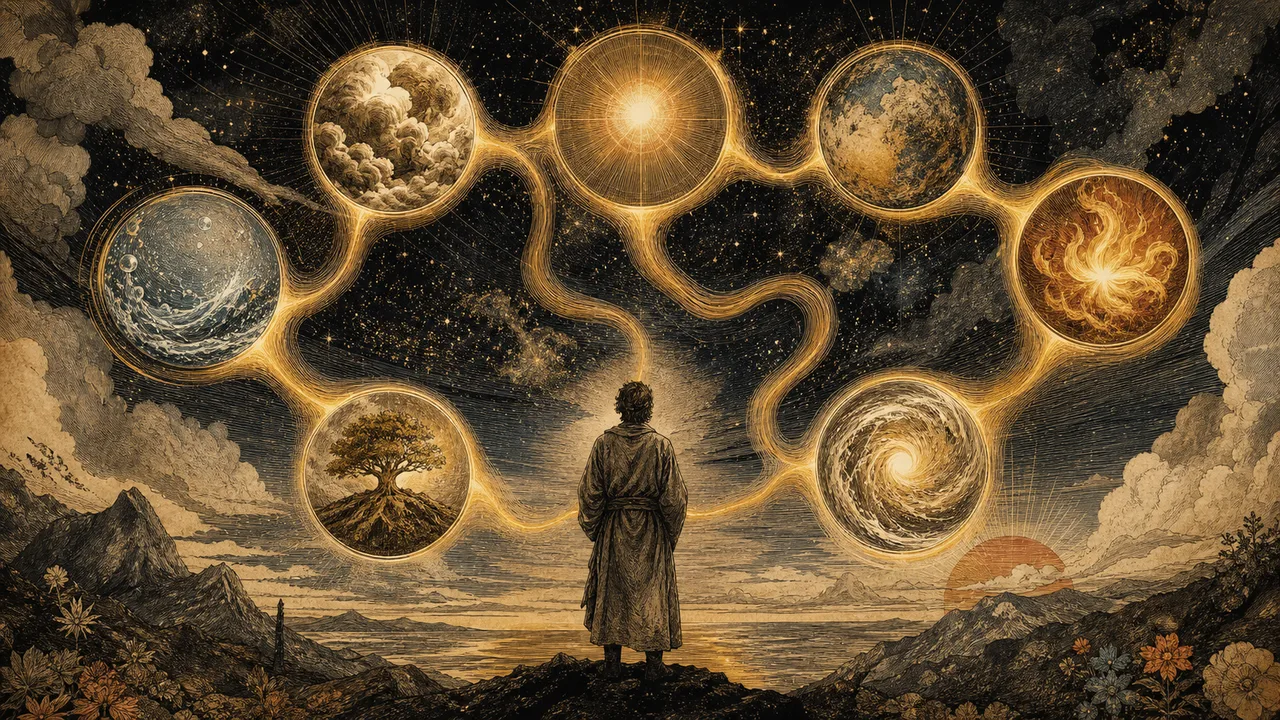
The seven Hermetic laws present an organized view of the mind, the universe, the movements of nature and the way different phenomena relate to one another. They are known as Mentalism, Correspondence, Vibration, Polarity, Rhythm, Cause and Effect, and Gender.
Although they are often called ancient laws of Hermes Trismegistus, this classification must be understood carefully. The list of seven laws does not appear organized in this way in the Corpus Hermeticum, the Asclepius or the other known Hermetic texts from antiquity.
The formulation used today comes mainly from The Kybalion, a work published in 1908 under the enigmatic name “The Three Initiates.” The book itself calls its teachings the seven Hermetic principles and states that they serve as keys to understanding different aspects of existence.
What are the seven Hermetic laws?
This does not mean that all the ideas presented by The Kybalion are completely foreign to Hermeticism. Some of its themes have parallels in earlier philosophical, religious and esoteric traditions. Nevertheless, the gathering of these ideas into a system of seven principles belongs to modern esotericism.
Recognizing this distinction does not diminish the philosophical or spiritual value of the work. On the contrary, it allows the seven laws to be studied in their proper context, without automatically attributing to ancient Egypt a doctrinal organization that emerged at the beginning of the twentieth century.
The seven Hermetic laws are metaphysical principles presented by The Kybalion as foundations of reality. Each principle seeks to explain a particular aspect of existence, but they were not conceived as completely separate teachings.
Mentalism presents mind as the foundation of the universe. Correspondence establishes relationships among different levels of reality. Vibration describes existence as movement, while Polarity shows that many opposites can be understood as extremes of the same nature.
Rhythm explains the oscillations between these poles. Cause and Effect reveals the chains connecting events, choices and consequences. Gender represents the complementary forces involved in processes of creation, generation and transformation.
The Kybalion states that these principles operate on the physical, mental and spiritual planes. Its proposal is to offer students a model through which different events may be observed as parts of an ordered structure.
The seven laws therefore form more than a list of statements about the universe. They compose a worldview in which mind, matter, energy, consciousness and transformation would be subject to common principles.
What is the origin of the seven Hermetic laws?
The direct origin of the seven laws is The Kybalion, first published in 1908. The work appeared under the name “The Three Initiates,” without clearly revealing the identity of its authors.
Later research began to attribute the book to the American writer William Walker Atkinson, one of the leading representatives of the movement known as New Thought. Atkinson wrote about mental power, will, personal development, magnetism, occultism and different spiritual traditions, often using pseudonyms.
The historical edition prepared by researcher Philip Deslippe connects the content, vocabulary and publishing history of The Kybalion to Atkinson's work. Even so, it is important to remember that the original edition did not present his name, but only the expression “The Three Initiates.”
The book's context also helps explain its language. At the end of the nineteenth century and the beginning of the twentieth, different currents sought to relate spirituality, thought, health, will and personal transformation. The Kybalion emerged within this cultural environment.
The work therefore combines elements attributed to Hermeticism with concepts characteristic of New Thought, modern metaphysics and the Western occultism of that period. Comparative studies identify important differences between the book's doctrine and the ancient Hermetic texts.
Do the seven laws appear in the Corpus Hermeticum?
The Corpus Hermeticum is a collection of dialogues and discourses attributed to Hermes Trismegistus. Researchers date the composition of its texts to Roman Egypt, mainly between the first and third centuries of the Common Era.
These treatises address themes such as God, the creation of the cosmos, human nature, divine intellect, fate, the soul, ignorance and the possibility of spiritual transformation. Human beings appear as creatures who participate in both bodily and divine reality.
The central purpose of these writings is not to present seven universal laws. They seek to lead disciples toward knowledge of God, the cosmos and their own spiritual nature. In different passages, this knowledge requires ethical transformation, purification and the overcoming of ignorance.
There are similarities between certain ancient themes and some concepts in The Kybalion. The importance of mind, the unity of the cosmos, the relationship among different levels of reality and the presence of generative forces can be found in varying forms within the Hermetic tradition.
The ancient texts, however, do not present a sequence consisting of Mentalism, Correspondence, Vibration, Polarity, Rhythm, Cause and Effect, and Gender. This organization belongs to The Kybalion and should be understood as a modern systematization.
Why are they called laws if The Kybalion speaks of principles?
The expression “seven Hermetic laws” became very popular in books and spiritual teachings. The Kybalion, however, mainly uses the expression “seven Hermetic principles.”
A principle is a fundamental proposition that guides the interpretation of a particular system. A law, in the spiritual or philosophical sense, usually represents an order considered constant and universal.
In popular usage, the two words came to be treated as equivalents. Saying “seven Hermetic laws” thus became a common way to refer to the principles presented by the book.
This does not mean that they are scientific laws. A scientific law depends on observations, measurements, tests and evidence that can be analyzed in a controlled manner. The Hermetic laws belong to a metaphysical and esoteric system for interpreting reality.
They should therefore be studied as philosophical and spiritual principles. Some of their ideas may support reflection on thoughts, emotions and behaviors, but that does not transform every statement in the book into a scientifically proven fact.
First Hermetic law: the principle of Mentalism
Mentalism presents mind as the foundation of reality. According to The Kybalion, the universe exists within a universal, infinite and living Mind that the book calls “The All.”
This does not merely mean that personal thoughts create everything that exists. The principle refers first to a cosmic Mind regarded as the basis on which the universe and its phenomena manifest.
The human mind would participate in this greater reality, although it is not identical to it in power or extent. Students are invited to recognize that their thoughts influence how they perceive, interpret and respond to experiences.
The most prudent application of Mentalism is to observe the mind's participation in constructing personal experience. Beliefs, memories, expectations and interpretations change the way each person understands events.
Mentalism, however, should not be reduced to the idea that merely thinking about something is enough to produce it materially. The principle presents a metaphysical theory about the nature of the universe, not a guarantee that individual will has absolute control over reality.
Second Hermetic law: the principle of Correspondence
Correspondence teaches that relationships may exist among different levels of reality. What occurs on one plane may help explain patterns found on another, even when their manifestations are not completely identical.
The best-known expression of this principle is the relationship between what is above and what is below. In The Kybalion, Correspondence would apply to the physical, mental and spiritual planes.
The principle makes it possible to reason from the known toward the unknown. By observing a particular structure on a smaller scale, one could look for similar patterns on larger scales. Likewise, a broader order could help interpret particular processes.
Correspondence does not, however, mean that everything is an exact copy of everything else. A symbolic similarity does not prove that two phenomena have the same cause or operate by the same rules.
Its application requires discernment. Correspondence can be used as a tool for reflection, analogy and interpretation, but it should not replace direct observation or concrete investigation of each phenomenon.
Third Hermetic law: the principle of Vibration
The principle of Vibration states that nothing remains absolutely still. Existence would be characterized by movement, variation and continuous transformation.
The Kybalion attempts to explain the differences among matter, energy, mind and spirit through different degrees or forms of vibration. The higher the frequency, the subtler the manifestation would be.
Within this system, thoughts and emotions would also have movements of their own. An inner change would be understood as an alteration in the predominant mental or vibrational state.
It is important not to automatically confuse this spiritual use of the word vibration with the concept used in physics. In science, frequency and vibration are quantities that must be defined and measured within specific phenomena.
In The Kybalion, vibration functions as a much broader metaphysical principle. It represents movement, intensity and change of state, including in areas that cannot be measured as a physical oscillation.
The practical application of this principle lies in perceiving that inner states are not completely fixed. Thoughts, emotions and dispositions can change, although this transformation depends on awareness, practice and concrete conditions.
Fourth Hermetic law: the principle of Polarity
Polarity teaches that many things that appear to be opposites can be understood as extremes of the same scale. Between those extremes are different degrees and intermediate positions.
Heat and cold, for example, are not completely separate substances. They represent different assessments on a temperature scale. The Kybalion applies the same reasoning to various mental and emotional phenomena.
Polarity helps explain that some states do not change only through a sudden break. They can be transformed gradually as a person moves among different degrees of the same condition.
This principle also seeks to explain the possibility of mental transmutation. Instead of fighting an inner state directly, students seek to develop qualities belonging to the opposite pole.
When facing fear, for example, a person can cultivate understanding, preparation and courage. The aim is not to pretend that fear does not exist, but to reduce its intensity while strengthening another way of responding to the situation.
Not all opposites, however, can be reduced to a single scale. Polarity functions as a philosophical model and observational tool, not as a mandatory explanation for every difference that exists.
Fifth Hermetic law: the principle of Rhythm
The principle of Rhythm explains that phenomena pass through movements of advance and retreat, expansion and contraction, growth and decline. The Kybalion uses the image of a pendulum to represent these oscillations.
Life presents cycles of activity and rest, enthusiasm and introspection, construction and reorganization. According to this principle, no manifested condition remains indefinitely at the same degree.
Rhythm is directly related to Polarity. Polarity establishes the extremes of a particular scale, while Rhythm represents the movement that takes place among different positions on that scale.
Understanding Rhythm helps us avoid interpreting every change as failure. A period of withdrawal may represent integration, recovery or preparation for a new stage.
The Kybalion also presents the idea of neutralization. A person could not completely eliminate the movements of Rhythm, but could develop the stability needed not to be unconsciously carried away by every emotional oscillation.
Neutralizing does not mean repressing feelings. It means recognizing that a state is temporary and avoiding impulsive decisions while consciousness passes through a period of great intensity.
Sixth Hermetic law: the principle of Cause and Effect
The principle of Cause and Effect states that events participate in chains. Every cause produces effects, and every effect forms part of a set of preceding causes.
According to The Kybalion, what is commonly called chance may involve laws, conditions or relationships that have not yet been identified. The fact that a cause is unknown does not necessarily mean it does not exist.
In human life, the principle draws attention to the consequences of choices, habits and repetition. A decision can produce effects that become causes of new events, forming increasingly complex sequences.
This does not mean, however, that every situation a person experiences was consciously created by that person. Natural, social, economic, historical, family and collective causes exist beyond individual will.
A responsible interpretation of this principle does not blame people for everything that happens to them. Its purpose is to broaden awareness of the causes in which intervention is possible.
The more a person recognizes their patterns, impulses and influences, the greater their conscious participation in decisions can become. They do not control every condition, but they may stop automatically repeating some causes that produce unwanted effects.
Seventh Hermetic law: the principle of Gender
The principle of Gender states that creative processes involve complementary forces. The Kybalion calls these forces masculine and feminine, applying them to the physical, mental and spiritual planes.
On the physical plane, the book relates Gender to the generation of living beings. On mental and spiritual levels, the terms are used symbolically to represent different functions within a creative process.
The masculine aspect is presented mainly as impulse, direction and projection. The feminine aspect is associated with receiving, developing, gestating and manifesting what has been initiated.
These characteristics should not be used to determine how men and women must think, act or behave. This is symbolic language produced within the historical context of the work.
Each person would possess both functions in their mental life. An idea may begin as an intention, but it needs to be received, developed and transformed until it becomes an action or concrete accomplishment.
The principle of Gender seeks to explain this cooperation. Creation requires both initiative and elaboration, both direction and receptivity, both movement and the capacity to form and sustain something.
How do the seven Hermetic laws relate to one another?
The seven laws form a system in which each principle helps develop the one before it. Mentalism presents a reality grounded in mind, while Correspondence shows relationships among the different levels of that reality.
Vibration introduces the movement present in all manifestations. Polarity organizes this movement between extremes, and Rhythm describes the oscillation that occurs among different positions.
Cause and Effect explains the chains produced by these movements. Gender, in turn, represents the interaction of complementary forces that enable generation, development and transformation.
A mental state, for example, can be analyzed through all the principles. It occurs in the mind, corresponds to other patterns, is in motion, occupies a particular position between poles, passes through oscillations, has causes and generates consequences.
At the same time, this state can participate in a creative process. A thought receives attention, develops, organizes behavior and contributes to producing new results.
This integration shows why The Kybalion does not present the seven laws as isolated teachings. They are different ways of observing the same reality.
Are the seven laws teachings from ancient Egypt?
The Kybalion presents its principles as part of a very ancient tradition associated with Hermes Trismegistus and Egypt. There is no historical evidence, however, that Egyptian priests taught the list of seven laws in this form.
The texts of the Corpus Hermeticum were produced in Roman Egypt and combine Egyptian elements with Greek philosophical language and concepts. They are not documents from the earliest pharaonic dynasties, nor were they written by a single master named Hermes Trismegistus.
The figure of Hermes itself results from the association between the Greek god Hermes and the Egyptian god Thoth. In the Hermetic texts, he appears as master, revealer and transmitter of knowledge about God, the cosmos and human beings.
The seven laws belong to a much later stage in the history of esotericism. They reflect the way modern authors reinterpreted ancient themes to respond to the spiritual and philosophical concerns of their own period.
It is therefore more accurate to say that they are principles of The Kybalion, presented as Hermetic, rather than a list proven to have been preserved since ancient Egypt.
Are the seven Hermetic laws scientific truths?
The seven laws belong to the field of esoteric philosophy and metaphysics. They were not formulated through the scientific method and do not have the same meaning as the laws used in physics, chemistry or biology.
Some statements in The Kybalion use terms such as energy, vibration, frequency, attraction and polarity. These words also appear in science, but they can have completely different meanings in each context.
In physics, a frequency must indicate the number of cycles of a phenomenon per unit of time. In spiritual usage, frequency can symbolically represent a state of consciousness, an emotional disposition or an inner quality.
Mixing these meanings produces confusion. A principle can have philosophical value without needing to be presented as a scientific discovery.
The best way to study the seven laws is to recognize their metaphysical nature. They can function as tools for reflecting on the mind, cycles, contrasts, choices and creative processes, but they do not replace scientific explanations of natural phenomena.
How can the seven laws be applied in daily life?
Applying the seven laws begins with observation. Instead of trying to control reality immediately, a person seeks to recognize how their mind interprets events, which patterns repeat and which consequences their decisions produce.
Mentalism helps observe thoughts and beliefs. Correspondence makes it possible to identify similarities between inner patterns and outward behavior. Vibration reminds us that states can change.
Polarity helps in seeking intermediate degrees and developing qualities opposite to the patterns one wishes to transform. Rhythm teaches us to recognize cycles without being completely driven by them.
Cause and Effect broadens responsibility for the choices that are possible. Gender shows that an intention needs elaboration, development and action to produce results.
Applying these principles does not mean believing that a person has absolute control over everything. It means increasing conscious participation in what one thinks, chooses, nurtures and accomplishes.
Study becomes more balanced when the principles are used to develop discernment, not to deny concrete problems or blame someone for situations beyond their control.
What is the true value of the seven Hermetic laws?
The value of the seven laws does not depend on presenting them as scientific truths or attributing them literally to ancient Egypt. Their importance lies in the philosophical structure they offer for observing reality and consciousness.
They invite students to notice that thoughts influence interpretations, that different levels may have relationships, that states change, that extremes have gradations and that life passes through cycles.
They also remind us that choices produce consequences and that every creation requires the interaction of different capacities. When studied together, they form a method of reflection on transformation, responsibility and balance.
Historically, it is necessary to recognize that the seven laws were systematized by The Kybalion, a modern work connected to the environment of New Thought and early twentieth-century occultism.
Philosophically, however, they continue to spark interest because they organize enduring human questions: the nature of mind, the relationship between human beings and the cosmos, the changing of inner states and the possibility of consciously participating in one's own transformation.
Studying the seven laws seriously requires maintaining both perspectives. The first respects the historical context and does not present the work as a proven Egyptian manuscript. The second seeks to understand the spiritual and philosophical meaning of each principle without reducing it to superficial promises.
Frequently Asked Questions
They are Mentalism, Correspondence, Vibration, Polarity, Rhythm, Cause and Effect, and Gender. The Kybalion presents these principles as interconnected foundations of reality.
The direct origin of the list is The Kybalion, published in 1908 under the name The Three Initiates, within the environment of New Thought, modern metaphysics and Western occultism.
Not in this organized sequence. The ancient texts contain some related themes, but Mentalism, Correspondence, Vibration, Polarity, Rhythm, Cause and Effect, and Gender form a system established by The Kybalion.
The expression seven Hermetic laws became popular, and the words came to be used as equivalents. The Kybalion, however, mainly uses the expression seven Hermetic principles.
No. They belong to esoteric philosophy and metaphysics and were not formulated through the scientific method, nor do they have the same meaning as the laws of physics, chemistry or biology.
Continue exploring spirituality and self-knowledge
Knowing the seven principles together helps you see how mind, relationships, movements, cycles, causes and creation participate in the same experience.
Explore the e-book collection to continue studying spirituality, consciousness and inner transformation from complementary perspectives.
Browse the e-books
About the author
Prof. Tibério Z has more than 30 years of experience teaching spirituality, metaphysics, holistic therapies and consciousness development.