
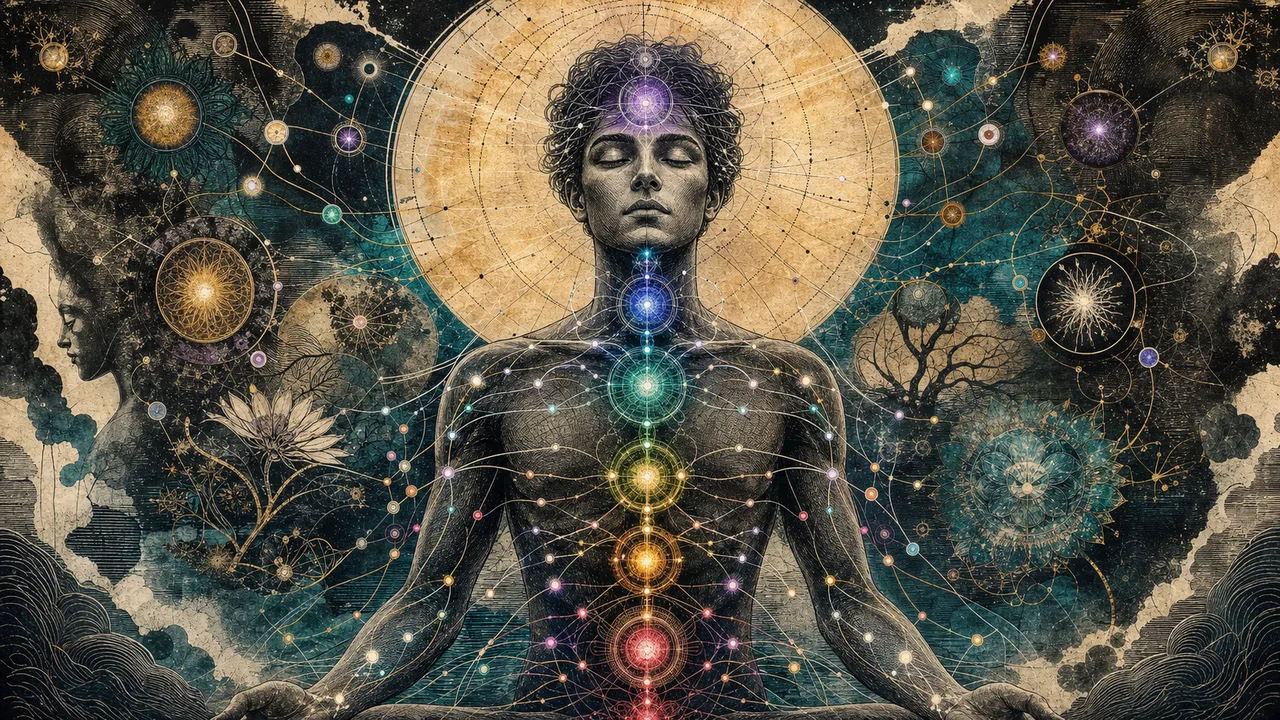
When chakras are mentioned, many people immediately think of seven colored circles distributed along the body. This image helps locate the best-known centers, but it does not explain what a chakra actually is or why it exists.
In this article, you will understand what chakras are, why the word means wheel, which body they exist in and how they are organized in the etheric body.
Continue reading to see why each center receives a different frequency and how chakras supply energy to the physical body.
What are chakras?
Chakras are units that form the etheric body. They consist of energy and participate in energetically sustaining different parts of the organism. There is not only a small group of chakras: the entire energy body is formed by countless smaller centers. To understand this concept within the complete system, also read the pillar article complete guide to the 7 chakras for beginners, where I explain the main centers, nadis, imbalances and paths toward harmonization.
We can understand them through a comparison with cells. Each physical cell has a function and participates in maintaining the organism. In the same way, each small chakra contributes to the functioning of a region in the energy body.
When many of these smaller centers organize themselves, they form larger energetic structures. Therefore, the best-known chakras are not the only ones that exist, but large groups formed by the coordinated activity of many smaller centers.
Why does the word chakra mean wheel?
The word chakra comes from Sanskrit and means wheel or disc. This name describes how energy moves in these centers, creating a rotating activity around a central point.
The idea of a wheel does not mean that a circular part exists inside the body. It is a way of representing an energetic movement that remains active while the human being is incarnated.
This movement allows the chakra to remain in contact with the energies needed for its functioning. The wheel therefore represents a dynamic structure, not a motionless symbol or merely an image used during meditation.
In which body do chakras exist?
Chakras are not in the physical body. They belong to the etheric body, an energetic structure that accompanies the organism and maintains a direct connection with its cells, tissues and organs.
When we say that a particular chakra is located in a physical region, that location serves as a reference. The energy center corresponds to that part of the body, but it is not inside it like a gland, nerve or organ.
For this reason, chakras cannot be found in imaging exams or surgical procedures. The physical body has biological structures; the etheric body has energetic structures that act in correspondence with them.
How are chakras organized in the etheric body?
Small chakras are not scattered without order. They group themselves according to the functions they need to sustain, creating larger structures within energetic anatomy.
In the physical body, similar cells form tissues, and different tissues organize themselves to form organs. In the etheric body, small energy centers also come together and begin to act as a broader unit.
The large chakras can be compared, for teaching purposes, to the organs of the energy body. Each one gathers many smaller centers and takes on a specific activity while remaining part of the complete system.
Why does each chakra receive a different frequency?
Vital energy does not always manifest in the same way. It has different frequencies, and chakras are organized to come into contact with specific types of vibration.
We can compare them to radio receivers. Several stations broadcast at the same time, but the device receives only the frequency to which it is tuned. Each chakra has its own tuning and receives energies compatible with it.
This specialization allows the energy body to receive different types of energy without mixing them in a disorganized way. Each center works with a frequency suited to the function it must sustain.
How do chakras supply energy to the physical body?
The organism does not depend only on food, water, oxygen and chemical processes. It also receives vital energy captured by the etheric body and directed to different physical regions.
Chakras participate in this supply by receiving the appropriate frequencies and directing them to the areas with which they are connected. In this way, they help energetically maintain cells, organs and systems.
This relationship works in both directions. The energy body provides vitality to the organism, but the physical state also affects the chakras. Sleep, nutrition, movement, illness and hormonal changes can modify energetic functioning.
How do chakras keep consciousness connected to the body?
The human being is not only the physical organism. Consciousness uses the body to live, perceive, learn and act in this reality, but it must remain connected to it throughout incarnation.
Chakras participate in this anchoring process. They help keep consciousness connected to the etheric body and, through it, to the biological organism.
Without this connection, consciousness would not be able to use the senses, brain and other physical structures properly. Chakras are part of the system that allows consciousness to remain present and act through the body.
How do chakras connect the different subtle bodies?
In addition to the etheric body, consciousness also uses other bodies related to emotions, thoughts and broader levels of perception. These structures do not function separately.
Chakras act as communication points among these bodies. A physical experience produces emotions and thoughts, while emotional and mental content can also influence the body and etheric field.
Through this connection, what happens at one level can be transmitted to the others. Chakras help maintain the continuity of experience, allowing body, emotions, mind and consciousness to participate in the same process.
How do emotions and thoughts affect chakras?
Every emotion moves energy. Fear, joy, anger, sadness and affection temporarily modify the frequency of the field and alter the activity of the centers related to the experience.
Thoughts also produce effects. A repeated idea keeps a particular frequency active, awakens corresponding emotions and influences how a person reacts to what happens.
When thoughts and emotions can follow their natural movement, the energy is experienced and released. When they are repressed or continuously fed, they can alter the functioning of a chakra and hinder energetic circulation.
Why do chakras store records of experiences?
Intense experiences leave marks on the energy body. This happens mainly when a person cannot understand, express or emotionally complete what they lived through.
The energy associated with the event may remain recorded in the chakra related to the subject. Even after the situation has ended, part of its frequency remains active and influences later reactions.
When a similar experience occurs, this record may be awakened. The person reacts not only to the present moment but also to previously accumulated energy, which once again participates in perception and behavior.
What is the relationship among chakras, organs and glands?
Chakras correspond to organs, glands and systems in the body, but they should not be confused with these structures. A chakra is energetic; a gland is physical and performs specific biological functions.
The relationship exists because the etheric body accompanies the organism. The energy provided by a particular center sustains the corresponding physical region, while the state of that region also affects its energy field.
This means that caring for the chakras does not replace caring for the body. When a physical change exists, it needs to be evaluated and treated on the biological plane, while energy work can act as a complement.
What does it mean for a chakra to function correctly?
A chakra functions correctly when it receives the appropriate frequency and provides the amount of energy needed by the region it sustains. It does not need to be at the maximum level of activity, but it must fulfill its function steadily.
Its functioning must also follow changes in life. At certain times, a region needs more energy; at others, activity may decrease. This variation is natural when the center can adapt and then return to balance.
The problem appears when a chakra stops receiving the necessary frequency, receives too little energy or remains overloaded. In these cases, the function it sustains begins to lose organization.
Understanding chakras beyond images and symbols
Chakras are real components of energetic anatomy. The colorful images used in books and practices are representations that help with study, but they do not show the full complexity of these structures.
Understanding how they work requires observing the connection among the physical body, etheric body and consciousness. Chakras exist to maintain this connection, energetically supply the organism and allow communication among different levels of the being.
From this foundation, it becomes easier to study the large centers, their functions and their imbalances. Before memorizing names, colors and symbols, we need to understand that every chakra is fundamentally an energetic structure organized to sustain the experience of consciousness.
Frequently Asked Questions
Chakras are centers in the etheric body responsible for receiving, processing and distributing vital energy. They energetically sustain regions of the organism and participate in the relationship among body, emotions, mind and consciousness.
No. They belong to the etheric body. When we use a physical region as a reference, we are indicating the energetic correspondence of that center, not an organ or physical structure.
The word chakra comes from Sanskrit and means wheel or disc. The term represents the rotating, dynamic movement of energy in these centers, not a physical part inside the body.
No. The seven main chakras are the best known, but the energy body has countless smaller centers that organize themselves and help form larger energetic structures.
They correspond to regions of the body, organs and glands, but they are not those structures. Energy work can complement physical care, but it does not replace biological evaluation and treatment when needed.
It means receiving the proper frequency, providing enough energy to the region it sustains and adapting its activity to changes in life without remaining blocked, weak or overloaded.
Continue exploring the chakras
Understanding what chakras are is the first step toward studying the energy system without confusing symbols, colors and images with the actual functioning of subtle centers.
In the Ultimate Guide to the Seven Chakras, you can deepen this knowledge and learn to recognize each center, its functions and its imbalances more clearly.
Explore the Ultimate Guide to the Seven Chakras
About the author
Prof. Tibério Z has more than 30 years of experience teaching spirituality, metaphysics, holistic therapies and consciousness development.