
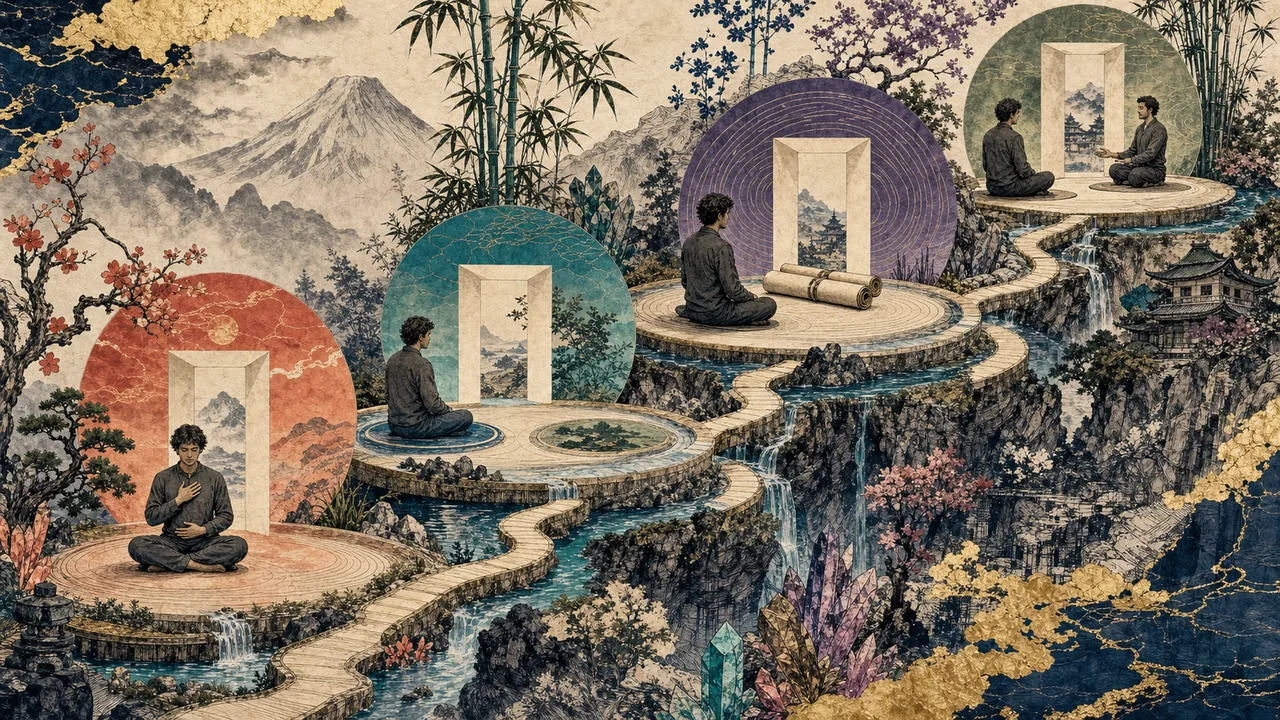
The levels of Reiki organize learning progressively. Students begin by developing direct contact with the energy, learning self-application and hand positions. They then advance to the use of symbols, mental and emotional work, distance sending, and, in later stages, personal deepening and transmission of the method.
In this article, you will understand how the levels of Reiki are organized progressively, what characterizes level 1 and self-application, what changes in level 2 with symbols and distance work, and what level 3A represents.
Continue reading to follow this progression and learn what each stage requires.
The Progressive Organization of the Reiki Levels
The levels were organized so that students do not receive all the content at once. Each stage offers a foundation that needs to be understood and practiced before new forms of energetic direction are added.
In the beginning, the work is concrete. Students use their hands, observe sensations, and learn to conduct an application on themselves and other people. Later, they begin to use energetic codes and forms of work that require greater concentration and responsibility.
This progression protects learning from haste. When someone advances without consolidating the previous stage, they may know many symbols and procedures but still feel insecure in perceiving the field and carrying out a basic application.
Reiki Level 1 and Direct Contact with Energy
Level 1 is the entry point into the Reiki system and is often called Shoden in some Japanese traditions. Its focus is on understanding the fundamentals, energetic initiation, and the use of the hands to transmit Reiki to one's own body and to other people.
At this stage, students study the meaning of Reiki, its origin, the five principles, and the way energy is conducted. They also learn basic positions for working on the head, chest, abdomen, back, legs, and feet.
The hands function as facilitators of emission, especially when they are positioned near the chakras. However, the center of the process lies in intention, focus, and energetic contact, not only in repeating the movements learned.
Self-Application as the Foundation of the First Level
Self-application occupies a central position in level 1 because practitioners need to experience Reiki on themselves. This practice allows them to recognize the energetic flow and understand how different regions of the body respond to hand positions.
When applying Reiki regularly, students may notice warmth, tingling, pressure, and changes in energy circulation. Repetition develops sensitivity and helps distinguish a real perception from an expectation created by the mind.
Self-application also teaches responsibility. Before trying to organize other people's fields, Reiki practitioners need to observe their own minds, emotions, habits, and the frequency they transmit during a session.
Reiki Level 2 and the Conscious Use of Symbols
Level 2 is often called Okuden and expands the possibilities for application. Students begin to work with symbols used to access, intensify, and direct specific frequencies within the Reiki system.
The symbols function as codes that organize the interaction among the mind, intention, and energy field. They help Reiki practitioners sustain a clear direction without relying only on the physical positions of the hands.
Drawing a symbol automatically does not guarantee a well-conducted application. Practitioners need to understand its function, concentrate on the frequency related to it, and use intention clearly.
Mental, Emotional, and Distance Work in Level 2
In level 2, Reiki is no longer used only through physical proximity. Students learn to establish an energetic connection with people who are in another location, directing the application through intention and vibrational attunement.
This stage also makes it possible to work more specifically with mental and emotional frequencies. Reiki can be directed as support for states of agitation, fear, tension, repetitive habits, and difficulties with internal organization.
This does not mean controlling another person's mind or erasing emotions. Reiki offers a frequency of balance, while transformation continues to depend on how the person understands their patterns and conducts their choices.
Reiki Level 3A and the Inner Master
Level 3A is called the inner master by many schools. It does not necessarily train a teacher, but it deepens the practitioner's relationship with Reiki, with their own development, and with the responsibility of working with higher frequencies.
At this stage, the master symbol used by the lineage is usually presented. This symbol is connected to integration, the deepening of awareness, and the expansion of the ability to direct energy during applications.
The title inner master does not mean that the person has become a complete master. It indicates a stage of personal maturation in which Reiki needs to stop being only a technique and become part of the practitioner's conduct, discipline, and internal organization.
Reiki Level 3B and Master Teacher Training
Level 3B prepares practitioners to teach Reiki and perform initiations. For this reason, it is also called the master level, master teacher, or Reiki master training.
Students learn the procedures used by their lineage to attune other people. They also need to understand how to organize courses, explain the different levels, supervise practices, and transmit the ethical principles of the method.
Receiving this training does not mean having enough experience to teach immediately. A certificate indicates that particular content was presented, but true mastery depends on years of practice, sessions, and maturation. Theoretical knowledge is only one part; experience transforms this theory into real understanding.
The Differences Among Levels, Names, and Lineages
Not every school divides Reiki in the same way. Some work with three levels, others use four stages, and certain Japanese traditions organize development through the terms Shoden, Okuden, and Shinpiden.
In some lineages, level 3 already includes training to teach. In others, level 3A is directed toward personal development and level 3B is reserved for training those who will perform initiations.
There may also be differences in the number of symbols and the content of each course. For this reason, students need to know the lineage in which they are studying and understand exactly what will be taught, without believing that every school uses the same structure.
The Integration Time Between Levels
Advancement between levels does not need to happen quickly. After each initiation, students need time to practice, observe their own fields, and incorporate the content received.
In level 1, this period serves to develop self-application and confidence with the hands. In level 2, it makes it possible to integrate the symbols and learn to maintain concentration during mental, emotional, and distance work.
At the master levels, the need for experience is even greater. Becoming a master does not depend on the speed with which the courses were completed, but on the ability to practice, understand people, recognize limits, and transmit the method responsibly.
Frequently Asked Questions
The most common division works with level 1, level 2, and level 3, and some schools may separate the third level into 3A and 3B.
Level 1 teaches fundamentals, self-application, hand positions, and direct application on oneself and other people.
Level 2 introduces symbols, mental and emotional work, and distance Reiki application.
It is a stage of personal deepening, often called the inner master, without necessarily training a Reiki teacher.
It is training directed toward the master teacher, with procedures for teaching Reiki and performing initiations on other people.
Continue learning with practical guidance
Understanding the levels of Reiki helps you study without rushing, knowing that each stage has a function and needs to be integrated through practice.
The 21-Day Reiki Self-Treatment Guide organizes these foundations in a clear sequence for those who want to study and practice responsibly.
Discover the complete guide
About the author
Prof. Tibério Z has more than 30 years of experience teaching spirituality, metaphysics, holistic therapies and consciousness development.