
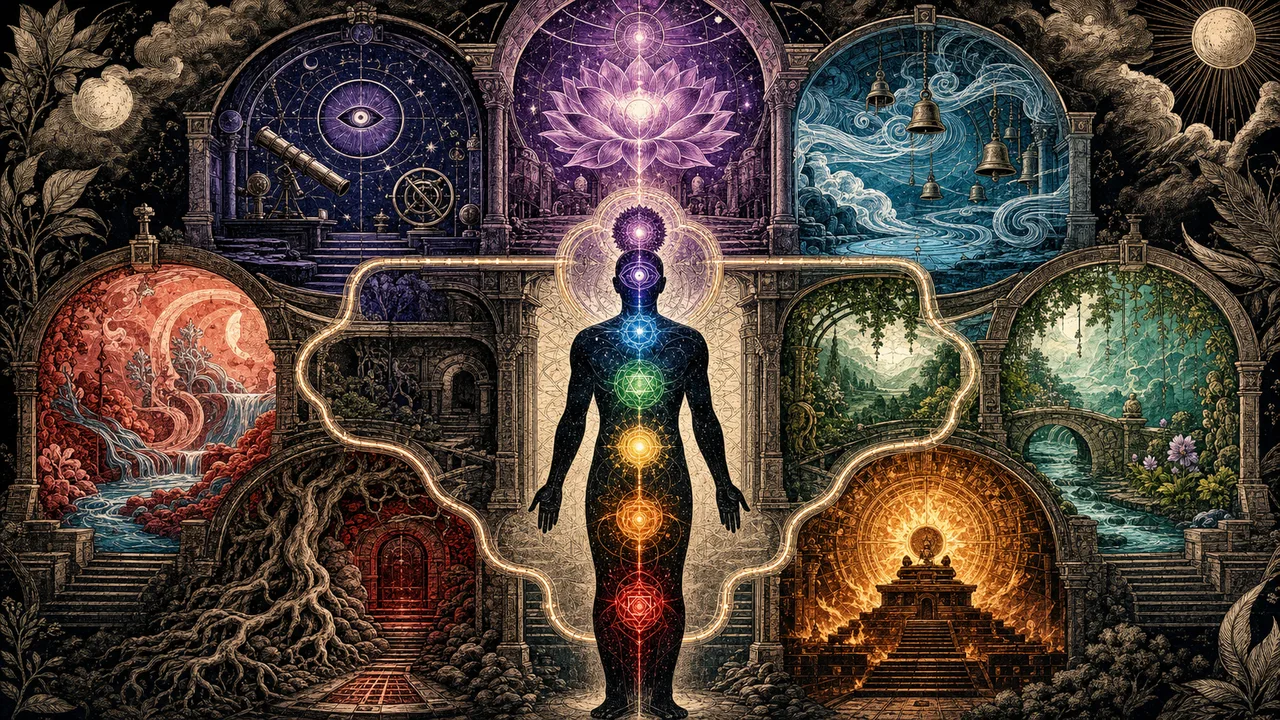
The seven main chakras are the large centers that organize the functioning of the energy body. They are distributed between the base of the spine and the top of the head, forming an axis that follows the central region of the body.
In this article, you will understand how the seven chakras are organized and what characterizes each one, beginning with Muladhara and continuing through Svadhisthana, Manipura, Anahata, Vishuddha, and the upper centers.
Continue reading to follow this sequence and understand the function of each center.
How are the seven chakras organized?
The seven main chakras are organized in sequence. The system begins with Muladhara at the base of the body and continues with Svadhisthana, Manipura, Anahata, Vishuddha, Ajna, and Sahasrara. To understand this map within the complete system, also read the pillar article complete guide to the 7 chakras for beginners, where I explain the origin, functioning, nadis, and paths toward harmonization.
This arrangement shows a progressive development. First, consciousness needs to remain connected to the body and learn to survive. It then develops the ability to feel pleasure, form bonds, construct an identity, love, communicate, and understand reality.
The process ends at the crown chakra, which expands perception beyond the individual personality. The manual presents these seven centers as structures that organize and distribute vital energy on the physical, emotional, mental, and spiritual levels.
Root chakra: Muladhara
Muladhara is the first main chakra. It is located at the base of the spine in the perineal region and maintains a direct connection with the energetic support of the physical body.
Its central function is to keep consciousness present in material reality. It organizes survival instincts, the need for security, self-preservation, and the ability to respond to life's basic demands.
This chakra also represents the foundation upon which the other centers develop. Without a stable foundation, a person may seek emotional or spiritual experiences without being able to maintain balance, discipline, and presence in everyday life.
Sacral chakra: Svadhisthana
Svadhisthana is the second main chakra. It is located in the lower abdomen below the navel, in a region corresponding to the sacral plexus and the organs connected to reproduction.
This center organizes pleasure, creativity, sensitivity, and emotional bonds. Through it, a person learns to connect with their own desires and perceive what produces satisfaction or discomfort.
The sacral chakra also relates to the ability to create and renew life. This includes biological creation but is not limited to it. Ideas, projects, relationships, and new ways of living also depend on this creative energy.
Solar plexus chakra: Manipura
Manipura is the third main chakra. It is located in the upper abdomen between the navel and the sternum, near the stomach and the abdominal nerve plexus.
This chakra organizes individual identity, personal willpower, and the strength needed to act. After recognizing their desires in the sacral chakra, a person needs to decide what they will do with them and assume responsibility for their own choices.
Manipura also participates in building self-esteem and autonomy. When this function matures, a person can take a position, make decisions, and use their own power without needing to dominate others or continually surrender their personal authority.
Heart chakra: Anahata
Anahata is the fourth main chakra. It is located in the center of the chest at the level of the sternum and occupies the central position between the three lower chakras and the three upper centers.
Its function is to organize love, empathy, acceptance, and the ability to establish mature emotional bonds. At this level, loving does not merely mean desiring someone, but recognizing their worth and building a relationship based on respect.
The heart chakra also acts as a bridge. It helps integrate the needs of the body and personality with broader values, allowing strength, pleasure, and willpower to be guided with awareness and consideration for others.
Throat chakra: Vishuddha
Vishuddha is the fifth main chakra. It is located in the throat region and participates in communication, personal expression, and the way a person presents themselves to the world.
Its function is not limited to speech. This chakra also relates to the ability to listen, transform feelings into words, and organize thoughts before communicating them.
Vishuddha makes it possible to express inner truth clearly. Its development allows a person to say what needs to be said without aggression, manipulation, or constant fear of rejection, maintaining consistency among thought, feeling, and speech.
Brow chakra: Ajna
Ajna is the sixth main chakra. It is located between the eyebrows and is popularly known as the brow chakra or third eye.
This center organizes inner perception, mental clarity, discernment, and intuition. Its function is to allow a person to observe thoughts, beliefs, and reactions without remaining completely dominated by them.
The brow chakra also expands our understanding of reality. It helps us recognize patterns, distinguish intuition from imagination, and perceive information that does not arrive solely through rational analysis or the physical senses.
Crown chakra: Sahasrara
Sahasrara is the seventh main chakra. It is located at the top of the head and extends beyond the physical body, forming an opening to subtler frequencies of consciousness.
Unlike the other centers, the crown chakra does not organize a specific emotion or need. Its function relates to the connection between individual consciousness and a greater reality.
Through this center, a person expands their perception of unity, purpose, and spiritual presence. Sahasrara allows experience to stop being understood only through the ego and begin to include a broader consciousness of existence.
The three lower chakras
Muladhara, Svadhisthana, and Manipura are called the lower chakras because they are located in the lower part of the body. This expression indicates position and function, not a lower degree of importance or evolution.
These three centers organize consciousness's experience in the material world. The root chakra sustains survival, the sacral chakra develops pleasure and bonds, and the solar plexus builds identity and the ability to act.
Without developing these functions, a person has difficulty sustaining their own life, making choices, and assuming responsibilities. Spiritual growth does not eliminate these centers; it requires their energies to be lived with greater awareness.
The three upper chakras
Vishuddha, Ajna, and Sahasrara are the three centers located above the heart chakra. They work primarily with expression, understanding, and the expansion of consciousness.
The throat chakra transforms inner experience into communication. The brow chakra makes it possible to understand what is being lived, while the crown chakra expands the connection with the spiritual levels of consciousness.
These centers do not function properly when there is an escape from material reality. Their activity needs to be supported by the lower chakras because spiritual perception must be understood and applied within human experience.
The heart chakra as a point of balance
Anahata occupies a different position from the others because it is at the center of the system. Below it are the chakras connected to matter and the construction of individuality; above it are the centers related to perception and subtle consciousness.
The heart chakra receives the experiences constructed in the lower centers and helps transform them. Instinct stops being merely a reaction, pleasure stops being only personal satisfaction, and power begins to consider the consequences for other people.
At the same time, it allows higher perceptions to be applied with sensitivity. Knowledge and spirituality without heart development can produce coldness, pride, or distance from human experience.
The seven chakras form a single system
Although each chakra has its own function, none works completely alone. Life requires security, pleasure, willpower, affection, communication, understanding, and spiritual connection in different proportions.
One center may be more active at a particular moment, but balance depends on the participation of the others. A decision, for example, may involve the security of the root chakra, the desire of the sacral chakra, the willpower of the solar plexus, the values of the heart chakra, and the discernment of the brow chakra.
Learning about the seven main chakras means understanding a map of human experience. Each center represents a necessary stage, and true development occurs when these different areas begin to work in an integrated way.
Frequently Asked Questions
The seven main chakras are the root, sacral, solar plexus, heart, throat, brow, and crown chakras. They form the central axis of the energy body.
They are distributed from the base of the spine to the top of the head, following the central region of the body and organizing different energetic functions.
The first is Muladhara, the root chakra. It is connected to the base of the body, survival, security, and presence in material life.
The heart chakra integrates the lower and upper centers. It works with love, empathy, mature bonds, and balance between matter and consciousness.
No. They work with perception, communication, and spiritual connection, but they depend on the lower chakras to maintain balance, presence, and practical application.
No. Each center has its own function, but all participate in a single system involving the body, emotions, mind, and consciousness.
Continue exploring the chakras
Learning about the seven main chakras is the first step toward understanding how the energy body organizes security, pleasure, willpower, affection, communication, perception, and spiritual connection.
In the Ultimate Guide to the Seven Chakras, you can deepen this map and learn to recognize how each center participates in energetic balance in practice.
Explore the Ultimate Guide to the Seven Chakras
About the author
Prof. Tibério Z has more than 30 years of experience teaching spirituality, metaphysics, holistic therapies and consciousness development.