
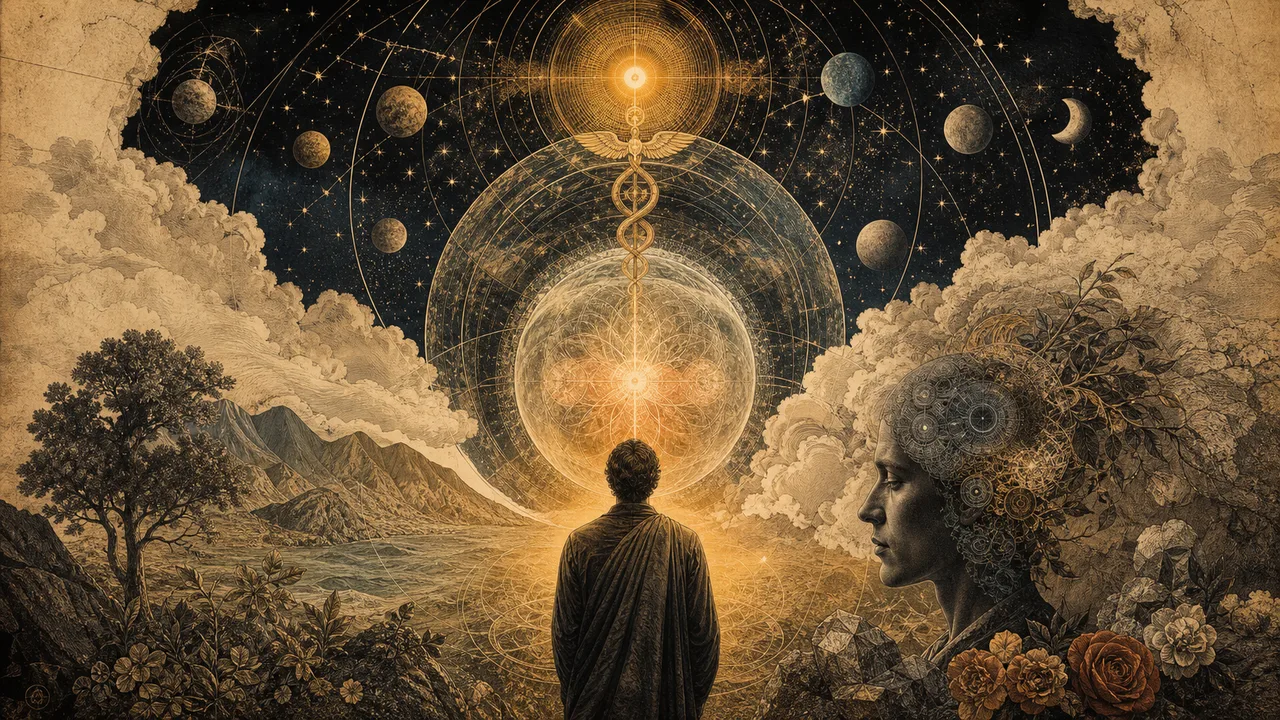
Hermeticism is a philosophical and spiritual tradition formed by teachings attributed to Hermes Trismegistus. Its texts explain the origin of the universe, the nature of God, the position of human beings in the cosmos, and the path through which consciousness can overcome ignorance and recognize its divine origin.
In this article, you will learn about the origin of Hermeticism, the texts of the Corpus Hermeticum, and the principal teachings of this tradition. You will also understand the differences among the ancient writings, the Emerald Tablet, the practices connected to alchemy, astrology, and magic, and the seven principles presented by The Kybalion.
Continue reading to understand the different historical stages of Hermeticism and recognize the place of each teaching. In this way, you will be able to study this tradition more clearly, without confusing its ancient spirituality with medieval, Renaissance, and modern interpretations.
Who Was Hermes Trismegistus?
Hermes Trismegistus is the central figure to whom the Hermetic texts were attributed. His name means approximately “Hermes thrice-great” and results from the association between the Greek god Hermes and the Egyptian god Thoth.
Thoth was connected to writing, sacred language, knowledge, calculation, and the work of scribes. In Greek culture, Hermes also had functions connected to communication, interpretation, and movement between different worlds. In Hellenistic Egypt, these correspondences contributed to the identification of the two deities.
In the Hermetic treatises, however, Hermes Trismegistus does not appear only as a god. He assumes the literary form of a sage, teacher, and revealer who transmits knowledge to disciples such as Tat, Asclepius, and Ammon. In some works, he teaches; in others, he receives a higher revelation and then communicates it.
There is not enough historical evidence to identify Hermes Trismegistus as a specific person. Scholars understand him as a religious and literary figure under whose name different anonymous authors presented their teachings.
Within the spiritual tradition, Hermes represents the teacher who knows the order of the cosmos and guides human beings toward the Divine. Historically, he represents the symbolic authority who brought together religious, philosophical, and technical texts produced at different times.
The Origin and History of Hermeticism
Hermeticism developed in Egypt during Greek and Roman rule, when cities such as Alexandria brought together different peoples, religions, and philosophical schools. In this environment, Egyptian concepts began to be expressed in Greek and interpreted through the philosophical vocabulary available at that time.
The earliest Hermetic texts did not necessarily form a community with a fixed doctrine. They present differences in language, cosmology, and spiritual understanding, indicating that distinct authors produced them. Despite these differences, they share themes such as God, the cosmos, intellect, soul, knowledge, and inner transformation.
Some of these writings are classified as philosophical or religious Hermeticism. Others belong to the so-called technical Hermetica, connected to astrology, alchemy, medicine, natural properties, and magical practices. This division helps us understand why the name of Hermes came to appear in such different fields.
With the decline of the ancient world, Hermetic teachings followed different paths. Some texts were preserved in Greek or Latin, others circulated in the Byzantine world, while traditions attributed to Hermes were translated and developed by Arabic-language authors.
In Renaissance Europe, the Latin translation of the Corpus Hermeticum renewed interest in Hermes. During the following centuries, his ideas influenced philosophers, alchemists, astrologers, scholars of natural magic, and different esoteric currents.
Present-day Hermeticism is the result of this long transmission. It does not correspond only to the ancient treatises, but also to interpretations that arose in the Middle Ages, the Renaissance, modern occultism, and the spiritualist movements of the nineteenth and twentieth centuries.
Corpus Hermeticum: The Fundamental Texts of Hermeticism
The Corpus Hermeticum is a collection of seventeen treatises originally written in Greek and attributed to Hermes Trismegistus. These texts form one of the principal sources for our knowledge of the philosophy and spirituality of ancient Hermeticism.
The treatises are presented mainly as dialogues. Hermes speaks with disciples, answers questions, transmits revelations, and guides his interlocutors regarding God, the cosmos, mind, and human nature.
Although they are gathered in one collection, the texts do not form a completely uniform system. Some passages present the cosmos positively, as a beautiful and ordered manifestation of God. Others emphasize the suffering produced by ignorance, passions, and excessive identification with the body.
This diversity should not be seen only as contradiction. It shows that different authors used the figure of Hermes to reflect on religious and philosophical problems common to the Greco-Egyptian environment. Brian Copenhaver's scholarly edition brings together the seventeen Greek treatises and the Latin Asclepius as fundamental sources for the study of this tradition.
Recurring themes include the unity of God, the creation of the universe, the role of Nous, the dual nature of the human being, the need for spiritual knowledge, and the possibility of rebirth.
The Corpus Hermeticum does not present the seven Hermetic laws known today. Its center is the transformation of the human being through knowledge of God, oneself, and the living order that sustains the universe.
Poimandres: The Creation of the Universe and the Spiritual Origin of the Human Being
Poimandres is the first treatise of the Corpus Hermeticum and one of the most important works of ancient Hermeticism. The text begins when Hermes enters a state of deep concentration and receives the manifestation of Poimandres, presented as the Nous of divine sovereignty.
The Greek term Nous can be translated as Mind or Intellect. In the Hermetic context, it does not represent only ordinary reasoning, but a divine intelligence capable of revealing the true structure of reality.
Poimandres shows Hermes a vision of creation. Divine light appears as the origin, while darkness, nature, and the elements participate in the formation of the cosmos. The divine Word organizes matter, and the Intellect gives rise to the powers responsible for the celestial order.
The primordial human being, called Anthropos by scholars, emerges as an image of God. While contemplating nature, the human being becomes involved with the material world and begins to participate in a dual existence: spiritual in origin and bodily in manifestation.
This dual nature explains the human conflict. The human being has a connection with the Divine, but is also subject to the body, passions, fate, and the conditions of the material world.
The goal presented in Poimandres is not to destroy the cosmos, but to awaken to our spiritual origin. The revelation received by Hermes transforms his understanding and leads him to teach others to abandon ignorance and seek knowledge of God. Current studies interpret the treatise as a visionary experience directed toward healing the soul and awakening consciousness.
Hermeticism: History, Teachings, and the Seven Hermetic Laws
Today, the word Hermeticism can refer to different historical layers. The first is formed by the religious and philosophical writings of Antiquity. The second includes technical texts attributed to Hermes and connected to astrology, alchemy, and magic.
A third layer arose during the Arabic and medieval transmission. In this period, Hermes was presented as an ancient sage, prophet, astrologer, and founder of alchemy. New texts were placed under his name even though they did not belong to the Corpus Hermeticum.
The Renaissance added another interpretation. Hermes came to be regarded as a representative of a primordial theology, earlier than the Greek philosophers and, according to some humanists, compatible with certain Christian teachings.
At the beginning of the twentieth century, The Kybalion presented seven principles called Hermetic. The work popularized Mentalism, Correspondence, Vibration, Polarity, Rhythm, Cause and Effect, and Gender. These principles became one of the best-known forms of modern Hermeticism.
The problem arises when all these stages are presented as a single and immutable doctrine. The Corpus Hermeticum, the Emerald Tablet, medieval alchemy, and The Kybalion belong to different contexts.
Studying the tradition in depth does not require choosing only one of these layers. We can recognize the value of each one as long as their origins and differences are explained clearly.
The Spiritual Path in Hermeticism
Ancient Hermeticism is not only a theory about the universe. Its texts present a path of transformation through which the disciple seeks to overcome ignorance, purify the way they live, and awaken Nous.
Ignorance does not mean only a lack of information. It represents a condition in which a person does not recognize their origin, identifies completely with the body, and allows disordered passions to govern their existence.
Gnosis is the transformative knowledge that breaks this condition. It is not simply a matter of believing in a doctrine, but of directly recognizing the relationship among God, the cosmos, and one's own consciousness. Hermetic literature associates ignorance with spiritual ruin and presents knowledge of God as a path to liberation.
The process also involves purification. The disciple needs to observe desires, impulses, vices, illusions, and behaviors that keep the mind directed only toward the sensible world. Hermetic spirituality seeks to heal the soul from its submission to the passions.
The transformation can culminate in rebirth, called palingenesis. In treatise XIII of the Corpus Hermeticum, this rebirth represents a radical change in the way the disciple perceives themselves and reality.
Prayer, reverence, silence, gratitude, and conduct also form part of this path. Hermetic knowledge does not separate understanding from behavior: drawing closer to the Divine requires learning, contemplation, and changing one's own life.
The Relationship Among Hermeticism, Alchemy, Astrology, and Magic
Hermeticism, alchemy, astrology, and magic often appear together because all of them were connected to the authority of Hermes Trismegistus. However, they are not different names for the same practice.
Philosophical Hermeticism seeks to understand God, the cosmos, the human being, and the path of spiritual transformation. Its main question is how a person can know their origin and consciously participate in the divine order.
Astrology studies the relationships between celestial movements and earthly events. In ancient and medieval contexts, it was used to interpret cycles, temperaments, events, and cosmic influences.
Alchemy investigates the transformations of matter. Historically, it involved knowledge about minerals, metals, substances, laboratory operations, and theories of nature. Its exclusive identification with an inner spiritual practice is a later interpretation and does not describe the full diversity of historical alchemy.
Magic seeks to act upon forces, properties, correspondences, or entities considered present in nature and the cosmos. Depending on the period, it could include talismans, invocations, astrological images, natural substances, and rites.
These fields met because they shared an understanding of a living and ordered universe permeated by invisible relationships. Even so, each field had its own questions, methods, and goals. The historical association among them does not erase their differences.
The Rebirth of Hermeticism in Renaissance Europe
European interest in Hermeticism increased when a Greek manuscript of the Corpus Hermeticum reached Florence in the fifteenth century. Cosimo de’ Medici asked Marsilio Ficino to give priority to its translation.
Ficino completed the Latin translation of the first fourteen treatises in 1463. The work was printed in 1471 and began to circulate among humanists, philosophers, religious thinkers, and scholars of nature.
Renaissance thinkers believed that Hermes Trismegistus had lived in a very ancient age, possibly before or around the time of Moses. For this reason, they regarded his writings as testimonies to a primordial wisdom.
This idea was called prisca theologia, the ancient theology. According to this interpretation, different sages of the past had preserved parts of a divine truth that predated later divisions among religions and philosophical schools.
The rediscovery of the Corpus Hermeticum influenced debates about religion, philosophy, astrology, natural magic, and the spiritual dignity of the human being. For Ficino, Hermes belonged to a succession of ancient sages who had transmitted a common truth.
This understanding began to change in 1614, when Isaac Casaubon demonstrated, through analysis of the language and internal references, that the treatises belonged to the first centuries of the Common Era. They could not have been written in the time of Moses.
The discovery changed the dating of the texts but did not eliminate their influence. Hermeticism had already become integrated into the intellectual and esoteric history of Europe.
The Emerald Tablet and the Meaning of “As Above, So Below”
The Emerald Tablet is a brief text attributed to Hermes Trismegistus and considered one of the most influential works in the alchemical tradition. Despite its fame, it is not part of the Corpus Hermeticum.
The oldest known versions emerged in Arabic during the Middle Ages. One account presents the text as an inscription found in a tomb or chamber of Hermes, reinforcing its image as an ancient revelation. Scholarly sources indicate that an Arabic version already existed around the tenth century.
The phrase popularly summarized as “as above, so below” describes a relationship between levels of reality. What occurs in one dimension can have a correspondence with processes found in another.
In alchemy, this relationship allows us to think of matter, cosmos, and transformation as parts of the same order. An operation performed on a substance is not viewed in isolation, but as integrated with a broader understanding of nature.
The Tablet also mentions the Sun, Moon, wind, earth, ascent, descent, and unity. These elements were interpreted in different ways by Arabic and European alchemists.
Correspondence does not necessarily state that the higher and lower are identical. It indicates a relationship between distinct levels while preserving the proper function of each one. The principle can guide analogies, but it does not turn every similarity into proof of an objective connection.
Ancient Hermeticism and The Kybalion: Differences and Common Ground
Ancient Hermeticism is represented mainly by the Corpus Hermeticum, the Asclepius, the fragments preserved by Stobaeus, and other texts found in Greek, Latin, and Coptic.
These works concentrate on God, the cosmos, Nous, the human condition, ignorance, gnosis, and spiritual rebirth. Their central goal is to transform the human being's relationship with the Divine.
The Kybalion was published in 1908 under the signature “Three Initiates.” The work presents a system composed of seven principles and uses language marked by modern occultism and the New Thought movement.
There are points of contact. Mentalism can be compared with the importance of the divine Mind in the ancient texts. Correspondence has a parallel in ideas of an integrated cosmos. The idea of Gender can be brought close to generative images found in earlier traditions.
However, these similarities do not demonstrate that the seven principles were taken directly from the Corpus Hermeticum. The complete sequence does not appear in the ancient treatises, and concepts such as Vibration, Polarity, and Rhythm are developed by The Kybalion within a modern structure.
Comparative studies conclude that the work shares some themes with earlier Hermetic traditions, but is deeply connected to the metaphysical concerns of the early twentieth century.
Ancient Hermeticism primarily teaches a path of knowledge and approach to God. The Kybalion emphasizes mastery of mental principles and the conscious transformation of inner states. This difference in purpose is fundamental.
The Seven Hermetic Laws: Origin, Meaning, and Overview
The so-called seven Hermetic laws are presented by The Kybalion as seven principles: Mentalism, Correspondence, Vibration, Polarity, Rhythm, Cause and Effect, and Gender.
The term “Hermetic laws” became popular later, although the book mainly uses the word “principles.” They are presented as foundations capable of explaining phenomena on the physical, mental, and spiritual planes.
Mentalism states that the universe has a mental nature. Correspondence addresses the relationships among different planes. Vibration presents reality as movement and transformation.
Polarity seeks to show that certain opposites are extremes on the same scale. Rhythm describes the oscillations that exist between those extremes. Cause and Effect states that events participate in chains of conditions and consequences.
Gender represents complementary forces involved in processes of generation and creation. The book applies this principle not only to the body, but also to mental and spiritual processes.
These principles form an integrated system within The Kybalion. However, they should not be presented as scientific laws or as a list demonstrably transmitted since ancient Egypt.
Their value belongs primarily to the philosophical, metaphysical, and spiritual field. They can be used as tools for reflection as long as their limits and modern origin are recognized.
The Principle of Mentalism in Hermeticism
The Principle of Mentalism states that reality exists within a universal Mind called “The All” by The Kybalion. The universe would be a mental manifestation of this infinite reality.
This statement does not mean that the individual mind has the same reach as the Universal Mind. A person participates in mental reality but does not control all events, other consciousnesses, or the conditions of the world alone.
Mentalism helps us understand the influence of beliefs, interpretations, memories, and expectations on human experience. The mind modifies the way a person perceives events and chooses their responses.
In the ancient Hermetic texts, Nous also occupies a central position, but it does not correspond exactly to the personal power to create any desired reality. It represents the divine Intellect that makes it possible to know God, understand the cosmos, and awaken to true human nature.
Therefore, the Mentalism of The Kybalion can be compared with themes from ancient Hermeticism, but it should not be confused with them. The comparison is valid when it recognizes that Universal Mind, Nous, and individual mind have different functions.
The Principle of Correspondence in Hermeticism
The Principle of Correspondence teaches that relationships can exist among different levels of reality. What is known on one plane can help interpret patterns found on another.
The Kybalion applies this relationship to the physical, mental, and spiritual planes. Correspondence would function as a key for studying realities that cannot be observed directly.
The idea finds a familiar parallel in the Emerald Tablet, which relates what is above to what is below. It can also be compared with the Hermetic understanding of an integrated cosmos in which different parts participate in a common order.
Correspondence, however, does not mean identity. A psychological pattern is not necessarily the same as a physical phenomenon, and a symbolic analogy does not prove that two things have the same cause.
Its use requires recognizing both similarity and difference. Correspondence can broaden understanding, but it becomes an error when every coincidence is interpreted as a proven universal connection.
The Principle of Vibration: Movement, Frequency, and Transformation
The Principle of Vibration states that nothing remains completely still. All manifestations would be subject to movement, variation, and transformation.
In The Kybalion, matter, energy, mind, and spirit are presented as different degrees of vibration. Changes of state would be produced by alterations in these degrees.
The word frequency is also used in spiritual teachings to describe mental, emotional, or energetic states. This use is metaphorical and should not automatically be confused with frequency as measured by physics.
In science, frequency is a defined number of cycles or oscillations during a particular interval. To state that something has a physical frequency, it is necessary to indicate the phenomenon measured, the unit, and the method used.
Within The Kybalion, Vibration is a metaphysical principle. Its practical application lies in understanding that thoughts, emotions, and dispositions are not permanent and can be transformed.
This change, however, does not happen only through the repetition of positive words. It may require observation, changes in habits, emotional processing, new choices, and concrete conditions that sustain another inner state.
The Principle of Polarity in Hermeticism
The Principle of Polarity states that certain opposites can be understood as extremes of the same nature. Different degrees would exist between these extremes.
Heat and cold, for example, can be observed as relative positions on a temperature scale. The Kybalion applies this model to mental and emotional states as well.
Polarity allows us to think of transformation as gradual movement. A person does not need to move immediately from fear to the complete absence of fear. They can develop understanding, preparation, and courage until they change their inner position.
The principle does not mean that all opposites are equal or interchangeable. There are moral, social, biological, and material differences that cannot be erased simply because two words appear to form a pair.
Polarity is most useful when it helps us perceive gradations and possibilities for change. It becomes problematic when used to relativize concrete situations or establish improper equivalences.
The Principle of Rhythm: Cycles, Movements, and Compensation
The Principle of Rhythm describes movements of expansion and contraction, advance and retreat, increase and decrease. The Kybalion uses the image of a pendulum to represent these oscillations.
Rhythm acts between poles. Periods of intense activity may be followed by rest, just as moments of enthusiasm may give way to introspection and reorganization.
Understanding cycles prevents us from interpreting every reduction in intensity as failure. Withdrawal can serve to restore energy, integrate experiences, and prepare a new stage.
The book also presents the idea of neutralization. A person would not prevent the movement of the pendulum, but could develop the stability needed not to react automatically to each oscillation.
Neutralizing does not mean eliminating emotions or always remaining in the same state. It means recognizing the movement, preserving awareness, and preventing a passing condition from determining important decisions.
Compensation should not be understood as a promise that every loss will be replaced by an equivalent gain either. Within the principle, it represents a tendency toward movement and reorganization between different directions.
The Principle of Cause and Effect: Choices, Consequences, and Awareness
The Principle of Cause and Effect states that events participate in chains. Every effect has prior conditions, while each cause can contribute to new effects.
The Kybalion teaches that chance may simply be the name used when the causes involved have not yet been recognized. This does not mean that human beings know or control all these causes.
In personal life, habits, decisions, and repetitions produce consequences. One choice can form a chain that influences other decisions, relationships, and results.
However, responsibility does not mean being guilty for everything. People are also affected by natural, social, historical, family, and economic conditions that were not created by their individual will.
The balanced application of this principle consists of recognizing the causes upon which intervention is possible. A person does not control the entire chain of reality, but can observe which behaviors they continue to feed.
The greater our awareness of impulses, patterns, and consequences, the greater our ability to choose less automatically. The principle can expand personal responsibility without turning suffering into accusation.
The Principle of Gender: Creation and Complementarity on Different Planes
The Principle of Gender states that creative processes involve complementary functions. The Kybalion calls these functions masculine and feminine and seeks to identify them on the physical, mental, and spiritual planes.
In its symbolic language, the masculine aspect represents direction, impulse, and projection. The feminine aspect is connected to reception, development, gestation, and manifestation.
These functions should not be used to impose social roles on men and women. The book's language reflects its historical context and seeks to describe creative processes, not establish limits for each sex.
The same person can initiate an idea, receive it, develop it, and transform it into action. In this way, both functions would participate in the mental life of every human being.
The principle also shows that an isolated intention does not complete a creative process. It needs to find the conditions to grow, take shape, and produce some manifestation.
When understood symbolically, Gender represents cooperation between different capacities. Creating requires initiative and receptivity, movement and development, expression and support.
The study of this final principle completes the overview presented by The Kybalion, but it does not conclude the study of Hermeticism. The seven laws represent only a modern stage of a much broader tradition whose ancient center remains in knowledge of God, the cosmos, Nous, and the spiritual nature of the human being.
Frequently Asked Questions About Hermeticism
It is a philosophical and spiritual tradition formed by teachings attributed to Hermes Trismegistus about God, the cosmos, human nature, and the path of transformation of consciousness.
He is the central figure to whom the Hermetic texts were attributed, formed through the association between the Greek god Hermes and the Egyptian god Thoth. Historically, he is understood as a religious and literary authority.
It is a collection of seventeen treatises in Greek attributed to Hermes Trismegistus, presented mainly as dialogues about God, the cosmos, mind, soul, and spiritual transformation.
No. The seven laws organized as Mentalism, Correspondence, Vibration, Polarity, Rhythm, Cause and Effect, and Gender belong to The Kybalion, published in 1908.
Its central goal is to lead human beings to knowledge of God, themselves, and the living order of the universe, overcoming ignorance and recognizing their spiritual origin.
Continue exploring spirituality and self-knowledge
Understanding the foundations of Hermeticism helps us study the seven laws without turning them into isolated phrases. Each principle gains more meaning when we perceive its relationship with consciousness and our choices.
Explore the e-book collection to continue studying spirituality, consciousness and inner transformation from complementary perspectives.
Browse the e-books
About the author
Prof. Tibério Z has more than 30 years of experience teaching spirituality, metaphysics, holistic therapies and consciousness development.