
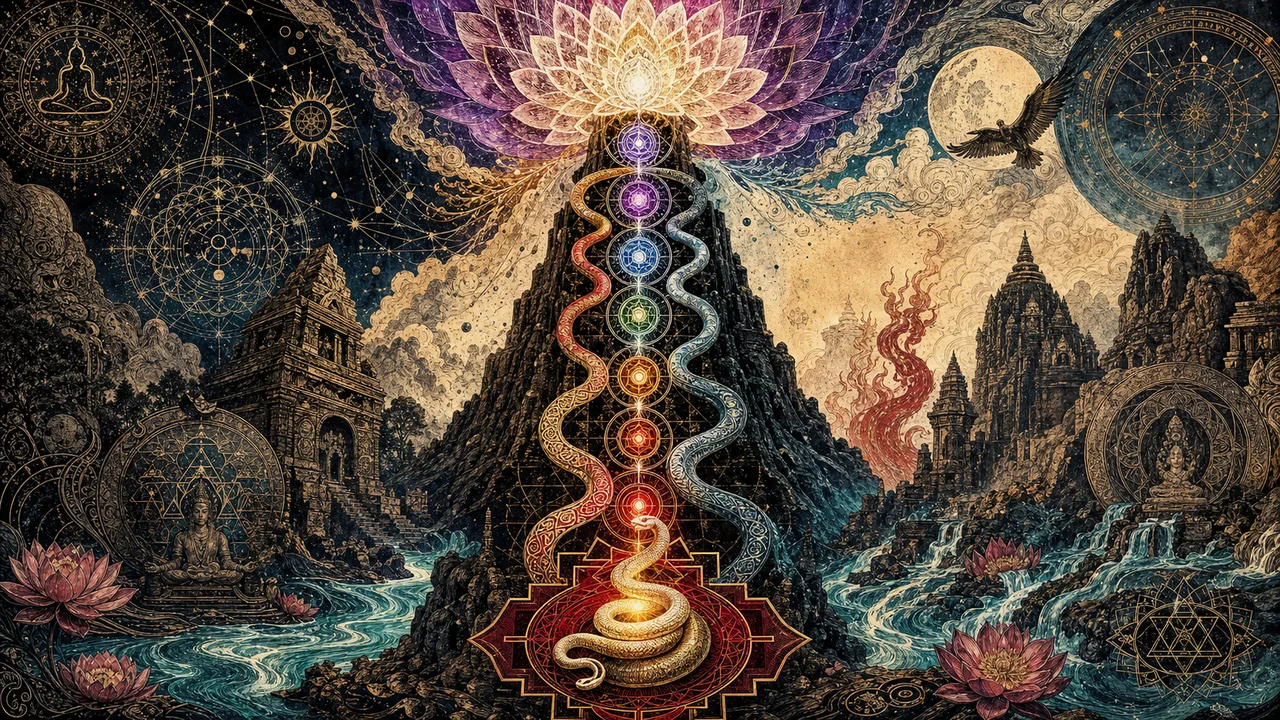
Kundalini is the force of consciousness that remains concentrated at the base of the human energy system. In the traditions of Yoga and Tantra, it is represented as a serpent sleeping in the root chakra, waiting for the right conditions to begin its upward movement.
In this article, you will understand what Kundalini is, why it is represented as a serpent, where it remains, whether it is the same as prana, how it relates to the root chakra and which path it takes through the chakras.
Continue reading to follow these answers and understand the place of this energy within the system.
What is Kundalini?
Kundalini is the energy of consciousness that remains in a potential state at the base of the energy body. It represents a force capable of moving the entire system of chakras and progressively expanding perception. To understand Kundalini within the complete energetic anatomy, also read the pillar article complete guide to the 7 chakras for beginners, where I explain how chakras, nadis and vital energy work together.
This energy is not created during meditation or an exercise. It is already part of the human energetic structure, but it generally remains concentrated in life's most basic functions, related to survival, reproduction, pleasure and protection.
When it begins to circulate more broadly, Kundalini provides energy for the chakras to express more developed levels of their functions. Instinctive force does not disappear, but becomes integrated with emotion, thought, discernment and spiritual awareness.
Why is Kundalini represented as a serpent?
The serpent represents a concentrated, latent force capable of moving from the bottom upward. For this reason, Hindu traditions describe Kundalini as a snake coiled at the base of the spine.
This image does not mean that a literal serpent exists in the energy body. It represents a great flow that remains gathered in the root chakra while it has not yet found suitable paths for rising through the system.
When the serpent awakens, its energy begins to uncoil and move toward the higher centers. This process can be understood as Kundalini being an accumulated force in the root chakra that must be set in motion through energetic development and the practice of Yoga.
Where does Kundalini remain?
Kundalini remains associated with the root chakra, Muladhara, located in the region of the perineum and the base of the spine. This center supports physical life, survival instincts and the energetic connection with the Earth.
Its presence in this region shows that the expansion of consciousness begins with matter. Spiritual energy does not arise from denying the body, but from consciously transforming the force that already sustains physical life.
When a person lives dominated by fear, insecurity and the permanent need for defense, much of this energy remains concentrated at the base. As these patterns are understood and balanced, the available force can nourish broader levels of the system.
Is Kundalini the same as prana?
Prana is the vital energy that circulates through the subtle body and maintains its functioning. It is captured, processed and distributed by the chakras and nadis according to the needs of the energetic organism.
Kundalini is also energy, but it represents a more concentrated force directly connected with the expansion of consciousness. While prana continuously sustains energetic life, Kundalini participates in a movement of transformation and development within the system.
We can understand prana as the energy that supplies the subtle body in its everyday activities. Kundalini is the power that, when properly mobilized, intensifies the work of the chakras and guides consciousness through different levels of perception.
What is the relationship between Kundalini and the root chakra?
Muladhara provides the point of support for Kundalini's movement. Before the energy can ascend, the root chakra must provide enough stability to keep the person present in the body and material reality.
This explains why spiritual work begins at the base. A person dominated by fear, disorganized in concrete life or disconnected from their own body may lack the structure needed to properly integrate an intense increase in energetic activity.
Developing Muladhara means transforming the energy of survival into presence, courage and trust. The same force once used only for defense begins to support growth and move the other centers.
Which path does Kundalini take through the chakras?
Kundalini's main path of ascent is Sushumna, the central nadi. This channel runs along the middle line of the subtle body and connects the chakras from the base of the spine to the top of the head.
Sushumna functions as an axis of integration. When energy rises through this channel, it does not spread in a disorganized way, but progressively comes into contact with the major centers of the energy system.
The manual identifies Sushumna as the channel through which the energy of consciousness, called Kundalini, rises when it is properly awakened. Through this movement, the chakras are integrated and perception reaches broader levels.
What is the role of Ida and Pingala?
Besides Sushumna, there are two main channels called Ida and Pingala. Ida relates to lunar, receptive and introspective energy, while Pingala is connected with solar, active energy directed toward manifestation.
These two nadis represent complementary forces. Receptivity makes it possible to feel, perceive and internalize; activity makes it possible to act, organize and express. The system needs both functions to work in a balanced way.
When Ida and Pingala find greater harmony, Sushumna can better sustain the central flow. Kundalini's ascent does not depend only on producing more energy, but on balancing the polarities that guide its movement.
How does Kundalini relate to each chakra?
When Kundalini reaches a chakra, it intensifies the energy passing through that center. This makes its functions more present and may also bring into awareness patterns that still need to be understood.
In the root chakra, the work involves survival, fear and security. In the sacral chakra, themes of pleasure, creativity and bonds arise. In the solar plexus, the energy encounters identity, willpower, self-esteem and personal power.
As it continues, it passes through the heart chakra, related to love and integration, the throat chakra, connected with expression, and the brow chakra, responsible for understanding and discernment. In the crown, the energy participates in the expansion of consciousness and the perception of unity.
Does the ascent of Kundalini open the chakras automatically?
The passage of energy may stimulate the chakras, but it does not replace the developmental work of each center. Energetic intensification does not automatically resolve fears, traumas, dependencies, conflicts or old beliefs.
When more energy reaches a chakra, it may amplify both its balanced qualities and its disorganized patterns. A mature solar plexus uses this force to act responsibly; an unbalanced solar plexus may turn it into control, pride or impulsiveness.
For this reason, the goal is not merely to make the energy rise. The chakras must be prepared to receive, process and express this force without turning the energetic increase into an amplification of existing imbalances.
What does it mean to awaken Kundalini?
Awakening Kundalini means setting in motion a force that previously remained concentrated at the base of the system. This movement increases the chakras' capacity to participate in the development of consciousness.
Internally, the awakening brings greater awareness of one's thoughts, emotions, instincts and patterns of behavior. Contents that were previously unconscious become more visible because more energy is available to observe and process them.
In practical terms, a true awakening must produce transformation. The person becomes less reactive, more aware of their choices and more capable of directing their energy according to what they understand.
Is the ascent of Kundalini only a spiritual experience?
The ascent of Kundalini should not be reduced to sensations, visions or unusual states of consciousness. These phenomena may accompany certain practices, but by themselves they do not represent the maturation of the process.
The main transformation occurs when instincts begin to pass through the filter of consciousness. Instead of reacting immediately to fear, anger, desire or frustration, the person creates space to understand what is happening before acting.
This relationship connects the union of Kundalini and Shiva with the ability to elevate basic instincts and place them under consciousness. The energy continues to exist, but it no longer produces only automatic reactions and begins to support more intelligent decisions.
What is the relationship between Kundalini and the heart chakra?
In this understanding, telluric energy rises from the root chakra and passes through the three lower centers. It represents the force of the Earth, the body, instincts, pleasure and the power to accomplish things.
At the same time, a subtler energy descends through the crown chakra and passes through the higher centers, bringing spiritual awareness, understanding and guidance. These two currents meet in the heart chakra.
The heart thus becomes the point of integration between material strength and spiritual consciousness. The energy coming from the base ceases to serve only the ego's interests and begins to be guided by love, empathy and perception of the whole.
Does Kundalini need to reach the crown chakra?
In the traditional representation, the serpent awakens in the root chakra and rises through the central channel until it reaches the crown chakra. This journey symbolizes the expansion of consciousness from the most material functions to the perception of unity.
It is also important to understand the meeting between ascending telluric energy and descending divine energy in the heart chakra. These two explanations show complementary aspects of the process: the complete ascent through the system and its integration in the heart.
Reaching the crown does not mean abandoning the previous chakras. Expanded awareness must return to life and manifest in attitudes, choices, communication, relationships and responsibility in the material world.
Why must the nadis be prepared?
Kundalini uses the energy channels to move. When these channels are disorganized or have reduced flow, the energy has difficulty circulating steadily.
For this reason, energetic traditions first work with purifying the nadis. The goal is to improve the passage of prana and prepare the system before increasing the activity of the higher chakras or Kundalini.
The manual states that energetic development practices prioritize clearing the channels before any attempt at activation. A more organized flow provides better conditions for energy to be distributed and integrated by the subtle body.
Why should you not force a Kundalini awakening?
Forcing an awakening means trying to move a large amount of energy before the chakras, nadis and consciousness are prepared to process it. The problem is not the energy itself, but the system's capacity to integrate it.
An intense practice may stimulate regions that still carry fear, guilt, anger, dependence, rigidity or confusion. When these contents receive more energy without understanding, they may become even stronger.
Proper development is gradual. First, the person improves their relationship with the body, emotions, bonds, power, communication and the mind. As the system matures, the energy finds safer conditions in which to circulate.
Which practices prepare the energy system?
Preparatory practices work with circulation, presence and the balance of the nadis. Conscious breathing, Yoga postures, stretching, meditation and mindfulness help reorganize energetic flow.
Nadi Shodhana, alternate-nostril breathing, is used specifically to work with the balance between Ida and Pingala. When practiced without excess, it helps stabilize the system's receptive and active polarities.
Preparation also includes everyday life. Sleeping, eating properly, caring for the body, managing emotions and assuming responsibilities strengthen the structure that must sustain any expansion of consciousness.
Kundalini represents the transformation of energy into consciousness
Kundalini is the force concentrated at the base of the energy system that can ascend through Sushumna and pass through the chakras. Its movement connects instinctive, emotional, mental and spiritual functions in a single developmental process.
True ascent does not consist merely of carrying energy to the top of the head. Each chakra must transform this force according to its function, allowing survival to become security, desire to become creativity and power to be guided by consciousness.
When ascending telluric energy meets spiritual energy, development ceases to be merely personal. The force that once served only the ego's defense and satisfaction begins to sustain a more conscious, integrated and responsible life.
Frequently Asked Questions
Kundalini is a force of consciousness concentrated at the base of the energy body, associated with the root chakra and the chakras' potential for development.
No. Prana is the vital energy that sustains the subtle body every day. Kundalini is a more concentrated force connected with transformation and the expansion of consciousness.
Kundalini's main path of ascent is Sushumna, the central channel that connects the chakras from the base of the spine to the top of the head.
No. It can intensify the chakras' activity, but each center must be prepared to process this energy with balance and awareness.
It is not recommended. Forcing an awakening may overload chakras and nadis that are still disorganized. Development should be gradual, with physical, emotional and energetic preparation.
The heart chakra integrates the energy rising from the base with the spiritual energy descending from the higher centers, uniting material strength and spiritual consciousness.
Continue exploring the chakras
Understanding Kundalini helps reveal that energetic development is not merely intensity, but preparation, integration and awareness applied to life.
In the Ultimate Guide to the Seven Chakras, you can deepen this map and learn to recognize how each center participates in energetic balance in practice.
Explore the Ultimate Guide to the Seven Chakras
About the author
Prof. Tibério Z has more than 30 years of experience teaching spirituality, metaphysics, holistic therapies and consciousness development.