
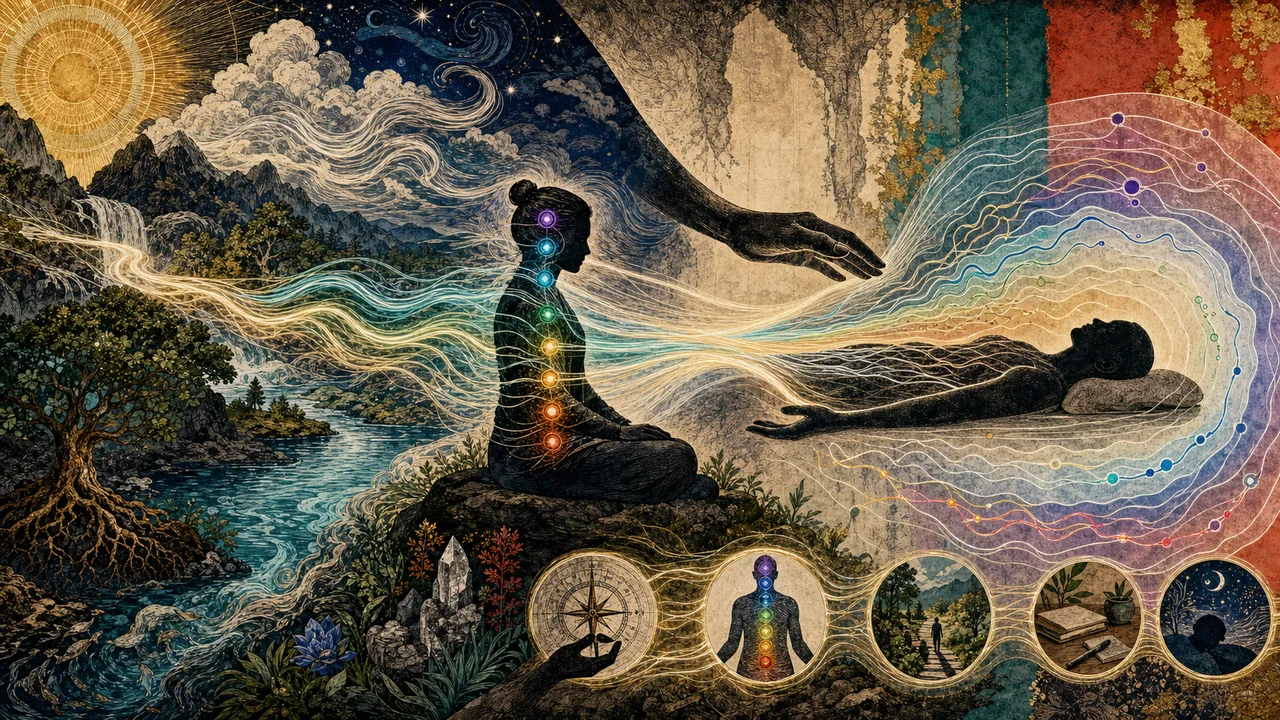
Reiki energy is an organized form of vital energy used to promote balance in the energy field. It is not created by the Reiki practitioner, nor does it belong exclusively to a religious tradition. Its foundation is the same energy that sustains living beings, objects and the different levels of reality.
In this article, you will understand what vital energy means within Reiki, the relationship between Reiki, Ki and Prana, why it is described as an organized frequency, the role of intention and how the Reiki practitioner acts as a channel of transmission.
Continue reading to follow these definitions and understand what supports the application.
Vital energy within Reiki
Vital energy is the energetic foundation that sustains life and enables the functioning of the different bodies. It is present in the physical body, etheric field, emotions, mind and environments, taking on different characteristics according to the frequency that organizes it.
In Reiki, the practitioner uses this vital energy consciously. They do not need to produce a new energetic substance because they work with a flow that already exists and is available throughout reality.
The application creates conditions for this energy to be directed toward a field experiencing fatigue, reduced circulation or disorganization. Reiki provides support so that the system can regain greater balance, without replacing the natural processes of the body and consciousness themselves.
The relationship between Reiki, Ki and Prana
Ki is a term used in Japan to represent vital energy. Prana is a word of Indian origin that also refers to the energetic force present in beings, environments and the very organization of matter.
These names belong to different traditions, but they seek to explain a similar foundation. Everything that exists is formed by the same fundamental energy, which takes on specific forms according to the vibrational frequency that organizes it.
In Reiki, Ki is not understood only as physical energy produced by the body. It is part of a broader field that can be received, directed and used to support the energetic reorganization of a person, an environment or the practitioner themselves.
Reiki energy as an organized frequency
Energy and frequency do not represent exactly the same thing. Energy provides the basis for movement, while frequency determines how that energy will be organized and what information it will carry.
Vital energy in its basic state can take on different functions. When it is directed toward tranquility, balance or support, it begins to carry a frequency compatible with that purpose.
For this reason, Reiki energy is not merely an amount of force transmitted through the hands. It is an energy flow organized by information, capable of coming into contact with a person's field and promoting a particular vibrational state.
The role of intention in directing Reiki
Intention is the element that gives direction to the energy flow. It organizes the focus of consciousness and determines what information will be sustained during the application.
A clear intention does not need to be long or accompanied by excessive effort. The Reiki practitioner can internally maintain a direction focused on balance, calm, vitality or reorganization without trying to control every detail of the outcome.
Intention becomes confused when it arises from neediness, fear or the need to prove power. In these situations, the ego mixes other information into the work, making it harder to keep the transmitted frequency stable.
The Reiki practitioner as a channel of transmission
The Reiki practitioner does not need to use only their personal energy during a session. Their role is to establish a connection with the available vital energy, allow it to circulate through their own field and direct it toward the person receiving the application.
This understanding prevents the idea that the practitioner must exhaust their vitality to help someone. When the process is conducted with balance, energy is received and transmitted without the Reiki practitioner trying to sustain everything through the strength of their own body.
The hands function as facilitators of emission, but they are not the source of the energy. The flow passes through the practitioner's field and receives direction from their consciousness before coming into contact with the person receiving Reiki.
The practitioner's internal state during the application
The Reiki practitioner's field participates in the session. Everything they think and feel during contact can influence the quality of the information transmitted, even when no words are spoken.
Concern, judgment, fear and the need for control can circulate during energetic coupling. For this reason, applying Reiki requires more than memorizing hand positions or reproducing a learned sequence.
The practitioner needs to develop presence, emotional stability and responsibility for their own state. The more organized their mind is, the less personal interference there will be in the flow they intend to transmit.
Reiki's action on the etheric field
Reiki acts mainly on the energy field, also called the etheric body. This level serves as a bridge between the physical body and the subtler frequencies related to emotions, mind and consciousness.
During the application, the transmitted energy comes into contact with regions that have greater or lesser circulation. The Reiki practitioner may perceive these differences through sensations such as heat, tingling, pressure or changes in energetic intensity.
The aim is not to modify tissues and organs directly through the force of the hands. Reiki offers a stimulus to the etheric field, promoting an energetic organization that may affect a person's vitality, relaxation and inner perception.
The coupling between the practitioner's field and the person's field
When the Reiki practitioner approaches the person receiving the application, an interaction occurs between the two energy fields. This proximity is called coupling and allows energy and information to be exchanged during the session.
Physical contact is not essential for this interaction to occur. The hands can remain above the body because the aura and etheric field extend beyond the visible boundaries of the skin.
The practitioner's mind organizes the flow during this contact. It defines the direction of the energy, while the person's field receives and distributes the frequency according to its own structure and needs at that moment.
Energy circulation through the chakras
The chakras are structures of the etheric body responsible for receiving, storing and distributing energy. They function as centers that enable the human system to interact with different frequencies.
The hands are usually positioned near the main chakras because these regions have a greater capacity for energetic absorption and distribution. The energy received can be directed to other parts of the field through the channels found in the etheric body.
The Reiki practitioner does not need to force the energy to follow a rigid path. The application provides a flow, while the energy system itself uses and distributes this energy according to the conditions present in its chakras and subtle organs.
Reiki does not mean accumulating energy indefinitely
Energetic balance does not depend solely on having a large amount of energy. A field may have excess energy in certain regions and a reduction in others, producing tension and difficulty in circulation.
Reiki energy promotes organization and movement. It can help reduce congested areas, increase flow in weakened regions and create greater integration among different parts of the system.
The aim is not to keep a person permanently charged. A balanced field needs to receive, use, transform and release energy while respecting the natural movements of the body and consciousness.
Perceiving energy during an application
Some people perceive Reiki energy as heat, cold, tingling, pulsation, heaviness or lightness. These sensations arise because the field and body respond to energetic contact in different ways.
The Reiki practitioner may also feel changes in their hands and their own perception. Certain regions may seem warmer, denser or quieter, indicating differences in the flow present at that point.
These sensations help guide the practice, but they do not need to be turned into diagnoses. Feeling heat does not automatically prove the existence of an illness, just as not noticing anything does not mean that the work is not taking place.
Reiki does not depend only on gestures and hand positions
Hand positions provide a structure for the application, especially for beginners. They help the practitioner move through the field in an organized way and reduce uncertainty during the session.
However, external movement is not Reiki's main agent. Repeating positions without presence and intention can turn the practice into a mechanical sequence without clear energetic direction.
The hands facilitate emission, but consciousness organizes the process. With experience, the Reiki practitioner understands that what matters most is the connection, attention and quality of the frequency sustained during the session.
Reiki energy and the natural capacity for reorganization
The body and energy field have their own mechanisms of balance. When given better conditions, they can reorganize circulation, reduce tension and regain some of their stability.
Reiki supports these natural movements. The energy received does not replace the body's functioning, but it can facilitate a state in which body, mind and emotions work with less overload.
For this reason, the Reiki practitioner does not need to mentally impose every effect they want to produce. They provide a frequency of balance, while the person's own system responds within its possibilities and current moment.
Reiki energy as temporary support
A session can produce relaxation, lightness and improved energetic circulation. These effects create a favorable condition for a person to perceive more clearly the body, emotions and thoughts they had been ignoring.
However, the energy received does not remain isolated from everyday life. After the application, the person returns to interacting with their habits, relationships, environments and mental patterns.
When these factors continue to produce dense frequencies, the field begins to return to its previous state. Reiki offers support, but its continuity also depends on how the person lives after the session.
Reiki in relation to mental and emotional patterns
Fear, anger, resentment and guilt produce frequencies that remain active as long as they are repeated. A Reiki application can temporarily reduce the weight of these patterns, but it does not automatically eliminate their origin.
If the person continues interpreting and reacting in the same way, they begin to feed the previous frequency again. External energy cannot permanently replace a change that depends on consciousness.
Reiki becomes more useful when it promotes the clarity needed to observe these patterns. Energetic reorganization offers support, while mental and emotional change prevents the same imbalance from continually being rebuilt.
Reiki energy does not replace personal responsibility
Receiving Reiki does not remove a person's responsibility for their choices. Nutrition, rest, movement, relationships and mental habits continue to directly influence the energy field.
The Reiki practitioner can offer energy, guidance and a space of balance, but cannot think, feel and act every day in place of the person receiving the session.
Transformation becomes more stable when a person uses the improvement to reorganize their life. Without conscious participation, any adjustment tends to remain temporary, regardless of the technique used.
Reiki energy as part of a conscious process
Reiki should not be reduced to an invisible force that automatically solves problems. It is a support tool within a broader process of perception, balance and education of consciousness.
Its energy helps create internal conditions for a person to reduce noise, recognize tensions and observe patterns that had been operating automatically.
When the application is accompanied by attention, responsibility and changes in habits, Reiki energy no longer produces only a passing state. It becomes part of a conscious process of vibrational reorganization and personal development.
Frequently Asked Questions
It is an organized form of vital energy used to promote balance in the energy field during an application.
They should not depend solely on personal energy. Their role is to act as a channel, allowing the available vital energy to circulate.
Intention organizes the focus of consciousness and gives direction to the energy flow transmitted during the application.
Reiki acts mainly on the energy field and may affect the body through relaxation, reorganization and improved inner perception.
Because the person returns to their habits, emotions and environments after the session. Continuity also depends on personal choices and changes.
Continue learning with practical guidance
Understanding Reiki energy helps you practice with greater clarity, without confusing energy application with an automatic promise of transformation.
The 21-Day Reiki Self-Treatment Guide organizes these foundations in a clear sequence for those who want to study and practice responsibly.
Discover the complete guide
About the author
Prof. Tibério Z has more than 30 years of experience teaching spirituality, metaphysics, holistic therapies and consciousness development.