
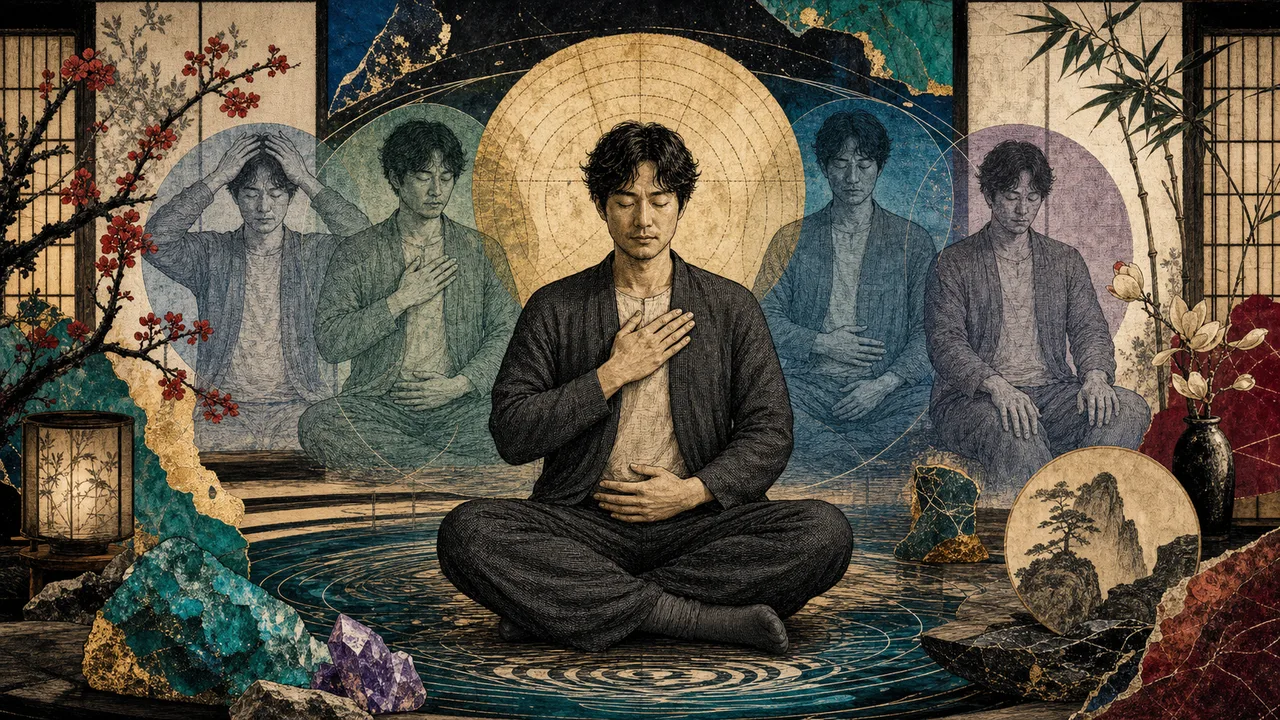
Reiki self-application is the practice in which the Reiki practitioner directs energy toward their own vibrational field. Instead of applying the technique to another person, they place their hands on different regions of the body and use attention and intention to promote energetic circulation.
In this article, you will understand the meaning of self-application, the role of attunement at the beginning of practice, how to prepare body and mind, the hand positions and how to organize a complete sequence.
Continue reading to follow these guidelines and determine the duration and regularity of your practice.
The meaning of self-application in Reiki
Self-application is a way of directing Reiki energy to one's own system. The practitioner uses their hands as emission points and works on the etheric body, chakras and corresponding physical regions without needing another person's participation.
The energy field can be directed both toward one's own body and toward someone else. The application takes place through focus, attention and clear intention, allowing the energy to follow the mental direction and act according to the frequency sustained at that moment.
In addition to receiving energy, the practitioner learns to perceive their own functioning. Self-application transforms Reiki into a direct experience, making it possible to understand the technique through what happens in the body and field, rather than only through the explanations received during training.
Attunement and the beginning of practice
Self-application is usually taught from the first level of Reiki. After attunement, the student learns the basic hand positions and begins practicing on themselves to develop confidence, perception and familiarity with the energy flow.
Attunement does not remove the need for training. It establishes a connection with the method, but the practitioner needs to use this ability regularly to learn to recognize sensations, maintain attention and direct energy without anxiety.
At first, it is common to depend on a written sequence or constantly remember what the next position will be. With repetition, the movements become natural and attention is no longer tied to the instructions, allowing a more conscious experience of the energy field.
Preparing the body and mind
Before self-application, it is important to choose a comfortable position. The practice can be performed lying down, seated or partially reclining, as long as the body does not have to make a constant effort to remain in that posture.
A few minutes of conscious breathing help reduce agitation. The practitioner can inhale and exhale slowly, observe the tensions present and direct their attention toward the goal of channeling and harmonizing vital energy.
Preparation does not require music, scents, candles or complex rituals. These elements may be used when they help concentration, but what matters is creating presence, reducing distractions and establishing a clear intention before positioning the hands.
Hand positions in self-application
The hands can be placed on the head, forehead, throat, chest, abdomen, hips, knees and feet. The sequence distributes energy through different parts of the system and allows the main energy centers to receive attention.
Contact can be direct or performed with the hands a few inches above the body. There is no need to press, massage or make physical movements because Reiki acts through energy transmission, not through tissue manipulation.
A position on the solar plexus, for example, can be performed with the hands over the abdomen, between the navel and sternum. This region is related to will, self-confidence and the accumulation of emotions such as fear, anger and frustration.
Organizing a complete sequence
A complete sequence generally begins at the head and gradually moves down the body. This order helps organize the practice and prevents the Reiki practitioner from choosing only the regions where they feel discomfort at that moment.
The application can begin with the hands over the eyes or forehead, continue to the back of the head and throat, move through the chest and abdomen, and end at the legs and feet. The sequence can be adapted according to mobility, time and perceived needs.
The chakras can be worked on individually or together. Each position offers energy to a specific part of the field, but the entire system remains integrated, allowing the transmitted frequency to be distributed to other regions.
Duration and regularity of the practice
There is no single duration for self-application. A complete practice may last from twenty minutes to an hour, depending on the number of positions and the time the Reiki practitioner remains in each region.
As a reference, each position can receive Reiki for a few minutes. Applications of five to ten minutes on a specific chakra can be extended when the practitioner perceives greater tension, blockage or a need to remain in that region.
Regularity is more important than occasionally performing a long session. A shorter practice maintained consistently develops perception and creates a daily space for reorganization more effectively than depending only on applications performed during periods of major imbalance.
Sensations and perception of the energy flow
During self-application, warmth, tingling, gentle pressure, pulsation or a change in the body's sense of weight may arise. These responses accompany the concentration of energy between the hands and the interaction with the region receiving Reiki.
It is also possible to feel relaxation, sleepiness or reduced mental agitation. When Reiki is applied to the brow chakra, for example, its vibration acts on the mental field, promoting better organization of thoughts, inner silence and clarity of perception.
Not feeling anything intense does not mean that the practice was performed incorrectly. Sensitivity varies among people and can also change from one day to another. The Reiki practitioner should observe without seeking extraordinary sensations or turning every response into a rigid interpretation.
Perceiving the chakras through self-application
Regular practice helps reveal differences among the chakras. Some regions may feel warmer, denser or harder to remain on, while others receive energy more gently and naturally.
These differences show how the field is organizing itself at that moment. The aim is not to immediately classify a chakra as open or blocked, but to observe how the body and energy respond to the position of the hands.
Over time, perception becomes clearer. The person learns to identify areas with greater or lesser flow and can direct energy toward their own body with less effort, using intention, attention and consistency.
Self-application as personal care and responsibility
Self-application reduces dependence on other people to receive Reiki. The practitioner can use the technique when they notice tiredness, emotional tension, mental agitation or the need to regain presence and balance.
This autonomy does not mean that no one else will ever be needed. Receiving an application from another Reiki practitioner can offer a different experience because it allows the person to relax without having to keep attention on their own sequence.
Self-Reiki also does not replace changes in routine. Energy can promote balance, but nutrition, rest, physical activity, thoughts and attitudes continue to organize the field every day. The practice becomes more consistent when it is part of complete and conscious care for one's own life.
Frequently Asked Questions
It is the practice in which the Reiki practitioner directs Reiki toward their own body and energy field, using their hands, attention and intention.
No. It offers autonomy and personal care, but receiving Reiki from another practitioner can provide a different and complementary experience.
A complete practice may last from twenty minutes to an hour, but shorter applications can also be useful when performed with presence and consistency.
Yes. Sensitivity varies from person to person and may change according to the day, emotional state and level of practice.
At first, a sequence helps organize the practice. With experience, the Reiki practitioner can adapt the positions according to perception, time and need.
Continue learning with practical guidance
Self-application shows how Reiki can become part of daily personal care, without depending only on occasional sessions or moments of crisis.
The 21-Day Reiki Self-Treatment Guide organizes these foundations in a clear sequence for those who want to study and practice responsibly.
Discover the complete guide
About the author
Prof. Tibério Z has more than 30 years of experience teaching spirituality, metaphysics, holistic therapies and consciousness development.