
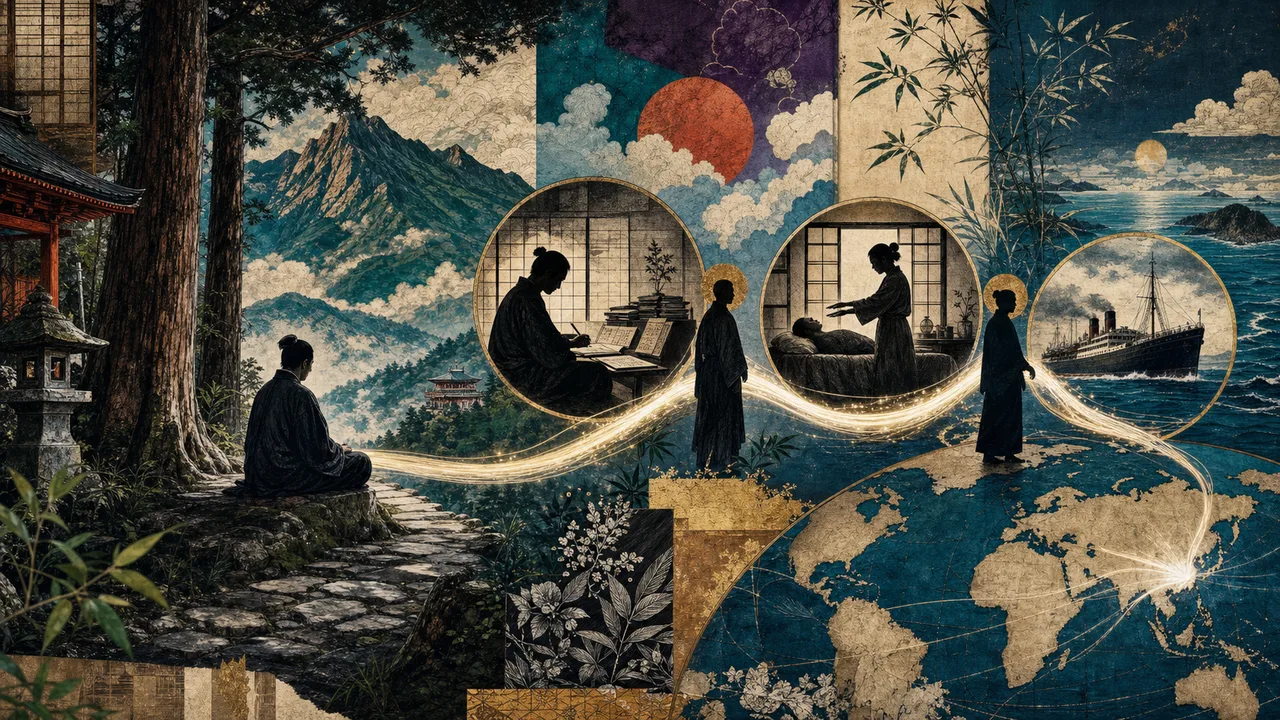
Reiki originated in Japan in the early twentieth century through the work developed by Mikao Usui. He did not create the idea of vital energy or invent the word Reiki, but he organized his own system of spiritual development, mental discipline and energy application through the hands.
In this article, you will understand the context in which Reiki emerged in Japan, why the term was already used before Mikao Usui, who he was before organizing the method, what happened on Mount Kurama and how Usui Reiki Ryoho began.
Continue reading to follow this history and the place of the five principles within that origin.
The context in which Reiki emerged in Japan
At the beginning of the twentieth century, Japan brought together different practices of spiritual healing, meditation, personal discipline and the use of vital energy. Some were related to Buddhism and Shinto, while others were part of therapeutic and spiritual movements that sought to integrate body, mind and inner development.
During this period, the word Reiki was already used to represent a subtle energy or spiritual action. There were also methods that used terms such as Reiki Ryoho to identify forms of treatment based on the transmission or organization of this energy.
Mikao Usui developed his method within this cultural environment. His system did not arise in isolation from everything that existed in Japan, but brought familiar elements together within its own structure, guided by his experience, studies and search for a deeper condition of inner balance.
The term Reiki was used before Mikao Usui
The word Reiki was part of Japanese vocabulary before Usui Reiki Ryoho was created. Therefore, it is not correct to say that Mikao Usui invented the term or that every practice called Reiki arose exclusively from his work.
Research into the history of the method indicates that other Japanese systems used the word Reiki before 1922. Matiji Kawakami, for example, created a practice called Reiki Ryoho in 1914 and published a book about its use and effects in 1919.
Usui was the creator of a specific system known as Usui Reiki Ryoho. The importance of his work lies in the way he organized teachings, energy practices, principles for living and transmission processes that formed the basis of the main lineages known today.
Who Mikao Usui was before organizing Reiki
Mikao Usui was born in 1865 in Gifu Prefecture, Japan. Available records indicate that he had different occupations and interests throughout his life while maintaining a constant search to understand the meaning of existence and the development of consciousness.
His main quest was connected to the state called Anshin Ritsumei, an expression associated with a condition of inner peace in which a person understands their mission and remains balanced amid life's changes. This search was broader than learning a healing technique.
Usui undertook studies, contemplative practices and periods of spiritual training. Therefore, the method did not begin simply because he wanted to transmit energy through his hands. Its starting point was an investigation into how to reach a stable condition of consciousness and integrate this understanding into daily life.
What happened on Mount Kurama
In March 1922, Mikao Usui undertook a retreat on Mount Kurama, located north of Kyoto. According to the tradition preserved by Japanese lineages, he remained fasting and meditating, taking his spiritual search to an extreme level.
During this period, Usui is said to have attained the experience of Anshin Ritsumei. He understood his unity with universal reality and became attuned to the frequency he would later use as the basis of his system.
Upon leaving the mountain, he realized that energy flowed through his hands and could be used to promote balance. This experience should not be reduced to the discovery of a technique because Usui's initial goal was to attain spiritual understanding, and the energetic ability emerged as a consequence of that realization.
How Usui Reiki Ryoho began
After his experience on Mount Kurama, Usui began organizing what he had understood. He called his system Shin-Shin Kaizen Usui Reiki Ryoho, an expression that can be understood as Usui's Reiki method for the improvement of body and mind.
In April 1922, he founded the Usui Reiki Ryoho Gakkai in Tokyo. The organization was created to teach the method, offer sessions and train people capable of using Reiki on themselves and others.
Usui did not present Reiki as an energy belonging exclusively to him. His purpose was to develop a form of training through which other people could also come into contact with this frequency, practice the laying on of hands and use the method as a path of personal improvement.
Why the five principles are part of Reiki's origin
The method created by Usui was not limited to energy transmission. He understood that the practitioner's mental, emotional and behavioral state directly affected the way energy was used and their ability to maintain balance.
For this reason, the five principles became a foundation of Usui Reiki Ryoho. They guide a person to observe anger, reduce worry, practice gratitude, work honestly and treat others with kindness, always bringing the commitment into the present moment.
These principles show that the origin of Reiki is connected to the education of consciousness. The laying on of hands provides energetic support, but transformation needs to appear in the way one thinks, acts and lives with others. Without this aspect, Reiki is reduced to a technical application and loses a central dimension of Usui's method.
How the Great Kantō Earthquake and the Gakkai helped expand the method
In September 1923, the Great Kantō Earthquake struck Tokyo and other regions of Japan. The large number of injured and displaced people increased the need for assistance and placed Usui's work before a collective situation of great magnitude.
Usui and his students began helping many people. The need to expand the method's reach also led to the development of more organized forms of training, allowing new practitioners and teachers to be prepared more quickly.
The Usui Reiki Ryoho Gakkai played an important role in continuing this work. After Usui's death in 1926, his students maintained the organization and preserved some of the Japanese teachings, while other lineages began developing different forms of application and instruction.
How Hayashi and Takata transformed Reiki into a worldwide practice
Chujiro Hayashi was one of the teachers trained by Mikao Usui. After his teacher's death, he created his own organization and developed a more structured form of session, with hand positions, sequences and guidance focused on different conditions.
Hawayo Takata, a Japanese woman born in Hawaii, learned Reiki from Hayashi during the 1930s. After her training, she took the method to Hawaii and became chiefly responsible for spreading it in the West, training the masters who would continue its international expansion.
For many years, Takata orally transmitted the Western history of Reiki. Later research showed that some details of this version did not correspond to Japanese records, such as the claim that Usui had been a Christian priest or university president. This explains why different accounts of Reiki's origin still exist.
Reiki's origin helps explain the method
The origin of Reiki shows that the method did not begin solely as a technique of laying on hands. It arose within a search for inner balance, mental discipline and the development of consciousness, organized by Mikao Usui based on his own spiritual experience.
It also shows that the Reiki known today went through different stages. Usui's Japanese system, Hayashi's adaptations and Takata's transmission helped shape the practice that spread throughout the West.
Understanding this history prevents oversimplification. Reiki becomes clearer when viewed as a method with context, lineages, principles and responsibility, rather than only as energy applied for a few minutes.
Frequently Asked Questions
Reiki originated in Japan in the early twentieth century within the method organized by Mikao Usui.
No. The word already existed in Japanese vocabulary. Usui organized a specific system known as Usui Reiki Ryoho.
Tradition relates that Usui undertook a retreat of fasting and meditation on Mount Kurama, an experience connected to the consolidation of his method.
Chujiro Hayashi helped structure sessions, and Hawayo Takata played a decisive role in spreading Reiki in Hawaii and other countries.
Because part of the history was transmitted orally in the West and later compared with Japanese records, revealing adaptations and different versions.
Continue learning with practical guidance
Knowing the origin of Reiki helps explain why the method involves history, principles, energy practice and inner development.
The 21-Day Reiki Self-Treatment Guide organizes these foundations in a clear sequence for those who want to study and practice responsibly.
Discover the complete guide
About the author
Prof. Tibério Z has more than 30 years of experience teaching spirituality, metaphysics, holistic therapies and consciousness development.