
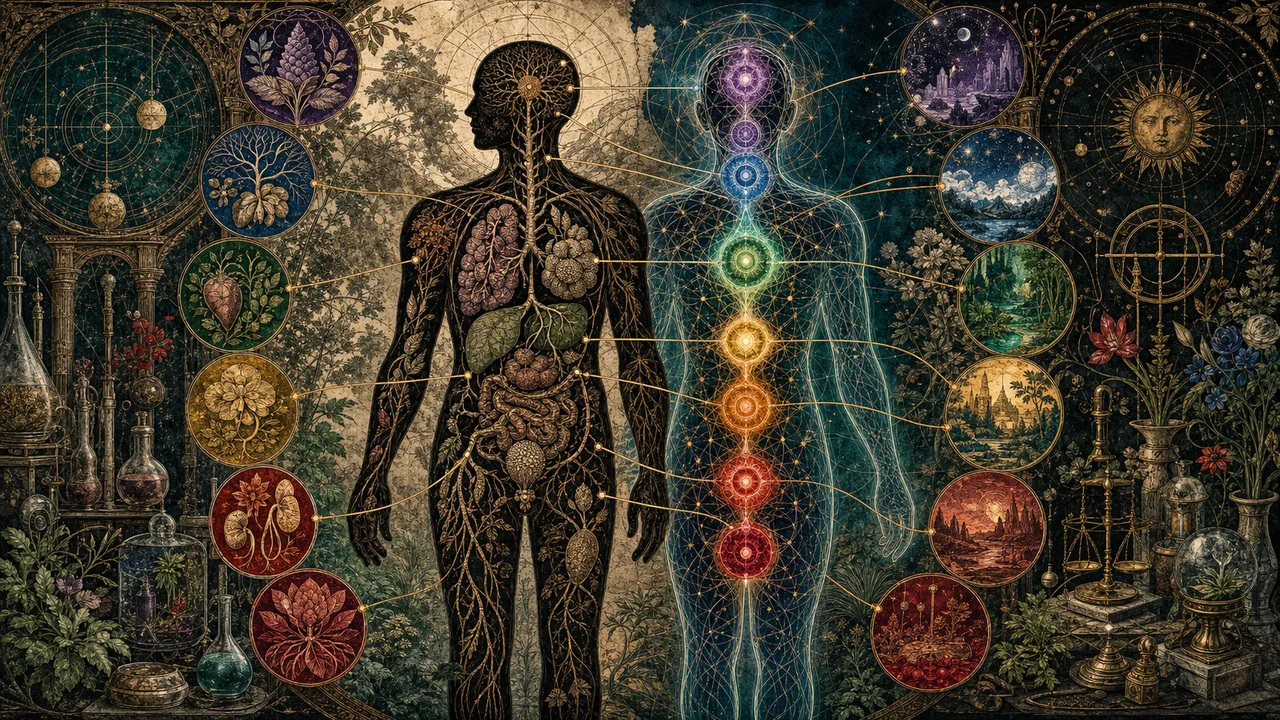
Chakras belong to the energy body, but they correspond directly to the physical organism. Each large center is related to particular regions, organs, glands, nerve plexuses and bodily functions that express, on the biological plane, the same principle energetically organized by the chakra.
In this article, you will understand whether chakras are inside the physical body, how the energy body relates to it, how received energy reaches organs, why glands hold a central place in this relationship and whether influence occurs in both directions.
Continue reading to follow these answers and understand the connection between chakras and hormones.
Are chakras inside the physical body?
Chakras are not physical structures. They do not exist inside the organism as the heart, lungs, liver or endocrine glands do. They belong to the etheric body, which accompanies and interpenetrates the biological body. To understand this relationship within the complete system, also read the pillar article complete guide to the 7 chakras for beginners, where I explain how energy centers, nadis and the physical body relate to one another.
When we say that a chakra is located in the throat, chest or abdomen, we are using an anatomical reference. The energy center is in the field corresponding to that region and remains connected to the physical structures present there.
The materials clearly state that the physical body contains molecules, cells and organs, while chakras are in the energy body. Even so, they remain directly connected to the corresponding cells and glands.
How does the energy body relate to the physical body?
The etheric body functions as an energetic structure superimposed on the organism. It provides vibrational support to different regions and participates in distributing the vital energy needed for the system to function.
This relationship can be understood through an analogy: just as physical cells organize themselves to form tissues and organs, the smaller centers of the energy body organize themselves into larger structures, including the seven main chakras.
Each large chakra coordinates a broad area. Its energetic activity corresponds to functions physically performed by organs, glands, nerves and muscles in the same region, creating a connection between physical and subtle anatomy.
How does energy received by the chakras reach the organs?
Chakras receive frequencies of vital energy compatible with their functions. After being received, energy is concentrated, organized and sent to the energy channels connected to the center.
These channels, called nadis in the Indian tradition, distribute the flow throughout the etheric body. Energy reaches smaller centers and the regions corresponding to physical tissues, organs and systems.
Chakras do not deliver a material substance to organs. They provide energetic support to the field associated with that structure, allowing the region to remain integrated with the rest of the organism and the system of consciousness.
Why are glands so important in this relationship?
Endocrine glands produce hormones that regulate growth, metabolism, reproduction, sleep, the stress response and many other functions. For this reason, they influence a large part of physical and emotional experience.
Each main chakra corresponds to a gland or group of glands. This association creates an interface between the energetic pattern of the center and the chemical processes of the organism.
In the materials, the seven large chakras are considered especially important because of their connection with the glands. Changes in energetic flow can accompany changes in hormonal balance, just as hormonal changes modify energy, emotions, thoughts and perception.
Does influence occur only from the chakra to the body?
Communication does not happen in only one direction. Energetic state can influence the body, but physical functioning also profoundly changes the chakras and consciousness.
A hormonal change, infection, nutritional deficiency, nights of poor sleep or a period of pain can reduce vitality and alter emotional behavior. The physical body is not a passive receiver of energy.
Therefore, balancing chakras without caring for the organism produces incomplete work. When a physical change already exists, biological treatment needs to be carried out, while energy practices can accompany the process as a complement.
What is the relationship between chakras and hormones?
Hormones function as chemical messengers. They circulate through the organism and modify the activity of organs, tissues, nervous systems and metabolic processes.
Because the main chakras correspond to endocrine glands, prolonged energetic changes can affect the field connected to hormone production. At the same time, hormonal changes affect the energetic state related to the chakra.
This relationship helps explain why certain imbalances can involve energy, emotions and behavior at the same time. A person does not live divided into parts: energy, body chemistry, mind and consciousness remain in communication.
What is the relationship between chakras and nerve plexuses?
Several chakras are located in regions corresponding to large nerve networks. The sacral chakra relates to the sacral plexus, the solar plexus chakra to the abdominal plexus and the heart chakra to the nerve plexus in the chest.
These plexuses receive and distribute impulses between the nervous system and different organs. They participate in automatic responses related to digestion, breathing, heart rhythm, bodily sensations and reactions to stress.
This correspondence shows how an experience can be perceived simultaneously as an emotion, physical sensation and energetic movement. A fearful situation, for example, can change breathing, contract the abdomen, accelerate the heart and modify several chakras at the same time.
Is a chakra connected to only one organ?
A main chakra does not govern only one organ. It organizes a group of structures that share a similar location, function or energetic principle.
Manipura, for example, relates to the stomach, liver, gallbladder, pancreas, small intestine, abdominal muscles and the nerve plexus in the region. All these structures participate in different ways in processes of transformation and use of resources.
There is also no absolute division among the centers. An organ may receive influence from more than one chakra, and secondary centers help regulate specific parts. The energy body works as a network, not as seven isolated compartments.
What are the main correspondences of the seven chakras?
The root chakra relates to the adrenal glands, bones, lower spine, legs, large intestine and structures of support and elimination. The sacral chakra corresponds to the gonads, reproductive system, bladder, pelvis and the functions of reproduction and pleasure.
The solar plexus chakra is associated with the pancreas, stomach, liver, gallbladder and small intestine. The heart chakra relates to the thymus, heart, lungs and chest. The throat chakra corresponds to the thyroid, parathyroid glands, larynx, pharynx, trachea and cervical region.
The brow chakra corresponds to the pituitary gland, eyes and brain areas connected to perception and interpretation. The crown chakra is symbolically related to the pineal gland, cerebral cortex and general integration of consciousness. These associations represent fields of influence, not automatic diagnoses.
How do emotions enter this relationship?
Emotions move energy and also produce physical responses. Fear, anger, sadness, anxiety and joy modify breathing, muscles, heartbeat, digestion, hormones and nervous system activity.
Chakras participate in processing these charges. When an emotion can be recognized, understood and released, energy continues to circulate. When it remains repressed or repeated for long periods, it may accumulate in the related field.
The manual describes chakras as centers that filter, amplify or block emotional energy. When processing fails, energetic retention, bodily tension and disorganized emotional reactions may arise.
Does an imbalance in a chakra immediately cause illness?
An energetic imbalance does not immediately become physical illness. The organism has an ability to adapt, compensate and recover, and many energetic states reorganize themselves before producing deeper effects.
When the pattern remains for a long time, the region can lose stability. Other centers try to compensate for the deficiency, harmful habits repeat and the body begins continuously responding to the same state of tension.
Changes in chakras generally take time to manifest physically. This progression reinforces the importance of observing energy, emotions, habits and the organism before the imbalance becomes more difficult to reorganize.
Does a physical symptom reveal which chakra is unbalanced?
An isolated symptom does not allow us to safely conclude that a particular chakra is blocked. Abdominal pain can have dietary, infectious, muscular, emotional or metabolic causes, among many other possibilities.
The correspondences help broaden observation, but they do not replace examinations, diagnosis or professional care. The fact that the thyroid is associated with the throat chakra does not mean that every thyroid change originates in difficulty communicating.
Energetic evaluation needs to consider the whole: emotional state, habits, recent events, energy pattern, physical symptoms and the person's history. Using rigid associations produces superficial interpretations and may delay necessary care.
Do energy therapies replace physical treatments?
Energy therapies work with the subtle body. They can help reorganize flow, reduce tension, expand emotional awareness and support changes in habits, but they do not directly provide biological treatment for an injured organ.
When the organism has an illness, hormonal change, inflammation, infection or any other physical problem, we need to care for the body through appropriate means. Work with the chakras should occur alongside treatment, not in its place.
Holistic practices should be understood as complementary. Caring only for the physical can leave energetic and emotional patterns unattended, but caring only for energy does not automatically correct changes already established in the organism.
Chakras, organs and glands form different levels of the same system
Chakras organize energy in the subtle body, while organs and glands perform functions in the physical body. They are not the same structure, but remain connected through correspondences and continuous exchanges.
Glands help transform inner states into chemical changes, nerve plexuses distribute responses through the organism and organs carry out the activities needed for life. Chakras provide energetic support and organization to this whole.
Understanding this relationship allows us to work in an integrated way. The body needs physical care, energy needs to circulate, emotions need to be processed and consciousness needs to recognize the patterns that influence the entire system.
Frequently Asked Questions
No. Chakras belong to the energy body. They correspond to regions, organs and glands, but they are not physical structures.
Each main chakra corresponds to a gland or group of glands, creating a bridge between energetic patterns and hormonal processes.
Not automatically. Physical symptoms can have many causes and need to be evaluated in the organism. An energetic reading should consider the person as a whole.
They can energetically influence the field connected to the glands, but hormonal changes also affect emotions, vitality and energetic state.
No. Energy therapies are complementary. Physical, hormonal, inflammatory or infectious problems need appropriate evaluation and treatment.
Because it shows that body, energy, emotions and consciousness continuously influence one another without reducing everything to a single energetic or physical cause.
Continue exploring the chakras
Understanding the relationship among chakras, organs and glands prevents simplistic interpretations and helps us study the energy body more responsibly.
In the Ultimate Guide to the Seven Chakras, you can deepen this map and learn to recognize how each center participates in energetic balance in practice.
Explore the Ultimate Guide to the Seven Chakras
About the author
Prof. Tibério Z has more than 30 years of experience teaching spirituality, metaphysics, holistic therapies and consciousness development.