
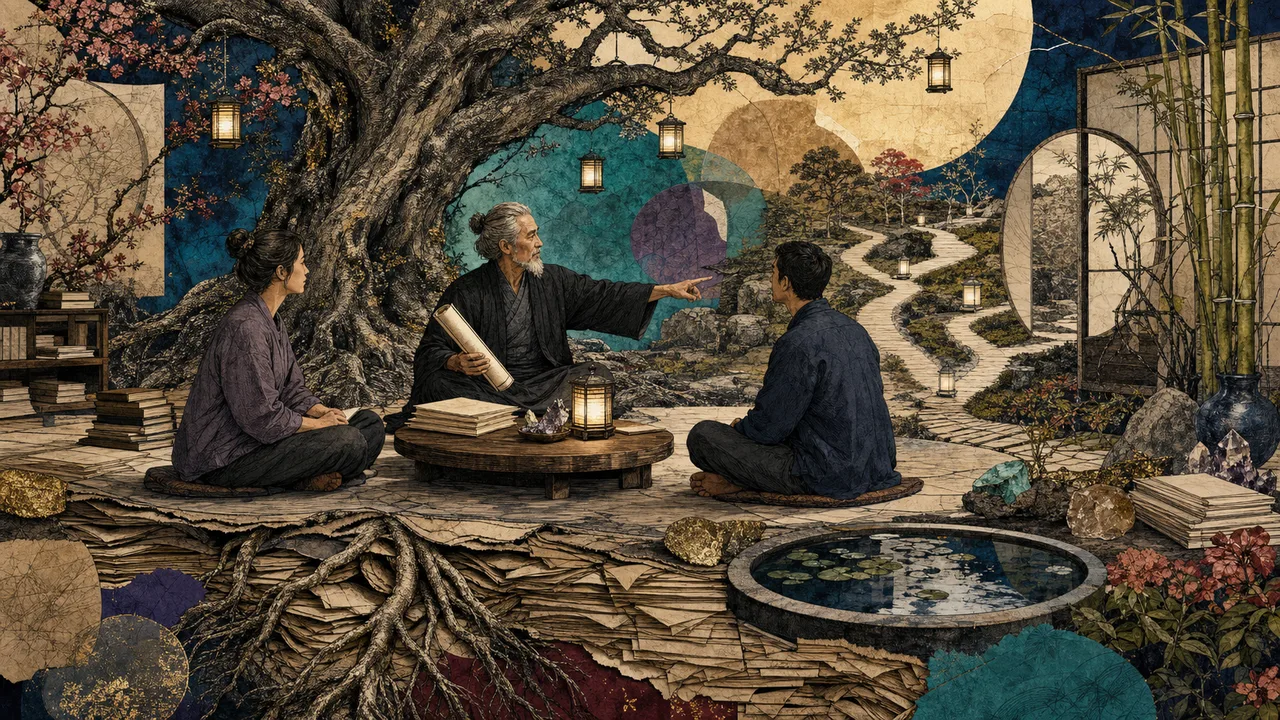
Becoming a Reiki master means assuming a stage of greater responsibility within the method. The person no longer uses Reiki only for self-treatment and treatments and becomes qualified to teach, guide students, and, according to the training received, conduct initiations at different levels.
In this article, you will understand the true meaning of the master title, the difference between receiving a certificate and assuming this role, the practical experience it requires, the necessary command of the previous levels, and the responsibility of conducting initiations.
Continue reading to follow these points and understand what mastery truly involves.
The true meaning of the master title
In Reiki, the master title identifies a person who has received training to work with the most advanced content of their lineage. Depending on the school, this may include the master symbol, specific techniques, spiritual development, and the procedures used to initiate new students.
This title does not mean that the practitioner has become a superior or enlightened being who is free from personal conflicts. A master remains a person in development, subject to doubts, difficulties, mistakes, and a constant need for learning.
The difference lies mainly in the knowledge acquired, the experience accumulated, and the responsibility assumed. A true master does not place themselves above their students, because they understand that everyone has the same essential nature and is at a different stage of learning.
The difference between receiving a certificate and becoming a master
A certificate proves that a person participated in training and received certain content. It may be necessary to document the course, organize the lineage, and demonstrate that the student went through the process planned by the school.
However, the document does not prove practical command. A person may complete every level in a short time, receive the master title, and still have little experience with self-treatment, treatments, energetic perception, and guiding other people.
Becoming a master requires turning theory into experience. Real knowledge emerges when the practitioner applies, observes results, makes mistakes, corrects methods, and learns to handle situations that no manual can fully predict. A certificate authorizes the beginning of training, but it does not replace years of practice.
The practical experience needed for mastery
Experience allows a master to understand how different people respond to Reiki. Each treatment presents its own field, history, sensitivity, and need, preventing the work from being reduced to a fixed sequence.
By treating many people, the practitioner learns to recognize differences in energetic flow, adapt hand positions, respect limits, and communicate what they perceive without turning sensations into diagnoses.
This practice also develops humility. The more a Reiki practitioner works, the more they understand that they do not control every result and that the same technique can produce different responses. Experience reduces exaggerated certainty and expands discernment, responsibility, and the ability to adapt.
Mastery of the previous Reiki levels
A master needs to master the foundations before teaching advanced content. Self-treatment, hand positions, Reiki principles, energetic perception, symbols, and distance transmission form a base that cannot be ignored.
Receiving new initiations without consolidating previous levels creates fragmented knowledge. A person memorizes symbols and procedures but does not clearly understand how intention organizes energy or how the field responds during a treatment.
The simplicity of Reiki does not eliminate the need for training. The hands are facilitators, while the practitioner's intention and the quality of their field organize the transmission. This understanding needs to be lived in practice before it is taught to other people.
The responsibility of conducting initiations
Conducting an initiation means guiding an energetic process that introduces the student to a particular level of Reiki. The master uses the procedures received in their lineage to establish an attunement and transmit a specific frequency.
This responsibility requires more than reproducing memorized movements. The master needs to understand each stage, maintain a clear intention, and organize their own field before coming into contact with the student.
During an initiation, the master's thoughts, emotions, and intentions participate in the energetic connection. Therefore, fear, vanity, anxiety, or the need to impress can interfere with the process. The inner preparation of the person conducting the initiation is as important as the external sequence used.
The ability to teach and guide students
Being a master also means knowing how to teach. Mastering a technique does not automatically guarantee the ability to explain it clearly, answer questions, and guide people with different levels of understanding.
The master needs to organize the content in a logical sequence. The student should understand what Reiki is, how energy is transmitted, the purpose of the positions, how to practice self-treatment, and which ethical limits guide the method.
Guidance continues after the course. Questions often arise when students begin to practice alone, notice different sensations, or encounter difficulties during treatments. The master needs to offer direction without turning this relationship into permanent dependency.
The master's ethical and emotional maturity
A Reiki master works with human energy fields and needs to observe their own ego constantly. The need for recognition, authority, or control can cause the title to be used to build superiority instead of serving learning.
A balanced ego recognizes limits, accepts criticism, and does not need to display power during treatments. This maturity preserves emotional frequency and allows more conscious decisions to be made in complex situations.
Ethics also requires honesty, respect, and responsibility. A master does not promise healing, use fear to sell courses, or present themselves as a savior. They guide, acknowledge what they do not know, and avoid creating false expectations about results they cannot control.
The commitment to preserve and explain the lineage
A lineage shows the path through which a particular system was transmitted. It connects the student to the master who initiated them and to the previous teachers who preserved or adapted that form of Reiki.
A master needs to know which method they teach, which symbols they use, and how their procedures were organized. This prevents recent adaptations from being presented as though they had been transmitted directly by Mikao Usui.
Preserving the lineage does not mean preventing change. It means honestly explaining what belongs to the system received and what was added later. This clarity allows students to understand their training and consciously choose how they will continue studying.
Mastery as a continuous path of learning
Mastery does not end the Reiki practitioner's development. When they begin teaching and initiating other people, new questions, responsibilities, and situations arise that require constant study.
A master continues practicing self-Reiki, receiving treatments, reviewing content, and observing their own conduct. They do not abandon the foundations because they have reached the final level, since those very foundations sustain their work.
Becoming a Reiki master means placing knowledge and experience at the service of other people. Mastery appears in the way practitioners live, teach, respect limits, and continue learning, not merely in the title placed beside their name.
Frequently Asked Questions
It means assuming a stage of greater responsibility, with the possibility of teaching, guiding students, and conducting initiations according to the training received.
No. The title indicates training received, but it does not represent spiritual superiority or the absence of personal conflicts.
It proves that content was transmitted, but real mastery depends on practice, experience, ethics, and maturity.
Yes. A master needs to maintain self-treatment, study, treatments, and constant observation of their own conduct.
To transmit the method clearly, respect limits, guide students, and avoid promises, dependency, or false expectations.
Continue learning with practical guidance
Understanding what it means to become a Reiki master helps us distinguish among a title, a certificate, and real responsibility within energy practice.
The 21-Day Reiki Self-Treatment Guide organizes these foundations into a clear sequence for anyone who wants to study and practice responsibly.
Explore the 21-Day Reiki Self-Treatment Guide
About the author
Prof. Tibério Z has more than 30 years of experience teaching spirituality, metaphysics, holistic therapies and consciousness development.