
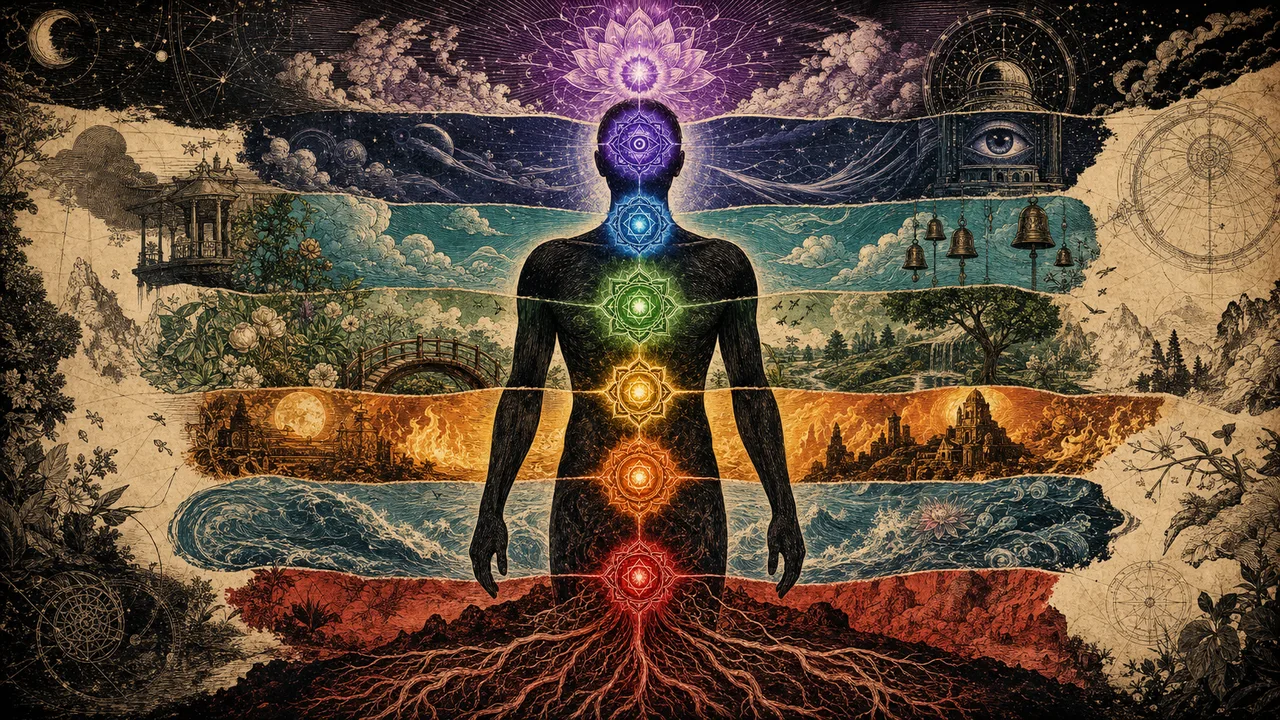
Chakras belong to the energy body, but we use the physical body as a reference to locate each one. For this reason, we say that a chakra is at the base of the spine, below the navel, in the center of the chest, or between the eyebrows, even though it is not a physical structure.
In this article, you will understand why the chakras are located in the etheric body, why we use the physical body only as a reference, and why each center is not limited to a point on the skin.
Continue reading to follow the distribution of the seven main centers, one by one.
The chakras are located in the etheric body
The etheric body is an energetic structure that accompanies the physical body. It has the same basic shape as the organism but is formed by energy rather than muscles, bones, blood, or organs. To understand this location within the complete system, also read the pillar article complete guide to the 7 chakras for beginners, where I explain the main centers, nadis, imbalances, and paths toward harmonization.
The chakras are part of this energetic anatomy. They are not hidden inside the physical body, but are situated in the etheric field that overlaps it. For this reason, a chakra's position can be indicated through an anatomical region.
We can understand the etheric body as an energetic copy of the organism. Just as the physical body is formed by countless cells organized into larger structures, the etheric body is formed by energy centers that also group together and assume broader functions.
Why do we use the physical body to locate the chakras?
The physical body offers reference points that everyone can recognize. It is much easier to say “below the navel” or “in the center of the chest” than to indicate a position within an energy field that cannot be touched in the same way.
These references help direct attention to the correct region. When a person focuses on the throat to perceive the throat chakra, for example, they use the physical part as a kind of map to reach the corresponding center in the etheric body.
This does not mean that the position is merely symbolic. There is a real relationship between the chakra and that area of the organism. The physical region indicates where the energy center overlaps the body and where its presence can be perceived more easily.
A chakra is not located only at one point on the skin
When we look at an illustration, a chakra is usually represented as a circle placed over the front of the body. This image shows the external reference point, but it can create the impression that the center is located only on the surface.
In fact, a chakra has depth. Its structure begins in a more central region of the etheric body and projects through the field, and it may have an anterior opening and a posterior one.
For this reason, when we say that the heart chakra is in the center of the chest, we are not referring only to a point on the skin. The indication represents an energetic region that crosses the field and also corresponds to the back of the thorax.
How are the main chakras distributed throughout the body?
The seven main centers form an axis that begins at the base of the torso and ends at the top of the head. They are not scattered randomly, but are organized in sequence along the central region of the body.
The first center is in the lower part. The others appear progressively in the lower abdomen, upper abdomen, chest, throat, head, and region above the skull.
This distribution creates a vertical energy line. Although the centers have different positions and directions, they are all part of a single system that follows the central axis of the human body.
Where is the root chakra located?
The root chakra, called Muladhara, is located at the base of the spine in the perineal region. The perineum is the area between the genitals and the anus.
Unlike most major centers, its main opening faces downward. For this reason, its location should not be sought at the front of the abdomen or directly over the lumbar spine.
To find its physical reference, a person can notice the base of the torso while seated. The region that remains in contact with the seat, between the two bones of the pelvis, indicates the approximate position of this chakra in the etheric body.
Where is the sacral chakra located?
The sacral chakra, called Svadhisthana, is located in the lower abdomen. Its frontal reference point lies between the pubic bone and the navel, usually a few centimeters below the navel.
The region should not be limited to the genitals. Although it is related to the pelvic area, its reference point is in the lower belly, over the central part of the lower abdomen.
At the back, its correspondence is near the sacral region, the bone located at the base of the spine between the hips. In this way, the center occupies a position between the front of the lower abdomen and the sacral region.
Where is the solar plexus chakra located?
The solar plexus chakra, called Manipura, is located in the upper abdomen. Its position is above the navel and below the central bone of the chest, called the sternum.
To find this region, simply place your attention on the space between the navel and the base of the chest. The point is usually perceived near the stomach, where the abdominal nerve plexus that gave the chakra its popular name is also located.
Its location should not be confused with the navel. The chakra is above it, in the region that many people feel contract when they experience anxiety, tension, or anticipation.
Where is the heart chakra located?
The heart chakra, called Anahata, is located in the center of the chest. Its reference point is over the sternum, approximately along the line between the two nipples.
It should not be positioned on the left side of the chest merely because the physical heart is oriented more toward that side. The name heart indicates its correspondence with the region of the heart, but the energy center is in the middle of the chest.
At the back, its correspondence is between the shoulder blades in the central region of the back. Therefore, when we direct our attention to this chakra, we should consider the entire axis passing through the center of the chest.
Where is the throat chakra located?
The throat chakra, called Vishuddha, is located in the central region of the throat. Its frontal reference point is near the larynx, in the area commonly known as the Adam's apple, although this structure is more evident in some people.
It is not found in the upper part of the neck below the chin, nor in the lower part over the chest. Its position is approximately in the middle of the neck, between the jaw and the base of the throat.
At the back, it corresponds to the cervical region near the base of the neck. Therefore, the throat chakra occupies an axis that crosses the throat and reaches the upper spine.
Where is the brow chakra located?
The brow chakra, called Ajna, has its external reference point between the eyebrows. This region is known as the third eye, although the chakra is not a physical eye and is not located only on the forehead.
The point between the eyebrows indicates its anterior opening. The energy center extends inward through the head, occupying a deeper position than the small point usually represented in images.
At the back, it corresponds to the central region of the head and the area near the nape of the neck. To locate it during a practice, however, the space between the eyebrows is usually used as the most accessible reference.
Where is the crown chakra located?
The crown chakra, called Sahasrara, is located at the top of the head. Its physical reference is the crown, the highest point of the skull when a person holds their head upright.
This center is not located in the forehead or at the back of the head. To find it, we can imagine a line rising through the center of the body and ending exactly at the top of the skull.
The crown chakra also extends above the physical body. Its opening projects into the upper energy field, which is why many representations show a light, lotus, or flow emerging from the top of the head.
Is the location of a chakra the same for everyone?
The general reference remains the same because the etheric body follows the human structure. The heart chakra will remain in the central region of the chest, and the brow chakra will remain between the eyebrows, regardless of individual characteristics.
However, the size, intensity, and reach of the field may vary. Two people have a chakra in the same region but may have centers with different levels of activity, expansion, or sensitivity.
Physical proportions also change. In a taller person or someone with a longer torso, the distances between the centers will be greater. For this reason, we should use our own anatomical references rather than trying to measure positions by a fixed distance in centimeters.
Is a chakra inside its corresponding organ or gland?
A chakra is not physically inside an organ or gland. When we say that a center is related to the heart, stomach, or thyroid, we are indicating an energetic correspondence, not an anatomical identity.
The organ belongs to the physical body and can be observed in medical examinations. The chakra belongs to the etheric body and acts on a broader area that may include organs, muscles, nerves, glands, and other nearby structures.
This difference prevents confusion. The heart chakra is not the heart, the throat chakra is not the thyroid, and the brow chakra is not the pituitary gland. They occupy corresponding regions and maintain an energetic connection with these structures, but they are not the same thing.
Physical location is a map for reaching the energy body
The positions used in the study of chakras function as a map. They allow a person to direct attention toward a familiar area of the body and, from there, perceive the corresponding center in the etheric body.
This reference is useful because our consciousness is accustomed to recognizing the physical body. When we focus attention on a region, we become more sensitive to the sensations and energy movements present there.
Understanding where the chakras are located does not mean treating them as material points. It means recognizing the correspondence between two anatomies that remain superimposed: the physical structure we can touch and the energetic structure that sustains and accompanies the organism.
Frequently Asked Questions
Chakras belong to the etheric body, but their locations correspond to regions of the physical body, such as the base of the spine, lower abdomen, chest, throat, forehead, and top of the head.
No. They are not organs, glands, or material structures. They are in the energy body that overlaps the physical organism.
Because the physical body provides references that are easy to recognize. These regions help direct attention toward the corresponding energy center.
No. The frontal image is only a reference. Many chakras have depth in the field and a posterior correspondence, crossing a broader energetic region.
No. Its main reference is at the base of the torso, in the perineal region, with its opening facing downward.
No. Its reference is the top of the head, but its opening also projects into the upper energy field.
Continue exploring the chakras
Understanding where the chakras are located helps us study the energy body more precisely without confusing an anatomical reference with a physical structure.
In the Ultimate Guide to the Seven Chakras, you can explore this energy map more deeply and learn to recognize each center, its functions, and its imbalances with greater confidence.
Explore the Ultimate Guide to the Seven Chakras
About the author
Prof. Tibério Z has more than 30 years of experience teaching spirituality, metaphysics, holistic therapies and consciousness development.