
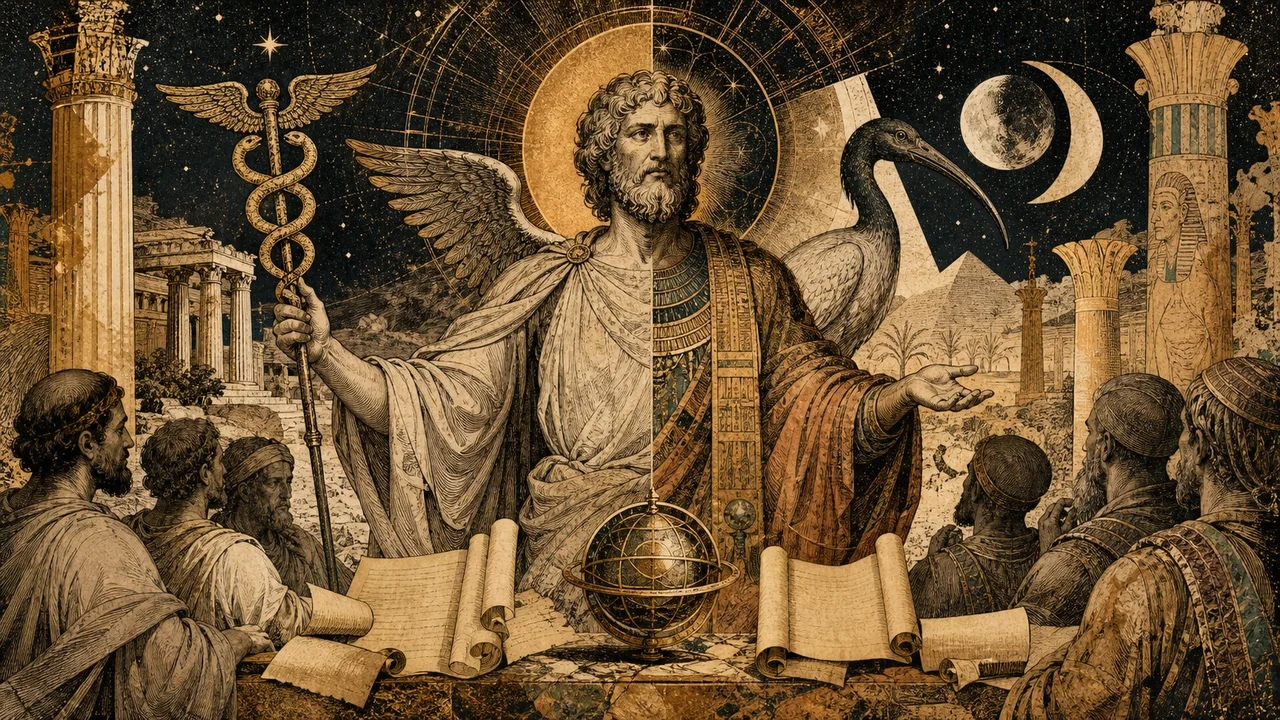
Hermes Trismegistus is presented as the great master of Hermeticism, the guardian of knowledge about God, the cosmos, the human mind, nature and the path of spiritual transformation. Numerous ancient works were attributed to him and transmitted as teachings from a very ancient Egyptian wisdom.
Historical research, however, does not regard Hermes Trismegistus as a person whose existence can be proven. He is understood as a legendary and literary figure formed in the cultural setting of Greco-Roman Egypt through the association between the Egyptian god Thoth and the Greek god Hermes.
Learning about Hermes Trismegistus therefore requires distinguishing two perspectives. Within the tradition, he represents the master who transmits divine wisdom. For history, his name functions as a symbolic authority under which different anonymous authors wrote their teachings.
Who was Hermes Trismegistus according to tradition?
According to the Hermetic tradition, Hermes Trismegistus was an Egyptian sage who mastered religious, philosophical and natural knowledge. He appears as a teacher, priest, revealer of mysteries and interpreter of the laws that organize human beings and the universe.
In the texts of the Corpus Hermeticum, Hermes usually takes part in dialogues with figures such as Tat, Asclepius and Ammon. In some passages, he receives teachings from a divine intelligence; in others, he assumes the role of master and transmits this knowledge to his disciples.
Hermes therefore does not have an organized biography in the texts, with a birth, youth, travels and death. His function is to represent the one who receives revelation, understands spiritual reality and guides other people toward knowledge.
Did Hermes Trismegistus really exist?
There are no historical documents capable of demonstrating that Hermes Trismegistus was a specific priest, philosopher or ruler. Researchers classify him as a legendary sage and as the fictional author to whom the Hermetic texts were attributed.
The identity of the real authors of the Corpus Hermeticum is also unknown. The works are considered pseudepigraphical, meaning that they were placed under the name of a revered figure to present the teachings as part of an ancient and authoritative tradition. This practice appeared in different religious and philosophical currents of antiquity.
The philosophical treatises of the Corpus Hermeticum are generally dated between the late first century and the late third century of the Common Era. They are therefore much later than the ancient Egypt of the pharaohs and were not written thousands of years before Christ, as people believed for a long time.
How did the union between Hermes and Thoth arise?
Thoth was an Egyptian deity related to writing, knowledge, sacred language and the activity of scribes. These characteristics led the Greeks to establish a correspondence between Thoth and Hermes, who was also connected to communication, interpretation and the transmission of messages.
During the period when Egypt was under strong Greek and later Roman influence, different religious traditions began to coexist and reinterpret one another. In this environment, Greek-language authors began to call Thoth Hermes.
Hermes Trismegistus should not be understood merely as a superficial blend of two gods. In the Hermetic texts, he becomes the figure of an Egyptian master and sage responsible for transmitting knowledge expressed in a philosophical language influenced by the Greek world.
What does the name Trismegistus mean?
The word “Trismegistus” comes from the Greek expression Trismegistos, usually translated as “thrice-great” or “thrice-greatest.” The title expressed the exceptional greatness of this Hermes identified with the Egyptian god Thoth.
Ancient texts and inscriptions applied repeated forms of the adjective “great” to Thoth. This repetition served as an intensifier, indicating that he was considered supremely great among the gods and the possessor of incomparable wisdom.
Later interpretations hold that he was thrice-great because he mastered philosophy, religion and science, or alchemy, astrology and magic. These explanations may have symbolic value, but they do not represent a historically proven origin of the title.
Which texts were attributed to Hermes Trismegistus?
The best-known collection is the Corpus Hermeticum, a group of Greek treatises presenting dialogues and discourses about God, the creation of the cosmos, mind, soul, human destiny and spiritual knowledge.
Another important work is the Asclepius, preserved mainly in its Latin version. There are also fragments preserved by ancient authors, Coptic texts found among the Nag Hammadi manuscripts, Hermetic definitions and passages collected by the writer John Stobaeus.
Alongside the philosophical and religious texts are the so-called technical Hermetic writings. They address subjects such as astrology, the properties of plants and stones, alchemy, medicine and magical practices. These works were also attributed to Hermes, although they have different origins, authors and periods.
What do the Hermetic texts teach?
The philosophical texts attributed to Hermes seek to understand the relationship among God, the cosmos and human beings. They present the universe as a living and ordered reality in which human beings occupy a special position because they participate simultaneously in the material and spiritual dimensions.
One of the central concepts is nous, a Greek term that can be translated as mind or divine intellect. Spiritual development depends on overcoming ignorance, understanding one's own origin and recognizing the presence of the divine in the structure of the cosmos and consciousness.
Hermetic knowledge is not presented merely as the accumulation of information. It involves inner transformation, contemplation, purification and a new understanding of human identity. To know God also means recognizing where the soul came from and the spiritual condition to which it can return.
Did Hermes write the Emerald Tablet and The Kybalion?
The Emerald Tablet was traditionally attributed to Hermes Trismegistus, but it is not part of the Corpus Hermeticum. The available evidence points to its initial circulation in medieval Arabic sources, with the earliest known references dated approximately to the eighth century.
This means that the Emerald Tablet belongs to the later history of Hermeticism, especially the Arabic and European alchemical traditions. Its attribution to Hermes gave the text ancient authority, but it does not prove that it was written by a person named Hermes Trismegistus.
The Kybalion is even further removed from the ancient texts. It was published in 1908 under the pseudonym “The Three Initiates” and presents the so-called seven Hermetic principles. These principles belong to the doctrinal organization of this modern work and do not appear together in this form in the Corpus Hermeticum.
How did Hermes Trismegistus influence the Renaissance?
During the Middle Ages and the beginning of the Renaissance, people believed that Hermes Trismegistus had lived in an extremely remote period, possibly before or near the time of Moses. His texts were regarded as records of a primordial wisdom that had anticipated later philosophical and religious teachings.
In 1463, Marsilio Ficino completed a Latin translation of treatises from the Corpus Hermeticum at the request of Cosimo de’ Medici. The first printed edition of this translation was published in 1471, expanding the circulation of Hermetic works among European philosophers, religious thinkers and scholars.
In 1614, Isaac Casaubon demonstrated through philological analysis that the texts had not been written in the time of Moses. Their language and concepts belonged to the first centuries of the Common Era. This discovery changed the historical understanding of the works, but it did not eliminate their philosophical and spiritual influence.
Why does Hermes Trismegistus remain important?
Hermes Trismegistus remains important because his name brings together different moments in the history of thought. He connects Egyptian religion, Greek philosophy, the spirituality of late antiquity, medieval alchemy and the Renaissance interest in a wisdom considered universal.
His relevance does not depend on proving his existence as an individual. As a symbolic figure, Hermes represents the master who crosses the boundaries between the human and the divine, transforms revelation into knowledge and guides the disciple in the search for understanding.
Historically, it is more accurate to say that Hermes Trismegistus was a religious and literary identity used by different authors. Within the Hermetic tradition, however, he continued to be recognized as the personification of wisdom that teaches human beings to know the cosmos, divinity and themselves.
Frequently Asked Questions About Hermes Trismegistus
Tradition presents Hermes Trismegistus as the great master of Hermeticism. Historically, he is understood as a legendary and literary figure formed through the association between the Egyptian god Thoth and the Greek god Hermes.
No historical documents can prove his existence as a specific person. His name functioned as a symbolic authority for texts written by different anonymous authors.
Trismegistus comes from the Greek expression Trismegistos and means thrice-great or thrice-greatest, a title expressing the exceptional greatness of Hermes identified with Thoth.
They include the Corpus Hermeticum, the Asclepius, fragments preserved by ancient authors, Coptic texts, Hermetic definitions and technical writings on astrology, alchemy, medicine and magic.
The Emerald Tablet was traditionally attributed to Hermes, but it initially circulated in medieval Arabic sources. The Kybalion was published only in 1908 under the pseudonym The Three Initiates.
Continue exploring spirituality and self-knowledge
Understanding who Hermes Trismegistus is helps you study Hermeticism more clearly. When we distinguish the symbolic master, ancient texts and later interpretations, each teaching finds its proper place.
Explore the e-book collection to continue studying spirituality, consciousness and inner transformation from complementary perspectives.
Browse the e-books
About the author
Prof. Tibério Z has more than 30 years of experience teaching spirituality, metaphysics, holistic therapies and consciousness development.