
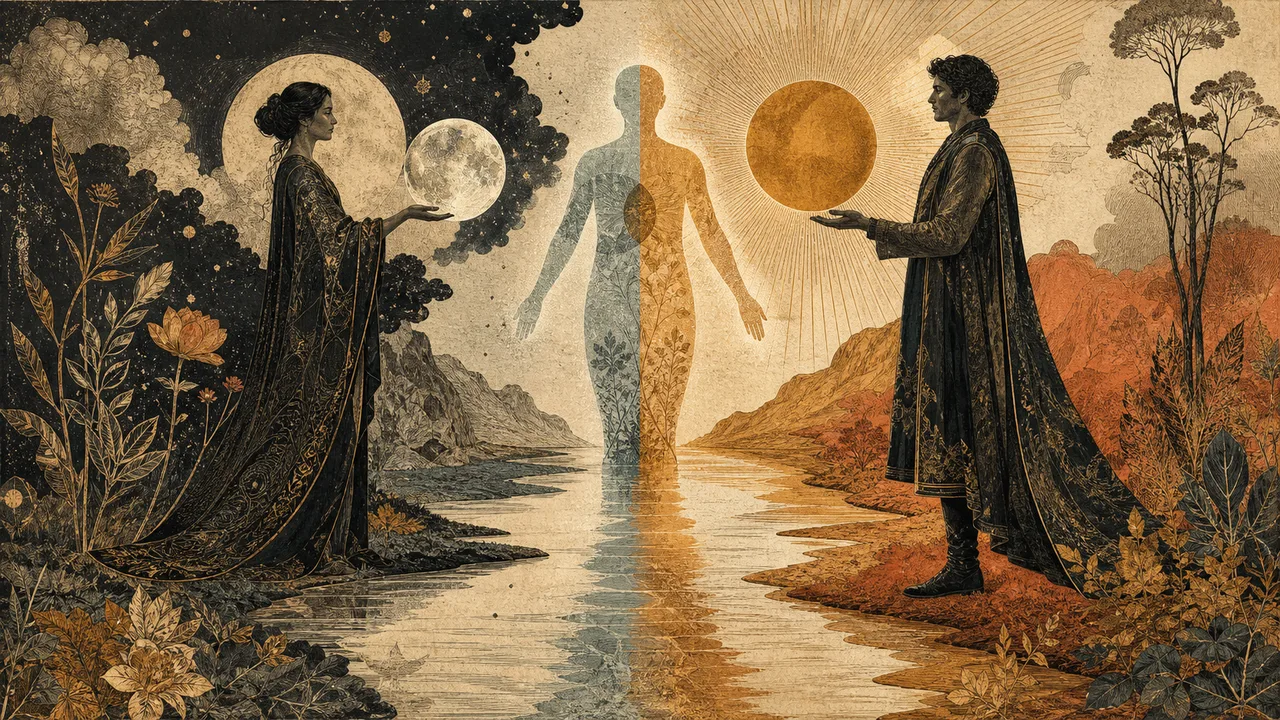
Anima and Animus are two figures created by Carl Gustav Jung to explain a deep part of the relationship between consciousness and the unconscious. The Anima is the inner feminine figure in a man, while the Animus is the inner masculine figure in a woman. These figures may appear in dreams, relationships, moods, fantasies and ideas that seem to have a will of their own.
In this article, you will understand the original meaning of Anima and Animus, how mother and father help give these figures a personal face and why they may be projected onto real women and men. We will also see what happens when they dominate consciousness, how they change throughout inner development and what their positive function is.
Continue reading to learn about these two archetypes without reducing them to lists of feminine and masculine qualities. When the definition becomes clear, we can better understand why some people awaken in us an attraction, irritation or trust far greater than what we actually know about them.
What Jung called Anima and Animus
Carl Gustav Jung called Anima and Animus the contrasexual figures of the psyche. This means that the Anima appears as a feminine figure in a man's unconscious, and the Animus appears as a masculine figure in a woman's unconscious. Jung also used the word syzygy to refer to this pair, an ancient term representing two parts joined together.
These figures are not people hidden inside us. They are psychic structures that acquire a face, voice and behavior in images from the unconscious. The Anima may appear as a mother, lover, seductress, companion or guide. The Animus may appear as a father, hero, teacher, critic, messenger or guide. The form changes, but there is an inner presence that was not created by conscious will.
Each figure has a personal part and an archetypal part. The personal part receives the marks of our history, especially from our earliest experiences with mother, father, women and men. The archetypal part is older and belongs to the archetypes that organize our inner life. This is why a real person can awaken a force that seems much greater than the little we know about them.
What the Anima is in a man's psyche
The Anima is the archetypal image of woman in the male psyche. Jung connected it with the soul, Eros and the ability to relate to life. It participates in the feelings, moods, fantasies and images that bring a man closer to his inner world. This does not mean that feeling is feminine or that a man has no feelings of his own. It means that, in Jung's language, the Anima personifies an unconscious relationship with these contents.
A man may build a very strong, controlled and rational outer image. At the same time, he may be dominated by sadness, fear, expectations and changes of mood that he cannot understand. The more he believes he is only the role he shows the world, the less he knows the figure reacting within him. The Anima does not disappear because it is ignored; it begins to influence his life without being recognized.
In its positive form, the Anima brings life to what was dry. It brings a man closer to sensitivity, imagination, affection, creativity and the ability to perceive subtle movements of his own soul. Its role is not to make him less masculine, but to prevent consciousness from becoming trapped in a single way of existing.
How the Anima takes on the faces of women
The first woman in a man's life is usually his mother. For this reason, the Anima receives marks from the maternal experience before he can separate his real mother from the inner image of woman. If his mother was protective, distant, controlling, fragile or unpredictable, these experiences help shape the personal way in which the Anima will be felt.
This does not mean that the mother creates the archetype. The archetypal image already exists as a possibility in the psyche, but it needs human experiences to acquire a familiar face. Later, sisters, teachers, friends, partners and other women add new forms to this image. None of them is the man's Anima, although any of them may receive the projection of this figure.
Imagine a man who, without realizing it, still expects to find in his partner the total protection he sought in his mother. He does not ask only for love or partnership. He expects her to know what he feels without his having to speak, to relieve every fear and never to withdraw when he feels insecure. The real woman begins to carry an impossible task because she has been mixed with a much older image.
What the Animus is in a woman's psyche
The Animus is the archetypal image of man in the female psyche. Jung connected it with Logos, the word, discernment, initiative and spirit. This does not mean that thinking, deciding and acting are masculine capacities. It means that the Animus personifies an unconscious form through which ideas, judgments and directions may enter a woman's life.
The Animus may appear as a voice that guides, organizes and opens a path. It may also arise as a ready-made opinion presenting itself as absolute truth. In this case, the statement arrives before experience: “no one changes,” “there is no point in trying,” “they are all the same.” The woman does not feel that she is repeating an idea; she feels that she is describing a fact that does not need to be examined.
In its positive form, the Animus strengthens the ability to formulate what was only sensed. It may bring courage to act, firmness to defend a choice and words to express an inner truth. Its function is not to transform a woman into a masculine caricature, but to help her establish a conscious relationship with a force that once spoke from behind her decisions.
How the Animus takes on the faces of men
The father is usually the first male figure of great importance in a woman's life. His presence, absence, words and way of exercising authority help give the Animus a personal form. A father who repeatedly said that his daughter never finished anything may continue speaking within her many years later, even when reality has already proved otherwise.
The Animus also receives marks from brothers, teachers, partners, religious leaders, bosses and masculine images from the culture. These experiences do not create its archetypal foundation, but they offer voices and faces through which it can manifest. Therefore, a woman's Animus may appear as a severe judge, an adventurer, a sage, a tyrant or a companion.
When an inner opinion arises, the main point is not to reject it simply because it may come from the Animus. The more useful question is: where does this certainty come from, and what is it trying to do? Some ideas protect an old wound. Others repeat inherited rules. Still others open a path that consciousness did not have the courage to follow.
When the Anima dominates a man
The Anima dominates a man when he identifies with its effects and loses the distance needed to observe them. A passing mood takes over all of reality. A fantasy seems like a certainty. An attraction becomes destiny. In this state, the man does not say, “I am experiencing an intense feeling”; he acts as though the feeling were final proof of everything.
A simple example appears when a man wakes up overcome by a feeling of abandonment. His partner has done nothing different, but every silence seems like rejection. He begins to test her love, demands immediate answers and turns small delays into signs of disinterest. The emotion is real, but the story used to explain it may have been created by the Anima.
Recognizing this activity does not mean dismissing the feeling. The first step is to separate the inner experience from the judgment about the world: “there is sadness within me” is different from “no one loves me.” This small difference makes it possible to listen to the content without forcing another person to confirm a fantasy.
When the Animus dominates a woman
The Animus dominates a woman when its autonomous opinions take the place of personal thought. Statements become rigid, broad and impossible to discuss. Instead of examining a concrete experience, consciousness receives a verdict: “it has always been this way,” “this never works,” “any intelligent person knows.” The tone of certainty conceals the lack of examination.
Imagine a woman who wants to change professions but hears within herself that it is too late. The sentence returns every time an opportunity appears. When she begins to investigate it, she realizes that the thought repeats the way her father spoke about risks and failures. Fear may continue to exist, but the verdict loses part of its power when it is no longer confused with truth.
Working with the Animus does not mean silencing the mind or rejecting firm opinions. It means learning to ask who is speaking, where the idea comes from and which facts truly support it. When a woman makes this separation, the Animus can stop being a judge that ends the conversation and become a force capable of formulating, discerning and guiding.
How Anima and Animus enter relationships
Projection occurs when an inner image is placed upon a real person. Instead of seeing only the person before us, we also see what the unconscious has deposited upon them. The person may seem perfect, irresistible, threatening or capable of saving us before there are enough facts to support such intensity.
A man meets a woman during a period of inner emptiness. She shows him attention, and he feels that he has finally found someone capable of completing his life. Within a few encounters, he turns similar tastes into proof of destiny and ignores important differences. When she reveals ordinary limitations, he does not feel only frustration; he feels that the perfect woman has disappeared. The swing between adoration and disappointment reveals the distance between the real person and the projected Anima.
The same mechanism may occur with the Animus. A woman meets a man who speaks confidently and begins to believe that he has all the answers that were missing from her life. She gives him the right to say what is true, important and possible. When he makes a mistake, the fall is much greater than the specific error because the inner image placed upon him also collapses.
Withdrawing a projection does not mean ceasing to love or concluding that the relationship was false. It means giving the real person back the right to be human and bringing back inside the part of the image that belongs to us. The bond may end, but it may also become more truthful because it no longer needs to sustain an impossible perfection.
How these figures appear in dreams
In a man's dreams, the Anima usually appears through feminine figures. She may be a stranger calling him, a woman leading him through a house, a seductress diverting him, a girl who needs help or an old woman offering guidance. Appearance has no fixed meaning. Its meaning depends on what the figure does, what the man feels and the stage of life in which the dream arose.
In a woman's dreams, the Animus usually appears through masculine figures. He may be an aggressor, teacher, messenger, group of men, travel companion or a voice announcing a statement. A man blocking a door has a different function from another who hands over a key. The dream reveals the current quality of the relationship between consciousness and this inner figure.
Therefore, there is no dictionary in which every unknown woman is a good Anima and every wise man is a positive Animus. The same figure may guide in one dream and deceive in another. What matters is observing the relationship: does it bring consciousness closer to an inner truth, impose an order, create fascination, provoke fear or invite us into an unknown part of the psyche?
The four stages of Anima and Animus
The Jungian tradition describes four symbolic stages of the Anima. Eve represents the figure still closely connected with the mother, dependence and the satisfaction of basic needs. Helen represents the woman idealized through beauty and desire. Mary reveals a relationship that already recognizes value, duration and a spiritual dimension. Sophia represents the wisdom that guides a man in his relationship with the inner world.
The Animus has also been described in four stages. It first appears as physical strength, bodily power or the ability to dominate. It then emerges as action, initiative and independence. In the third stage, it becomes word, idea and knowledge, often represented by a teacher or leader. In the fourth, it appears as a bearer of meaning, like a messenger connecting consciousness and the unconscious.
These stages are not a test for classifying someone as inferior or superior. The same person may experience different forms according to the situation. The value of this sequence lies in showing a possible change: the figure stops demanding satisfaction, power or admiration and begins to offer relationship, discernment and meaning.
How Anima and Animus become bridges to the unconscious
The goal is not to eliminate the Anima or Animus. Jung recognized that these figures retain an autonomy that consciousness never completely controls. The work is to perceive their effects, separate the ego from the content dominating it and build a more conscious relationship with what once appeared only as mood, opinion, dream or projection.
For a man, this may begin when he learns to listen to a feeling without requiring a woman to carry it for him. Instead of searching outside for the person who will bring everything to life, he asks what the fascination reveals about his own soul. The energy once bound to idealization may return as creativity, capacity for relationship and attention to dreams.
For a woman, this movement may begin when she examines an opinion that seemed indisputable. Instead of fighting the statement or obeying it, she looks for its origin, facts and intention. The Animus stops imposing a collective verdict and may offer her own words, direction and contact with a deeper meaning.
When this happens, these figures change function. The force that once pushed from behind begins a conversation with consciousness. Anima and Animus become bridges because they bring images and meanings from the unconscious without forcing the ego to become completely confused with them.
How to study these concepts today without erasing Jung
Jung created the concepts of Anima and Animus at a time when masculine and feminine were described more rigidly. Today, many of these descriptions are debated because women and men do not fit into fixed lists of emotion, reason, care, strength or action. This criticism is important, but it does not change what Jung wrote.
The most honest path is to separate two questions. The first is historical: how did Jung define Anima and Animus? The answer is the inner feminine figure in a man and the inner masculine figure in a woman. The second is contemporary: how do current authors expand, correct or reinterpret this formulation? This answer has several lines and needs to be presented as a later development.
If we mix the two questions, we create a third theory and attribute to Jung something he did not say. If we refuse any current discussion, we turn a living theory into a frozen rule. We can learn the original concept, recognize its historical limits and then evaluate new readings without erasing the origin of each idea.
Frequently Asked Questions
Carl Gustav Jung created these concepts within Analytical Psychology. He called the inner feminine figure in a man the Anima and the inner masculine figure in a woman the Animus.
No. Emotions, ideas, moods and opinions may reveal the activity of these figures, but they are not their definition. Anima and Animus are broader unconscious figures, formed by an archetypal foundation and personal experiences.
Projection occurs when an inner image is placed upon a real person. They may seem perfect, threatening or capable of completing our life before we have enough facts to know them in this way.
No. They may appear in dreams, fantasies, moods, opinions, artistic creations and encounters with different people. Romantic relationships simply make some projections more intense and easier to perceive.
No. The work is to recognize their effects, withdraw projections and build a more conscious relationship with the inner content. These figures do not cease to exist, but they no longer need to act only behind consciousness.
Explore the Ultimate Guide to Archetypes
Understanding Anima and Animus helps us separate the real person from the inner images we place upon them and recognize forces that once acted without being perceived.
In the Ultimate Guide to Archetypes, you will learn to observe these forces and use them as part of a path toward integration and awareness.
Explore the Ultimate Guide to Archetypes
About the author
Prof. Tibério Z has more than 30 years of experience teaching spirituality, metaphysics, holistic therapies and consciousness development.