
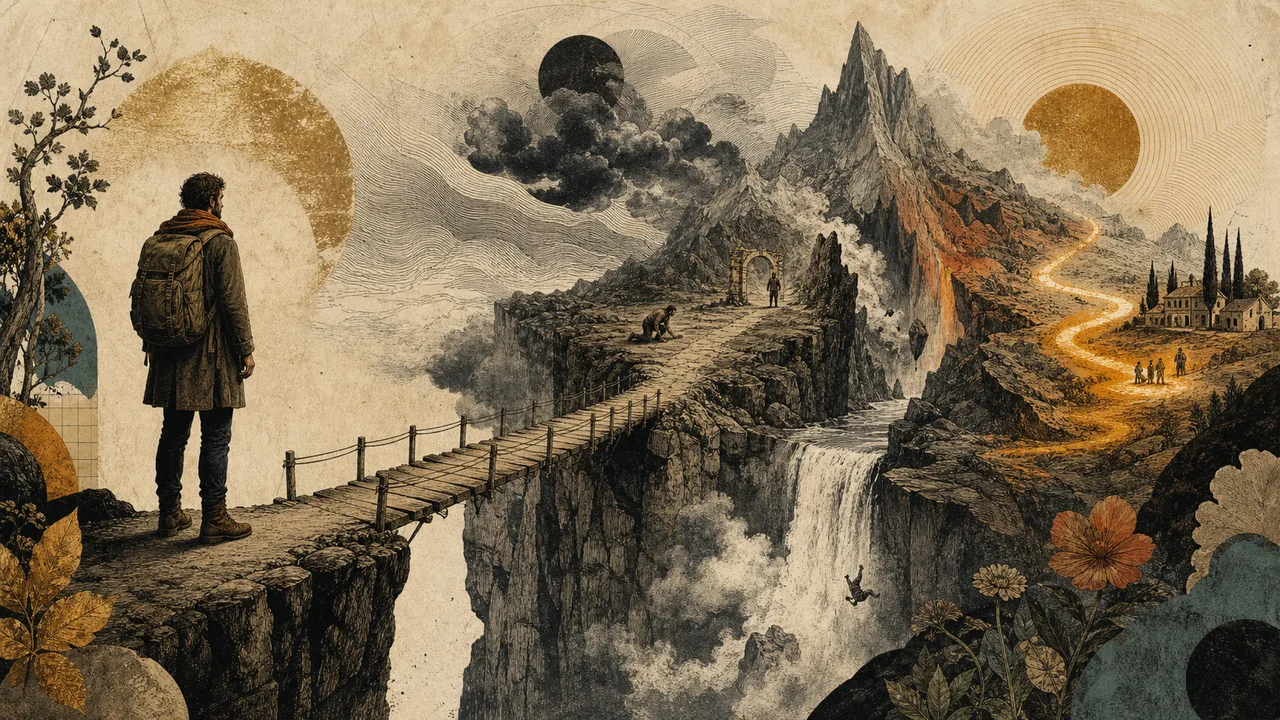
The Hero archetype appears when a situation forces us to leave familiar safety, face an obstacle, and develop an ability we do not yet possess. It does not represent only strength or courage. It represents the movement of consciousness that accepts a task, passes through trials, and returns transformed.
In this article, you will understand how Jung developed the symbol of the Hero, the difference between this archetype and the journey organized by Joseph Campbell, and why call, fear, help, confrontation, and return are part of this process. You will also learn to recognize when heroic strength turns into arrogance, control, or the need to save everyone.
Continue reading to understand the Hero beyond stories of warriors and see how this movement appears in changes that demand courage, learning, and responsibility in our own lives.
The Hero is a movement of consciousness
When we hear the word hero, it is common to imagine someone strong, fearless, and capable of saving other people. The Hero archetype does not begin with this finished image. It begins at the moment when a force within us accepts facing something that seemed greater than our capacity.
Jung recognized the Hero as an archetypal motif. This means it does not belong to a single person, culture, or story. The pattern repeats because all of us encounter situations in which the old way of acting is no longer sufficient and a new ability needs to be born.
The Hero represents the advance of consciousness in the face of something that still remains dark. Consciousness is what we can perceive, understand, and choose. The unconscious gathers forces, fears, desires, and possibilities that act within us before we know how to name them. The heroic task begins when we need to relate to this unknown without allowing it to dominate us.
For this reason, the Hero is not a fixed personality. We are not the Hero all the time. This archetype becomes more present when life presents a task that calls for separation, risk, effort, and transformation. Once the task ends, other forces also need to take their place.
Jung developed the symbol of the Hero before the popular journey
Jung did not invent stories about heroes. They had already existed for thousands of years. His work was to observe that very different characters went through similar movements: they left a familiar condition, encountered dangers, faced a threatening force, and attained something that changed their lives.
In Symbols of Transformation, Jung studied these images as expressions of psychic energy. He called this energy libido, using the word in a broader sense than sexual desire. It is the energy that moves thoughts, choices, bonds, creations, and changes. In the figure of the Hero, this energy gains direction and enters into conflict with what keeps consciousness trapped.
Decades later, Joseph Campbell compared myths from many peoples and organized what he called the monomyth. His work became known as the Hero's journey. Campbell described the path of heroic narratives, while Jung sought to understand what the figure of the Hero represents within the psyche.
This difference is important. The archetype is not a list of stages or a personality type. The journey is a way of observing how this movement appears in stories. When we merge the two without distinction, we lose both Jung's psychological meaning and the richness of the variations studied by Campbell.
The call interrupts familiar life
The call appears when the response we have used until now no longer resolves what stands before us. It can arise as an invitation, loss, crisis, encounter, restlessness, or unexpected change. The form varies, but the message is similar: continuing exactly as before is no longer possible.
Imagine someone who has mastered the technical aspects of their work and receives an invitation to lead a team. While responsible only for their own tasks, their experience was enough. The new role, however, requires listening, decision-making, organization, and the ability to deal with conflict. The call does not ask this person to do more of the same. It asks them to become capable of something new.
The first response may be refusal. We find reasons to postpone, diminish the importance of the change, or wait for a certainty that never comes. Refusal protects familiar safety, but it also reveals the place where fear is deciding for us.
The Hero relates to other archetypes present in the human journey, but its specific function is to accept the movement that breaks accommodation. The Hero does not know everything they will find. They know only that the old shore no longer offers the necessary answer.
Courage begins when fear does not decide alone
Courage is not the absence of fear. Someone who does not perceive risk may act out of impulse, naivety, or carelessness. The Hero senses the threat because they understand that something can be lost. Even so, they decide that fear will not be the only force responsible for their choice.
This difference completely changes the meaning of courage. A person may look very daring while merely fleeing from consequences. Another may tremble, ask for time to prepare, and still take the necessary step. The second attitude has greater consciousness because it recognizes the danger without handing all power over to it.
Fear also shows where our identity is trapped. Sometimes we fear failure because we have constructed the image of someone who is always right. In other situations, we fear displeasing others because we still depend on approval. The external obstacle awakens an internal conflict, and it is at this point that the crossing begins to transform us.
The Hero does not promise success. Error, loss, and failure are possible. Courage lies in accepting the task responsibly, not in believing that some special force will guarantee victory.
Trials reveal what brute force cannot solve
A trial does not serve only to measure how much strength we possess. It reveals the limit of the strategy we usually use. When the same difficulty returns, perhaps the problem is not a lack of effort. Perhaps we are trying to open every door with the same key.
A leader who centralizes every decision may work herself to exhaustion and continue delaying projects. Her trial is not to learn to bear more weight. It is to learn to trust, share responsibility, and talk before the problem grows. If she merely increases her effort, she will strengthen exactly the behavior that needs to change.
For this reason, trials strike at the image we have of ourselves. The person who prides themselves on never depending on anyone encounters a situation they cannot cross alone. Someone who has always avoided conflict needs to sustain a difficult conversation. Someone who believed they controlled everything encounters an event that does not obey their will.
Transformation happens when we stop asking only “how can I win?” and begin asking “what does this situation require me to develop?” The trial ceases to be a punishment and becomes an encounter with an ability that has not yet found space in our life.
The Hero does not cross the journey alone
Heroic stories are full of mentors, allies, protective animals, magical objects, and advice received at the right moment. These figures remind us of a simple truth: the consciousness that began the journey does not yet possess every resource needed to complete it.
Receiving help does not diminish the Hero's value. It diminishes their fantasy of omnipotence. A mentor may reveal a danger the Hero cannot yet see. A friend may offer the strength that is missing. Even an adversary may expose a hidden weakness and force the Hero to abandon an attitude that no longer works.
In life, help can come from a conversation, knowledge, a practice, a friendship, or someone who asks an uncomfortable question. Help does not travel the path in our place. It works like a lantern: it illuminates the next step, but we are still the ones who need to walk.
The immature Hero interprets dependence and cooperation as weakness. The Hero who begins to mature understands that autonomy does not mean isolation. They learn to recognize what they can do, what they still need to learn, and when it is necessary to walk beside someone.
The monster guards a part of the transformation itself
Jung wrote that the Hero's principal feat is defeating the monster of darkness. This image does not mean destroying everything that exists in the unconscious. The monster represents a force that can swallow consciousness when it remains unknown and takes control of our choices.
The dragon usually guards a treasure. Psychologically, this shows that the ability being sought is connected to the conflict itself. Whoever flees from the dragon also moves away from the treasure. A person who avoids every confrontation may preserve an apparent peace, but does not develop the firmness needed to protect their boundaries.
Facing something does not mean attacking blindly. First, we need to recognize what stands before us. An old fear may look like prudence. A dependence may look like love. The need to control may look like responsibility. The monster grows stronger when it receives a beautiful name and continues acting unnoticed.
The story of Gilgamesh illustrates this movement well. At first, he uses his strength arrogantly and believes that great deeds can place him above others. After Enkidu's death, he sets out in search of immortality. He cannot defeat death, but returns to Uruk knowing his own limit and understanding his responsibility as king differently. The greatest confrontation does not give him everything he wanted. It gives him a consciousness he did not possess before.
Campbell organized the journey into separation, initiation, and return
Joseph Campbell realized that many heroic stories could be understood through three broad movements. In the first, separation occurs: the Hero leaves the familiar world. In the second comes initiation: they pass through trials, receive help, face dangers, and are transformed. In the third, they return: they go back to life carrying what they attained.
These three movements form the center of the monomyth. Call, refusal, mentor, descent, dragon, treasure, and other images are possibilities found in the stories. They do not always need to appear or follow a mechanical order.
The rigid list of stages that became popular helps some writers organize narratives, but it should not be used as a ruler for measuring life. A true change may not have an obvious mentor. Another may involve several refusals. Some crossings end in failure and need to begin again.
The value of the journey lies in showing a process, not in fitting each event into a scheme. Something separates from the old form, passes through an experience that changes it, and returns in another condition. When these movements exist, we can perceive the transformation even if the story uses completely different images.
The return shows whether transformation truly occurred
Many explanations end when the Hero attains the treasure or defeats the enemy. This ending is incomplete. The journey finds its meaning only when the achievement returns to life and changes the way the Hero works, chooses, lives with others, and assumes responsibilities.
A person can go through an intense experience, learn new words, and tell an impressive story about themselves. If they continue treating others in the same way and repeating the same choices, the transformation has not yet found a place in life. The adventure has become a memory, not a new consciousness.
The return also requires humility. Everyday life may not recognize the change immediately. The people who stayed behind did not experience the same crossing. The Hero needs to translate what they attained into sustainable attitudes instead of demanding that everyone celebrate their experience.
Gilgamesh returns without the immortality he sought. His achievement is accepting the human limit and looking at Uruk again. The benefit does not lie in becoming invincible, but in returning able to inhabit his life in a different way. Sometimes, the true treasure is a more conscious relationship with what we cannot control.
When the Hero becomes the only identity
The archetype has a force greater than the ego. When we confuse this force with our personal identity, inflation arises. The person begins to believe they are more important, capable, or destined than they truly are. They stop living a heroic movement and begin playing the role of the Hero all the time.
A common sign is the need to save everyone. The person offers help that was not requested, assumes responsibilities that belong to others, and then feels wronged because no one recognizes their sacrifice. Without realizing it, they keep others dependent in order to continue occupying the indispensable role.
Another sign is turning every relationship into a battle. Disagreements become attacks, boundaries become challenges, and different people become enemies. Rest seems like weakness. Asking for help seems humiliating. Admitting an error threatens the image of a winner that needs to be protected.
The Hero's strength finds balance when it accepts that not every situation requires combat. There are moments to advance, but there are also moments to listen, wait, care, receive, and let someone else lead. No archetype should govern all of life alone.
The Hero appears when life requires a new response
Helena had always been a competent professional. When she received the invitation to coordinate her team, she refused. She knew every technical detail of the work, but was afraid to make decisions that affected other people. Remaining in her old role preserved her image as someone who knew exactly what to do.
Months later, the coordinator left and the team began to lose direction. Helena accepted the role, but tried to lead in the same way she had worked before: she solved everything alone, hid her doubts, and avoided difficult conversations. The first project was delayed. The more she tried to prove that she could handle it, the less the team was able to participate.
This was the trial that revealed her limit. Helena needed to admit that technical experience was not the same as leadership. She asked for help, listened to her colleagues, divided responsibilities, and faced an honest conversation with the client. None of this eliminated her fear of failure, but fear stopped commanding all her decisions.
When the next project began, Helena did not return as an invincible boss. She returned able to sustain decisions, receive contributions, and accept consequences. The transformation was not in the position or recognition. It was in the new response she had learned to offer.
This movement does not depend on gender, profession, or physical adventure. Women and men encounter tasks that rupture safety, require courage, and develop a new response. The images in myths change, but the human need to face limits remains present.
This is how the Hero appears in ordinary life. There is a rupture, a risk, an ability that needs to be born, and a return with greater consciousness. Without this movement, we have only agitation, effort, or the desire for victory. With it, the trial returns us to life different from how we entered it.
Frequently asked questions
The Hero archetype is the movement that leads us to face an obstacle, develop an ability, and expand consciousness. It is not a fixed personality and does not mean living without fear.
Jung developed the psychological meaning of the Hero. Joseph Campbell later organized the narrative movement of the journey into separation, initiation, and return.
No. Women and men can experience this movement whenever a situation requires courage, transformation, and a more conscious response.
The shadow appears when a person believes they need to overcome everything, save everyone, or create enemies in order to feel important. At that point, courage can turn into arrogance and control.
No. The heroic movement involves a real rupture, a risk, the development of an ability, and a return to life with greater responsibility.
Explore the Ultimate Guide to Archetypes
Recognizing the Hero helps us use courage and discipline without turning all of life into a war.
In the Ultimate Guide to Archetypes, you can understand this and other patterns and learn to use them more consciously along your journey.
Explore the Ultimate Guide to Archetypes
About the author
Prof. Tibério Z has more than 30 years of experience teaching spirituality, metaphysics, holistic therapies and consciousness development.