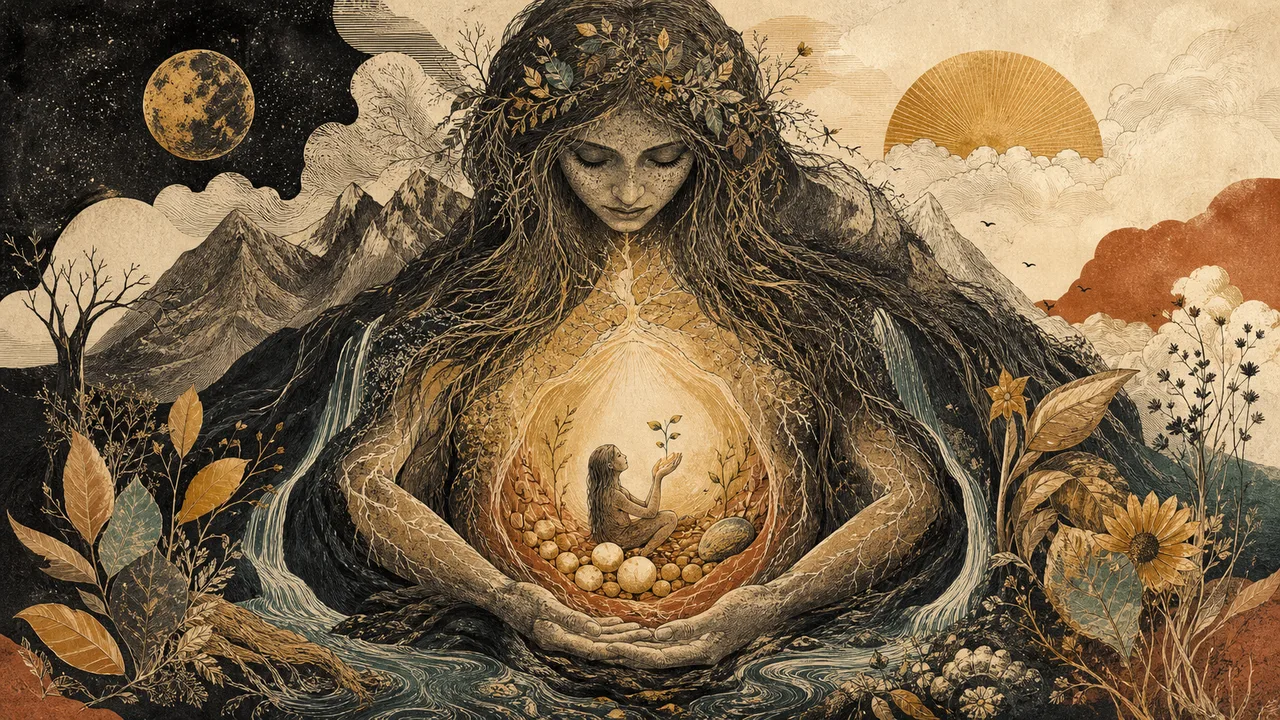
The archetype of the Great Mother brings together the forces that generate, nourish, protect and transform life. The same force that offers shelter may also imprison; the one that favors birth also takes part in separation, the death of one phase and the beginning of another. For this reason, the Great Mother has a loving side and a terrible side.
In this article, you will understand how Carl Gustav Jung arrived at the maternal archetype and how Erich Neumann deepened the image of the Great Mother. We will distinguish this archetype from the personal mother, learn about its protective and devouring sides, and follow an example in which care needs to change so that a new stage of life can be born.
Continue reading to see how this force appears in dreams, symbols, relationships and the way we care for our own creations. Understanding the Great Mother helps us welcome without suffocating, protect without dominating and transform without preventing growth.
What is the archetype of the Great Mother?
Carl Gustav Jung called the deep patterns that organize fundamental human experiences archetypes. We do not invent birth, care, fear of abandonment, the need for shelter or the transition from childhood to adult life. We encounter these experiences when we are born, just as all previous generations also encountered them. The Great Mother belongs to this group of archetypes that organize experience.
An archetype does not arrive in consciousness as a ready-made definition. It acquires images according to each person's era, culture and history. It is like a riverbed through which water can flow: the bed guides the movement, but the water takes on different colors, rhythms and forms in each place.
Jung showed that the Great Mother is one of the images produced by the maternal archetype. It brings together everything humanity has associated with origin, the womb, nourishment, protection, fertility and growth. At the same time, it includes darkness, dependence, devouring, death and the return to the place from which life came.
Erich Neumann, a scholar of Analytical Psychology, explored this subject more deeply. He explained that the Great Mother is not a single character hidden within us. She is an inner image that may appear as a goddess, nature, house, cave, water, earth, forest, vessel or caring person. The figures change, but all may express the same experience: something greater that receives, contains and transforms life.
The Great Mother is not the personal mother
The first distinction is essential. Our personal mother is a concrete woman, with qualities, difficulties, choices and a history of her own. The maternal archetype is much older and broader than any person. It brings together everything the human psyche expects, fears and imagines when it encounters the experience of being generated, nourished, protected and separated.
When a child looks at their mother, they do not see only that woman. In the early years, the mother may seem like the source of all nourishment, warmth and safety. When she is present, the world becomes whole again. When she takes too long, the child may feel that all protection has disappeared. This intensity belongs to the real relationship, but it also receives the power of the archetype.
For this reason, an ordinary mother may be seen as perfect or terrible at certain moments. A small failure may seem like absolute abandonment, and necessary care may take on the magnitude of salvation. Later, these images may continue to operate even when we can better understand the real person who raised us.
Separating these two things prevents an injustice. Not everything we feel toward our mother was caused only by what she did. We also bring very deep needs, fears and images into this relationship. At the same time, the archetype does not erase concrete facts. Care, abandonment, violence, presence and absence need to be acknowledged as they actually happened.
When these experiences form a group of emotions, memories, fears and reactions that begins to act almost by itself, we have a mother complex. The complex belongs to personal history. The archetype provides a collective foundation that may give this history great intensity. Using the two names as synonyms would conceal precisely the difference between what all of us may experience and the particular form it took in each person.
Inner work does not consist of turning the mother into a saint or blaming her for everything. It consists of perceiving what belongs to the real person, what arose from the relationship and what was magnified by an archetypal image. This separation restores each part to its proper size.
The Great Mother does not define all women
The image of the Great Mother has often appeared connected with goddesses, mothers, wise women and feminine figures of nature. This does not mean that every woman is obligated to care, bear children, sacrifice herself or occupy a maternal role. An archetype is not a social command and does not define anyone's destiny.
Men and women experience this force. A man may nurture a project, protect a child, keep someone dependent on his help or undergo a profound transformation. A woman may live these same experiences, reject them or express other archetypes much more intensely. A person's sex alone does not determine the form of their inner life.
Neumann used the vessel as one of the Great Mother's major symbols. The body receives nourishment, holds, transforms and eliminates. This basic experience belongs to human beings. It helps explain why pots, bowls, caves, houses, temples and wombs may carry a maternal meaning without obliging real women to become walking symbols.
We also find the Great Mother in groups and institutions. A school may welcome a student and help them grow, but it may also control every choice and fail to prepare them to walk alone. A spiritual community may offer belonging and direction, yet it becomes devouring when it treats every departure as betrayal. The maternal force appears wherever there is containment, nourishment, protection and dependence.
Understanding this point prevents an impoverished reading of the archetype. The Great Mother is not a description of “what women are like.” She is a way of understanding how psychic life experiences everything that welcomes, nourishes, surrounds, generates and, at certain moments, threatens to swallow.
Why the Great Mother is loving and terrible
Jung brought together two faces that seem opposed. On one side is the loving mother, connected with care, wisdom, nourishment, fertility and growth. On the other is the terrible mother, related to darkness, poison, seduction, imprisonment, devouring and death.
These faces belong to the same force because protection always creates an inside and an outside. Inside the shelter there is warmth; outside it there is the unknown. While life is still fragile, remaining inside is necessary. When the time comes to grow, the same safe place may prevent movement.
Think of a seed. The dark earth receives, covers and nourishes it. Without this embrace, the seed dries out. After germinating, however, the plant needs to break through the earth itself and seek the light. If it remains closed forever in the place that protected it, what once served life begins to prevent life.
The terrible side does not arise only when conscious malice exists. It also appears when love is afraid of losing. The person cares but cannot bear for the other to choose independently. They help but demand obedience. They protect from every risk and, without realizing it, prevent the ability to face life from developing.
This is why the Great Mother cannot be reduced to affection. She includes the power to give and withdraw, bring closer and separate, give birth and receive back. Her wisdom lies in rhythm. Each gesture may serve life at one moment and become destructive when it continues after its function has ended.
The elementary character that contains and protects
Neumann called the force that contains, protects, nourishes and preserves the elementary character. It creates a stable foundation so that something can remain alive. A baby needs arms, nourishment and repetition. An idea needs time, attention and work. An injured person needs a safe place before being able to return to the world.
This force says, “you may remain here while you grow.” It offers continuity when everything is still fragile. In inner life, it appears when we can rest, receive help, respect our pace and hold an experience until we are ready to understand it.
The vessel helps us visualize this movement. A pot keeps ingredients together while heat transforms them. A womb protects gestation. A house creates a space where we can shelter the body. In all these cases, containing does not mean keeping something still; it means sustaining a process that cannot yet be exposed.
Imagine Helena, who raised her daughter Marina practically on her own. During childhood, Helena organized schedules, followed schoolwork, solved difficulties and quickly noticed when the girl needed help. This care gave Marina a secure foundation. She grew up knowing that someone was by her side.
The elementary character of the Great Mother was present in this relationship in a creative form. Helena contained what her daughter could not yet manage. The problem was not the care. It would begin only if the old form of caring remained unchanged when Marina was already able to take responsibility for her own life.
When care becomes a prison
Marina grew up, completed her studies and received a job offer in another city. The opportunity matched what she wanted to build. Helena said she was happy, but soon began presenting all the dangers: violence, distance, the cost of living, the possibility of failure and how much they would miss each other.
The concerns had a real component. Every change involves risks. The devouring movement appeared when Helena began using these risks to prevent any decision. She became ill before the trips, recalled everything she had sacrificed and asked how her daughter could leave her alone after so many years.
Helena still called this movement protection. However, her help no longer prepared Marina to live. It kept her daughter in the role of a child and turned love into a debt. Marina, in turn, began to feel guilty whenever she thought about her own future.
Here we see the terrible side of the Great Mother without needing to imagine a monstrous person. The devouring mother may appear in care that holds someone back, in help that makes the other person incapable and in suffering used to prevent a separation. The bond remains, but life stops circulating.
This movement also occurs outside the relationship between mother and daughter. A leader does not train successors because they need to remain indispensable. A family solves every difficulty for an adult and then complains about that person's dependence. A person revises their creation so much that they never allow it to encounter the world. In all these cases, preservation has stopped serving growth.
Recognizing this prison does not require abandoning care. It requires asking what the help is producing. If it increases the other person's capacity, there is nourishment. If it increases only dependence and fear of leaving, the devouring face has begun to take the place of protection.
The transformative character that leads to change
In addition to the force that contains and preserves, Neumann described the transformative character of the Great Mother. Here, the main concern is no longer keeping something protected. It is leading a passage in which the old form needs to change so that another can emerge.
Every true transformation has an unknown part. A child leaves one stage of childhood without knowing exactly what growing up will be like. A person leaves a job before mastering the new activity. An identity built over many years loses strength while the next one is not yet ready. The transformative Great Mother accompanies this interval.
She appears as a guide, wisdom, inspiration and a force capable of leading consciousness beyond its previous state. In many myths, a character enters a cave, descends to the underworld, crosses a night or is received by a feminine figure. After this passage, the character does not return exactly as they entered.
Darkness, in this case, does not represent only danger. It is also the place where one form dissolves before the new one can be seen in full. A seed opens beneath the earth. Food loses its form inside the body to become energy. Certain certainties also need to dissolve before a broader understanding can be born.
For Helena, the transformation began when she realized that she no longer knew who she was beyond being needed by her daughter. For many years, care had organized her time, decisions and sense of personal value. Marina's departure threatened more than the routine. It ended an identity.
The archetype now revealed another task. Helena needed to direct toward her own life part of the energy she had previously used to direct her daughter's life. The maternal force would not disappear; it would change form. Instead of watching and solving, she could listen, trust and begin creating something that also belonged to her.
Creating also means allowing separation
A creation is not complete when it remains forever inside the person who created it. A child needs to form a life of their own. A student needs to think beyond the teacher. A work needs to find readers. A project needs to function without depending on every gesture of its founder.
This passage is difficult because every creation carries something of us. When it separates, we lose control over what will happen. The child may choose a different path. The student may disagree. The text may be understood in a way the author did not imagine. Creating includes accepting this risk.
Helena believed that allowing the departure meant ceasing to love. Gradually, she realized that separation would not necessarily break the bond. It would change the form of the bond. Marina would no longer need permission for every step, but she could still share decisions, ask for help and remain close.
Marina also needed to take responsibility for her part. While she blamed her mother for every difficulty, she continued to expect Helena to approve the change. The separation matured when she acknowledged her fear, organized her practical life and communicated the decision without asking her mother to eliminate all uncertainty.
Both suffered. There was silence, guilt, difficult conversations and a desire to return to the old way. The transformation did not happen through a beautiful sentence. It appeared when Helena stopped using suffering to prevent the journey and when Marina accepted that growing also involves enduring the sadness of the person who remains behind.
Allowing separation is one of the Great Mother's most mature expressions. Care fulfills its function when it helps the other person exist outside the space that protected them. It does not require love to disappear; it requires love to relinquish possession.
Life, death and rebirth in the Great Mother
The Great Mother is connected with birth, but her image also includes death. The earth causes things to germinate and receives back what has died. The sea sustains countless forms of life and may swallow those who enter it. Night ends the day's activity and prepares another dawn.
This union seems strange when we think of death only as the end of the body. In psychic life, many deaths occur while we remain alive. A phase, belief, role, relationship or image we held of ourselves dies. The ending opens space, but first it produces emptiness.
When Marina left, the routine in which mother and daughter organized almost every detail of the day together died. Helena lost the role of solving immediate problems. Marina lost the security of finding a ready-made answer whenever something went wrong.
After this ending, each needed to develop capacities that had previously remained dormant. Marina learned to deal with money, loneliness and practical decisions. Helena returned to an old interest in plants and began taking part in a community garden. The care she wanted to offer found another form, now without keeping her daughter dependent.
Rebirth did not erase the loss. The new stage was born precisely because they both crossed the emptiness left by the previous one. This is the Great Mother's movement of death and rebirth: something returns to darkness, loses its familiar form and offers material for another life.
Not every ending automatically produces growth. Sometimes we remain attached to what has passed or repeat the same bond with someone else. Transformation occurs when we can experience grief, gather the learning and allow the energy once trapped in the old form to take part in a new creation.
The symbols that give form to the Great Mother
Archetypes become visible through images. Jung brought together many symbols connected with the maternal archetype: mother, grandmother, goddess, Virgin, earth, sea, forest, spring, well, tree, cave, house, church, city, country, vessel and various animals. What brings these images together is their capacity to contain, generate, nourish, protect or receive.
A cave may be shelter during a storm. It may also be a dark place where someone gets lost. Water quenches thirst and sustains life, but it may drown. A house offers belonging and intimacy, yet becomes a prison when its doors cannot be opened.
Therefore, there is no simple dictionary in which “water always means Great Mother” or “a cave always means womb.” The symbol needs to be observed within the complete experience. Who entered this place? What did they feel? Did they find protection or threat? Did they leave transformed or remain trapped?
Positive and negative symbols may also appear together. A tree has deep roots in the darkness of the earth and branches turned toward the light. A vessel holds a substance, but it must be opened for the substance to be used. The womb offers protection for a certain period and then takes part in birth.
In Helena's life, the house acquired this double meaning. During Marina's childhood, it was the place of safety and nourishment. When her daughter decided to leave, the same house began to represent the space Helena wanted to keep unchanged. After the separation, it could become a home again, but it stopped functioning as a boundary against growth.
A living symbol does not provide a ready-made answer. It unites experiences that rational explanation usually separates. By showing protection and danger in the same image, it helps consciousness perceive a contradiction that was already present in life.
How the Great Mother appears in dreams and life
In a dream, the Great Mother may appear as an immense woman, a grandmother, a queen, a witch, an animal, a forest, a house or an expanse of water. The figure may welcome, nourish, pursue, seduce, conceal a passage or prevent departure.
The size of the image usually shows that we are facing something greater than our conscious will. However, the dream should not be interpreted only by appearance. A loving woman may be leading the dreamer back to sleep, while a frightening figure may force the dreamer out of complacency.
Before Marina's move, Helena dreamed that she was trying to keep a bird inside a box lined with soft fabric. She put in water and food, but the bird beat its wings against the lid. The more it struggled, the more Helena reinforced the box so that it would not hurt itself.
The dream did not say that Helena was evil. It revealed the mechanism of her care. She offered nourishment and comfort, but her attempt to prevent any injury also prevented flight. The soft box brought together the Great Mother's two faces: shelter and prison.
In waking life, we can find the same pattern by observing repeated situations. Do we feel responsible for solving everything? Do we need the other person to remain fragile in order to preserve our place? Do we confuse disagreement with a lack of love? Do we abandon too early what needed care? These questions reveal how we use the force of containment.
We can also look at what we are gestating. A relationship, project, inner change or new way of living may need more protection. Another creation may already be ready to leave. Wisdom lies in recognizing which movement serves life now.
How to welcome without preventing growth
Living the healthy side of the Great Mother begins by distinguishing need from dependence. A small child truly needs someone to decide many things. An adult may need support during an illness or crisis. Care becomes a prison when it continues taking away capacities that the other person can already exercise.
A simple question helps: does my help increase or decrease the strength of the person receiving it? Doing everything for someone may relieve immediate suffering and, at the same time, prevent learning. Welcoming may also mean remaining near while the person faces a difficulty that no one can face for them.
Boundaries are part of care. Someone who lives only to nourish others eventually expects, even without admitting it, that they will give meaning back to their existence. Then demands, exhaustion and resentment arise. Caring for one's own life prevents love from depending on another person's fragility.
Helena began talking with Marina without turning every phone call into surveillance. When she wanted to offer a solution, she first asked whether her daughter only wanted to be heard or needed practical help. Marina began to speak about her problems without handing her mother the responsibility of solving them.
This change preserved the bond and removed the debt. Helena remained a mother, but she no longer needed to be indispensable in every choice. Marina continued receiving love, but she could transform it into a foundation for walking, not a chain pulling her back.
The mature Great Mother knows the time for an embrace and the time for the door. She protects the seed, nourishes the root and allows the shoot to break through the earth. Her care does not seek to preserve every form; it serves the life that grows, separates, ends and begins again.
Frequently Asked Questions
Carl Gustav Jung showed that the image of the Great Mother arises from the maternal archetype. Erich Neumann deepened this study and explained its protective, creative, devouring and transformative sides.
No. A personal mother is a concrete person, with her own history and limitations. The Great Mother is an archetypal image that brings together human experiences of origin, protection, nourishment, danger, death and rebirth.
No. It does not determine a woman's personality or social role. It is a pattern of human psychic life and may appear in dreams, relationships, institutions, nature and the ways men and women care, create or prevent a separation.
The force that welcomes and protects may also retain, control and suffocate when it does not allow growth. Therefore, the same archetype brings together nourishment and devouring, birth and death, shelter and imprisonment.
Healthy care offers presence, nourishment and protection while they are needed, but recognizes the time to allow autonomy. It sustains life without turning help into control or dependence.
Explore the Ultimate Guide to Archetypes
The Great Mother teaches that caring also requires respecting growth, boundaries and separation.
In the Ultimate Guide to Archetypes, you will learn to recognize the light and shadow of this force and other patterns present in your life.
Explore the Ultimate Guide to Archetypes
About the author
Prof. Tibério Z has more than 30 years of experience teaching spirituality, metaphysics, holistic therapies and consciousness development.