
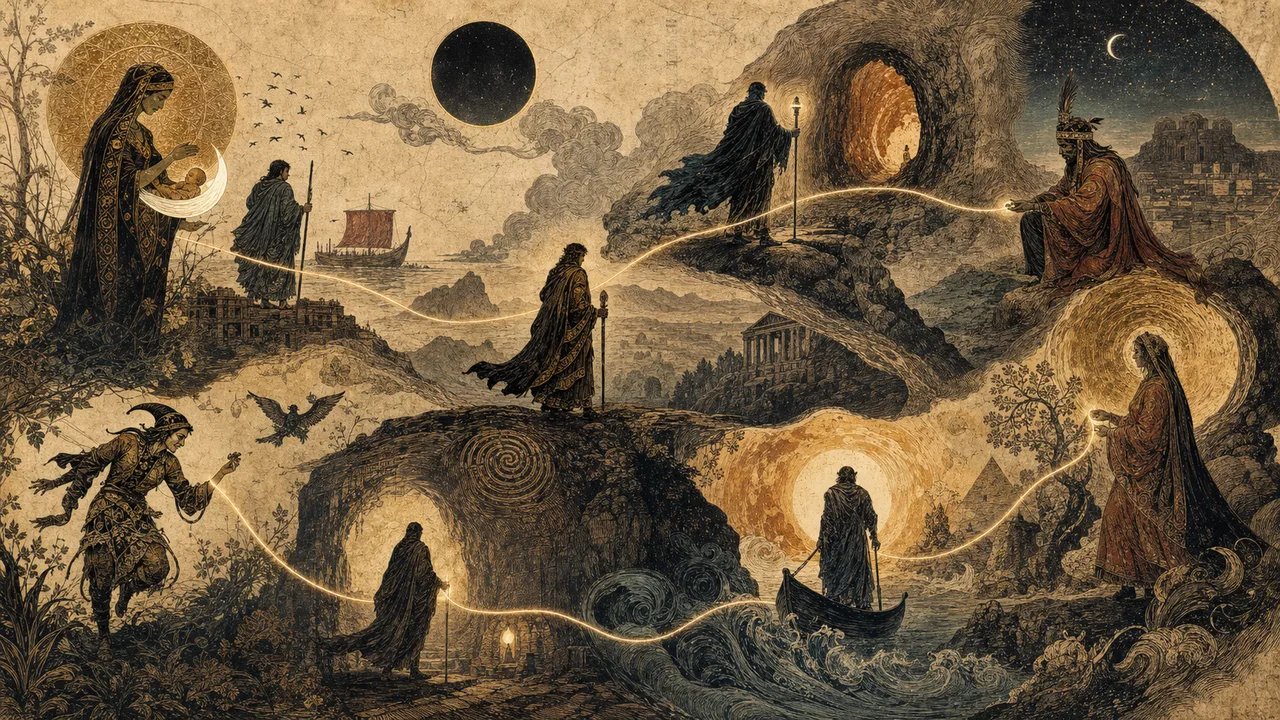
Myths repeat movements because every people must deal with birth, separation, danger, power, death, and renewal. Archetypes help give form to these experiences, but they do not create identical stories. Each culture offers its gods, its values, its landscape, and its own consequences.
In this article, you will understand the difference among myth, motif, and archetype. You will also learn about the psychological and historical paths that bring the narratives of different peoples closer together and follow a comparison between the descents of Inanna and Persephone.
Continue reading to see what truly repeats in these stories and what belongs only to each people. In this way, we can recognize a shared pattern without turning different cultures into copies of one another.
Myth is not merely an invented story
In ordinary use, we call a false idea a myth. When we study mythology, this word takes on another meaning. A myth is a traditional narrative that brings together human beings, gods, ancestors, animals, forces of nature, and extraordinary events to organize questions that matter to a people.
Where did we come from? Why does death exist? How was order born from chaos? What happens when someone breaks a sacred boundary? These questions do not receive only a logical answer. They gain characters, conflicts, and consequences that can be told, remembered, and transmitted.
A myth is neither a historical report nor a scientific explanation. Even so, it cannot be treated as empty fantasy. A narrative about the origin of fire may speak about the relationship between knowledge and power. A flood story may organize guilt, destruction, survival, and a new beginning. The narrated event has a function within collective life.
Consider the myth of Demeter and Persephone. It brings together the loss of a daughter, a mother's grief, the absence of crops, the intervention of the gods, and the young woman's partial return. The narrative participates in religion, ritual, and the Greeks' relationship with the fertility of the earth. Removing this context and saying only that it is a “story about change” eliminates almost everything that gives it meaning.
We also need to remember that not every people calls its sacred narratives myths. This is a word we use to compare traditions, but each culture has its own ways of separating history, ritual, memory, teaching, and relationship with the sacred. Respect begins when we do not treat another people's narrative as an inferior belief.
Stories repeat movements, not complete scripts
When we observe myths from different places, we find elements that return. There are extraordinary births, battles with monsters, rival siblings, protective mothers, abandoned children, journeys to the world of the dead, and returns after a great trial. These recurring elements are called motifs.
A motif is a recognizable part of the narrative, not the entire narrative. The descent into the underworld is a motif. To understand it, we still need to know who descends, why they descend, what happens there, what price is paid, and whether there is a return. Two stories can use the same descent and arrive at opposite meanings.
Think of two journeys across the sea. One person flees a war and looks for a new home. Another sets out to conquer a territory. Both face water, distance, and danger, but intention changes everything. The sea does not perform the same function, and the arrival does not produce the same consequence either.
The same care applies to the characters. A hero may defend the community, seek glory, repair a mistake, or try to return home. A monster may represent chaos, guard a border, or protect something that should not be taken. The name “hero” or “monster” does not complete the explanation.
Therefore, there are no “same stories” in the literal sense. There are movements that reappear in different combinations. Each narrative chooses its characters, joins particular motifs, and builds its own sequence. The repetition lies in the deeper design; the complete story remains unique.
The archetype offers a form without writing the story
Carl Gustav Jung called archetypes the collective and inherited forms that organize possibilities of perception and action. They belong to the collective unconscious and do not depend on the experience of one person. This does not mean that we receive complete myths ready-made inside the mind.
The archetype does not bring the god's name, the hero's clothing, or the ending of the adventure. It offers a possible form for experiences that repeat in human life. Birth, care, separation, trial, confrontation, death, and renewal can activate patterns that seek an image through which to become conscious.
We can compare the archetype to the bed of a river. The bed guides the path of the water, but it does not decide the whole landscape. Rain, rocks, soil, and human action modify the current. In the same way, the archetypal form guides an experience without determining every detail it will receive.
This is the point that connects mythology to the broader study of archetypes and their movements. The pattern remains invisible until it gains a face. In myths, it may appear as a god, animal, mother, child, hero, trickster, mountain, tree, cave, or ocean.
The image is not the whole archetype. It is one possible manifestation. When we confuse the two, we begin to say that every mother represents the same thing, every dragon performs the same function, and every descent has the same meaning. The archetype brings stories closer together, but it does not remove the need to understand each one.
Each culture gives the pattern a face, a name, and a consequence
No archetype appears outside a culture. Every story is born within a language, a landscape, and a way of understanding the gods, the family, nature, and life in community. These elements provide the content that the pattern alone does not possess.
A narrative created by a people who depend on the flooding of a river does not use water in the same way as a tradition born in a dry region. In one story, water may bring fertility. In another, it may mark a dangerous border. It may also represent the state before creation or the force that destroys a corrupted order.
Social values also change the meaning. A warrior who seeks honor may be admired in one culture and condemned for pride in another. A goddess who breaks a rule may establish a new order or cause a catastrophe. The consequence shows what that tradition is teaching, preserving, or questioning.
Even the same motif may participate in different rituals. The death and return of a divine figure may accompany the cultivation of the earth, religious initiation, the authority of a king, or the transition between stages of life. Calling all of this “rebirth” helps little if we do not ask who is reborn and what changes afterward.
See why this matters: recognizing a Great Mother in the deities of different peoples does not turn all of them into the same goddess. A figure may nurture, protect, pursue, devour, or prevent separation. The maternal pattern opens a field of experiences, while the narrative decides how these forces come into action.
Human life presents problems that always return
Why did distant peoples create similar motifs? Part of the answer lies in life itself. We all come into the world dependent on care. We grow, need to leave some form of protection, encounter limits, lose people, face the unknown, and know that we will die.
These experiences do not automatically produce the same narrative. They create similar questions. How can we leave home without losing our origin? How do we face fear? How do we accept that a stage has ended? How do we continue living after a loss? The collective imagination transforms these questions into crossings, forests, deserts, monsters, and underworlds.
An abandoned child appears in many myths because vulnerability at the beginning of life is a profound human experience. However, each abandonment has a cause and a destination. The child may be saved by animals, found by kings, raised by another family, or die. The shared motif opens the question; the particular story answers it in its own way.
The battle with a monster also arises from many situations. It may give form to an encounter with a threat that seems greater than our familiar strength. The creature may guard water, block a passage, or occupy a land. When the hero wins, the consequence reveals whether the story concerns liberation, conquest, maturation, or the creation of an order.
Myths remain alive because these situations have not disappeared. We still leave home, face losses, struggle over power, and seek meaning. The clothing of the story changes, but the movement may return in a film, a book, a dream, or a personal crisis.
Stories also travel among peoples
Archetypes and human experiences do not explain every similarity by themselves. Ancient peoples did not live in isolation. Merchants, travelers, soldiers, priests, artisans, and families crossed borders carrying objects, words, customs, and narratives.
A story told in a port could travel with a sailor, receive local names, and encounter a different religion. After a few generations, the new account retained recognizable parts and added others. Cultural transmission works like a song that changes rhythm and words as it passes from one region to another.
Some myths belong to an ancient shared heritage. Others were transmitted through trade, migration, marriage, conquest, or translation. There are also motifs created independently in response to similar problems. In many cases, more than one path participated in the formation of the narrative.
The traditions of Greece and the Near East, for example, had long periods of contact. Therefore, a similarity between their myths should not immediately be attributed to the collective unconscious. There may be historical influence, adaptation of a known narrative, or participation in a regional set of motifs.
Nor should we fall into the opposite extreme and explain every parallel as a copy. Evidence of influence requires historical, linguistic, and cultural evidence. When these elements do not exist, the similarity remains a question. A serious comparison accepts more than one possibility before choosing an answer.
A good comparison looks for context and function
Comparing myths is not a matter of placing similar figures side by side. We need to discover the work each image performs within the story. Where does it appear? What does it do? Who reacts to it? What order existed before it, and what order exists afterward?
A serpent demonstrates this need for care. It may create, heal, deceive, protect, destroy, or renew. Two cultures may feature enormous serpents without assigning them the same role. Appearance brings the images closer; action and consequence reveal the difference.
The religious context also needs to remain. A deity is not merely a psychological character. It participates in worship, prayer, ritual, calendars, and communal relationships. We can recognize an archetypal dimension in the image without reducing the whole religious experience to a part of the personality.
Jung applied the same care to parallels between dreams and myths. It is not enough to find a snake in a dream and another in an ancient narrative. We need to determine whether they perform a similar function. If the context changes, the comparison may be interesting, but it does not prove that we have found the same movement.
A good comparison asks two questions at the same time: what repeats, and what changes? The first reveals the pattern. The second preserves the story. When we use only one of them, we either fail to see any relationship or turn every culture into a single narrative.
Inanna and Persephone descend without telling the same story
The descent into the world of the dead appears in many traditions. It brings together passage, loss of a previous condition, encounter with an unknown law, and difficulty returning. The stories of Inanna and Persephone allow us to observe this motif without concluding that one is merely a version of the other.
In the Homeric Hymn to Demeter, Persephone is gathering flowers when Hades takes her against her will into the underworld. Demeter learns of her daughter's absence, searches for her, and falls into deep grief. When she discovers what happened, she withdraws her power from the earth, and the seeds stop producing.
Demeter's suffering threatens the continuation of human life and breaks the balance among the gods. Zeus sends Hermes to bring Persephone back. However, she eats pomegranate seeds in the world of Hades and begins to divide the cycle: she stays below the earth for part of the time and returns to her mother during the other part.
The return restores fertility to the earth, but it does not erase what happened. Persephone no longer remains only in her mother's realm. She also comes to belong to the underworld. The narrative brings together grief, separation, divine power, agriculture, and a new organization of the relationship between mother and daughter.
Inanna begins differently. The Sumerian goddess decides to descend into the world ruled by her sister Ereshkigal. Before leaving, she instructs her servant Ninshubur to seek help if she does not return. Inanna arrives with her powers, her adornments, and her position as queen of heaven.
At each of the seven gates, Inanna must surrender one of her symbols of power. When she arrives before Ereshkigal, she is without the marks that sustained her position in the world above. She is judged, killed, and hung. Ninshubur follows the instructions, and Enki creates beings able to enter that realm and restore her.
Even after she is restored, Inanna cannot simply leave. The law of the underworld demands someone in her place. She returns accompanied by beings who seek a substitute and finds Dumuzi failing to show the expected grief. The choice produces new consequences and, later, an alternation involving Dumuzi and his sister Geshtinanna.
What repeats? A female figure crosses the world of the dead, loses her previous condition, and returns through a new arrangement. What changes? Persephone is abducted, while Inanna chooses to descend. Demeter stops the fertility of the earth, while Ninshubur seeks help. One narrative reorganizes the cycle among mother, daughter, and the underworld; the other demands a substitute and distributes the price of leaving.
Reducing both stories to “death and rebirth” erases precisely what they teach. Inanna does not undertake a simple journey of personal growth. Persephone is not merely a young woman who matures. Both participate in religious systems, power relationships, and collective consequences that need to remain visible.
The archetypal pattern of descent brings the narratives closer. Story, ritual, and culture separate their paths. When we maintain both dimensions, the comparison becomes deeper: we recognize a shared human experience without tearing each myth from its roots.
Recognizing the pattern expands the story without erasing its roots
An archetypal reading helps us see why an ancient myth still touches us. A descent may recall a period in which we lost our references and needed to move through a change. A battle may reveal the fear we feel before a task greater than our familiar strength. A return may show that no one comes back from an important experience exactly as they left.
This does not mean that we are Inanna, Persephone, or any other deity. Turning a god into a personality type diminishes the narrative and enlarges our ego. The myth offers an image through which to think about experience; it does not give us a special title to use for ourselves.
Nor do we need to find a positive lesson in every story. Some myths preserve violence, injustice, sacrifice, and difficult consequences. Removing these parts to produce a comforting message changes the teaching. Sometimes the power of the narrative lies precisely in not resolving the conflict in the way we would like.
The hero's journey presents a valuable set of motifs, but it does not explain all of mythology. Many myths address the origin of the cosmos, divine kinship, fertility, the founding of cities, ritual duty, and balance among forces. Forcing all of them to depart, face a trial, and return turns a tool into a prison.
We can read a myth in stages. First, we learn the story and its context. Then we observe the motifs and the function of each figure. Only afterward do we bring the movement closer to other narratives and to our own lives. This order prevents a ready-made interpretation from taking the place of the myth itself.
Archetypes show why certain questions cross the centuries. Cultures show why each answer has a different face. When we respect both sides, myths stop being repeated stories and reveal something much richer: humanity encounters the same great mysteries but never tells them in only one way.
Frequently Asked Questions
Myths may resemble one another because human beings face experiences such as birth, separation, danger, death, and renewal. Archetypes organize these experiences, while contact among peoples also allows stories to be transmitted and transformed.
No. A myth is not an ordinary historical account, but neither should it be reduced to a lie. It is a traditional narrative that organizes questions of origin, relationship with the sacred, behavior, power, death, and the order of the world.
An archetype is a collective form of the psyche that organizes a possible experience. A motif is a recognizable part of a story, such as a descent, a trial, or an extraordinary birth. The motif makes the pattern visible within the narrative.
No. Similarity may also arise through cultural transmission, a shared historical origin, or independent creation. We need to compare the function of the image, its position in the story, and its consequences before claiming that the parallel is archetypal.
No. It helps us recognize an important set of movements, but many myths address creation, kinship, fertility, power, ritual, and cosmic order through other structures. Forcing every narrative to follow the same journey erases essential parts.
Explore the Ultimate Guide to Archetypes
Myths show how archetypes cross cultures and transform human experiences into stories filled with meaning.
In the Ultimate Guide to Archetypes, you will learn to recognize these movements and see how they remain present in your life.
Explore the Ultimate Guide to Archetypes
About the author
Prof. Tibério Z has more than 30 years of experience teaching spirituality, metaphysics, holistic therapies and consciousness development.