
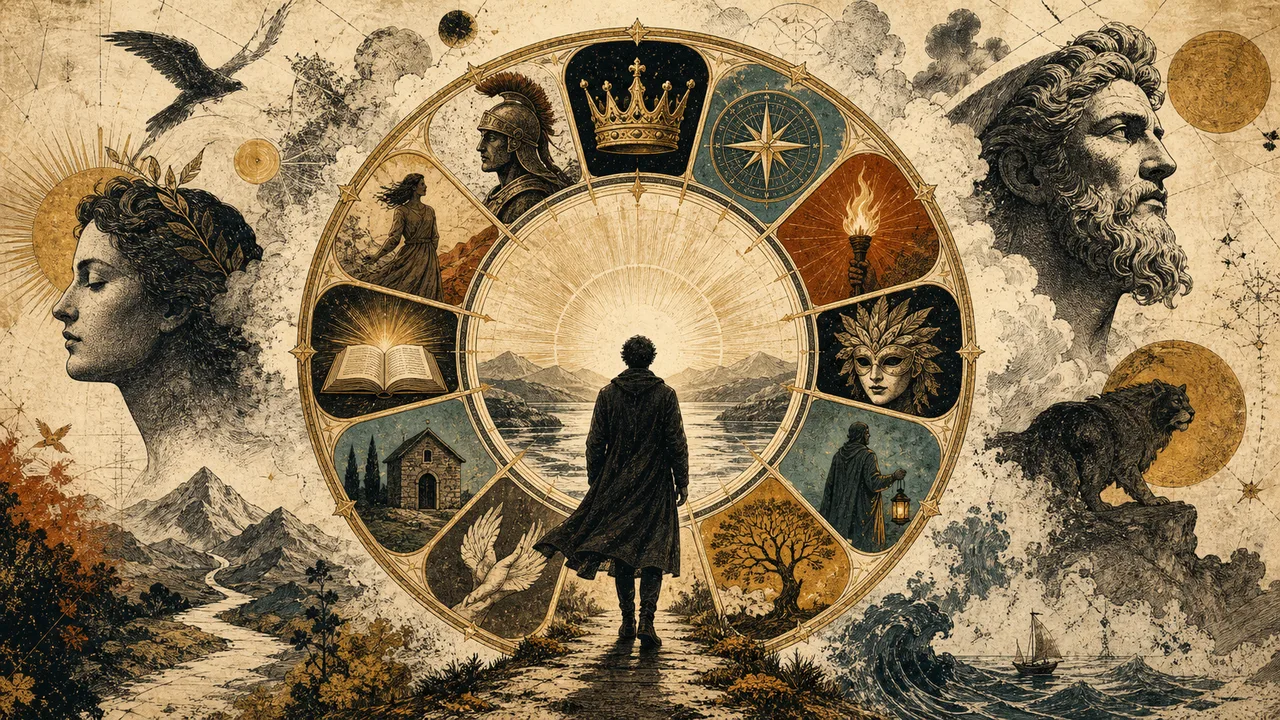
The twelve personality archetypes represent forces that all of us can express. They reveal different ways of trusting, facing difficulties, caring, seeking freedom, loving, transforming, creating, leading, understanding and enjoying life. None of them alone defines who we are.
In this article, you will learn about the correct origin of this system and understand what each of the twelve archetypes represents. You will also see why the names change in some books, how a strength becomes a shadow and why several patterns may act in the same situation.
Continue reading to observe these archetypes beyond their labels. When we understand the capacity and risk of each one, we can perceive which force is guiding our choices and which one needs to be developed to bring greater balance.
Who created the system of 12 archetypes?
Many lists found online present the twelve archetypes as a classification created by Carl Gustav Jung. This information is not correct. Jung developed the theory of archetypes, but he did not publish a closed list containing these twelve personality types.
For Jung, an archetype is a deep form of the psyche. The difference becomes clearer when we understand what archetypes are and how they influence our lives. An archetype does not arrive ready-made as a character with a name, clothing and defined behavior. It acquires images and stories when it encounters our consciousness, culture and experiences.
Carol S. Pearson built on this foundation and organized a system of twelve patterns. In 1991, she published Awakening the Heroes Within, a book in which she connected these archetypes with the human journey of growth. Later, her work with Hugh Marr led to the Pearson-Marr Archetype Indicator, an instrument created to observe which archetypal stories are most active at a stage of life.
Therefore, the relationship needs to be explained clearly: the general theory of archetypes comes from Jung; the twelve-archetype system was developed by Pearson. This distinction diminishes neither body of work. It simply places each contribution where it belongs.
Pearson also changed some names over time. The Innocent became known as the Idealist, the Orphan became the Realist and the Destroyer became the Revolutionary. In applications related to brands, we still find the Everyman, Hero and Outlaw. The names vary, but they need to point to the same central force.
How the 12 archetypes work in our lives
You do not need to choose one archetype and say, “I am only this.” All twelve patterns may exist within us. Some appear frequently, others remain less developed, and several awaken only when a situation requires their capacity.
Imagine that you need to change jobs. The Seeker realizes that the current path no longer fits your life. The Sage researches possibilities. The Realist observes the risks. The Creator imagines a new activity. The Warrior sustains the effort of change, and the Ruler organizes time and money.
The problem begins when a single force tries to solve everything. The Seeker without the Realist may leave a situation without preparing. The Realist without the Seeker may find so many dangers that they never move forward. The Warrior without the Caregiver may achieve a goal while destroying their own body.
Each archetype offers a resource and has a shadow. The shadow appears when the force acts without awareness, grows beyond measure or becomes a defense. The Idealist's hope becomes denial. The Ruler's leadership becomes control. The Sage's knowledge becomes distance from life.
Pearson organized the patterns into a journey of Ego, Soul and Self. This order helps us study development, but it does not function as a rigid staircase. Life is more like a spiral: we return to the same archetypes in new situations and learn to express them with greater maturity.
An overview of the 12 archetypes
The table brings together the names used in this article, the main strength of each archetype and the risk that appears when this strength loses its balance. It serves as a reference map. It should not be used to place an entire person inside a single row.
Table: Strengths and shadows of the 12 archetypes
| Archetype | Central strength | Shadow risk |
|---|---|---|
| Innocent or Idealist | Hope, values and trust | Denying facts and problems |
| Orphan or Realist | Realism, resilience and belonging | Victimhood and cynicism |
| Warrior | Courage, discipline and achievement | Creating enemies and living in conflict |
| Caregiver | Compassion, service and protection | Martyrdom, control and burnout |
| Explorer or Seeker | Freedom, discovery and authenticity | Avoiding commitments |
| Lover | Connection, beauty and commitment | Losing one's identity in a relationship |
| Rebel or Revolutionary | Disruption, reform and renewal | Destroying without direction |
| Creator | Imagination, expression and creation | Perfectionism and unfinished projects |
| Ruler | Order, leadership and responsibility | Domination and rigidity |
| Magician | Vision, meaning and transformation | Manipulation and fantasy |
| Sage | Knowledge, reflection and truth | Analysis without action and dogmatism |
| Jester | Humor, presence and lightness | Irresponsibility and hurtful humor |
Some names appear in pairs because the terminology has changed. Idealist, Realist and Revolutionary are the current names used in the PMAI. Innocent, Orphan and Destroyer belong to Pearson's earlier development and remain well known. What matters is understanding the movement represented, not arguing over which word is the only correct one.
Innocent or Idealist
The Idealist represents the ability to trust life, remain faithful to personal values and preserve hope in the face of difficulties. The Idealist looks at a situation and sees that a possibility still exists. This trust helps us continue when fear tells us to give up.
Think of someone who receives difficult financial news. The healthy Idealist does not close their eyes to the bills. They believe that a solution can be built and use this hope to seek help, reorganize expenses and continue working.
Their strength appears in loyalty, perseverance, gratitude and the ability to encourage other people. The Idealist reminds us that not every difficulty needs to destroy our faith. They preserve what we consider good even when the environment becomes harsh.
The shadow arises when hope becomes denial. The person avoids talking about problems, believes empty promises or remains loyal to someone who has already shown that they do not deserve such trust. Instead of using faith to move through reality, they use faith to avoid looking at reality.
The maturation of this archetype unites trust and discernment. Hoping for the best does not mean pretending that danger does not exist. It means recognizing what is happening without giving the problem the power to define the entire future.
Orphan, Everyman or Realist
The Realist is born from encountering the limits of life. They know that plans fail, people disappoint us and difficulties arrive without permission. This experience may produce bitterness, but it may also develop resilience, humility and empathy.
The name Orphan does not refer only to someone who has lost their parents. It represents the experience of realizing that no protection is perfect. When this understanding matures, we stop expecting someone to solve everything and learn to seek support without abandoning our responsibility.
Imagine a team discovering that the company is going through a crisis. While some try to hide the problem, the Realist gathers the facts and asks what everyone can do. They do not promise ease, but they create cooperation. Their strength lies in facing the situation and remembering that no one needs to go through it alone.
The search for belonging explains the name Everyman. This archetype values equality, coexistence and dignity. It brings people together without needing to impress. Its language is often simple: “we are in this together; let us solve it.”
In the shadow, the Realist may always expect the worst, assume the role of victim or divide the world into “us” and “them.” They may also hide their individuality to avoid losing the group. Their maturity appears when they recognize vulnerability without turning it into a permanent identity.
Warrior
The Warrior represents the force that accepts a challenge, defines a goal and takes action. It offers courage, discipline, focus and the ability to continue even when the result requires effort. Without this energy, many ideas would remain nothing more than wishes.
A student decides to take a difficult examination. For months, they need to organize their schedule, refuse distractions and return to material they have not yet mastered. The Warrior appears in this repetition. It does not depend on daily enthusiasm; it builds preparation through practice.
This force also protects boundaries. Saying no, defending someone, confronting an injustice and following through on a decision may require the Warrior. Its function is not to create conflict, but to place energy at the service of what needs to be achieved or defended.
The shadow appears when every difference becomes a battle. The person needs to win conversations, turns colleagues into opponents and measures their worth only by results. Even after a victory, they search for another battle because they no longer know how to live without tension.
The mature Warrior chooses their battles. They know that doing more does not always mean acting better. They use strength when the situation requires firmness and can lower the sword when listening, waiting or cooperating produces a more complete result.
Caregiver
The Caregiver represents compassion, service and responsibility in the face of another person's need. The Caregiver notices suffering, offers support and creates conditions for life to continue. This force appears in the family, healthcare, education, work and anywhere someone needs to be sustained.
Imagine a family member accompanying someone during treatment. They help with schedules, transportation and practical tasks, but continue listening to the choices of the person who is ill. Their care provides presence without taking away the other person's right to participate in their own life.
The healthy Caregiver does not help in order to receive praise. They recognize that we are interdependent and that everyone, at some point, needs to offer or receive support. Their dedication can transform cold environments into humane and safe places.
The shadow arises when caring means controlling, doing everything for the other person or continually abandoning one's own needs. The person makes themselves indispensable, exhausts their body and then feels angry because no one recognizes their sacrifice. They may also keep someone fragile in order to preserve their place as a savior.
Boundaries are part of caring. Saying “I can help up to this point” protects both the person offering care and the person receiving it. The Caregiver matures when their support increases the other person's strength instead of creating silent dependence.
Explorer or Seeker
The Seeker represents the need to discover another path and live more authentically. The Seeker looks beyond what is known, questions old limits and searches for experiences that expand their understanding of themselves and the world.
This search may happen through a journey, a professional change, a study or an inner transformation. It is not always necessary to leave a place. Sometimes the Seeker appears when we ask a question that our old way of living can no longer answer.
Think of a professional who wants to work in another field. Instead of resigning at the first impulse, she speaks with people, studies the new field and experiments with small projects. The search stops being a fantasy and begins to gain direction.
In the shadow, the Seeker confuses freedom with an absence of commitment. Whenever the new path requires routine, they think they chose incorrectly and leave again. They may spend years searching for the perfect life without remaining long enough to build anything.
The mature search accepts that every chosen path closes other possibilities. Freedom is not keeping every door open forever. It is being able to recognize a true direction and assume the responsibilities necessary to follow it.
Lover
The Lover represents the force of connection, intimacy, beauty and commitment. The Lover wants to bring together what was separated and make life richer through relationship. It may appear in romantic love, but it is not limited to it.
We find the Lover in friendship, connection with family, care for a place and dedication to an activity we truly value. The Lover notices details, appreciates qualities and makes the other person feel that their presence matters.
Imagine a couple experiencing their first major disagreement. The Lover's shadow interprets conflict as a threat of abandonment and tries to restore harmony by hiding what they feel. The mature Lover remains in the conversation, acknowledges the difference and seeks a closeness that does not depend on constant agreement.
Their strength lies in the ability to commit. The Seeker opens paths; the Lover chooses what they want to form bonds with. This archetype teaches us that a deep relationship requires time, presence and a willingness to know the other person beyond an idealized image.
In the shadow, this force produces jealousy, drama, seduction used as control and loss of one's own identity. The person accepts everything to avoid being alone. The Lover matures when they can say “I love” without turning this sentence into “I have ceased to exist.”
Rebel, Destroyer or Revolutionary
The Revolutionary represents the force that recognizes what has stopped working and breaks a structure to make room for the new. In Pearson's earlier work, it was called the Destroyer. In other applications, it became the Rebel or Outlaw.
Destruction may seem like an entirely negative word, but many cycles depend on an ending. We need to abandon a habit, remove an unjust rule, end a relationship or allow an old image of ourselves to die. Without this rupture, energy remains trapped in a form that has already lost its function.
Imagine a team realizing that its assessment method harms students. The Revolutionary does not merely complain. They gather the problems, question the rule and participate in creating another process. Their rupture has direction.
The shadow appears when the person only feels alive while opposing someone. They tear down proposals without offering an alternative, confuse shock with courage and reject any authority simply because it exists. Opposition becomes an identity.
The mature Revolutionary knows what needs to end and why. They also take responsibility for the space opened after the rupture. Liberation is not merely breaking down a door; it is understanding where we are going when we are no longer trapped behind it.
Creator
The Creator represents the ability to transform imagination into form. An idea alone is not yet a creation. It is necessary to work, choose materials, test paths and allow something previously invisible to come into existence in the world.
This force appears in art, but also in a lesson, a business, a technical solution, a recipe or a new way of organizing the home. The Creator combines elements and perceives possibilities that have not yet been realized.
Think of an author writing her first book. She has many ideas, but always returns to the beginning to improve each sentence. While searching for a perfect first page, she never reaches the second. The Creator is present in the vision, but has become trapped in her own shadow.
Perfectionism is one of this archetype's greatest risks. The person compares the real beginning with the ideal work they see within and considers every result insufficient. They may also begin so many projects that they give none of them time to mature.
The mature Creator accepts versions. First, they give something form; then they observe, correct and deepen it. They understand that an imperfect work can grow, while a work that never leaves the imagination cannot reach anyone.
Ruler
The Ruler represents the ability to create order, assume responsibility and manage resources. The Ruler goes into action when many parts need to work together and someone needs to make decisions while considering the whole.
It is not necessary to hold a leadership position to express this archetype. Organizing a household routine, coordinating a project, managing money or establishing fair rules also requires its strength. The Ruler asks, “what needs to be put in order for this to work?”
Imagine a coordinator who receives a confused team. She defines objectives, distributes responsibilities and creates clear forms of follow-up. Then she allows each person to carry out their part. Order increases autonomy because everyone knows what they need to do.
The shadow arises when responsibility becomes control. The Ruler believes that only they know how to decide, creates rules for every movement and treats disagreement as disloyalty. In the name of stability, they prevent adaptation and concentrate all power.
Leading is not doing everything or watching everyone. The mature Ruler builds a structure that continues to function when they are not present. Their power serves the whole, establishes boundaries and prepares other people to assume responsibility as well.
Magician
The Magician represents the force that perceives possibilities for transformation and helps a vision become reality. The Magician recognizes relationships that are not yet evident, changes the way a problem is viewed and creates conditions for a new response to appear.
In our lives, the Magician may emerge through an understanding that reorganizes everything we were experiencing. The external fact may remain the same, but we perceive another connection, another meaning or a possibility for action. This inner change alters the way we enter the situation.
Imagine a therapist listening to someone who considers themselves incapable because they failed at a project. Instead of promising success, the therapist helps the person perceive what they learned, which choices they repeated and where they still have the ability to act. The experience stops being only a defeat and becomes material for transformation.
The Magician works with vision, intuition, healing and change. Their strength grows when they can unite inspiration and responsibility. They do not depend only on a great idea; they know that transformation requires presence, relationship and action.
In the shadow, the Magician manipulates people, presents themselves as the owner of special powers or expects a miracle to eliminate all effort. They may also try to impose their vision on someone who is not yet ready. The mature Magician inspires possibilities without taking away anyone's freedom.
Sage
The Sage represents the search for truth through study, reflection and observation. The Sage wants to understand before reaching a conclusion. They gather information, compare ideas and try to separate what they know from what they merely want to believe.
This force appears in the researcher, teacher, adviser and anyone who asks a sincere question. The Sage does not study only to accumulate data. They seek a clarity that can guide decisions and be shared.
Imagine someone choosing a treatment. The Sage consults information, talks with professionals and observes limitations and possibilities. Then they make a decision with the knowledge available, aware that they may revise it if they encounter new facts.
The shadow appears when analysis replaces life. The person reads endlessly, finds a new question for every answer and never commits to a choice. They may also use knowledge to feel superior or treat feelings as though they were flaws in reasoning.
Wisdom does not mean knowing everything. It means recognizing what we know, what we still do not know and the moment when we need to act even without absolute certainty. The mature Sage keeps an open mind without turning doubt into a hiding place.
Jester
The Jester represents humor, presence, spontaneity and the ability to reveal a truth through irreverence. The Jester perceives the absurdity of situations and reduces the exaggerated importance we assign to ourselves.
In a tense meeting, everyone may be avoiding an obvious problem. A humorous observation names what no one had the courage to say. People laugh, their defenses diminish and the conversation finally begins. At that moment, lightness served the truth.
This archetype also brings us back to the present. Not everything needs to produce a result, teach a lesson or prepare the future. Playing, celebrating and enjoying an experience restore energy and remind us that life cannot be reduced to tasks.
The shadow arises when humor is used to escape responsibility. The person turns every serious conversation into a joke, mocks other people's pain or attacks someone and then says they were only joking. Lightness stops liberating and begins to hurt.
The mature Jester knows how to laugh at themselves and respect the other person's boundary. They do not deny the seriousness of a situation; they prevent seriousness from destroying our ability to breathe, create and continue living.
How to recognize the most active archetypes
Recognizing an archetype does not mean choosing a beautiful image and trying to imitate it. We need to observe the movement that actually organizes our choices. What are we seeking? What do we fear losing? How do we react when a situation becomes difficult? Which capacity do we always use, and which one do we avoid developing?
Rafael has worked for years in a secure position, but he wants to create his own educational project. The Seeker realizes that the current path has become too small. The Creator begins to imagine lessons and materials. If Rafael stops at this point, he will have many ideas and no passage into real life.
The Sage enters when he researches the audience, studies the subject and recognizes what he still needs to learn. The Realist calculates expenses and realizes that he cannot immediately abandon his income. Instead of destroying the dream, this prudence offers a foundation for testing it.
Then the Warrior needs to sustain hours of work that no one sees. The Ruler organizes deadlines, prices and resources. The Lover builds relationships with students and partners. The Jester helps Rafael endure mistakes without turning every failure into a tragedy.
These forces also come into conflict. When the Seeker wants to leave everything at once, the Realist calls for preparation. When the Realist finds too many dangers, the Warrior reminds them that no plan eliminates every risk. When the Creator wants to change the project every week, the Ruler calls for continuity.
The shadow does not disappear because we discover its name. Knowledge only creates a pause between impulse and choice. Rafael may still feel fear, anxiety or the urge to flee, but he begins to notice which voice is speaking and what is missing to balance it.
The twelve archetypes form a map of human capacities. The goal is not to find a word that sums up who you are. It is to expand your awareness so that hope, realism, courage, care, freedom, love, transformation, creativity, leadership, vision, knowledge and joy can occupy the right place at each stage of your life.
Frequently Asked Questions
No. Jung developed the theory of archetypes and the collective unconscious. Carol S. Pearson built on this foundation and organized the system of twelve patterns presented in her book Awakening the Heroes Within, published in 1991.
They are Innocent or Idealist, Orphan or Realist, Warrior, Caregiver, Explorer or Seeker, Lover, Rebel or Revolutionary, Creator, Ruler, Magician, Sage and Jester.
No. All twelve patterns may appear within us. Some become more active according to our history, the stage of life and the challenge we are facing.
Not necessarily. A change may activate the Seeker, a challenge may summon the Warrior and a responsibility may strengthen the Ruler. The combination changes according to the task being lived.
No. Each archetype offers a necessary capacity and also carries risks when it acts automatically or excessively. What matters most is recognizing the strength a situation requires and using it consciously.
Explore the Ultimate Guide to Archetypes
The twelve archetypes offer a clear map for recognizing motivations, potential and shadows that appear at different stages of life.
In the Ultimate Guide to Archetypes, you can explore each force more deeply and learn to observe how they take part in your choices and your journey.
Explore the Ultimate Guide to Archetypes
About the author
Prof. Tibério Z has more than 30 years of experience teaching spirituality, metaphysics, holistic therapies and consciousness development.