
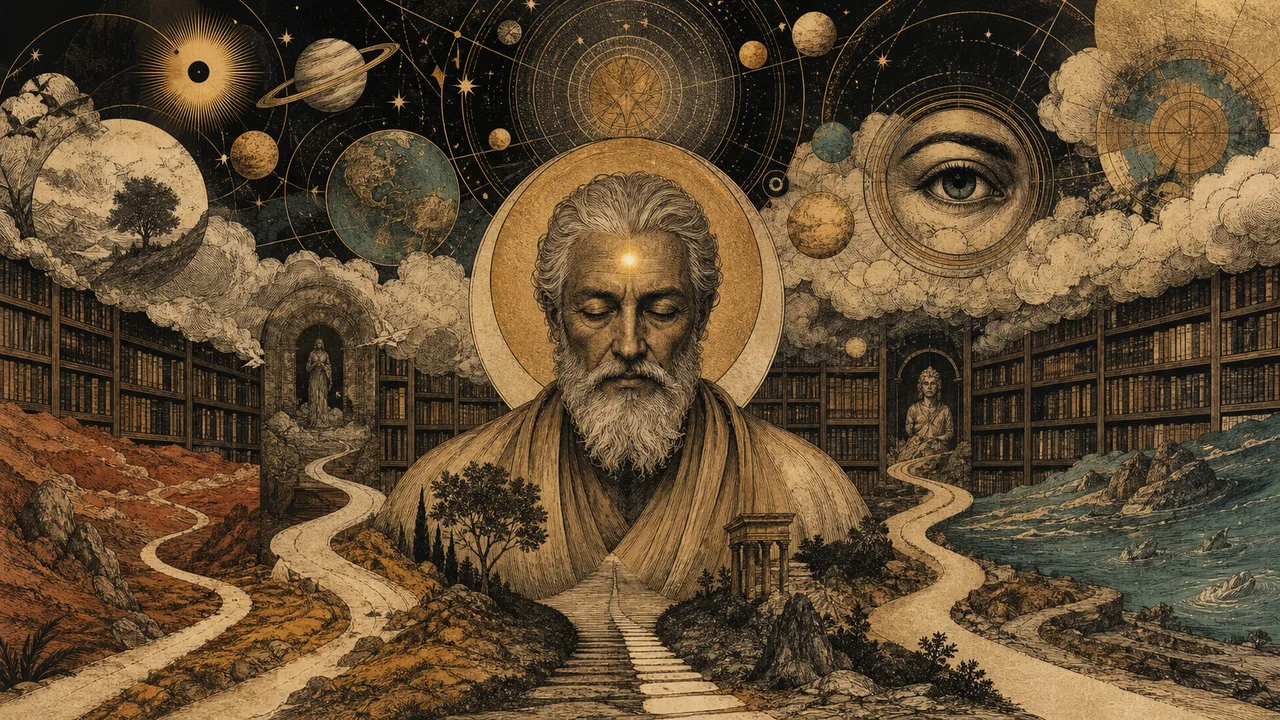
The Sage archetype represents the search for meaning, truth, and understanding. It appears when a situation demands more than a ready-made answer and forces us to stop, observe, and recognize what has not yet been understood. Its strength lies not in accumulating information, but in transforming knowledge into guidance and discernment.
In this article, you will understand how Jung developed the figure of the Wise Old Man, why it emerges at moments of impasse, and the difference among information, knowledge, wisdom, and discernment. You will also learn to recognize the relationship with teachers, the dark face of authority, and the moment when studying stops expanding life and begins hiding it.
Continue reading to understand how the Sage can help us think clearly without falling into intellectual arrogance, dependence on an authority, or excessive analysis that prevents any decision.
The Sage is not merely someone who knows a lot
When we hear the word sage, we may imagine an elderly person surrounded by books and capable of answering every question. This image shows only part of the symbol. Age does not guarantee wisdom, study does not guarantee discernment, and intelligence does not prevent anyone from using a correct answer at the wrong time.
A person may know many theories and continue repeating choices that hurt themselves and others. They may also quote authors, explain difficult concepts, and be unable to listen to a simple question. In this case, knowledge exists, but it has not yet encountered the experience that transforms it.
The Sage archetype is not an inner diploma or a title someone earns. It is a force that seeks to understand the meaning of a situation before responding. For this reason, it can appear in the person who teaches, the person who learns, the person who advises, and also the person who sincerely admits that they do not yet know.
The Sage is not a fixed personality type either. We can experience this force at certain moments without becoming “the wise person” all the time. Reducing the archetype to a list of characteristics creates a label and erases precisely what it should produce: a deeper understanding of life.
Women and men can experience this movement. Jung worked with the figure of the Wise Old Man because this was how the symbol appeared in many dreams and stories he studied. The image's form belongs to the symbolic material; the capacity to reflect, guide, and discern does not belong to one gender.
Jung found the Wise Old Man in dreams and tales
Carl Gustav Jung encountered the figure of the Wise Old Man while studying dreams, myths, active imagination, and fairy tales. In different stories, a character appeared who knew something the Hero could not yet perceive. He might appear as a magician, physician, priest, teacher, grandfather, hermit, or any figure carrying authority and guidance.
Jung called this figure a personification of the spirit. To personify means to give a face, voice, and behavior to a psychic force. Instead of understanding appearing as an abstract idea, it emerges as someone who speaks, asks, warns, hands over an object, or shows a path.
Spirit, in this context, is not merely intelligence. It is the capacity to produce meaning, bring scattered elements together, and find a direction the ego has not yet been able to form. The ego works with what it knows and controls. The Wise Old Man appears when an understanding is available in the psyche but has not yet entered consciousness clearly.
Imagine a dream in which an unknown teacher hands over a key and asks why the dreamer keeps trying to open the wrong door. The teacher, key, and question are parts of the same message. The image shows that the way out does not depend only on more effort. It depends on understanding what is being sought and where energy is being wasted.
This does not mean that every elderly person, teacher, or spiritual leader is a conscious manifestation of the Sage. The authority figure is one possible form of the symbol, not a guarantee of wisdom. The value of the image needs to be recognized by what it produces: more understanding, more responsibility, and a more truthful relationship with the situation.
The Sage appears when the familiar answer fails
In the tales Jung studied, the Wise Old Man usually appears when the Hero reaches a dead end. The Hero has already tried to use strength, courage, or speed and still cannot advance. What is missing is an understanding that organizes the problem and reveals a possibility that has not yet been seen.
This impasse is important because it shows the limit of consciousness. We tend to resolve new situations with answers that worked in the past. When they stop working, the first reaction may be to increase the effort, repeat the argument, or blame something outside ourselves. The Sage begins to appear when we accept that perhaps the problem requires another way of looking.
A family argument illustrates this mechanism well. Two people repeat the same arguments, each trying to prove they are right. The sentences grow harsher, voices rise, and nothing changes. The way out does not depend on finding an even stronger argument, but on perceiving the fear, need, or wound sustaining the dispute.
For this reason, the Sage's pause is not passivity. It interrupts reaction so that we can gather what had been separated. Facts, feelings, experiences, risks, and consequences begin to take their places. The problem ceases to be a confused mass and becomes a situation that can be examined.
Jung observed that the knowledge needed appears in tales as personified thought. The old man is not merely someone from outside who arrives by chance. He represents a capacity that presents itself when the Hero cannot produce it through their usual will. What consciousness lacked takes form and begins to converse with it.
The Sage does not eliminate the difficulty. He offers the conditions for facing it in another way. The situation still requires a choice, a conversation, or an action, but it no longer needs to be crossed entirely in the dark.
The Sage's questions organize the path
The Wise Old Man in tales does not always begin by giving an answer. He often asks who the traveler is, where they came from, why they are there, and where they wish to go. These questions seem simple, but they force the Hero to leave confusion behind and recognize their own situation.
When we are dominated by an emotion, we see only one part of the problem. Anger shows the offense but may hide sadness. Fear shows danger but may conceal an ability that has not yet been developed. Haste shows urgency but may hide a fear of honestly examining the consequences.
The right question creates space between impulse and action. “What really happened?” differs from “who is against me?” “What do I want to protect?” differs from “how can I win?” “Which consequence am I willing to assume?” differs from “how can I get everything I want?”
In the tales, the Sage also offers warnings and resources. He reveals where danger lies and gives a map, key, food, or an object capable of helping with the trial. These images represent knowledge and abilities the Hero needs to incorporate in order to continue.
The old man, however, does not travel the path in the Hero's place. Advice has value because it prepares a decision. If the question leads to no understanding and knowledge changes no attitude, wisdom remains merely an interesting conversation.
In life, a good question also needs to reach the point where something can be done. After understanding why a relationship is stuck, it is still necessary to talk. After recognizing the fear behind a choice, it is still necessary to decide. The Sage organizes the path; walking remains our responsibility.
The Sage seeks to understand before responding
Each archetypal force participates in life in a particular way. The Hero faces the trial, the Great Mother cares and transforms, and the Shadow reveals what was rejected. The Sage seeks the meaning that makes it possible to see the situation and find direction. It is part of the collection of archetypes and their functions, but it does not replace any of them.
In the tales, the Hero may have courage and still not know which way to go. The Sage offers the missing understanding, points out the risk, and reveals the necessary resource. He works like a lantern: he illuminates the part of the road that needs to be seen, but does not carry the traveler.
Understanding before responding means not allowing the first emotion to decide everything. This does not require denying anger, fear, or desire. It requires listening to them without giving them all the authority. Emotion tells us something is happening; reflection seeks to discover what it is and what response the situation demands.
Intuition also participates in this movement. It allows us to perceive relationships that have not yet been organized into words. Yet an intuition needs to encounter facts, limits, and consequences. When someone uses “I felt it” to end every conversation, they are not necessarily living the Sage. They may simply be protecting a certainty from every question.
True advice does not take freedom away from the person who receives it. It broadens the view, presents risks, and helps the person perceive what they were not seeing. The decision continues to belong to the one who will live with its consequences.
For this reason, the Sage can say “I don't know” without losing strength. Recognizing the limit of one's own knowledge creates room to investigate, listen, and learn. False wisdom needs to appear complete; real wisdom can endure remaining before what it has not yet understood.
Knowledge is not the same as wisdom
Information, knowledge, wisdom, and discernment are connected, but they are not the same. Information is a fact we receive. Knowledge arises when we understand that fact, relate its parts, and can explain how it works.
Wisdom begins when knowledge encounters experience. A person may know every rule about raising children and discover, through living together, that no child fits entirely into a manual. Experience reveals limits, differences, and consequences that theory alone cannot offer.
Discernment is the ability to recognize what belongs in a concrete situation. It asks which truth needs to be spoken, at what moment, in what form, and with what responsibility. Two choices may look good on paper, but only one respects the real conditions of that moment.
A physician may know a treatment and still need to evaluate each patient's history, condition, and risks. A teacher may master a subject and still need to perceive why a student cannot learn. A parent may have extensive experience and still need to recognize that a child's life will not repeat their own.
Jung connected the Wise Old Man not only with knowledge, reflection, and intuition, but also with goodwill and a willingness to help. This shows that wisdom is not merely mental capacity. The way we use what we know also reveals the value of our knowledge.
Without moral qualities, knowledge can become a tool of domination. Someone understands other people's weaknesses and uses that perception to manipulate them. Another person masters difficult language and uses it to prevent questions. In such cases, intellectual skill exists, but the responsibility that transforms knowledge into wisdom is absent.
Discernment chooses what fits each situation
Discernment does not mean discovering a perfect answer. It means seeing enough to choose responsibly. Every real decision has limits. Not every fact is available, not every consequence can be controlled, and no choice completely eliminates uncertainty.
Excessive certainty ignores these limits. Excessive doubt, meanwhile, turns prudence into paralysis. Discernment walks between the two. It investigates what needs investigation, admits what it cannot know, and recognizes the moment when continuing to think has stopped bringing understanding.
We can organize a decision through concrete questions. What do we actually know? What are we only imagining? Which fear is influencing our reading? Who will be affected? Which consequence can we assume? What will happen if we choose nothing?
These questions do not create a formula that works for everything. They prevent a single force from governing the decision unnoticed. A desire may be legitimate and still require preparation. A risk may be real and still not justify a lifetime of refusal.
Discernment also recognizes that the same truth may require different forms of expression. There is a difference between sincerity and cruelty. Saying something true only to hurt does not transform aggression into wisdom. Truth needs to find a way to serve understanding, not merely the need to win.
When this ability matures, our choices do not become easy, but they become more whole. Reason, feeling, experience, limit, and consequence can participate in the same decision. We do not choose because we have eliminated every doubt. We choose because we understand what can be sustained.
The outer teacher can awaken the inner teacher
Teachers, therapists, spiritual leaders, relatives, and mentors can carry the image of the Sage for us. They appear at a moment when we need guidance and seem to possess exactly the knowledge we lack. This relationship can open important paths, but it also demands attention.
When we recognize great wisdom in someone, we may project onto that person a force we have not yet perceived in ourselves. Projection means placing in another a psychic quality that also needs to be recognized in our inner life. The teacher seems to know every answer, while we feel unable to think without their approval.
At first, this admiration can help. It draws us closer to knowledge and awakens the desire to learn. The problem begins when the relationship prevents growth. The student repeats the teacher's words but cannot examine a new situation. The follower asks for an order for every choice and feels guilty when perceiving something different.
A teacher who fulfills a wise function does not create dependence as proof of loyalty. They offer knowledge, correct errors, and also teach the student to observe, compare, and assume decisions. Their guidance strengthens the learner's consciousness.
This does not mean rejecting all authority. Some people have studied, practiced, and matured knowledge that can genuinely help us. Recognizing their experience differs from believing that they have no limits, interests, fears, or blind spots.
The inner teacher begins to be born when we can receive a teaching without abandoning our responsibility. We listen, study, and verify. Then we need to relate it to our experience and answer for the choice. External guidance finds its value when it awakens an inner capacity, not when it replaces that capacity forever.
The Sage's dark face uses knowledge as power
Jung showed that archetypes have a luminous pole and a dark one. The Wise Old Man can guide, protect, and reveal the path. He can also deceive, imprison, create dependence, or lead someone into a dangerous situation. The appearance of wisdom does not eliminate the figure's ambiguity.
In life, the dark face appears when the ego identifies with the archetype. The person stops seeking truth and begins to believe they own it. Their experience becomes absolute authority, their opinions become laws, and every question is received as disrespect.
This movement produces intellectual arrogance. Instead of using knowledge to illuminate a problem, the person uses it to display superiority. They correct details to humiliate, complicate language to exclude others, and turn every conversation into an opportunity to prove they know more.
Dogmatism also belongs to this shadow. An idea that helped in one situation begins to be applied to everyone. Reality must obey the system even when facts show something else. The more rigid the explanation becomes, the less life can enter it.
There is also a quieter shadow: using study to avoid living. The person reads another book, completes another study program, and postpones the conversation or decision they already know they need to face. Knowledge creates a sense of movement, but nothing changes outside the mind.
Excessive analysis can hide fear. Another piece of information, confirmation, or final certainty is always missing. Because no real choice offers complete control, the decision never arrives. At this point, the search for truth has become protection against experience.
The Sage's dark face can also be cold. It understands concepts but loses contact with concrete pain. It explains why someone suffers without being able to offer presence. It uses a true theory to avoid the emotion that the situation awakens.
Balance does not require abandoning study or diminishing intelligence. It requires returning knowledge to humility, relationship, and practice. The more we learn, the more we need to recognize the part of reality that still does not fit within our explanation.
Wisdom matures when it returns to life
André worked in administration for many years and built a stable career. When his son decided to study music, he was certain he needed to prevent that choice. He presented numbers, told stories of failure, and prepared a plan for his son to follow the same profession that had given the family security.
André believed he was offering wise advice. His experience truly contained important information about work, money, and planning. Yet he did not ask what his son had researched, how he intended to prepare, or which risks he already knew. His answer was ready before the conversation began.
The conflict grew. His son stopped sharing his plans and began making decisions in secret. André continued presenting correct arguments, but did not notice that the way he used knowledge was destroying trust between them.
After an argument, André began observing what lay behind his certainty. He was afraid to see his son suffer and also feared losing the role of the person who always knew which path to follow. His authority was not made only of experience. It contained love, fear, and a need for control.
In their next conversation, André did not abandon everything he knew. He asked which schools his son had researched, what they would cost, how he imagined beginning to work, and what plan he would have if the first attempt did not succeed. He showed concrete risks, but also listened to answers he had never allowed to appear.
His son remained responsible for the decision. André offered help comparing schools, organizing expenses, and talking with professionals in the field. His experience stopped functioning as a sentence and began serving as an instrument of understanding.
This change shows the passage from knowledge to discernment. André did not discover a perfect answer or lose his fear. He learned to use what he knew without taking away another person's responsibility for their own life.
The Sage matures when knowledge returns to relationships, choices, and attitudes. Study needs to change the way we listen. Truth needs to find a responsible form in which to be spoken. Reflection needs to reach the moment when life asks for an answer.
We also need to accept that some answers appear only after the first step. Experience will continue teaching what no book could anticipate. When we remain willing to correct the path, error ceases to threaten the image of wisdom and becomes part of learning.
Living the Sage does not mean possessing every answer. It means learning to recognize the question that truly matters, seek the necessary knowledge, and choose without hiding behind certainty or doubt. Wisdom does not place us above life. It helps us enter it with greater clarity, humility, and responsibility.
Frequently asked questions
The Sage is an archetypal image of meaning, reflection, and guidance. It appears when we need to understand a situation that cannot be resolved using only the answers we already know.
Carl Gustav Jung studied the Wise Old Man in dreams, myths, and fairy tales. He presented this figure as a personification of the spirit archetype.
Knowledge organizes what we learn. Wisdom unites this knowledge with experience, limits, and the consequences of life.
The shadow appears when knowledge turns into superiority, rigidity, or control. The person begins to believe they possess the truth and uses knowledge to diminish others or avoid their own life.
No. Jung used the historical figure of the Wise Old Man, but the capacity to reflect, guide, and produce discernment can appear in the lives of women and men.
Explore the Ultimate Guide to Archetypes
The Sage shows how knowledge and experience need to meet in order to produce discernment.
In the Ultimate Guide to Archetypes, you will learn to recognize this force and balance its potential and its shadows.
Explore the Ultimate Guide to Archetypes
About the author
Prof. Tibério Z has more than 30 years of experience teaching spirituality, metaphysics, holistic therapies and consciousness development.