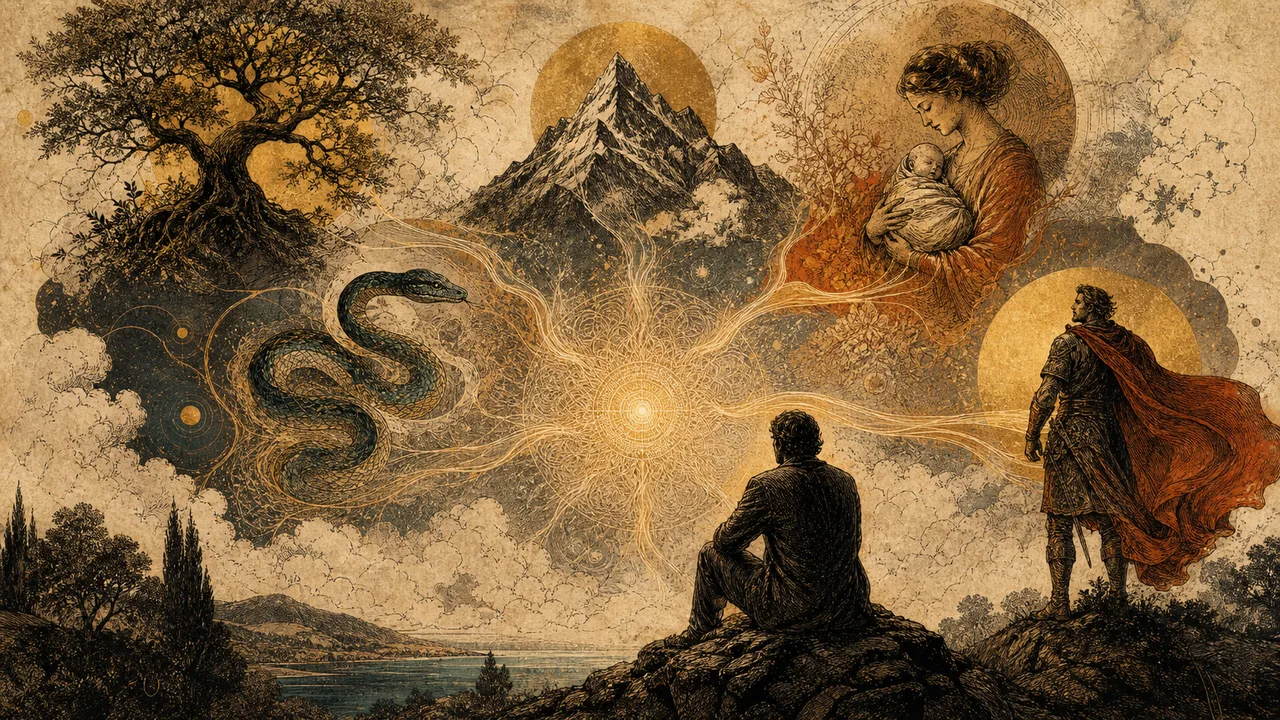
Archetype, archetypal image, and symbol are not three names for the same thing. The archetype is a deep form that we do not see directly. The image is the face this form receives as it enters our consciousness, and the symbol arises when this image expresses a meaning greater than we can fully explain.
In this article, you will understand the place of each concept and follow the path from the invisible pattern to the concrete image. We will also distinguish symbol, sign, and allegory, and observe a bridge that appears in dreams during an important life change.
Continue reading to learn how to recognize these differences without turning images into ready-made answers. When we understand how the three concepts work together, we can listen more closely to a symbolic experience without treating it as a command, prediction, or formula.
Three words that do not mean the same thing
When we encounter a mother, hero, child, or mandala in a dream, it is common to say that we saw an archetype. This way of speaking is practical, but it mixes different levels. The figure we can describe is not the archetype itself. It is already a representation that has passed through consciousness.
We can begin with a simple comparison. A mold is not the piece produced from it. Nor is the piece limited to what our eyes see, because it can awaken memories, emotions, and meanings that were not apparent at first glance.
The archetype occupies the place of the mold in this comparison. The archetypal image is the concrete form we can see in a dream, fantasy, myth, or work of art. The symbol appears when this image, besides showing something known, leads our consciousness toward something we still do not know how to formulate.
This sequence helps, but it should not become a machine with three rigid stages. In actual experience, image, emotion, and meaning arise together. We separate the concepts to understand what is happening, not to cut inner life into isolated parts.
The main difference is this: the archetype organizes a possibility, the image gives it a face, and the symbol opens a meaning. If we call everything an archetype, we lose the image's particular history. If we call every image a symbol, we begin looking for deep messages even where there is only a familiar indication.
The archetype is the form we do not see
Jung made an important distinction between the archetype itself and the images through which it manifests. The archetype itself has no face, character, or ready-made story. It is an unconscious disposition that organizes possibilities for perceiving, feeling, and acting in the face of fundamental human situations.
Think about birth, care, separation, the passage into adulthood, confrontation, death, and new beginnings. These events accompany humanity, but no one experiences them in the same way. There is a common form to the experience, while the concrete content is born within each life.
Jung compared this form to the structure of a crystal. The structure guides its growth, but it does not contain a photograph of the crystal that will form. Its size, appearance, and details depend on the materials and conditions it encounters.
The same occurs with the archetype. It does not carry a ready-made mother, bridge, or hero inside the mind. It offers a possibility of organization that becomes visible only when it encounters a situation, a history, and a culture.
For this reason, we do not inherit complete images as though receiving an album from our ancestors. We inherit possibilities for producing certain forms of experience. The representations can vary greatly and still preserve a recognizable organization.
This difference also prevents the word archetype from becoming merely the name of a character. The Hero is not a strong man with a sword, and the Great Mother is not a specific woman. These figures are ways in which deeper forms may appear.
Understanding this foundation helps us locate the set of archetypes and their manifestations without confusing pattern and figure. The archetype remains invisible, but we recognize its effects in the repetition of certain movements, conflicts, and images.
The archetypal image gives the pattern a face
If the archetype does not appear directly, what do we see? We see images. They may arise in dreams, fantasies, visions, myths, rituals, stories, works of art, and also in the figures we project onto other people.
The archetypal image is born when the deep form encounters material capable of representing it. Our memory offers faces and places. Culture offers stories, values, and familiar symbols. The current situation offers the conflict that set this pattern in motion.
Maternal care, for example, does not need to appear only as one's personal mother. It can take the form of a grandmother, a house, fertile soil, a garden, a cave, a spring, or a vessel. All these images may carry welcome, nourishment, origin, and protection, but none holds this meaning automatically.
A house can protect in one dream and imprison in another. The sea can welcome, threaten, cleanse, or swallow. A tree can represent growth, connection between levels, family memory, or simply the tree the person saw during the day.
Concrete consciousness gives color to the image. Someone raised near the sea does not respond to water in the same way as someone who almost drowned. A childhood home may bring security to one sibling and fear to another, even if both lived under the same roof.
For this reason, an archetypal image does not mean an identical image across all cultures. The common form wears different clothes. The pattern of care may appear as a goddess, a forest, a community, or a kitchen, according to the life that gave it content.
Nor is it enough to recognize similarities with a myth. A winged figure does not prove that the messenger archetype has been activated. We need to observe what this figure does, which emotion it produces, when it appears, and how it relates to the rest of the experience.
The image is the bridge through which we perceive the pattern. It makes visible what could not reach consciousness without taking form. After that, we still need to discover whether this image merely represents something known or is acting as a symbol.
The symbol reveals more than its appearance
A symbol has one part we recognize and another that remains open. We can look at a bridge and know what it is. Yet in a symbolic experience, this bridge leads us toward an inner passage that the word “change” cannot explain completely.
Jung did not treat the symbol as a secret code with a ready-made answer. He understood it as the best available expression for something we do not yet know completely. The image points toward this meaning, but does not contain it entirely.
This is why a living symbol continues working within us. We return to it, notice a new detail, and relate its form to events that previously seemed separate. Consciousness expands because the image brings together parts that were not yet connected.
In dreams, this process occurs spontaneously. The unconscious does not deliver a report explaining which conflict exists and how we should resolve it. It produces scenes, movements, characters, and objects that carry more meaning than the first explanation can reach.
Imagine that you dream of a closed door. Merely saying “a door means opportunity” closes the image too soon. We need to observe where the door stood, who was trying to open it, what existed on either side, which feeling accompanied the scene, and what is closed in your life.
Perhaps the door represents a desired passage. Perhaps it protects something that should not yet be entered. Perhaps it shows that you are waiting for an external opening while avoiding a decision. The symbol remains alive while these possibilities converse with the experience and produce understanding.
Not every image has this openness. Some merely recall an event from the day. Others repeat a concern almost directly. Symbolic power appears when the image takes consciousness beyond the evident meaning and helps form an answer that did not yet exist.
Sign, allegory, and symbol fulfill different functions
A road sign showing a bridge indicates that there is a bridge ahead. Its meaning has been agreed upon and can be understood by anyone familiar with that signage. This is a sign: it points to something already defined.
An allegory also has a prepared meaning. A writer may create a bridge to deliberately represent the passage from youth to adulthood. The reader may find other layers, but the image was constructed to translate an idea already known to the author.
The symbol works differently. It does not merely replace a word with a figure. It is born where consciousness does not yet have a sufficient explanation and offers a form for what is trying to arrive.
Let us use the same bridge in all three cases. On the road, it indicates a physical structure. In a fable, it may represent a passage chosen by the writer. In a dream arising during a change, it may bring together fear, desire, separation, return, and the connection between two moments of life.
The object is the same, but its function has changed. The bridge's appearance does not decide whether we are looking at a sign, an allegory, or a symbol. What decides is the relationship between the image, the known meaning, and what still remains unknown.
This distinction protects us from two errors. The first is treating any drawing, logo, or signal as a profound symbol. The second is reducing a symbolic experience to a short translation, as if it were enough to exchange the image for a word.
When someone says that “water means emotion” or that “a house means the psyche,” they may be offering a starting point. The problem begins when this phrase becomes the conclusion. A symbol does not fit on a label because its function is precisely to take consciousness beyond what it already knows.
How archetype, image, and symbol work together
Now we can bring the three concepts together. An important human situation sets a pattern in motion. This pattern receives an image formed from elements of personal history and culture. The image becomes symbolic when it expresses a meaning that consciousness still needs to develop.
Imagine someone who is ending a stage of life. The passage between a familiar state and another that remains uncertain activates an archetypal form of crossing. This form does not appear naked. It may arise as a bridge, road, boat, tunnel, door, staircase, or journey.
The image chosen by the psyche is not an insignificant detail. A bridge connects two shores and keeps both visible. A tunnel requires entering darkness. A boat depends on the water and the way the person crosses it. Each representation adds its own qualities to the pattern.
Then the symbolic work begins. The bridge may show that the person wants to change without losing the connection to what is left behind. The tunnel may reveal that there is no complete view of the path. The boat may place trust, direction, and surrender to movement in the foreground.
The archetype organizes the passage, the image gives it a particular form, and the symbol allows this form to participate in consciousness. None of the three decides what the person should do. They help us understand the experience that accompanies the decision.
Nor do we need to assume that every archetypal image is alive as a symbol at that moment. An image may be repeated by habit, used as decoration, or accepted without producing any transformation. The symbol exists in the active relationship between image and consciousness.
For this reason, recognizing the name of an archetype is only the beginning. Saying “this is a crossing” still does not explain which crossing it is, what needs to be connected, what should be left behind, and which fear blocks the movement. Real knowledge begins when the collective form meets the particular question.
A bridge appears during a life change
Marcos received an offer to work in another city. The new position would bring growth and better financial conditions, but his father was ill and needed frequent help. Marcos wanted to accept the opportunity and, at the same time, felt that leaving would be a form of abandonment.
During this period, he dreamed that he was standing before a wooden bridge over a strong river. He could see the other shore, but some of the planks were loose. His father remained behind him while an unknown person called him from the other side.
A quick interpretation would say that the bridge means change and that Marcos should cross it. This answer ignores almost the entire scene. The bridge was incomplete, his father remained on one shore, the call came from an unknown figure, and the river showed a force that could not be controlled.
The situation activated a human form of passage between two moments. This is the archetypal level. The form took on a bridge, a river, a father, and a distant shore because it needed to speak to Marcos's concrete history. This is the level of the archetypal image.
The bridge began to act as a symbol because it did not merely represent moving to another city. It brought together growth, responsibility, fear of separation, and the need to build a connection between the two parts of life. Marcos still did not know how to do this, and the image kept this question open.
He looked for a list of meanings and found the phrase “a bridge is a transition.” The phrase was correct, but poor. It did not explain the loose planks, his father's presence, or the fact that Marcos could see both shores at the same time.
In the following days, Marcos spoke with his siblings, explained the offer, and admitted that he could not care for everything alone. The family began organizing schedules, appointments, and expenses. For the first time, he realized that he was trying to handle his father's illness as though he were solely responsible.
After these conversations, he dreamed about the bridge again. The planks were still old, but now there were ropes along the sides and other people crossed with him. His father did not disappear from the scene. He merely ceased to be a figure holding Marcos to the shore.
The new dream did not order him to accept the job. It showed that the crossing became possible when it stopped being a solitary act. The symbol expanded the decision by revealing a condition that consciousness had not yet formulated: growing without breaking away required building support.
Marcos evaluated his father's treatment, the conditions of the job, the distance, the money, and his siblings' availability. The final decision required these facts. The image helped him understand the conflict, but did not replace reality.
The case allows us to see the three levels without confusion. The archetype organized the experience of passage. The archetypal image gave it a bridge, river, shores, and characters. The symbol connected the known conflict to a new understanding of responsibility and support.
A symbol does not have a fixed meaning
If another person dreams of a bridge, its meaning may be very different. For someone afraid of heights, it may bring risk and lack of control. For someone living apart from family, it may represent return. For someone who insists on a relationship that has ended, perhaps it shows a connection that needs to be examined.
The image itself can change within a person's life. A firm bridge may become narrow. An interrupted passage may receive new planks. The desired shore may reveal something frightening when the dreamer finally approaches it.
These changes are part of the symbol. They show how the relationship between consciousness and the unconscious is transforming. A fixed definition erases precisely what the image is trying to reveal.
Personal associations are essential. Marcos connected bridges with the trips he took with his father during childhood. This detail would not appear in a dictionary, but it helped explain why professional transition and family bonds were united in the same scene.
Culture also participates. Bridges appear in religious stories, myths, films, and rites of passage. These references can expand the image, as long as they are not placed above concrete experience. The parallel serves to open questions, not impose an answer.
We also need to observe the emotion. The same bridge seen with joy, fear, haste, or tranquility does not fulfill the same function. Emotion shows how consciousness is encountering that image at that moment.
Finally, we look at the consequences. An interpretation that increases responsibility, understanding, and contact with the facts deserves consideration. A reading that demands blind obedience, feeds grandiosity, or turns the dream into prophecy needs to be questioned.
The symbol is not vague because any answer will do. It is open because its meaning needs to be constructed in the relationship between image and life. Context limits mistaken interpretations while preserving what we still cannot explain.
How to observe an image without forcing an answer
The first step is to describe before interpreting. What appeared? Where was it? Who took part? What happened before and after? This description prevents a familiar name from erasing important details.
Then observe your associations. Which memory does the image awaken? Do you know this object from a story, religion, film, or personal experience? Which part provokes the most emotion? The answer is born from the relationship, not the isolated object.
The third step is to locate the current situation. What change, conflict, or choice was happening when the image arose? In Marcos's case, the bridge appeared at a time when work and family care seemed to demand opposite paths.
It is also worth following the image over time. Does it repeat? Does any detail change? Do you approach or move away? The transformations may reveal a movement that a single scene does not yet make clear.
Next, compare the image with the facts. Does the symbol help you see reality or offer an escape? Does it expand your responsibility or seem to give you permission to ignore consequences? Concrete life remains part of the interpretation.
Only then can we bring in an archetypal name. Perhaps there is a crossing, a symbolic death, a birth, a confrontation, or a search for wholeness. The name organizes the observation, but does not contain the entire meaning.
Notice the difference. We do not ask only “which archetype is this?” We ask which human form was activated, what image it received in this life, and what understanding this image is trying to form.
Archetype, archetypal image, and symbol work closely together, but they are not the same. When we preserve the difference, the archetype ceases to be a list of characters, the image recovers its history, and the symbol remains alive. It is in this dialogue that an inner figure can truly expand our consciousness.
Frequently asked questions
An archetype is an unconscious form that organizes certain human experiences. An archetypal image is the concrete representation that arises when this form meets a person's history, culture, and situation.
Not automatically. An image acts as a symbol when, in addition to its evident meaning, it expresses something that consciousness cannot yet explain completely.
A sign indicates something whose meaning is already defined, such as a road sign. A symbol has a known meaning, but it also opens an unknown dimension that still needs to be understood.
No. The image needs to be observed alongside current life, personal associations, culture, emotion, and the changes it undergoes over time.
Begin by describing the image without quickly naming it. Then observe what was happening in your life, what memories it awakens, how you feel before it, and what changes when it appears.
Explore the Ultimate Guide to Archetypes
Distinguishing archetype, image, and symbol allows us to observe more clearly what consciousness is trying to reveal.
In the Ultimate Guide to Archetypes, you can deepen your understanding of this language and learn to recognize the patterns present in images, behaviors, and experiences.
Explore the Ultimate Guide to Archetypes
About the author
Prof. Tibério Z has more than 30 years of experience teaching spirituality, metaphysics, holistic therapies and consciousness development.