
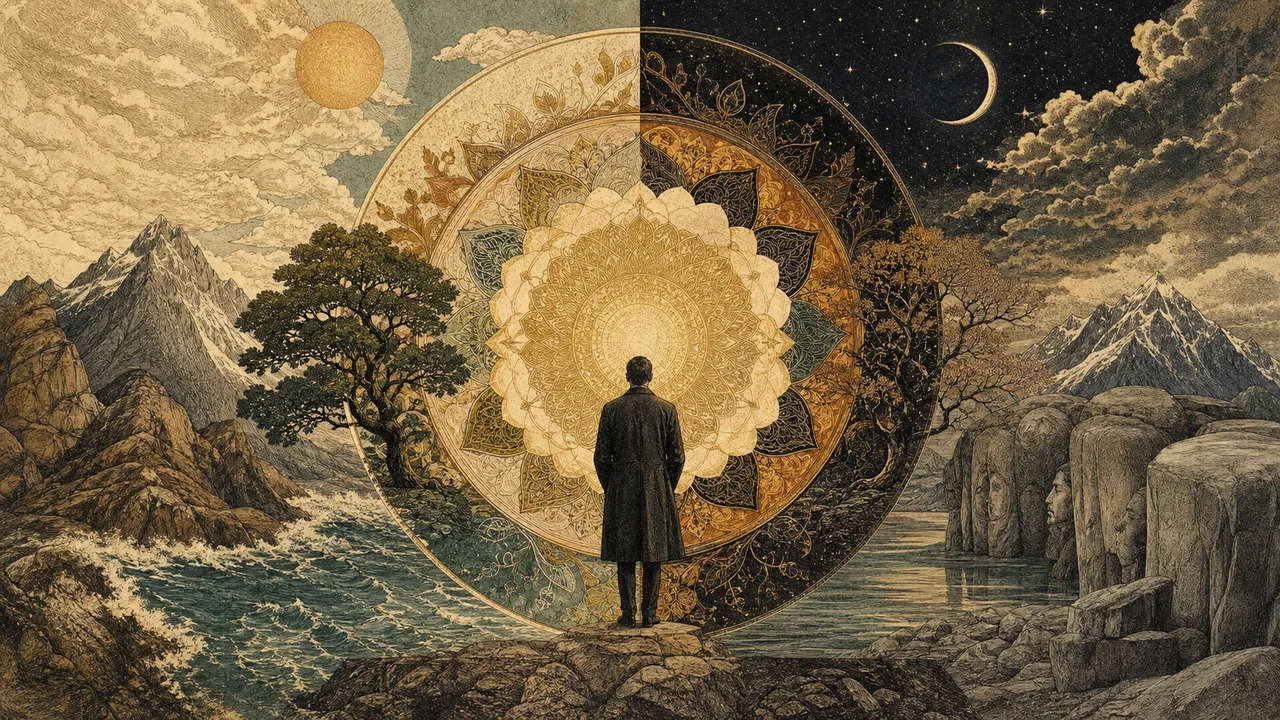
The Self is the totality of the psyche and the deep center that seeks to organize its different parts. It includes consciousness, the unconscious, what we already recognize in ourselves, and what still remains hidden. The ego belongs to this totality, but does not represent everything we are.
In this article, you will understand the difference between ego and Self, how something can be center and totality at the same time, and why the Self is not a perfect version of us. We will also learn about its principal symbols, follow a complete example, and understand the danger of the ego believing itself to be the owner of a greater force.
Continue reading to see how conflicts, dreams, emotions, and choices can participate in a path of integration. This understanding helps us listen to inner life without abandoning reality, responsibility, and the boundaries needed for living.
The ego is the center of consciousness
The ego is the part of the psyche that says “I.” When we remember our history, recognize our name, make a decision, or state what we want, the ego provides a point of reference. It organizes conscious experience and allows us to maintain an identity over time.
We can compare consciousness to an illuminated area within a house. The ego holds the flashlight, identifies what is before it, and chooses where to walk. Without this function, it would be difficult to distinguish a memory from a current event, sustain a decision, or recognize that a feeling belongs to us.
This does not turn the ego into an enemy of inner life. We need it to study, work, care for the body, build relationships, and answer for our actions. The problem begins when the illuminated part believes the house ends where its light reaches. Desires, fears, images, memories, and possibilities also belong to us, although they are not yet recognized.
This difference is the foundation for understanding archetypes and the path of integration. Not everything that moves our lives was consciously chosen. Sometimes, we repeat a reaction before understanding its origin. At other times, a dream reveals a need our habitual identity cannot accept.
The ego is the center of consciousness, not the center of the entire psyche. This distinction changes the way we deal with conflict. Instead of asking only “how can I make everything return to the way I want it?”, we can ask “what is trying to find a place in my life?” The second question does not remove the ego's authority, but expands its ability to listen.
The Self is the totality that includes the ego
Carl Gustav Jung called the totality formed by consciousness and the unconscious the Self. The concept includes the part we know and an extent of psychic life we cannot know completely. The ego lies within this totality as a necessary but limited part.
Let us return to the image of the house. The ego knows some rooms, knows where certain objects are, and has built habits within that space. The Self includes the whole house: the rooms visited, the closed rooms, the structure supporting the building, and possibilities not yet discovered.
This comparison also reveals an important limit. The Self is not a second personality hidden away and waiting for the moment to take control. It is the name given to the totality that already exists and to the movement that seeks to relate its parts. Therefore, we cannot point to an emotion, a dream, or an intuition and claim that the entire Self is there.
A part can never fully see the whole to which it belongs. The ego can expand its consciousness, recognize previously rejected contents, and change its way of living, but it cannot transform the entire unconscious into knowledge. There will always be something new, unknown, or greater than the image we form of ourselves.
This limitation is not a defeat. It protects inner life from the certainty that we already understand everything. When we recognize that our identity is true but incomplete, we gain space to learn from what surprises us. The Self does not erase what we know about ourselves; it shows that our life does not end with that explanation.
How the Self can be center and totality
At first glance, there is a contradiction: how can the Self represent totality and also be called the center? Totality is the whole field of the psyche. The center is the principle that relates and organizes the different parts of that field. The two ideas reveal aspects of the same reality.
A mandala helps us understand this relationship. It has a complete area formed by lines, colors, and figures, but it also presents a center around which the elements find their position. The center does not replace the design. It offers a reference capable of relating parts that, without this order, would seem disconnected.
Jung also compared the relationship between ego and Self to the Earth's movement around the Sun. The Earth does not cease to exist, lose its form, or become the Sun. It occupies its place within a larger system. In the same way, the ego remains necessary, but stops acting as if all psychic life had to revolve around its immediate plans.
The organizing center does not function as a boss who issues clear orders. It often appears through a conflict between different paths. One part desires safety; another calls for change. One wants to preserve the familiar image; another can no longer accept living hidden. The meaning does not lie in destroying one side, but in finding a form of life capable of responding to both.
For this reason, the center should not be confused with comfort. A more whole decision may require abandoning an old role, admitting a need, or recognizing the limit of a relationship. Organization arises when the parts find a truthful relationship, not when we eliminate everything that creates tension.
The Self is not a physical place within the brain or a little person hidden in our mind either. “Center” is a way of speaking about the order that can arise when consciousness and the unconscious enter into relationship. We recognize this order through its effects: greater coherence, responsibility, meaning, and ability to sustain opposites.
The Self is not a perfect version of us
In everyday language, speaking of a “true self” can suggest an ideal personality hidden beneath our flaws. The Self does not have this meaning. It is not a version that is always calm, kind, enlightened, and free of contradictions. If it represents totality, it must also include what contradicts our preferred image.
Imagine someone who has built their entire identity around kindness. This quality is real and can guide valuable choices. Yet if the person believes feeling anger is always wrong, they may accept abuse, hide needs, and say “yes” when they want to say “no.” Their kindness also begins serving the fear of displeasing others.
In this case, recognizing anger does not mean abandoning kindness or starting to hurt others. It means discovering that anger can warn us when a boundary has been crossed. The personality becomes more whole when kindness learns to say “no” and anger learns to protect without destroying.
The Self includes light and shadow, strength and fragility, union and conflict. This does not mean that every impulse should be enacted. A desire can be recognized without being obeyed; aggression can be transformed into firmness; a fantasy can reveal a need without becoming a literal plan.
Integration does not eliminate moral choice. On the contrary, it expands responsibility. Before, we could say “I am not like that” and let a part act in secret. After recognizing it, we need to decide what to do with this force. The goal is not to appear perfect, but to live with greater truth and less division.
The Self seeks to correct a one-sided life
A life becomes one-sided when the ego accepts only one side of the personality. We may live solely for work, caring for others, approval, control, or freedom. The chosen part grows so large that the others no longer find a place.
The unconscious then begins to present what is missing. This can occur through dreams, unexpected emotions, repeated conflicts, fantasies, or a sense of emptiness that does not disappear with new achievements. Jung called this movement compensation: the psyche brings forward the forgotten side to correct the excess of the conscious attitude.
Compensation does not mean always doing the opposite. A highly organized person does not need to abandon all order; perhaps they need to create space for rest and the unexpected. Someone who cares for everyone does not need to stop loving; they need to recognize that they also have needs. The new side modifies the old one without necessarily destroying it.
Conflict arises because the ego tends to defend the identity it knows. If someone learned that they have value only when useful, resting can produce guilt. If they learned that weakness is dangerous, asking for help may seem humiliating. The reaction shows that we are not merely changing a habit; we are touching the form through which the person learned to exist.
The Self guides integration by placing these parts in relationship. Yet it does not choose for us like an infallible voice. A dream needs to be considered alongside reality, emotions, history, and consequences. A crisis may reveal a path, but may also require medical, psychological, financial, or family care.
The sign of integration appears in concrete life. The person begins making choices that once seemed impossible, sustains boundaries, accepts a forgotten ability, or finds a more truthful way to participate in relationships. Without this passage into life, understanding remains only an interesting idea.
Symbols of the Self show center and union
The Self cannot be seen directly as we observe an object. It appears through symbols that give form to the experience of center, totality, and the union of opposites. Circles, mandalas, squares, crosses, and groups of four elements are among the most frequent images.
The circle can reveal unity and continuity. The square provides direction, limit, and organization. When the two forms appear together, the image can unite movement and structure. The quaternity, formed by four parts, often presents a totality organized around a central point.
Other images can also fulfill this function. A tree unites root, trunk, branches, and fruit in a single living being. A stone expresses permanence and unity. A child can represent a new possibility that still needs to grow. Kings, queens, sages, and divine figures can carry the force of a personality greater than the ego.
None of these images has a fixed meaning. A circular house may indicate organization for one person and imprisonment for another. A stone may represent firmness, weight, or something precious. The symbol needs to be understood within the dream, the moment being lived, and the emotions it awakens.
Nor is finding a mandala enough to conclude that integration has been achieved. Sometimes the image arises precisely because life is disorganized. It presents an order that is needed, not a medal awarded to the dreamer. Its value lies in the relationship we can build with what it reveals.
A true symbol does not fit within a quick explanation. It continues producing questions, emotions, and new relationships. Instead of closing meaning, it opens a path. For this reason, drawing the image, remembering its details, and observing its connection with life may be more important than seeking a ready-made translation.
A circular house reveals a forgotten life
Helena built her identity around caring. She solved the family's problems, anticipated everyone's needs, and rarely refused a request. She was praised for her availability, but felt tired, irritated, and empty when no one needed her.
Her consciousness accepted only the caregiver. The creative woman who liked to paint, the anger that arose in the face of abuse, and the desire to have time of her own were left without a place. Helena said these things were selfish and returned to organizing other people's lives.
During this period, she began dreaming of a circular house. Four rooms surrounded a central table. Three were clean and organized; the fourth remained locked. Helena tried to serve a meal, but everyone waited for her to open that door before sitting down.
At first, she interpreted the dream as confirmation of her responsibility to keep the family united. This reading repeated exactly the role that was already exhausting her. When she paid attention to the locked room, she remembered the painting materials stored away for years and realized that her irritation increased whenever her help was treated as an obligation.
The door did not say that Helena needed to abandon her family. It showed a part of the house that did not participate in her life. Her creativity and protective anger were different, but were excluded for the same reason: both required her to stop existing solely for others.
Helena returned to painting two nights a week. She divided some responsibilities, refused requests that other people could handle, and talked about her tiredness before exploding. There were complaints, guilt, and a desire to return to her old role. The change had to be sustained through small decisions.
The family did not become perfect, the anger did not disappear, and the dream did not solve everything by itself. Anger gained a protective function; painting restored space for a life of her own; caring stopped being the sole source of value. The ego continued choosing and acting, but began serving a broader personality.
The case shows how a symbol of the Self can guide without issuing a literal order. Helena did not build a circular house or look for four real rooms. She understood the relationship among the center, the organized parts, and the excluded room. Then she transformed that understanding into boundaries and concrete choices.
When the ego identifies with the Self
Symbols of the Self can awaken an intense sense of meaning, greatness, or presence. Jung called this type of experience numinous. It can draw the ego out of a narrow life and show that something greater exists, but it also presents a danger: the ego can take this force for itself.
When this happens, the person no longer says only “I had a profound experience.” They begin to believe they have become chosen, superior, or incapable of error. A personal intuition becomes truth for everyone. A dream turns into an unquestionable mission. Any disagreement begins to be treated as ignorance or attack.
This identification is called inflation. The ego swells with an archetypal force and loses the measure of its human condition. Instead of recognizing that it encountered a symbol of totality, it behaves as if it were totality itself. The part tries to occupy the place of the whole.
We can observe this risk when a leader uses a spiritual experience to control others. They may have lived something true and transformative, but begin to believe their interpretation stands above limits, facts, and consequences. The force that could expand consciousness begins to feed power and isolation.
Protection against inflation does not lie in denying every profound experience. It lies in maintaining a relationship with reality. What does this experience change in my behavior? Does it increase my responsibility or only my importance? Can I listen to disagreement? Do I recognize my mistakes? Do I respect other people's boundaries?
The greater the experience, the greater the ego's humility must be. The Self does not confirm that we are the center of the world. It shows exactly the opposite: we are part of a totality that we do not control and cannot understand completely.
The ego does not disappear before the Self
Finding a relationship with the Self does not require destroying the ego. A weakened ego can be invaded by emotions, fantasies, and forces it cannot organize. We need a consciousness capable of observing what arises, distinguishing symbol from fact, and deciding how to act.
The mature ego does not control the entire psyche, but it does not blindly obey every inner content either. It listens to a dream without treating it as an order. It recognizes an emotion without using it as an excuse. It accepts that an identity needs to change, but examines how that change affects the body, work, and relationships.
This relationship requires dialogue. The unconscious presents something that is missing; the ego seeks to understand it and find a possible form of expression. The response produces new consequences that need to be observed. Little by little, the personality stops being guided only by habit and begins participating in a greater meaning.
This is what happened to Helena. The circular house revealed an organization her conscious life did not possess. The ego needed to transform the image into painting schedules, shared responsibilities, conversations, and boundaries. Without these choices, the symbol would remain beautiful but produce no transformation.
The path of becoming more whole is called individuation. It does not end in a personality without conflicts and does not separate us from the world. On the contrary, it allows us to participate in relationships with fewer masks, projections, and dependencies. The ego finds its place when it stops trying to be everything.
The Self is center and totality because it unites the whole field of the psyche and guides the relationship among its parts. We never possess it completely. We can only build a more conscious relationship with what it presents and allow that relationship to transform the way we live.
Frequently asked questions
The ego is the center of consciousness and corresponds to the part we recognize as “I.” The Self includes consciousness, the unconscious, and the principle that seeks to organize the whole personality. Therefore, the ego is part of the Self, but does not represent everything we are.
No. The Self unites consciousness and the unconscious. Reducing it to the unconscious would remove precisely the ego and conscious life from the totality the concept seeks to express.
No. The Self is not an ideal personality without flaws or conflicts. It includes qualities, limits, desires, contradictions, and difficult parts that need to find a conscious place in our lives.
Circles, mandalas, squares, groups of four elements, stones, trees, children, and central figures can symbolize the Self. Their meaning depends on the dream, the story, and the moment being lived; none of these images has an automatic interpretation.
No. The ego is necessary to observe, choose, act, and assume the consequences of choices. Maturity occurs when the ego recognizes that it is part of a greater totality without losing its function.
Explore the Ultimate Guide to Archetypes
Understanding the Self shows that our consciousness is part of a greater totality and that the ego does not need to control everything alone.
In the Ultimate Guide to Archetypes, you can explore this movement more deeply and learn to recognize the symbols that guide the path of integration.
Explore the Ultimate Guide to Archetypes
About the author
Prof. Tibério Z has more than 30 years of experience teaching spirituality, metaphysics, holistic therapies and consciousness development.