
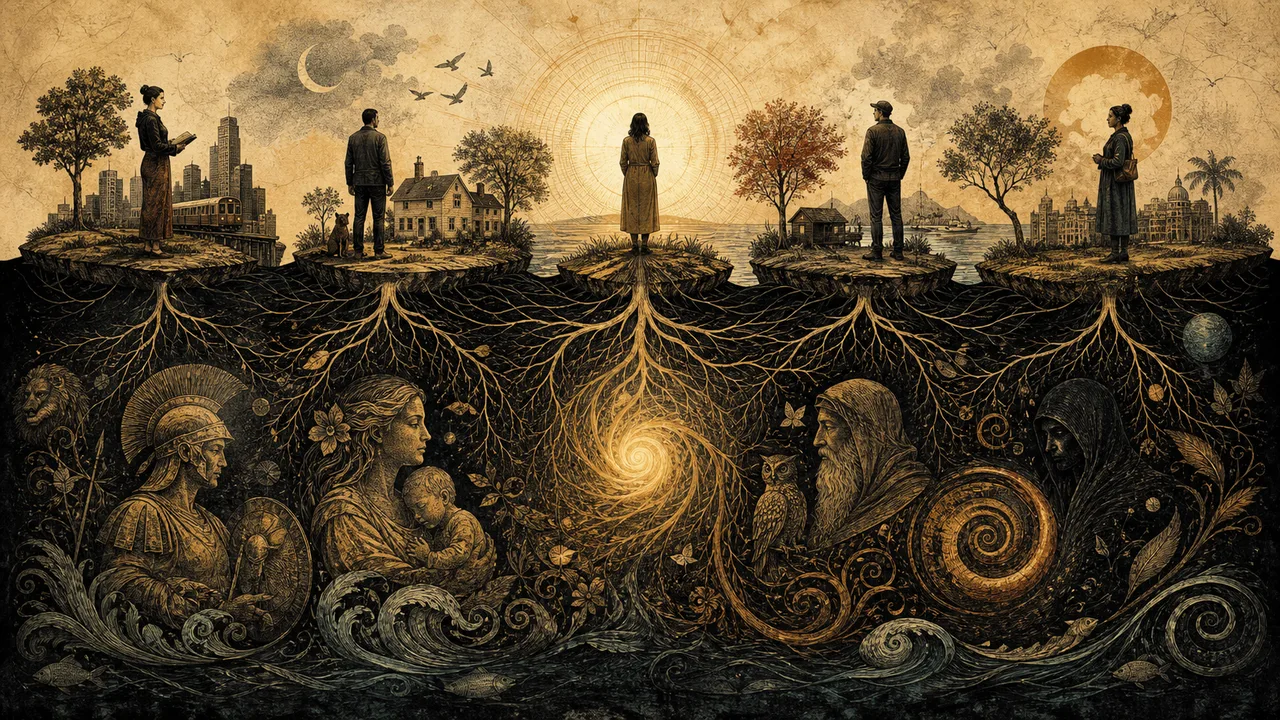
Archetypes are the structural contents of the collective unconscious. For Jung, one part of the unconscious is formed by our personal history, while another, deeper layer was not created solely by what each of us has lived. Within this collective layer are the forms that help organize fundamental human experiences.
In this article, you will understand how Jung organized this map of the psyche, the difference between a personal complex and a collective archetype, and why we do not inherit ready-made images or memories. We will also follow a complete example in which a particular loss encounters ancient images of descent, death, and return.
Continue reading to understand how the collective manifests without erasing individuality. When we distinguish form, image, history, and culture, the collective unconscious stops seeming like a vague idea and takes a clear place within Analytical Psychology.
Jung's proposed map of the psyche
Jung organized the psyche into parts that have different functions but remain related. Consciousness is the field we can recognize. Within it, we think, decide, remember, and say “I.” The ego functions as the center of this conscious identity.
Around this field is a great quantity of contents we do not perceive at that moment. A memory can disappear from attention and return later. A feeling can be avoided. A reaction can occur before we understand where it came from. All this shows that psychic life is greater than consciousness.
Jung called the layer formed by each person's history the personal unconscious. There we find forgotten, repressed, or poorly developed experiences, as well as emotional complexes organized around relationships and events.
Beneath this layer, Jung placed the collective unconscious. It would not come from what a person learned or experienced. It would be an innate foundation common to humanity, formed by dispositions that orient typical experiences.
We can imagine a house with an illuminated area and other parts outside the light. The comparison helps, but it has a limit: these layers are not physical rooms. They describe functional relationships within the psyche.
Nor is there a perfect wall separating the personal and the collective. We perceive a collective form only when it appears in a particular experience. The map allows us to distinguish origins and functions, but life continually blends memory, culture, emotion, and archetypal pattern.
The central point is this: complexes form a large part of the contents of the personal unconscious, while archetypes are the structural contents of the collective unconscious. This difference organizes the rest of the explanation.
Personal complexes and collective archetypes
A complex brings together memories, emotions, expectations, and defenses constructed through biography. A difficult relationship with the father can form a father complex. Later, situations involving authority awaken fear, anger, or a need for approval, even when the father is not present.
The archetype is not this personal history. It offers a deeper form related to authority, protection, law, power, and direction. This form can increase the complex's intensity, but it does not replace the real events that contributed to its formation.
Imagine two people facing a demanding boss. The first grew up with respectful limits and can disagree without feeling that they will lose all their worth. The second experienced constant humiliation and reacts as if every correction threatened their existence.
Both encounter an authority figure, but their personal histories give different content to the encounter. The collective pattern offers a possible organization. The complex determines a large part of the particular emotions and memories activated at that moment.
This relationship explains why an ordinary event can acquire enormous force. The real boss has attitudes that need to be evaluated. At the same time, this person may carry projections of judge, father, king, tyrant, or protector. The image becomes greater than the concrete person.
Separating complex and archetype restores proportion. We can recognize what arose from our history, what belongs to the present person, and the collective form that amplifies the experience. Without this separation, we blame only the past or treat everything as archetypal destiny.
The collective does not erase the personal. It passes through it. Every archetypal manifestation encounters complexes, memories, values, and cultural conditions. For this reason, two people never experience the same archetype in an identical way.
What the collective unconscious does not store
A frequent misunderstanding is to imagine the collective unconscious as a great archive of ancestral memories. It would contain complete dreams, myths, and experiences lived by our ancestors, waiting to reappear. This is not Jung's mature formulation.
According to Jung, we do not inherit images already filled with content. We inherit forms or possibilities of organization. Concrete experience is necessary for these forms to gain a face, place, emotion, and narrative.
Jung used the comparison of a crystal. A structure guides its formation, but the concrete crystal varies according to the materials and conditions it encounters. The structure does not contain a ready-made photograph of the result.
The archetype works in a similar way. The experience of care can produce images of mother, grandmother, house, earth, school, community, or divinity. The form brings together containment, nourishment, dependence, and growth. Life determines how these elements will be experienced and represented.
Nor do we inherit an entire myth. No one is born consciously knowing the story of Persephone or Inanna's descent. An experience of loss and return can produce images that resemble these narratives because it touches a similar human structure.
This difference is essential for understanding archetypes within the whole of human experience. If the content arrived ready-made, cultures and people would produce identical images. What we find are similarities of organization together with profound differences.
The collective unconscious, therefore, is not a repository. It is a foundation of living forms that we can infer only through their manifestations. We do not see the structure directly. We see dreams, fantasies, emotions, and behaviors in which it has received content.
How the collective becomes personal
An important situation can activate an archetype. Jung called this process constellating an archetype. The pattern gathers energy and begins to organize how we perceive the event, feel, and prepare to act.
A separation can constellate abandonment, the death of a stage, a crossing, and the search for return. These movements are collective because they accompany humanity. Yet the concrete person loses someone specific, has personal memories, and lives within a culture that offers certain images for death.
It is in this encounter that the collective becomes personal. The archetypal form organizes the experience. Biography offers faces, places, and bonds. Culture offers words, rituals, and symbols. Consciousness tries to bring all of this together.
Clara lost her partner after a rapid illness. During the first months, she dreamed that she descended through a cave until she reached a dark river. She searched for a bridge but found no passage. She awoke with a feeling of weight and distance.
The loss belongs entirely to Clara's history. The man who died, the interrupted plans, and the silent house are not abstract symbols. At the same time, the cave, descent, and river give the pain a form that appears in many human experiences.
The archetype alone does not explain the dream. We need to know what Clara experienced, how she feels about caves and rivers, and how the images transform over time. The collective offers a field of meaning, not an automatic answer.
When we follow this process, we perceive that the personal and collective are not separate boxes. The form becomes visible only in someone's experience. That experience, in turn, can touch a depth that extends beyond biography.
Personal grief encounters a collective image
In the first dreams, Clara only descended. The cave seemed to have no exit, and the river blocked the path. She felt that life had ended along with her partner. The image expressed what she could not yet say.
If someone stated that the cave always represents rebirth, they would be ignoring the dream's real stage. For Clara, at that moment, it meant descent, isolation, and contact with a darkness that could not be rushed.
As the months passed, details began to change. A small light appeared on a wall. Later, she found shallow stones across the river. In another dream, she saw a figure on the other side without being able to recognize who it was.
These changes did not predict an external event. They showed that Clara's relationship with grief was also changing. She continued to suffer, but began moving through days when she could work, talk, and care for her own home.
The collective images of descent, death, and return gave form to this movement. Many myths present characters who enter the underworld and return transformed. The parallel helps us perceive that descending does not mean remaining forever.
Yet Clara did not need to copy any myth. Her crossing included objects, memories, and bonds that belonged only to the relationship she had lived. The collective removed the pain from absolute isolation; the personal preserved the truth of that loss.
When she dreamed that she crossed the river, she did not consider her grief finished. She realized only that she could already carry the memory without feeling that she needed to die along with her partner. The image accompanied a change that also appeared in her attitudes.
This is the meeting between archetype and collective unconscious in a real life. The human form of descent and return encounters a particular loss. The result is not a ready-made universal symbol, but a new story in which the collective and the singular remain united.
Collective does not mean a single mind
The word collective may suggest a great shared mind, as if thoughts circulated through an invisible cloud. This is not what Jung's definition states. The collective lies in the common structure, not in a permanent mental conversation among all people.
We can compare it with the human capacity for language. We are born with dispositions to learn and produce language, but we do not bring a complete language with us. Portuguese, Spanish, Mandarin, and Indigenous languages have concrete forms, histories, and differences.
In the same way, an archetype offers a disposition that receives content. The fact that people experience care, separation, authority, and death does not make them think alike. Each culture organizes these experiences with its own images and practices.
Collective does not mean majority opinion either. A belief can be widespread and still remain conscious content learned socially. The collective unconscious describes a layer that does not depend only on a group's approval.
We also need to consider cultural transmission. A similar image may have traveled through books, films, religions, migrations, and education. Before calling it a spontaneous manifestation, Jung sought to rule out what the person might have known and forgotten.
This requirement prevents a hasty conclusion. Similarity does not prove a common origin. We need to understand the image's function and verify its context. A river in one dream may be a crossing; in another, it may represent a boundary, threat, or the flow of life.
The collective does not diminish diversity. It attempts to explain why human diversity also contains recurring movements. The common form and the singular manifestation need to remain together.
When a collective force dominates consciousness
An archetype can carry great energy. When it is constellated, the person feels they are living something larger than an ordinary situation. This intensity can favor transformation, but can also dominate consciousness.
Imagine someone who identifies with the role of savior. At first, this person wants to help and finds meaning in protecting people. Gradually, they begin to believe that only they know what others need. Disagreement becomes ingratitude, and limits become abandonment.
The collective force of the savior has amplified a personal intention. The person no longer realizes they are occupying a role. They believe they are this entire function. Jung called this exaggerated enlargement of identity through archetypal energy inflation.
The same movement can happen with victim, warrior, sage, mother, or leader. The image offers power, belonging, and certainty. In return, it demands that contradictory parts be denied. The savior does not admit exhaustion; the sage does not admit doubt; the warrior turns everything into battle.
Groups can also be taken over by collective images. A leader is treated as a redeemer, a community sees itself as a chosen people, or an adversary receives all projections of evil. Individuality diminishes, and ordinary people begin acting within an absolute narrative.
Recognizing this risk does not mean rejecting all collective enthusiasm. It means observing when the image removes the capacity to think, question, and answer for consequences. The greater the force, the more necessary it becomes to recover limits.
The archetype participates in life; it should not replace it. We need to continue seeing concrete people, facts, differences, and responsibilities. Collective meaning expands experience when it converses with consciousness, not when it takes its place.
How to dialogue with the collective without losing your own life
A conscious relationship begins with the image that appeared. Instead of immediately asking “which archetype is this?”, we can observe what it does. Does it bring together or separate? Protect or confine? Lead toward a passage or repeat a movement with no way out?
Then we return to personal history. Which memories were touched? Which current relationship participates in the emotion? What actually happened? This step prevents us from using a collective explanation to escape concrete wounds and choices.
Culture also needs to enter. Do we know this image from a book, film, religion, or teaching? What meaning does it have in the group to which we belong? Recognizing transmission does not diminish the symbol's value. It merely prevents us from attributing to the unconscious what we learned.
Finally, we look at the consequences. Does the image expand our capacity to live or confine us within a role? Does it help us endure a change or demand literal obedience? A living symbol opens understanding; a closed identification reduces every response.
Clara welcomed the cave as a form of her grief, but did not treat it as prophecy. She observed the transformation of her dreams alongside the changes in her routine. The collective offered a narrative of crossing, while her life revealed the real steps.
This attitude preserves both dimensions. We do not reduce everything to biography, as if each image were only a memory. Nor do we turn everything into archetype, as if facts and relationships did not matter.
The collective unconscious gives archetypes their place in Jung's theory. Our consciousness gives them the possibility of being recognized, distinguished, and lived responsibly. The work of making a deep force part of a singular life happens between these two parts.
Frequently asked questions
It is the innate and deep layer of the psyche that was not created solely by personal experience. Its structural contents are the archetypes, forms that organize fundamental human experiences.
The personal unconscious mainly contains memories, forgotten or repressed contents, and complexes formed through biography. The collective unconscious contains archetypal dispositions that extend beyond one person's history.
Jung did not say that we inherit complete memories or ready-made stories. The inheritance would be formal, similar to a possibility for organizing certain experiences, which receives content only in personal and cultural life.
No. It describes structures common to the human psyche, not a cloud of thoughts transmitted among people. Each manifestation appears within a particular consciousness, culture, and history.
An important situation can activate the pattern. It then manifests through images, emotions, expectations, and ways of acting filled by the person's experience.
Explore the Ultimate Guide to Archetypes
Understanding the collective unconscious helps us perceive where the patterns that extend beyond our personal history come from.
In the Ultimate Guide to Archetypes, you will learn to recognize these forces and observe how they take form in different areas of your life.
Explore the Ultimate Guide to Archetypes
About the author
Prof. Tibério Z has more than 30 years of experience teaching spirituality, metaphysics, holistic therapies and consciousness development.