
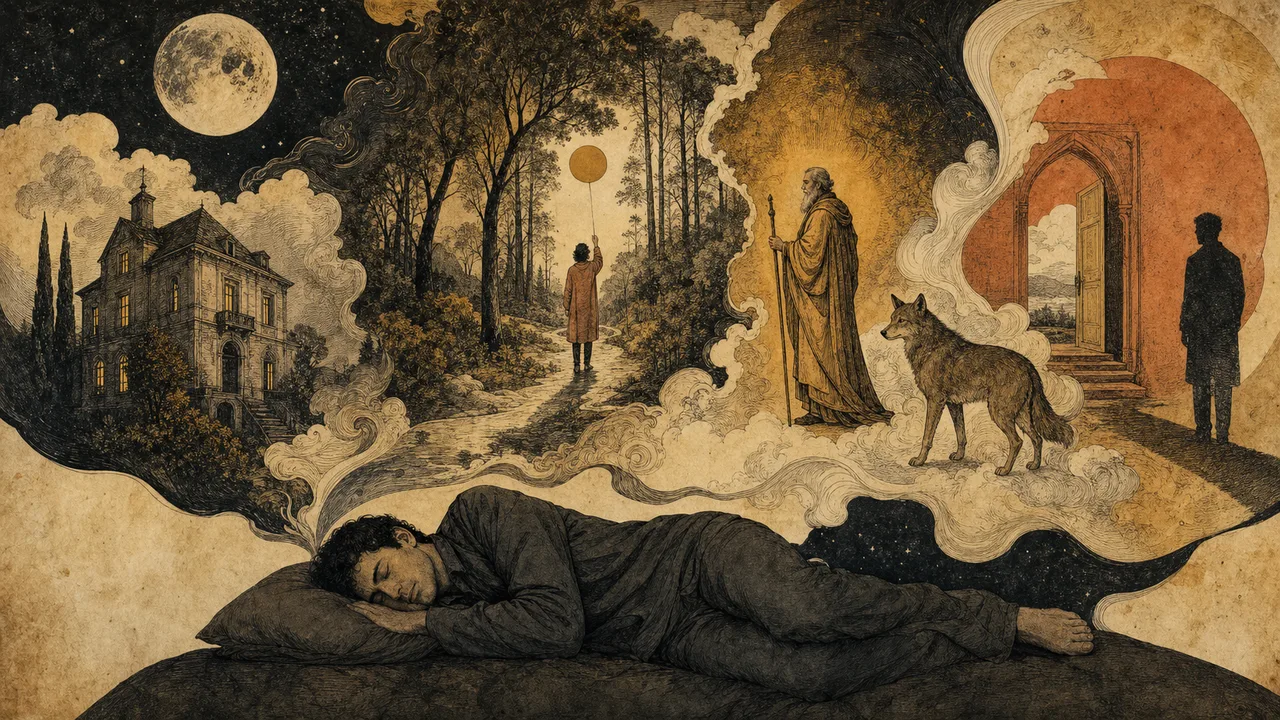
Archetypes may appear in dreams through characters, animals, places, and events that carry a force greater than an ordinary scene. However, a recurring image does not become archetypal merely because it has returned several times. To understand it, we need to observe its function, the emotion it awakens, and the history of the person who dreamed it.
In this article, you will understand how Jung viewed dreams, what compensation means, and the difference between a personal symbol and an archetypal image. We will also see why there are no ready-made meanings and follow a series of dreams from its beginning to the changes it produced in life.
Continue reading to learn to observe images carefully without turning them into codes, prophecies, or commands. A dream gains meaning when it stops being an isolated figure and begins to converse with our memories, conflicts, and choices.
Jung understood the dream as a portrait of the psychic situation
Carl Gustav Jung defined the dream as a spontaneous presentation of the current situation of the unconscious. This means that the scene is not built by conscious will. While we sleep, the psyche gathers images, characters, places, emotions, and actions to show an inner condition that we still cannot perceive in full.
A dream does not work like a note written in another language. Nor does it hide a simple sentence behind each object. We can compare it to a small play: the setting, the characters, and what happens among them form a whole. Removing a serpent, a door, or a tree from the story and looking for its isolated meaning destroys precisely the relationship that could help us.
The language of dreams is symbolic. A symbol does not fit into a single translation because it holds more than one possibility. A bridge may participate in a crossing, an approach, a fear of falling, or a concrete memory. What it represents begins to appear when we observe where it is, who crosses it, what lies on the other side, and how we feel before it.
For this reason, two people may dream of the same image and experience completely different movements. An old house may be a place of comfort for one person and imprisonment for another. Even in the life of a single dreamer, its function may change. A door that was locked in one dream may appear open months later because the person's relationship with the conflict has also changed.
Dreams are one of the ways in which archetypes in different experiences can gain a concrete image. This does not turn every dream into a manifestation of the collective unconscious. A large part of these scenes arises from memories, emotions, relationships, and personal problems. The archetypal dimension appears when this material participates in a broader human pattern without ceasing to belong to the particular story.
Compensation shows the side that consciousness left out
During the day, we organize life through a conscious attitude. We choose what we consider right, necessary, and possible. This attitude allows us to study, work, care for people, and build relationships. The problem begins when a single way of acting occupies all the space and prevents us from recognizing needs, emotions, or abilities that are also part of us.
The dream can compensate for this limited view. To compensate does not mean ordering us to do the opposite. It means presenting what had no representation in consciousness. If someone tries to be kind in every situation and dreams that they are shouting, the dream is not ordering that person to attack others. It may be showing a power of self-defense that was excluded along with every possibility of disagreement.
Imagine a woman who solves everyone's problems, never asks for help, and takes pride in needing no one. She dreams that she is lost in a forest, cannot carry her backpack, and needs to call a child who knows the way. The scene places before her a dependence that her conscious identity does not accept. The child does not give a literal command; it represents a different relationship with vulnerability and help.
Sometimes compensation appears gently. In other situations, it arrives through an exaggerated image because the conscious side has become too rigid. The more someone insists that they do not feel anger, fear, or sadness, the more intense the form used by the dream to reveal that emotion may become. The intensity draws attention to the imbalance, but we still need to discover how that image connects with life.
Compensation also does not turn the unconscious into a voice that is always right. Consciousness sees one part, and the dream presents another. Understanding arises from the dialogue between them, not from replacing one extreme position with its opposite. The person who is always helpful does not need to become indifferent; they can learn to help without abandoning their boundaries.
Not every recurring image is an archetype
When a house, a pursuit, or an animal returns for several nights, it is natural to imagine that we have found an archetype. The repetition truly deserves attention, but it is not enough to support this claim. An image may return because a personal experience remains emotionally charged and the conflict connected with it is still active.
We may dream many times about our childhood home during a family change. The place may concentrate memories of protection, fear, rivalry among siblings, or a need for approval. In this case, the repetition is organized by a personal complex, that is, by a set of experiences and emotions that reacts within us as though it had a will of its own.
The recurring image may also accompany a present habit. Someone who accepts tasks beyond their limit repeatedly dreams of missing a train. The train does not have a universal meaning. The scene may bring together haste, fear of disappointing others, lack of choice, and the feeling that life follows a schedule established by other people. The motif returns while this way of living remains outside awareness.
To understand the repetition, we need to observe what remains and what changes. Does the same dog continue chasing the person, or does it begin to walk beside them? Does the house remain closed, or does an entrance appear? Does the water rise, recede, or become clear? These changes reveal a movement. Often, the transformation of the image is more important than its frequency.
A personal image may draw closer to an archetypal dimension. The childhood home may become a deep space with unknown rooms and represent the psyche itself. A pursuit may take the form of a descent, a trial, or an encounter with the Shadow. Even so, the path begins with personal experience. The collective pattern expands the scene; it does not erase the dreamer's life.
The archetypal image has collective force without a fixed meaning
The archetype is a collective pattern of the psyche. It organizes basic human experiences such as care, abandonment, birth, death, search, conflict, creation, and transformation. We do not see the archetype directly. We encounter it through the images it assumes in dreams, myths, religions, art, and relationships.
An archetypal image is the concrete form that this pattern receives. The mother who welcomes or suffocates, the hero who goes through a trial, the child who announces something new, and the wise figure who guides may participate in archetypal movements. However, none of these figures has a function guaranteed by its name. An old woman may guide in one dream and deceive in another. A child may represent renewal or a fragile part that was abandoned.
These images often produce a different impact. The dream seems greater than an ordinary memory, carries an intense atmosphere, and remains vivid in the memory. We may feel fascination, fear, reverence, or the impression that we have entered an ancient story. This force indicates that the dream deserves care, but it does not prove by itself which archetype is present.
We also need to separate the archetype from the image. The Mother archetype is not a specific woman, a goddess, or the biological mother. These figures are possible forms of a pattern related to generating, nurturing, protecting, containing, and also preventing growth. Each culture and each person gives different clothing to this movement.
This difference explains why there is no catalog capable of translating dreams. Saying that “a serpent means transformation” or that “water means emotion” may seem to make the interpretation easier, but it removes action, context, and consequence. The serpent may injure, protect, shed its skin, surround a treasure, or remain still. Water may be absent, flood, cleanse, or separate. Meaning lies in the complete movement.
Personal associations come before mythological comparisons
The first step in understanding an image is to ask what it awakens in the person who dreamed it. Which memories arise? Which recent experience carries a similar emotion? Was the object familiar or strange? Did the figure help, threaten, observe, or guide? These questions bring the dream closer to life without reducing the scene to a quick explanation.
Think of a serpent. For a biologist, it may evoke interest, knowledge, and care. For someone who suffered a bite, it may bring danger and helplessness. For a doctor, it may approach healing; for another person, betrayal. None of these associations exhausts the symbol, but each offers a starting point that belongs to real experience.
After listening to personal associations, we can expand the image through myths, tales, religions, and cultural expressions. This work is called amplification. A bird can be compared with messengers, movements between heaven and earth, or figures that cross boundaries. The comparison shows possibilities that were not visible, but it does not decide which of them belongs to the dream.
Amplification stops helping when it becomes an imposition. Finding a serpent in a myth does not prove that the serpent in the dream performs the same function. The myth may reveal a question, a similarity, or an opposition. Confirmation comes from the relationship among the image, the associations, the situation being lived, and the development of later dreams.
It is also important to observe the verbs. A tree that protects does not perform the same movement as a tree that falls on the house. An old man who hands over a key differs from one who blocks the passage. When we look only at the name of the figure, we lose the action. It is precisely the action that shows how that force is relating to consciousness.
Dream characters may speak about the world and about us
Dreaming about someone we know creates an immediate question: does the scene speak about that person or about me? Both possibilities exist. On the objective level, the character may primarily represent the real relationship, a conflict, a concern, or something we perceive in that person. On the subjective level, the character may give form to a quality that also participates in our personality.
Imagine someone who dreams of a demanding boss insisting on an impossible report. If the work situation is abusive, the dream may highlight an external problem that requires a boundary. However, the same boss may also represent an inner authority that never considers the person's effort sufficient. Life and the scene help us see which side has more strength.
Unknown characters usually make a subjective reading easier, but they do not follow an automatic rule either. An aggressive man may represent a rejected force, a fear, a memory, or a perception of danger. Before classifying him as the Shadow, we need to ask what he does, how the dreamer reacts, and where that relationship appears during the day.
The subjective level does not mean that everything is the dreamer's fault. If a real person crosses boundaries, recognizing an inner part does not erase the external fact. In the same way, pointing only to the other person's behavior may prevent us from seeing our participation. A good interpretation can hold both questions: what is happening in the relationship, and what does this figure move within me?
Sometimes the two levels work together. We may choose authoritarian partners because an inner authority has not found a conscious form. We may admire someone's courage because this ability is beginning to ask for space within us. The dream connects outer and inner experience, allowing the relationship to stop carrying by itself everything that we have not yet recognized.
A series of dreams shows the movement more clearly
An interpretation is a hypothesis. We may build a very convincing idea about a dream and discover the next night that we were looking in the wrong direction. For this reason, a series of dreams offers greater assurance than an isolated scene. Later images complete, transform, or correct the initial understanding.
Imagine someone being pursued by a hooded figure. In the first dream, the person runs away. In the second, they find a door and observe the figure from a distance. In the third, the pursuer removes the hood and hands over a tool. If we interpreted only the first scene, we might conclude that the figure represents a threat. The sequence shows that it also carried an ability that had not yet been accepted.
Recording dreams helps us follow this movement. It is worth noting the date, the place, the characters, the actions, the emotions, and important events from the nearby days. We do not need to write a book every morning. A few lines that remain faithful to the scene already allow us to recognize what returned and what changed.
The record also protects against selective memory. After finding an explanation, we tend to remember only the details that confirm our idea. When we reread the dream as it was recorded, we notice forgotten elements: a door was already open, the figure did not attack, or the main emotion was not fear but curiosity.
The criterion is not to make the dream fit a theory. The question is whether the hypothesis clarifies the conflict and helps connect image and life without violence. When an interpretation requires us to ignore facts, abandon responsibilities, or treat every doubt as resistance, it has lost contact with reality. Later dreams may reveal this mistake and call for a broader understanding.
The black bird leads Camila to a forgotten voice
Camila manages a team and is known for always being available. She accepts tasks beyond her limit, avoids disagreement, and tries to respond calmly to everyone. This attitude helped her career, but it also created a problem: every sign of conflict seems to threaten her image as a competent and pleasant person.
In her youth, Camila wrote stories. She abandoned her notebooks when she started working and came to consider writing a waste of time. In recent months, she felt irritated when she heard colleagues express ideas freely. Instead of recognizing this desire within herself, she called those people irresponsible and continued accumulating demands.
In the first dream, Camila returns to her grandmother's house. She sees a closed attic and hears loud knocks at the window. A black bird is trying to get inside. Camila feels afraid, runs out, and wakes with her heart racing. The dream repeats two weeks later with the same house, the same window, and the same bird.
It would be easy to look up “black bird” in a dictionary and choose among death, bad omen, or transformation. Camila begins another way. Her grandmother's house reminds her of the vacations when she wrote. The attic held old boxes and notebooks. Her grandmother said that birds brought news. At the same time, the bird awakens the childhood fear of being punished when she spoke her mind.
These associations create a first hypothesis. There is a guarded voice, connected with writing and expression, knocking against a closed part of life. The bird seems threatening because the power to speak is still received as a danger. Repetition by itself does not prove an archetype. It shows that the personal conflict remains active and calls for attention.
In the third dream, the scene changes. Camila manages to open the attic door. The bird is already inside, perched beside some dusty notebooks. It does not attack her. It only looks at the notebooks. The change corrects the idea that the bird was merely a threat. Its action now leads her to something forgotten.
We can expand the image by remembering that birds appear in many stories as messengers and cross spaces that human beings do not cross in the same way. This comparison deepens the bird's role as the bearer of a message between different realms. Even so, myth does not replace Camila's story. The house, attic, and notebooks remain connected with her experience.
Camila begins to record her dreams and returns to writing twice a week. At work, she respectfully challenges a deadline she could not meet and explains the team's limits. At home, she talks with her partner about her fear of rejection when she disagrees. She does not leave her job or turn the bird into an order. She gives real space to the voice that previously could appear only at night.
A few weeks later, Camila dreams that she opens one of the notebooks. The attic window is open, and the bird flies outside. The image did not need to disappear: its function changed. First it knocked at the window, then it led Camila to the notebooks, and finally it found a passage. The series accompanied the transformation in the relationship between consciousness and expression.
The case shows why the meaning did not lie in the bird's color. It arose from the scene, the associations, the repetition, the changes, and the choices made during the day. The possible archetypal force of the messenger expanded the experience but did not erase its personal origin. The dream gained value because it helped Camila live in a different way.
Interpretation requires a dialogue with reality
Observing dreams is not a search for certainty where there is a symbol. We begin with questions and treat every interpretation as a possibility. The hypothesis grows stronger when it respects the scene, makes sense to the person who dreamed it, clarifies a conscious attitude, and continues to find support in later dreams and in life.
A dream also does not predict the future as a closed event. It may perceive tendencies that consciousness still ignores. Someone who lives exhausted may dream of a machine breaking before admitting their own limit. This is not a prophecy about a real machine. It is the presentation of a path already being built by habits, emotions, and choices.
Likewise, a death in a dream does not necessarily announce a physical death. It may show the end of a role, a relationship, or a way of living. However, even this explanation should not be applied automatically. The death of a loved one may also arise from the fear of losing them. Context remains indispensable.
We can begin with a notebook and four questions: what happened, what was the main emotion, what does each image awaken in me, and where does this movement appear in my life? Then we observe what repeats and what changes. This practice already removes the dream from the field of quick curiosity and creates a more conscious relationship with its images.
Dreams that are very disturbing, frequent, or connected with intense suffering deserve care. Symbolic reflection does not replace psychological support, medical evaluation, or protection in real situations. Seeking help does not diminish the inner experience; it offers a safe space in which it can be understood without hasty decisions.
The value of a dream does not lie in receiving a ready-made answer. It allows us to encounter a part of life that did not yet have words. When we bring image, emotion, history, and reality together, archetypes stop being distant names and begin to reveal movements that call for awareness, choice, and responsibility.
Frequently Asked Questions
No. Repetition may be connected with a memory, a current conflict, or an emotion that has not yet been understood. An archetypal image participates in a collective pattern, but it also receives the particular form of the dreamer's life.
No. The same image can perform very different functions. Its meaning depends on the action, emotion, personal associations, current circumstances, and the image's relationship with the rest of the dream.
Record the scene, the date, the emotions, and important events from the nearby days. Then write down what each person, place, or object evokes in you. Begin with your own experience before seeking cultural comparisons.
It may indicate that a conflict remains active, but repetition also needs to be observed through its changes. The figure may draw closer, speak, stop threatening, or assume another role as the relationship with that content changes.
A dream can broaden reflection and show a side that was forgotten, but it does not replace an analysis of reality. Important decisions need to consider facts, consequences, responsibilities, and professional guidance when necessary.
Explore the Ultimate Guide to Archetypes
Observing archetypes in dreams expands our dialogue with images that reveal conflicts, strengths, and movements of consciousness.
In the Ultimate Guide to Archetypes, you will learn to recognize these patterns and connect them with the experiences you are living.
Explore the Ultimate Guide to Archetypes
About the author
Prof. Tibério Z has more than 30 years of experience teaching spirituality, metaphysics, holistic therapies and consciousness development.