
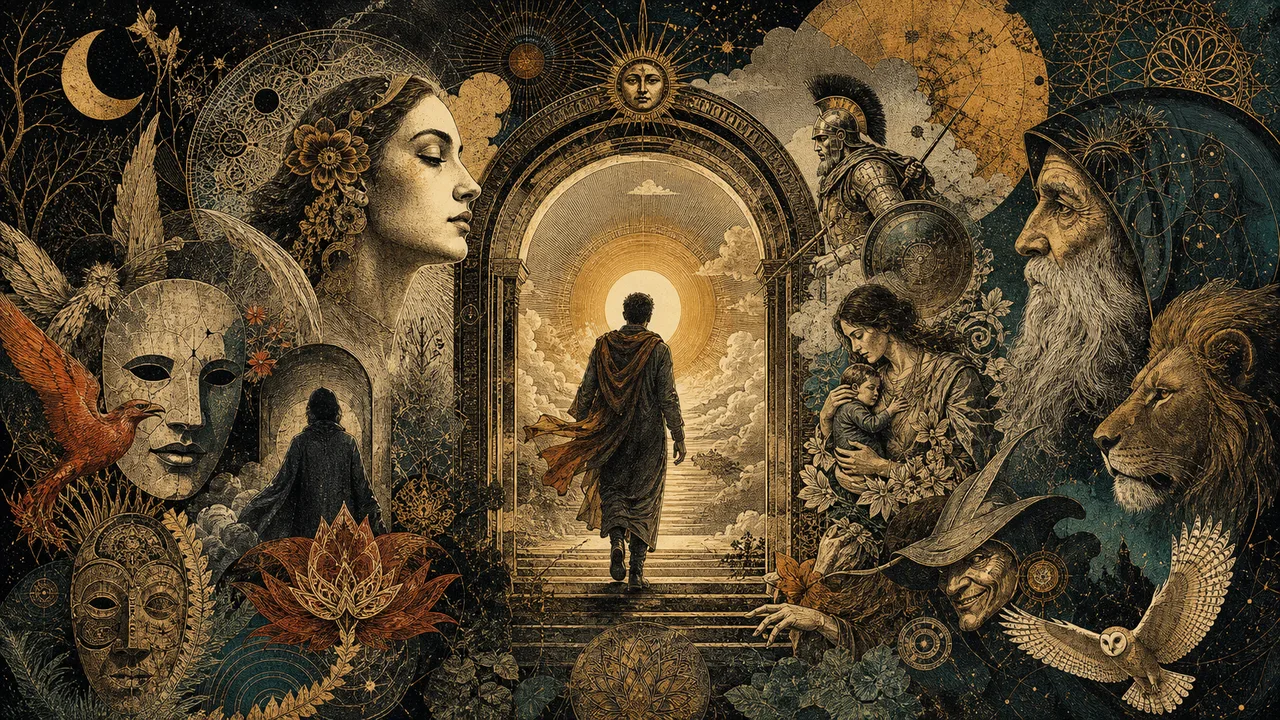
Archetypes are deep forms that organize human experiences such as care, separation, struggle, transformation, and the search for meaning. They are not ready-made characters hidden inside us. Each archetype gains images, emotions, and ways of acting when it encounters our history, our culture, and the stage of life we are going through.
In this article, you will understand where this concept came from and how Carl Jung brought it into Analytical Psychology. You will also learn about the relationship among archetypes, the collective unconscious, symbols, dreams, and myths, as well as the functions of the Persona, the Shadow, Anima, Animus, and the Self.
Continue reading to follow the subject in a clear order, from its definition to recognizing these patterns in your own life. This will allow you to study these forces without turning them into labels, ready-made answers, or excuses for acting without awareness.
What are archetypes?
An archetype is an unconscious form that guides the way certain experiences acquire meaning. Think of a riverbed. The bed indicates where the water tends to flow, but it does not determine every drop, the speed of the current, or the landscape that will emerge around it. An archetype likewise offers a direction without writing a person's story in advance.
For this reason, we do not inherit a ready-made image of the Hero, the Mother, or the Sage. We inherit the possibility of organizing challenges, protection, and the search for knowledge through these forms. When one of them is activated, images, emotions, fantasies, and impulses related to the same movement arise. The study of what archetypes are explores this passage between the invisible form and its effects on life.
The archetype influences experience, but it does not make every decision in our place. Our history, our awareness, and our choices continue to participate in what we do. Recognizing an archetypal force is not meant to say, "This is just who I am." It is meant to help us understand what has gained so much energy within us and how we can relate to it without losing responsibility.
How did the concept of archetype arise?
The word archetype existed long before Carl Jung. It brings together the idea of origin and the idea of a model or form. In Plato's philosophy, visible things were related to Forms that did not depend on particular objects. A specific horse ages and dies, but the philosophical question sought what allows us to recognize all horses as participating in the same form.
After Plato, the word appeared in religious and philosophical texts to indicate original models, divine images, and principles that came before the visible world. Centuries later, other thinkers changed the question. Instead of looking only for models outside the human being, they began to investigate the forms through which we know and organize experience.
Jung received this long heritage, but made a decisive change: he placed the archetype within the study of the psyche. He did not claim that Plato's Forms and psychological archetypes were the same thing. The origin of the concept of archetype shows how the word passed through different questions before becoming the name of an unconscious disposition capable of producing images and behaviors.
How did Carl Jung develop the study of archetypes?
Jung did not begin with a list of characters. Early in his career, he used word-association tests and noticed that certain words caused delays, confusion, forgetfulness, or emotion. These reactions showed that some groups of memories and feelings acted with relative autonomy. He called these groups complexes.
While studying the dreams, fantasies, and accounts of his patients, Jung encountered images that did not seem to be explained by personal history alone. He also went through an intense period of confrontation with his own inner images. Instead of treating everything as meaningless fantasy, he recorded, drew, and observed the movement of these figures. This led him to compare individual experiences with myths, religions, tales, and alchemical images.
Carl Jung's work with archetypes matured over decades. Jung corrected terms, separated the archetype from its image, and insisted that we should not interpret a symbol through superficial resemblance. His method looked for the function of the image within that particular life and only then sought cultural parallels that might expand understanding.
What is the relationship between archetypes and the collective unconscious?
Jung divided the unconscious into two layers to explain different phenomena. The personal unconscious holds forgotten memories, repressed feelings, and complexes formed through each person's history. The collective unconscious is deeper and was not created solely by individual experiences. It contains the archetypal forms shared by humanity.
This does not mean that we all hold the same memories or that there is a collective mind filled with ready-made images. What is collective is the form. The concrete content emerges when that form encounters a family, a culture, and a personal situation. Two people may experience a loss and dream of descent and return, but the characters, places, and meaning of the experience will be different.
The relationship between archetypes and the collective unconscious explains how the universal and the personal meet. A mother complex, for example, carries facts lived with the real mother as well as the greater force connected to protection, dependence, nourishment, and separation. If we erase personal history, everything becomes myth. If we ignore the collective layer, we fail to understand why certain experiences affect us so powerfully.
What is the difference among an archetype, an archetypal image, and a symbol?
The archetype is the form that we cannot see directly. The archetypal image is the face that this form receives when it enters consciousness. A wise old woman, a gigantic tree, a luminous child, or an underground house are images that may carry an archetypal force. They are not the archetype itself, because the same pattern could appear in another way.
A symbol arises when an image expresses a meaning that we still cannot exhaust with an explanation. A traffic sign has a defined meaning; a bridge in a dream does not work that way. It may bring together passage, risk, union, farewell, or a decision, depending on the life of the dreamer and what happened before and after that scene.
Understanding the difference among an archetype, an image, and a symbol prevents two mistakes. The first is believing that every image has a universal meaning. The second is reducing a living symbol to a dictionary answer. An image must be related to emotion, the moment, and personal associations before it receives any name.
What is the Persona?
The Persona is the face we present to the world. It helps us occupy a profession, speak with different groups, and meet the basic expectations of each environment. You do not speak to a child in the same way you speak in a work meeting. This change does not prove falsehood; it shows that living with others requires forms of adaptation.
The problem begins when the mask stops being a tool and becomes the entire identity. A teacher may continue correcting everyone at home. A person known for being strong may hide all sadness so as not to disappoint others. The more rigid the Persona becomes, the more aspects of life must be pushed into the hidden side.
Understanding the function of the Persona helps us use our roles without being used by them. Losing a position, ending a relationship, or leaving a group hurts even more when we do not know who we are outside that role. A conscious Persona is flexible: it fulfills its role and then allows other parts of life to exist as well.
What is the Shadow?
The Shadow gathers everything that does not fit the image we accept showing. When a child learns that feeling anger is always wrong, the child does not stop feeling angry. The child learns to hide it. Over time, this emotion may appear in sarcasm, outbursts, and accusations against people who openly express what the child was taught to forbid within.
Not everything that goes into the Shadow is destructive. Courage, creativity, firmness, and pleasure may also be rejected when they threaten adaptation to the group. Encountering the Shadow, therefore, does not only mean discovering flaws. It often means recovering a quality that was abandoned in order to preserve love, approval, or safety.
The Shadow archetype becomes most visible in projections and in reactions that are greater than the situation. Integration does not mean obeying every hidden impulse. It means recognizing the emotion, removing from others the role of carrying everything we deny, and finding a responsible expression for that force. Recognized anger, for example, can become a clear boundary instead of aggression.
What are Anima and Animus?
Jung called the inner feminine figure of a man Anima and the inner masculine figure of a woman Animus. This is the original definition, created within the language and gender distinctions used in his time. Anima and Animus have a part formed through relationships with real mothers, fathers, women, and men, but they also carry an archetypal dimension that goes beyond any single experience.
When these figures remain unconscious, we tend to project them. A man may see in a woman a perfection he does not know and expect her to carry his entire emotional life. A woman may assign absolute authority to a man or become dominated by rigid opinions that seem like unquestionable truths. The real person disappears behind the projected image.
The study of Anima and Animus shows how these figures appear in dreams, moods, and relationships. Jung also attributed a positive function to them: becoming a bridge between consciousness and the unconscious. Today we may discuss the limitations of tying these figures rigidly to sex, but we should not erase Jung's formulation and replace it with a definition he did not create.
What is the Self?
The ego is the center of consciousness. It is the "I" that remembers, chooses, plans, and recognizes continuity in its own life. The Self is greater: it represents the totality of the psyche, including consciousness, the unconscious, and possibilities we do not yet know. The ego belongs to the Self, but it does not own everything that exists within us.
Jung described the Self as both center and totality. This sounds strange until we think of a city: it has an organizing center, but its life encompasses neighborhoods, paths, and regions that extend far beyond that point. Dreams of circles, mandalas, stones, divine children, and unions of opposites may give an image to the organizing movement of the Self.
The archetype of the Self does not represent a perfect or superior version of us. It leads toward a more whole life, in which forgotten parts find a place and opposites cease to be a war with no way out. There is also a risk: when the ego identifies with this force, the person feels chosen, infallible, or above human limits.
What is individuation?
Individuation is the path of becoming a more whole and singular person. It does not mean abandoning others to do only what we want. Nor does it mean destroying the Persona, releasing every impulse of the Shadow, or reaching a state of perfection. The process asks for a conscious relationship with the parts of the psyche and responsibility for the choices we make.
This path often begins when an identity that worked for years no longer serves. A person has built a career, family, and recognition, yet realizes that something important was left out of life. Dreams, conflicts, and persistent emotions begin to present what was forgotten. The crisis does not bring a ready-made answer, but it forces the ego to enter into dialogue with what it once ignored.
The process of individuation passes through encounters with the Persona, Shadow, Anima, Animus, and Self, although it does not follow the same staircase for everyone. Integrating a part does not mean allowing it to rule. It means creating a new response that recognizes both sides of the conflict. Becoming whole requires concrete choices, not only intellectual understanding.
How do archetypes appear in dreams?
During a dream, consciousness does not choose the scene in the same way it chooses a sentence while awake. Characters, animals, places, and events arise with emotions of their own. When they carry a force greater than ordinary experience, they may reveal the presence of an archetypal image. Even so, intensity and repetition are not enough to name the pattern.
Jung understood that a dream shows the situation of the psyche and often compensates for a conscious attitude that has become too narrow. Someone who lives trying to control everything may dream of a flood. Water does not automatically receive a universal meaning. We need to know what it awakens in that person, how the person experiences control, and what changes over a series of dreams.
The study of archetypes in dreams begins with personal associations and context. Myths and cultural images may then expand the reading. A dream is neither an order nor a prophecy. It opens a dialogue, and its understanding must be confronted with reality, relationships, and the consequences of choices.
Why do archetypes repeat in myths?
Every people must deal with birth, separation, power, loss, sexuality, danger, and death. These fundamental experiences activate similar forms, which is why we find descents into the underworld, monsters, creator mothers, special children, and journeys of transformation across many cultures. What repeats is the movement, not a complete story.
Each people gives the pattern its own names, landscapes, values, and conflicts. Inanna and Persephone descend into the underworld, but their stories are not copies. The power relationships, consequences, and place of each character change. Narratives have also traveled through trade, migration, wars, and encounters among cultures.
Recognizing archetypes in myths requires keeping the human pattern and cultural roots together. If we look only at similarities, we erase the history of each people. If we look only at differences, we fail to see why certain movements continue to touch people living in places and times far apart.
What does the Hero archetype represent?
The Hero appears when life requires us to leave a familiar position, face a trial, and develop a new ability. The call does not always arrive as an adventure. It may appear as illness, separation, responsibility, a change of job, or the need to defend a value. Courage begins when fear is still present but no longer decides alone.
The trials show that brute strength cannot solve everything. The Hero must accept help, recognize limits, and face the monster guarding part of the transformation. Sometimes the monster represents an external danger; in other situations, it reveals pride, fear, or violence the hero has not yet recognized within. The return shows whether the learning has entered life or remained only in fantasy.
The Hero archetype was studied by Jung before Joseph Campbell organized the well-known journey into separation, initiation, and return. Heroic force also has a shadow. When it becomes the only identity, the person creates unnecessary battles, rejects rest, and tries to save everyone in order to continue feeling indispensable.
What does the Great Mother archetype represent?
The Great Mother brings together forces connected to generating, nourishing, protecting, containing, and transforming life. She is not the personal mother and does not represent all women. The actual mother participates in a biographical relationship; the archetype is broader and may take form in people, institutions, houses, caves, gardens, seas, and other symbols of origin and shelter.
This force has a loving side and a terrible side. The same womb that protects may also prevent departure. Care that sustains a child becomes a prison when it does not allow growth. Creation and separation, therefore, are not opposite movements: what is truly born must gain an existence of its own.
The Great Mother archetype also participates in cycles of death and rebirth. One phase must end so that another can find space. Erich Neumann explored these poles more deeply by showing the containing character and the transforming character. The practical question is simple: does our care nourish life, or does it keep another person dependent on us?
What does the Sage archetype represent?
The Sage appears when familiar answers fail and we need to understand before acting. Its strength does not lie in accumulating books, degrees, or difficult phrases. Information provides data; knowledge organizes that data; wisdom recognizes what it means; discernment chooses what fits the concrete situation.
In dreams and tales, the Sage may appear as an old man, an old woman, a master, a guide, or a voice that offers a decisive question. A true guide does not live the hero's task for them. The guide provides direction, an object, or a new way of seeing and returns the decision to the one who must walk. The external teacher fulfills the finest role when awakening the inner teacher.
The Sage archetype also has a dark face. Knowledge becomes power when it is used to humiliate, control, or create dependence. Study may also hide the fear of acting: the person looks for one more theory, one more lesson, and one more certainty so as never to face the risk of a real choice.
What does the Trickster archetype represent?
The Trickster crosses boundaries, breaks rules, and reveals contradictions that order tried to hide. This figure appears as deceiver, prankster, thief, messenger, and creator of confusion. Its logic does not respect fixed identities: it can help and harm, reveal a truth, and at the same time lie about its own intentions.
Humor is one of its forces because it breaks an appearance that has become too serious. A joke reveals the absurdity of a rule and allows everyone to see what no one dared to say. Disruption alone, however, does not create transformation. When a person uses irreverence to hurt others and then escapes the consequences, freedom has become manipulation.
The Trickster archetype forces us to ask what the disorder revealed and who paid for it. Jung connected this figure to a primitive and poorly differentiated layer of consciousness. The Trickster matures when it stops considering itself innocent in the face of the chaos it created and accepts its part in the change.
What are the 12 personality archetypes?
The well-known system of twelve archetypes was not created by Jung. Carol Pearson organized this model from Jungian thought and the journey of development. It includes the Innocent or Idealist, Orphan or Realist, Warrior, Caregiver, Explorer, Lover, Rebel, Creator, Ruler, Magician, Sage, and Jester.
Each force offers an ability and a shadow. The Caregiver supports, but may create dependence. The Ruler organizes, but may control. The Explorer opens paths, but may run from bonds. The Creator gives form to the new, but may never consider anything finished. This double face prevents the model from becoming a division between good and bad archetypes.
The twelve personality archetypes do not form twelve boxes into which we must place everyone. Several patterns act together, and each phase of life calls forth different forces. The model becomes useful when it expands observation; it loses value when it turns a current response into a permanent label.
How can we identify the active archetypes in our lives?
The first step is not to choose the most attractive character. It is to observe what repeats. What role do you occupy in different groups? Which conflict returns even when the people change? What kind of character appears in your dreams? Which qualities provoke fascination or rejection far greater than the situation seems to justify?
Then gather the signs. A man who always rescues teams in crisis, feels guilty when resting, and repeatedly dreams of towers in flames may be living through a powerful heroic constellation. The name does not come from a single behavior. It emerges when role, emotion, dream, and relationship point to the same movement.
Learning to identify active archetypes does not mean turning the Hero into an identity. The man in the example also needs to recognize his fear of appearing weak and his need to be indispensable. When he accepts helping without carrying everything alone, the heroic force remains available but stops commanding his life automatically.
Frequently Asked Questions
No. An archetype is an unconscious form that organizes certain experiences. It gains characters, images, emotions, and behaviors when it encounters our history and the situation we are living through.
No. Jung developed the psychological study of archetypes, but the closed system of twelve archetypes was later organized by Carol Pearson from Jungian ideas.
No. Different archetypes participate in our lives and gain strength according to the phase, conflict, and task we are facing. Turning one of them into a fixed identity impoverishes observation.
No. Meaning depends on the person's history, culture, emotion, and the context in which the symbol appeared. An image should not be interpreted through a ready-made table.
Observe roles, conflicts, emotions, dreams, and relationships that repeat. Gather these signs before choosing a name, and notice what changes when you stop acting automatically.
Explore the Ultimate Guide to Archetypes
This guide brought together the origin of archetypes, their place in the psyche, and the main ways these forces appear in dreams, relationships, conflicts, and choices.
In the Ultimate Guide to Archetypes, you can explore each force more deeply and learn to recognize its potential, its shadows, and its participation in your journey.
Explore the Ultimate Guide to Archetypes
About the author
Prof. Tibério Z has more than 30 years of experience teaching spirituality, metaphysics, holistic therapies and consciousness development.