
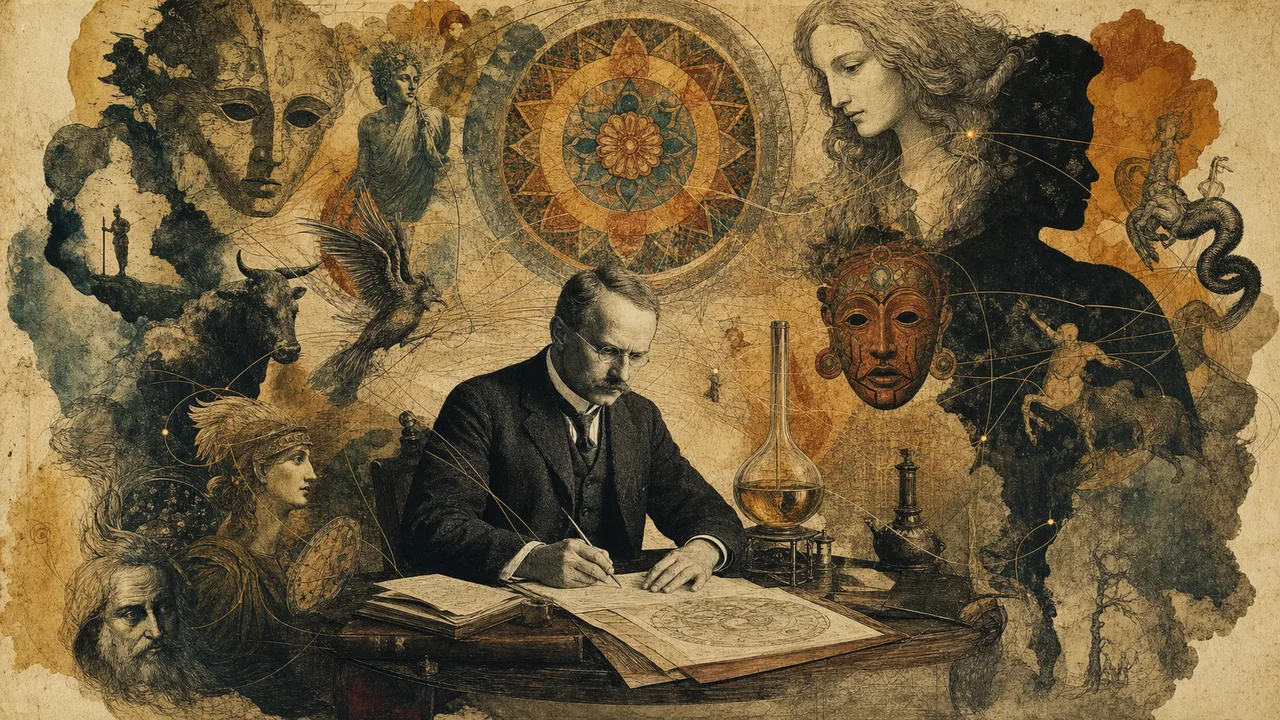
Carl Jung did not create the theory of archetypes all at once. His study began with experiments on emotional responses, passed through personal complexes, expanded through dreams, fantasies, and myths, and continued to be revised for decades. The concept arose from a journey, not from a ready-made list of characters.
In this article, you will follow the main stages of this development. We will understand how association tests opened a door to the unconscious, why Jung moved away from Freud, the importance of his own images, and how he compared dreams, religions, tales, and alchemy without using an automatic dictionary of symbols.
Continue reading to see what Jung was truly observing when he spoke of archetypes. Understanding his method helps separate a deep investigation of the psyche from the hurried use that turns every character, dream, or behavior into a label.
Jung began with association experiments
Before becoming known for archetypes, Jung worked as a physician at the Burghölzli psychiatric hospital in Zurich. There he took part in word-association research. The procedure seemed simple, but it revealed movements that the person did not consciously control.
The researcher spoke a word, and the participant responded with the first word that came to mind. The response time, repetitions, lapses of memory, errors, and physical reactions were also observed. Some words received quick responses. Others produced silence, confusion, or an unexpected emotion.
Imagine that someone responds normally to table, window, and garden, but remains silent for a long time when hearing father. The person then tries to explain the delay, forgets what was said, or makes another mistake when the word reappears. The disturbance shows that this stimulus touched an emotional core.
Jung called these cores complexes. They bring together memories, feelings, expectations, and conflicts connected to an experience. A complex is not merely an idea we choose to think about. It can interfere with attention, memory, the body, and behavior before consciousness understands what happened.
These experiments were important because they gave Jung an empirical beginning. The unconscious did not appear as an abstract theory. It showed its effects in response time, errors, and what a person tried to avoid without realizing it.
The first step, therefore, was discovering that consciousness does not govern psychic life alone. There were relatively autonomous emotional groups. The theory of archetypes would emerge only when Jung encountered material that did not seem to be explained solely by the personal history of these complexes.
Complexes opened a door to the unconscious
A complex forms around personal experiences. A difficult relationship with one's father, for example, may bring together fear, a desire for approval, anger, and memories of humiliation. Later, an authoritative voice at work may activate the same group, even when the current supervisor does not behave like the father.
At that moment, the reaction no longer belongs only to the present. A simple question sounds like an accusation. An ordinary boundary is experienced as rejection. The person responds to the current situation as well as to the emotional group that was awakened.
Jung realized that complexes acted like small personalities within the personality. They had an organization of their own and could alter what consciousness intended to do. This discovery remained central to his psychology.
A complex and an archetype, however, are not synonyms. A complex has a recognizable personal history. An archetype belongs to a collective layer and offers a deeper form that can increase the intensity of the complex.
In a relationship with the real father, larger images of authority, law, protection, judgment, and power may enter. These images do not erase what the father did. They help explain why the personal figure may receive a magnitude that exceeds the actual person.
This difference opened a new question for Jung. Part of the unconscious was formed by what we live through, forget, or repress. Yet some images seemed to touch human experiences that existed before our biography: birth, care, separation, trial, death, and transformation.
The path from complexes to archetypes was not a leap. Jung first recognized the autonomy of the personal unconscious. He then began to investigate whether the psyche also contained collective forms capable of organizing experiences that accompany humanity.
Symbols of Transformation broadened the question
Early in his career, Jung maintained an important collaboration with Sigmund Freud. Both agreed that the unconscious participated in symptoms and human life. Their differences grew when Jung began to give psychic energy and symbols a broader reach.
Freud related libido primarily to sexual energy. Jung began to use it as a broader psychic energy that could appear in sexuality, the pursuit of power, creation, religion, and the transformation of personality.
This change took shape in Psychology of the Unconscious, published in two parts between 1911 and 1912 and later thoroughly revised as Symbols of Transformation. Jung analyzed fantasies alongside numerous mythological and religious parallels.
The symbol was no longer understood only as the disguise of a repressed desire. It could also transform energy and create a passage between an attitude that no longer served and another that was still being born. The image did not merely conceal the past; it could participate in a future movement.
Think of a person who has lost any sense of meaning in their work and begins to dream of a sea voyage. The image may bring together fear, a desire for change, loss of direction, and the search for another shore. Reducing it to a single explanation would destroy precisely what the symbol is still trying to form.
The work marked the theoretical separation between Jung and Freud. The rupture did not happen because of a single statement, but because of differences over libido, religion, symbols, and the nature of the unconscious. Jung was moving toward a psychology in which the psyche was not formed solely by individual biography.
The mature definition of archetype did not yet exist. Its main elements, however, were drawing closer: primordial images, psychic energy, recurring myths, and symbols capable of organizing transformation.
The confrontation with his own images
After the break with Freud, Jung entered a period of great inner instability. Between 1913 and the years that followed, he began recording dreams, visions, and fantasies. This material would later form the work known as Liber Novus, or The Red Book.
Jung did not treat these images as invented stories without importance. Nor did he obey them as literal commands. He tried to enter into dialogue with the figures, follow the development of the scenes, and understand their effect on his consciousness.
This work gave rise to a practice he called active imagination. Instead of interrupting a fantasy as soon as it appears, the person allows the image to continue and consciously participates in the dialogue. The purpose is not to lose contact with reality, but to give form to something that is already acting.
An inner figure may accuse, guide, frighten, or contradict. By responding, consciousness ceases to be merely a spectator. A relationship arises in which unconscious content can reveal aspects that had previously remained hidden.
The Red Book was important to the development of ideas such as the collective unconscious, archetypes, and individuation. In his own experience, Jung encountered figures that seemed to possess a life and meaning greater than his conscious intentions.
This personal experience alone does not prove a theory about all humanity. Jung knew that he needed to compare the material with patients' dreams, myths, religions, tales, and historical documents. The inner laboratory brought questions and methods; the theory required a wider field.
This period also showed that an image does not have to be explained immediately in order to produce transformation. Sometimes it must be lived, drawn, written, and confronted until its meaning begins to appear. This attitude would remain present in the study of archetypes.
The term archetype appears in 1919
Before using the word archetype, Jung spoke of primordial images. In 1919, in the essay Instinct and the Unconscious, he introduced the term to name preexisting forms that participate in the apprehension of experience.
He brought archetype and instinct closer without saying they were the same thing. Instinct guides typical modes of action. The archetype guides typical ways of perceiving and organizing certain situations. One participates in the impulse; the other in the form assumed by psychic experience.
We can imagine an animal that does not learn from scratch every movement needed to build a nest. There is a disposition to act in a certain way when the conditions arise. Jung asked whether the human psyche also possessed dispositions that organized images and meanings.
A situation of separation may awaken abandonment, crossing, the death of one phase, and the search for return. The person does not receive a complete script. The event encounters a preexisting form and gains content through that person's history and culture.
In 1919, the theory was still not complete. Jung would continue revising the words and limits of the concept. At times, he used primordial image and archetype in very similar ways, which created confusion among later readers.
The decisive step had already been taken. The pattern was not merely an inherited memory or a transmitted story. It was an unconscious disposition capable of organizing experience and producing new images.
This assertion required a method. If similar images also circulate through books, religions, and traditions, how could one distinguish a cultural copy from a spontaneous manifestation? Jung sought an answer by beginning with the dream and the person's context.
How Jung compared dreams and myths
Dreams were an important source because they arise without consciousness deciding their script. Jung began by observing the image within the life of the dreamer. What emotion appeared? What was happening at that time? What memories and associations did the image awaken?
Only after this work did he seek parallels in myths, religions, tales, and other materials. He called this procedure amplification. Its purpose was to expand a symbol when personal associations could not exhaust its force.
Imagine a patient who, during a period of disorganization, dreams repeatedly of a circle divided into four. First, we need to know what that circle does. Is it whole or broken? Does it protect something? Does it appear when she must choose among paths that seem incompatible?
Suppose that the image brings together four parts that had been separate and produces a sense of calm. In this case, Jung might compare it to historical mandalas and quaternities that also have a function of organization and wholeness.
Similarity of form would not be enough. A circle can represent confinement, repetition, protection, a center, or many other experiences. The parallel helps only when there is a similarity of function and the personal context continues to be respected.
For the patient in the example, the mandala would not provide a ready-made answer. The comparison would show that her psyche might be trying to create a center during a period of fragmentation. It would then be necessary to discover how this movement could enter her choices, relationships, and actual attitudes.
This example shows why Jung's method differs from a dream dictionary. The personal image comes first. Historical material expands the field. Interpretation returns to life and must show what it clarifies, changes, or requires.
Why Jung studied religion, alchemy, and tales
Jung sought materials in which humanity had recorded images of transformation over long periods. Religions, myths, folk tales, and alchemy offered symbols that crossed generations and received many forms.
Tales presented figures such as the king, the child, the wise old woman, the helpful animal, the monster, and the treasure. Jung did not understand these characters as people literally hidden within us. He saw them as ways of representing conflicts and possibilities in the psyche.
Alchemy became important because it described processes of dissolution, separation, union, and transformation of matter. Jung observed parallels between these images and movements found in the dreams of people who did not know alchemical texts.
This does not mean that alchemists were merely practicing psychology without knowing it. They had their own aims, beliefs, and practices. Jung selected a symbolic dimension of the material to understand how the psyche projected inner processes onto matter.
Mandalas also caught his attention. Circular forms organized around a center appeared in religious traditions, ancient works, and spontaneous drawings. For Jung, they could express an attempt to create order and wholeness.
When the patient in the example dreams of the circle divided into four, the historical parallel helps identify an organizing function. Its meaning, however, does not come from tradition to replace her life. It expands what the dream had already begun to show.
Comparative study allowed Jung to build an overview of archetypes and their manifestations. At the same time, it increased the risk of bringing images together through superficial similarities. Context and function therefore remain essential boundaries.
Jung revised and refined his own concept
Over decades, Jung revised the theory. One of the most important corrections was distinguishing the archetype in itself from the archetypal image. Without this separation, we might believe that a mother, a hero, or a mandala is already the archetype itself.
The archetype in itself cannot be seen directly. It is a structure or possibility of organization. The archetypal image appears when this form receives content from consciousness, personal history, and culture.
Jung used the comparison of a crystal. Its basic structure guides the way it forms, but the concrete crystal may vary in size and appearance. The structure is not a photograph hidden inside matter.
Likewise, no one inherits a ready-made drawing of a mandala or a complete script of the hero. According to Jung, we inherit forms capable of organizing certain experiences. Concrete images are produced when these forms encounter life.
This distinction also corrects the idea of universal symbols with fixed meanings. A snake does not mean the same thing in every dream. It may carry threat, healing, renewal, sexuality, or something else entirely. The pattern can only be inferred from the whole.
By refining the concept, Jung made his theory more precise and also more difficult. It is easier to create a list of figures and characteristics. The psyche, however, does not work like a catalog. It forms living, contradictory images that depend on context.
For this reason, we need to place a sentence by Jung within the period when it was written. The early formulation of primordial image and the later distinction of the archetype in itself belong to the same journey, but they do not say exactly the same thing.
The reach and limits of Jung's method
Jung's method offers a way to relate personal life to broader human experiences. A dream of crossing may gain depth when we recognize that passage, loss, and renewal appear in many cultures.
This expansion helps when it does not erase the present. The person still needs to understand their relationship, work, history, and choices. The myth does not decide what the person should do. It offers an image capable of revealing dimensions that an ordinary explanation could not reach.
The method requires care because similarities are easy to find. Two circles may have different functions. Two stories of descent may address different experiences. Comparing appearance alone creates a beautiful but empty interpretation.
We also need to recognize that the theory of archetypes is a construction by Jung. It has broad influence and continues to be developed in Analytical Psychology, but its claims about universality, heredity, and the relationship with biology remain debated.
This limit does not require us to abandon the concept. It requires us to use it precisely. We can observe repetitions, images, and effects without treating every coincidence as proof. We can recognize a symbolic hypothesis without confusing it with a diagnosis or historical fact.
Jung's journey teaches precisely this attitude. He began by measuring responses, encountered complexes, expanded his theory, faced his own images, compared materials, and corrected definitions. His study advanced because it did not remain bound to the first explanation.
Understanding how the concept was developed takes us away from quick formulas. Archetypes are not a list that Jung wrote to classify people. They are part of a long investigation into the deep forms that participate in dreams, symbols, emotions, and human transformations.
Frequently Asked Questions
No. His starting point was experimental. In word-association tests, he observed reactions that revealed emotional complexes beyond conscious control.
The work broadened the meaning of libido into psychic energy and treated symbols as forms of transformation. It marked the development of Jung's own position and his theoretical separation from Freud.
In 1919, in the essay Instinct and the Unconscious. Before that, he was already working with the expression primordial images and with material that would later become part of the theory of archetypes.
He began with the dreamer's emotions, associations, and circumstances. He could then compare the image with myths, religions, tales, or alchemy, provided that the parallel had a similar function and not merely a similar appearance.
No. Jung refined the concept and more clearly separated the archetype in itself, which cannot be represented directly, from archetypal images filled by personal and cultural experience.
Explore the Ultimate Guide to Archetypes
Carl Jung's work helps us understand why dreams, myths, and symbols can reveal deep movements of consciousness.
In the Ultimate Guide to Archetypes, you will learn to recognize these patterns and relate them to the choices, challenges, and transformations in your life.
Explore the Ultimate Guide to Archetypes
About the author
Prof. Tibério Z has more than 30 years of experience teaching spirituality, metaphysics, holistic therapies and consciousness development.