
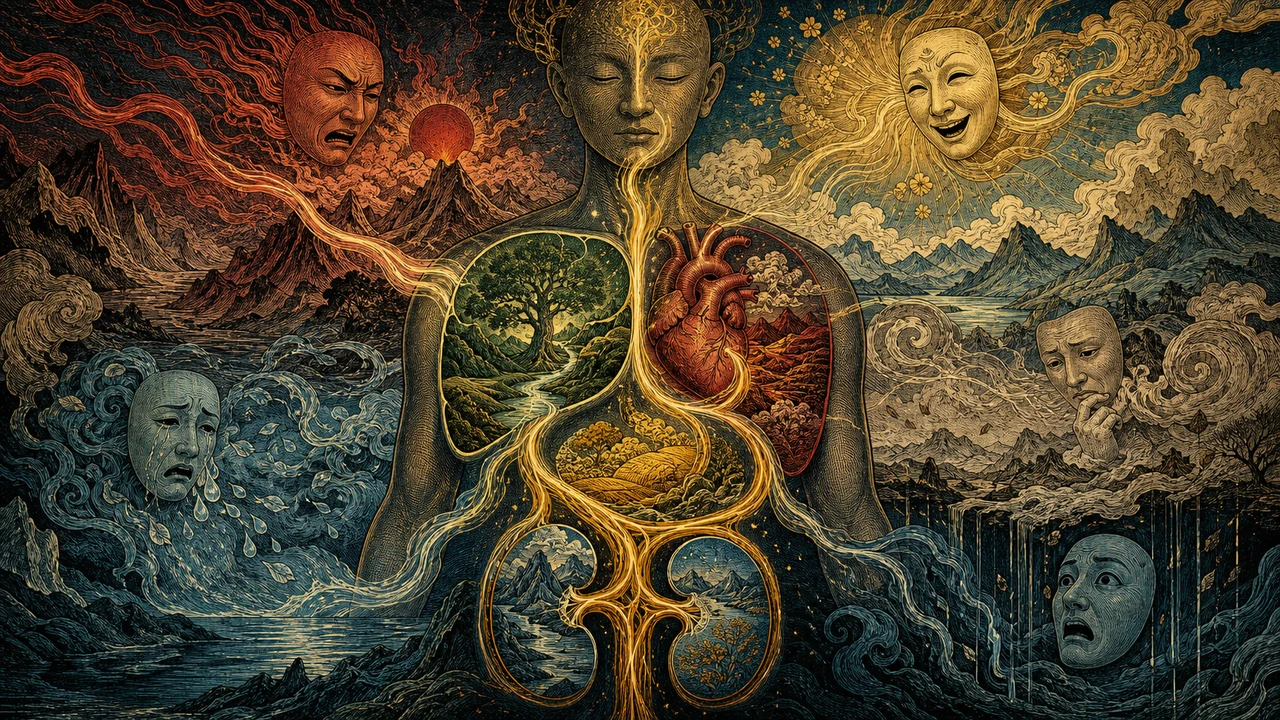
In Chinese Medicine, emotions can modify the movement of Qi and influence the functions attributed to the organs, while persistent changes in these systems can also affect how a person feels and reacts.
In this article, you will understand when a natural emotion may contribute to imbalance, how each emotional state modifies the flow of Qi and which relationships the theory establishes with the Liver, Heart, Spleen, Lung and Kidneys.
Continue reading to understand how the body and emotions participate in the same organization within Chinese Medicine.
How does Chinese Medicine understand the relationship between emotions and the body?
In Traditional Chinese Medicine, emotions are not considered experiences separate from the body. Thought, behavior, physical sensations and organ activities participate in the same organization. An emotional change may modify bodily function, while persistent changes in the organism may also influence how a person feels and reacts.
This understanding was built within an integrated conception of the human being. Ancient Chinese models related affective and cognitive activities to the heart-mind and the different internal systems. Thus, an emotion could be recognized both through subjective experience and through changes produced in expression, breathing, movement and behavior.
The theory does not state that each organ mechanically produces a single emotion. It uses correspondences to organize observed tendencies between certain emotional states and particular bodily functions. The Heart, Liver, Spleen, Lung and Kidneys appear as systems related, respectively, to joy, anger, thought, sadness and fear.
When can a natural emotion contribute to illness?
Joy, anger, worry, reflection, sadness, fear and shock are part of human experience and are not considered harmful by nature. Chinese theory begins treating them as possible internal causes when they become excessively intense, remain for a long time or exceed a person's capacity to adapt.
A passing emotion may temporarily change the rhythm of breathing, attention, posture and other activities without producing a persistent imbalance. Its clinical meaning depends on intensity, duration, repetition and the individual's general condition. Therefore, feeling fear, sadness or irritation does not automatically indicate an illness.
Difficulty may also arise when an emotion cannot be recognized, expressed or processed. Both an explosive reaction and a restrained, prolonged state may modify the movement of Qi in different ways. Traditional assessment seeks to observe the complete pattern rather than merely identify which emotion is present.
How do emotions modify the movement of Qi?
Classical texts describe specific directions produced by emotions. Anger makes Qi rise, joy relaxes it, sadness disperses it, fear sends it downward, shock disorganizes it and excessive thinking binds it. These expressions describe functional movements, not measurable physical displacements.
When Qi rises, certain activities tend to be directed more intensely toward the upper region. When it descends, functional energy loses support or moves rapidly toward the lower regions. Dispersing indicates a loss of concentration, while binding or knotting describes circulation that becomes less free in the presence of persistent worry.
These directions help explain why different emotions may produce distinct manifestations. A reaction of anger does not modify the body in the same way as a sudden shock or prolonged sadness. However, these descriptions are not absolute rules, because combined emotions, constitution and previous conditions may produce more complex patterns.
How do anger and frustration affect the Liver?
Anger is traditionally related to the Liver because this system ensures the smooth flow of Qi. Irritation, resentment, frustration and indignation may modify this circulation when they become intense or persistent. Movement that was initially free may become constrained or take on a very strong upward direction.
In explosive anger, Qi tends to rise quickly. The theory relates this movement to manifestations concentrated in the upper region, such as tension, agitation and a feeling of pressure. When the emotion remains repressed, the traditional description usually emphasizes constraint of Liver Qi, marked by difficulty expanding and adapting.
The relationship may also occur in the opposite direction. When the flow attributed to the Liver is restricted, a person may show greater irritability, frustration or difficulty dealing with obstacles. This does not mean that all anger is caused by the Liver, but that body and emotional state are interpreted as mutually influential.
How do joy and excitement affect the Heart?
Joy is the emotion associated with the Heart, the system that houses Shen and participates in the organization of consciousness. Under appropriate conditions, it promotes openness, communication and relaxation. The problem is not feeling pleasure or happiness, but remaining in a state of excessive excitement that hinders mental stability.
Traditional texts state that joy relaxes or slows the movement of Qi. A pleasant experience may relieve tension, but very intense stimulation may scatter attention and reduce the ability to turn inward. This description includes euphoria, agitation and a continuous search for stimulation, not ordinary happiness alone.
Because the Heart occupies a central position in relation to Shen, some traditional formulations consider that all intense emotions eventually affect this system in addition to the organ with which they have the strongest correspondence. This is because every emotional experience must be perceived, integrated and expressed by consciousness.
How do worry and excessive thinking affect the Spleen?
The Spleen is related to Yi, the capacity involved in concentration, reflection and processing information. Studying, analyzing and thinking are normal activities. They become problematic when the mind keeps repeating the same questions without being able to conclude, decide or move attention to other experiences.
Excessive reflection causes Qi to become bound or form a knot. This expression describes the loss of mobility produced by rumination, constant worry and uninterrupted mental activity. Instead of moving forward, thought continually returns to the same content, consuming attention and making mental rest difficult.
Worry may also involve the Lung, especially when it changes breathing and produces a feeling of restriction in the chest. Therefore, the correspondences are not exclusive. The same experience may affect different systems according to how it manifests, how long it lasts and the person's particular conditions.
How do sadness and grief affect the Lung?
Sadness and grief are traditionally related to the Lung. These emotions may arise in the face of loss, separation, disappointment or important change. They are not considered illnesses and may play a necessary role in adaptation, provided the person can move through them and gradually regain their ability to participate in life.
The classical description states that sadness disperses or consumes Qi. A person may notice less energy, a weakened voice, frequent sighing and difficulty sustaining certain activities. Dispersal represents a loss of concentration of functional resources, especially when suffering remains intense for a long time.
The connection with the Lung is also expressed through breathing. During crying or grief, the respiratory rhythm may change and become interrupted. In Chinese theory, these changes show how emotional experience manifests in the body, without meaning that all sadness causes a respiratory disease.
How do fear and shock affect the Kidneys and Heart?
Fear is related to the Kidneys and produces a downward movement of Qi. This description can be perceived symbolically in the feeling of losing support in the face of a threat. When very intense, fear temporarily reduces steadiness, security and the ability to maintain control over certain bodily responses.
Shock is different because it occurs suddenly and disorganizes Qi. A person may stop what they were doing, momentarily lose their bearings or show an abrupt bodily reaction. Tradition relates it to the Kidneys because of its connection with fear and to the Heart because of its immediate influence on Shen.
Persistent fear does not necessarily produce the same changes as a sudden shock. The first may progressively weaken the sense of security, while the second abruptly interrupts the previous organization. This distinction shows that Chinese Medicine considers not only the name of the emotion, but also the way it appears.
Why is the relationship between organs and emotions reciprocal?
In Chinese theory, emotions may change the organs, but the condition of the organs may also modify emotional life. Functional constraint may increase irritability, worry, sadness or fear, while these states may intensify the existing pattern. The relationship is circular and does not follow a single causal direction.
Therefore, an assessment should not conclude that a certain emotion “made” an organ ill based on an isolated association. Physical manifestations, history, duration, context and the pattern's other characteristics must be observed. Two people exposed to the same emotional situation may respond differently according to their resources and previous conditions.
The correspondences among emotions, Qi and organs belong to the traditional model of Chinese Medicine and do not prove a direct anatomical relationship according to biomedicine. Persistent emotional suffering, significant behavioral changes or physical symptoms need appropriate assessment. The WHO recommends that traditional practices be used with evidence, safety and responsible integration into healthcare.
Frequently Asked Questions
No. Joy, anger, worry, sadness, fear and shock are part of human experience. They may contribute to imbalance when they are very intense, last a long time or exceed a person's capacity to adapt.
Each emotion may produce a different functional direction. Anger makes Qi rise, joy relaxes it, sadness disperses it, fear sends it downward, shock disorganizes it and excessive thinking binds it.
The Liver ensures the smooth flow of Qi. Intense anger may make this movement rise quickly, while persistent frustration and resentment may restrict its circulation.
Worry and repetitive thinking bind Qi and hinder mental mobility. A person continually returns to the same subject, consumes attention and has difficulty reaching a conclusion or resting.
Yes. The relationship is reciprocal. Functional changes in the organs may increase irritability, worry, sadness or fear, while these states may also intensify an existing imbalance.
Deepen your understanding of emotions, organs and Qi
Understanding how emotions modify the movement of Qi expands an integrated view of body and mind in Chinese Medicine.
Explore our e-books for clear, organized material that connects energetic foundations with personal awareness and daily practice.
Explore the e-books
About the author
Prof. Tibério Z has more than 30 years of experience teaching spirituality, metaphysics, holistic therapies and consciousness development.