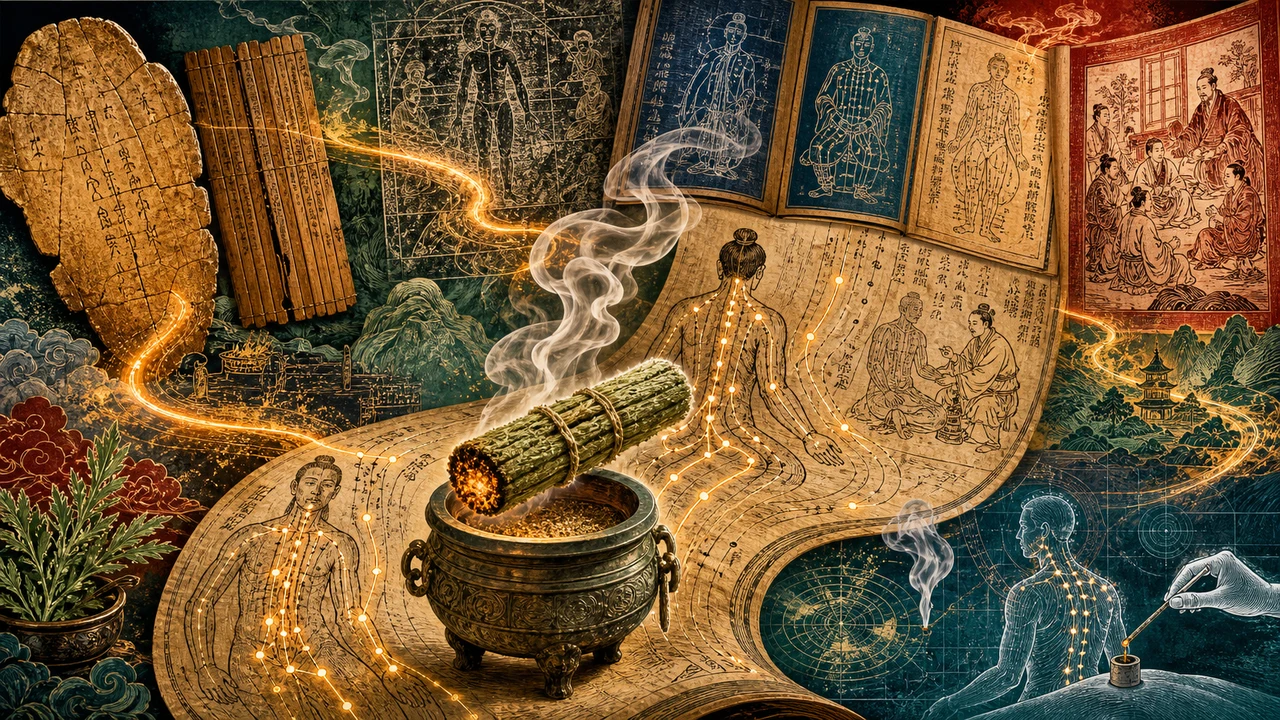
Moxa therapy developed gradually in ancient China from the therapeutic use of heat and the burning of plant materials. Rather than having a single inventor or an exact date of origin, the technique was observed, recorded and organized over time until it became part of the system of Traditional Chinese Medicine.
In this article, you will learn about the earliest records of moxa therapy, the evidence found in the Mawangdui manuscripts and its incorporation into the Huangdi Neijing. You will also follow the contribution of different dynasties, medical compendia and forms of transmission to the development of the practice known today.
Continue reading to follow this historical path and understand how a warming practice became, over the centuries, a structured technique transmitted in different countries and now taught alongside other Chinese Medicine resources.
Why is there no exact date for the appearance of moxa therapy?
Moxa therapy did not appear at a single moment and was not created by an identifiable person. It developed gradually from the therapeutic use of heat and the burning of plant materials. Its history is reconstructed through transmitted texts, archaeological manuscripts and medical works produced during different periods of ancient China.
Traditional narratives often attribute ancient medical practices to legendary figures such as Huangdi, the Yellow Emperor. These attributions gave authority to the teachings, but they should not be interpreted as proof of authorship. The classical works associated with Huangdi were formed by different authors and went through successive stages of compilation and revision.
For this reason, historians do not look for a single date of invention. Their aim is to follow how a warming practice became progressively associated with bodily regions, internal pathways, therapeutic points and diagnostic methods. Moxa therapy became an organized system only after a long process of observation, recording and systematization.
What are the earliest historical records of moxa therapy?
Some modern studies interpret inscriptions on oracle bones from the Shang dynasty as possible early references to therapeutic burning or cauterization. However, identifying these practices specifically as moxa therapy is not a matter of consensus, because the records are brief and belong to a context in which ritual and medicine were not yet clearly differentiated.
The literary reference most often regarded as clear appears in the Zuo Zhuan. The text describes a medical discussion that took place in 581 BCE and mentions moxibustion as an established resource. This record shows that the therapeutic use of burning was already part of the medical vocabulary before the unification of the Chinese empire.
The account does not yet present a complete manual of the technique. It shows that moxa therapy was already recognized, but it does not explain its materials, points or procedures in detail. These elements were systematized later, when different clinical experiences began to be gathered in manuscripts devoted to vessels and bodily regions.
What do the Mawangdui manuscripts reveal about moxa therapy?
In 1973, researchers found important medical manuscripts in a tomb at Mawangdui, in present-day Hunan Province. The tomb had been sealed in 168 BCE. These documents offer direct evidence of medical practices that circulated before the great classics of Chinese Medicine were consolidated.
Among the texts were two manuscripts describing eleven bodily pathways, generally translated as vessels or channels. The treatments associated with these pathways relied primarily on moxa therapy. The system did not yet contain all twelve channels or the detailed organization of points found in later texts.
These findings show that moxa therapy occupied an important position in medicine during the first centuries of imperial China. They also suggest that the association between bodily pathways and treatment with heat may have preceded the complete organization of needle acupuncture. This does not prove that moxa alone created channel theory, but it confirms its part in that development.
How was moxa therapy incorporated into the Huangdi Neijing?
The Huangdi Neijing, known as the Yellow Emperor's Inner Classic, was formed from different textual layers and compiled over an extended period. The work was not personally written by the legendary figure Huangdi. Its composition gathered knowledge that circulated during the final centuries BCE and the early centuries of the imperial period.
In this classic, moxa therapy appears within a more organized medical structure. Its use is related to channels, affected regions, the nature of the imbalance and the principles of Yin and Yang. Treatment with heat is no longer presented merely as an isolated procedure, but becomes part of a general interpretation of the organism.
The text also distinguishes situations in which moxa or a needle might be selected. The choice depended on the condition, its location and the characteristics observed. This relationship helped form the Chinese term zhenjiu, which brings needling and moxibustion together within the same therapeutic field, even though the two techniques produce different forms of stimulation.
How did Huangfu Mi help systematize the technique?
During the third century, the physician and scholar Huangfu Mi gathered material from earlier works and produced the Zhenjiu Jiayi Jing, known as the Systematic Classic of Acupuncture and Moxibustion. Compiled approximately between 256 and 282, the work became one of the fundamental references for organizing knowledge about channels and points.
Huangfu Mi reorganized information that had been scattered across different texts. His work presented channels, locations, indications, methods and clinical relationships in a more systematic structure. Researchers regard this work as establishing one of the first major scholarly models for the joint study of acupuncture and moxa therapy.
His importance lies not in having invented moxa therapy, but in turning ancient knowledge into material that could be studied and transmitted in a more orderly way. The book served as a bridge between earlier classics and the manuals used by physicians in later dynasties.
How did moxa therapy develop during the Tang and Song dynasties?
During the Tang dynasty, between the seventh and tenth centuries, moxa therapy became widely used and held an important place in medicine both inside and outside institutions. Historical studies indicate that its relative ease of application contributed to its use by specialists as well as in popular settings.
Works from the Tang period preserved particular methods, locations and indications. They included texts devoted directly to moxa therapy and broader medical compilations such as the Waitai Miyao. Certain methods for locating points through bodily measurements, later reproduced in numerous manuals, were also recorded during this period.
During the Song dynasty, the expansion of printing and government participation in the publication of medical books increased the circulation of knowledge. Clinical texts, diagrams and instructions became more accessible. This process helped transform practices once transmitted within restricted groups into knowledge that could also be learned from printed works.
How did the compendia of the Ming dynasty consolidate the practice?
During the Ming dynasty, different authors brought teachings on channels, points, needling and moxa therapy together in large compendia. One of these works was Xu Feng's Xu Shi Zhenjiu Daquan, first published in 1439. The book combined written explanations with images intended for teaching the practices.
The diagrams showed pathways, points and regions of the body, while the texts recorded indications, prohibitions and methods of location. These images helped students relate written theory to the human body. Copies preserved by the Wellcome Collection show how the channels and sites used in acupuncture and moxa were represented in this period.
Another landmark was the Zhenjiu Dacheng, the Great Compendium of Acupuncture and Moxibustion, compiled by Yang Jizhou. The work gathered knowledge from different earlier sources and became an important reference in Ming dynasty medicine. These compendia helped preserve methods and establish a shared language for teaching.
How did moxa therapy spread to other countries?
Moxa therapy crossed China's borders along with medical texts, religious practices, diplomatic exchanges and the movement of scholars. It was incorporated into the medical traditions of Korea, Japan and other regions of East Asia, where it developed its own forms of preparation, application and teaching.
In Japan, the technique underwent important adaptations and became highly popular, especially during the Edo period. Japanese practitioners developed direct application methods using small amounts of moxa and refined the processing of mugwort fibers. Moxa therapy also came to be used in domestic and popular settings.
The Western name “moxa” reached Europe from the Japanese term mogusa. In the seventeenth century, Hermann Buschoff published a work on treatment by fire using this name. Editions in Dutch, English and German helped spread the technique and its name among European readers.
How did moxa therapy reach the form practiced today?
During the twentieth century, Traditional Chinese Medicine underwent processes of institutional reorganization. Knowledge from the classics, regional schools and clinical experience was selected and incorporated into curricula, hospitals and research centers. Moxa therapy began to be formally taught alongside acupuncture and other traditional practices.
Today, the technique includes direct and indirect methods, cones, sticks, applications on needles and different warming devices. UNESCO records that its knowledge continues to be transmitted through demonstration, master-disciple relationships and formal academic education. These modern methods are the result of centuries of adaptation and refinement.
In 2010, the acupuncture and moxibustion of Traditional Chinese Medicine were inscribed on the Representative List of the Intangible Cultural Heritage of Humanity. This recognition values their historical and cultural transmission, but it does not mean that the practice has remained unchanged. Moxa therapy today combines ancient legacies, later interpretations, modern standardization and adaptations developed in different countries.
Frequently Asked Questions
No. The technique developed gradually from the therapeutic use of heat and the burning of plant materials, passing through several periods of observation and organization.
A reference often considered clear appears in the Zuo Zhuan, in a medical account from 581 BCE that mentions moxibustion as an established resource.
They describe eleven bodily pathways treated primarily with moxa therapy and show that the technique already held an important position before the channels and points were fully organized.
Huangfu Mi brought together ancient information on channels, points, indications and methods in a more organized structure, making acupuncture and moxa therapy easier to study and transmit.
Present-day practice combines classical knowledge, regional methods, adaptations made in other countries and modern teaching and standardization processes developed mainly during the twentieth century.
Deepen your understanding of moxa therapy
Learning about the history of moxa therapy helps explain how its foundations, methods and forms of application were organized over the centuries.
Explore our e-books for clear, organized material on energetic traditions, personal awareness and practical study.
Explore the e-books
About the author
Prof. Tibério Z has more than 30 years of experience teaching spirituality, metaphysics, holistic therapies and consciousness development.