
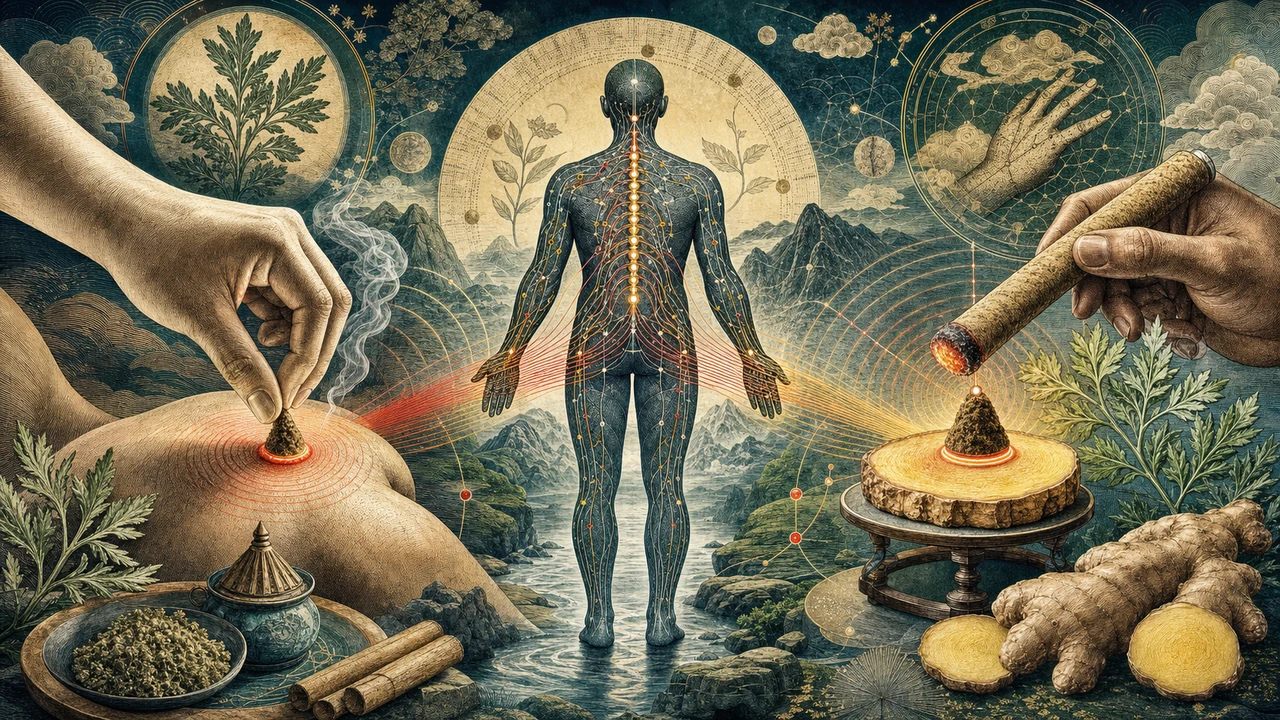
The difference between direct and indirect moxibustion lies in the position of the moxa in relation to the skin: in the direct technique, the material is placed on the selected point; in the indirect technique, heat reaches the body across a distance, support or intermediate barrier. This change affects thermal concentration, forms of application and the precautions required.
In this article, you will understand how each method is performed, what distinguishes scarring and non-scarring techniques, which barriers can be used, what sensations may occur and which factors influence heat and procedural safety.
Continue reading to compare the two techniques clearly and understand why choosing between direct and indirect moxibustion must take the full method, the person's sensitivity and professional proficiency into account.
What distinguishes direct from indirect moxibustion?
The main difference is the position of the moxa in relation to the skin. In direct moxibustion, a small portion of the material is placed on the selected point. In indirect moxibustion, a separation created by air, a support or an intermediate substance stands between the lit moxa and the body.
This difference changes the way heat is transferred. Direct contact concentrates warming in a small area, while separation allows better control over the distance, distribution and speed of the thermal stimulus. The result also depends on the size, compaction and burning time of the moxa.
Direct and indirect do not merely represent different intensities of the same application. Each category includes its own techniques, materials, sensations and risks. For this reason, findings from a study using moxa on ginger, for example, cannot automatically be applied to direct moxibustion or to a stick held at a distance.
How is direct moxibustion performed?
In direct moxibustion, moxa wool is compressed and shaped into small cones or grains. This unit is placed on the skin, usually over an acupuncture point, and its upper end is lit. During combustion, heat gradually advances toward the point of contact.
Size can vary according to the tradition and aim of the application. Some techniques use clearly visible cones, while Japanese methods may use small, refined portions. The smaller the contact area, the more localized the stimulus tends to be, requiring precision in preparation and placement.
Because there is no protective barrier, the practitioner must continuously monitor combustion and the person's response. The moment at which the moxa is extinguished or removed determines whether the stimulus will produce only warming, minor irritation or a deeper injury. This method requires training and strict control.
What is the difference between scarring and non-scarring direct moxibustion?
In scarring direct moxibustion, combustion is maintained until it produces an intentional burn. A blister, wound, scab and scar may appear after application. This historical method is also called suppurative or scar-producing moxibustion and represents an intense form of stimulation.
In the non-scarring method, the moxa is removed or extinguished before combustion causes a significant injury. Intense warming and localized redness may occur, but the aim is not to create a wound or scar. Controlling the timing becomes decisive because the material remains in contact with the skin.
The term “non-scarring” does not mean a complete absence of risk. Delayed removal, an excessively large cone or reduced sensitivity can result in accidental burns. The difference between the methods therefore depends both on therapeutic intent and on effective control of the temperature reached.
How is indirect moxibustion performed?
In indirect moxibustion, the moxa does not remain directly supported on the skin. A stick may be held at a certain distance from the body, or a cone may be placed on an intermediate layer. This separation allows heat to be transmitted to the point without immediately exposing the skin to the ember.
In the suspended method, the lit end of the stick is brought near the selected site and moved by the practitioner. The distance can be increased or reduced according to the thermal sensation. The technique seeks to produce gradual, tolerable heat without stinging or pain caused by excessive proximity.
Indirect application may also use boxes, adhesive supports or devices that hold the moxa. These resources modify airflow and thermal concentration. Even without direct contact, the temperature must be monitored continuously, because separation reduces risk but does not prevent burns.
What barriers can be used in indirect moxibustion?
Traditional barriers include slices of ginger, garlic, layers of salt, preparations of aconite and other materials. The moxa cone is placed on this layer, which separates combustion from the body's surface. The choice of material depends on the traditional method and the region where it will be applied.
The barrier affects heat transfer through its thickness, moisture and composition. A thicker slice, for example, increases the distance between the flame and the skin. Experimental studies show that the support, its material and its thickness modify the temperature reached and the effects produced on the skin's surface.
These substances should not be regarded merely as neutral thermal protectors. Garlic, ginger and other plants can irritate the skin or trigger reactions in sensitive people. In addition, prolonged heating can pass through the barrier and cause injury even when the cone does not touch the body directly.
Which technique produces more heat?
Direct moxibustion has a greater potential to concentrate heat in a small area because combustion occurs on the skin. However, it is not correct to say that every direct technique is necessarily hotter than any indirect technique. The result depends on the size of the moxa, duration, distance and support used.
In indirect application, a thin barrier or a stick held very close can also raise the temperature considerably. Devices that concentrate heat can extend combustion and modify its distribution. The name of the method alone therefore does not tell us the intensity that will actually reach the tissues.
Studies of thermal transfer show that heat can reach regions beneath the skin's surface. The depth and duration of this warming vary with the characteristics of the procedure. Thermal control must take into account the complete method, not simply the presence or absence of direct contact.
What sensations may occur with each method?
In non-scarring direct application, the person usually feels a small, concentrated heat that increases as combustion approaches the skin. The practitioner must stop the stimulus before the sensation becomes intensely painful or burning. Communication during the procedure is important for adjusting the moment of removal.
In the indirect method, warming tends to appear more gradually and may cover a larger area. A stick allows the heat source to be moved away immediately, while barriers delay its arrival at the skin. Even so, the sensation can intensify quickly depending on the device and how long it remains in place.
Individual perception is not sufficient as the only control in every case. People with neuropathies, circulatory changes, reduced sensitivity or difficulty communicating discomfort may not recognize a dangerous temperature. These patients require special caution, or the technique may be considered unsuitable for them.
What are the risks of direct and indirect moxibustion?
Direct moxibustion exposes the skin more closely to the ember and consequently carries a greater possibility of burns, blisters, wounds and scars. With scarring methods, some of these changes are produced intentionally. Open wounds may also increase the risk of contamination and infection when care is inadequate.
Burns may also occur with indirect methods when the moxa remains too close, the barrier becomes excessively hot or the device shifts. Ash and burning fragments may fall on the body. Plant barriers can also cause irritation and allergy, while smoke may provoke coughing or respiratory discomfort.
Safety reviews have recorded burns, allergic reactions, infections, coughing, nausea and other events. Distance, duration, position, the practitioner's experience, the patient's sensitivity, ventilation and environmental conditions directly affect safety. Neither method should be treated as risk-free.
How is the choice between direct and indirect moxibustion made?
The choice considers the purpose of the stimulus, the size of the area, the person's sensitivity and the practitioner's training. The direct technique offers a highly localized application, while indirect sticks, boxes and supports make it possible to warm larger regions or continuously control the distance from the heat source.
The condition of the skin, local circulation, tolerance of smoke and the ability to perceive and communicate heat must also be assessed. The scarring method has particular requirements and risks and should not be confused with an ordinary warming session performed without the intention of injuring the skin.
No method is universally superior. Clinical studies use different procedures, often with insufficient descriptions of temperature, moxa size and application time, making comparisons difficult. Responsible selection must bring together individual assessment, technical proficiency and strict safety control.
Frequently Asked Questions
In direct moxibustion, moxa is placed on the skin. In indirect moxibustion, heat reaches the body across a distance, support or intermediate barrier.
It is an application in which the moxa is removed or extinguished before causing a significant injury. The aim is to produce localized warming without creating a wound or scar.
Slices of ginger, garlic, layers of salt and other materials can be used. The barrier's thickness, moisture and composition modify the transfer of heat.
Yes. The skin can be injured when the moxa is kept too close, the barrier becomes too hot, the device shifts or the application lasts too long.
Selection takes into account the aim, size of the area, skin, circulation, sensitivity, tolerance of smoke, ability to communicate discomfort and the practitioner's technical proficiency.
Deepen your understanding of direct and indirect moxibustion
Understanding moxa contact, barriers, distance and heat transfer is essential for distinguishing each method and recognizing its particular precautions.
Explore our e-books for clear, organized material on energetic traditions, personal awareness and practical study.
Explore the e-books
About the author
Prof. Tibério Z has more than 30 years of experience teaching spirituality, metaphysics, holistic therapies and consciousness development.