
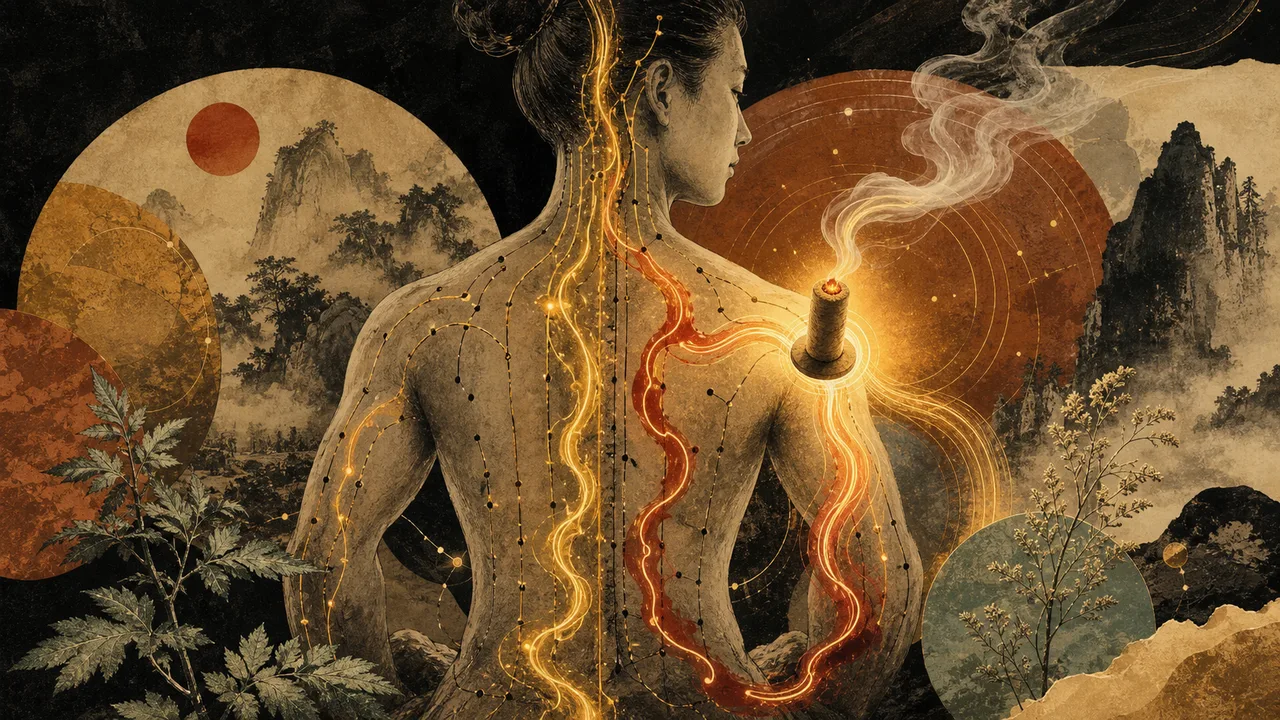
Moxa therapy uses the heat of moxa to stimulate points and regions related to the meridians. In Chinese Medicine, this warming is associated with dispersing Cold, unblocking the channels and restoring the movement of Qi and Blood, always according to the pattern identified during assessment.
In this article, you will understand what warming the meridians means, why Cold may hinder circulation, how Qi participates in the movement of Blood and which thermal, circulatory and nervous responses help explain the physical effects produced by moxa application.
Continue reading to understand how traditional explanations and scientific observations can be analyzed together, without confusing Chinese Medicine concepts with anatomical structures or treating local physiological responses as automatic proof of clinical effectiveness.
How does Chinese Medicine explain the action of moxa therapy?
In Traditional Chinese Medicine, moxa therapy uses the heat of moxa to stimulate points and regions connected with the meridians. These channels are understood as functional pathways that connect different parts of the body and participate in the circulation of Qi and Blood. The stimulus applied at the surface would be transmitted through this network.
The technique is traditionally described as being able to warm the meridians, disperse Cold, unblock the channels and promote circulation. These expressions do not mean that meridians are physical tubes heated by a flame, but that functions related to movement and internal communication begin to occur more freely.
Qi and Blood are studied as interdependent aspects. Qi participates in movement and transformation, while Blood nourishes and sustains the tissues. When the heat of moxa is applied according to the identified pattern, the traditional intention is to restore the joint circulation of these two vital substances.
What does warming the meridians mean?
Warming the meridians means applying a thermal stimulus to points or pathways where circulation is considered impaired by Cold. In Chinese theory, Cold contracts, reduces movement and makes the passage of Qi and Blood more difficult. Heat has the opposite tendency, promoting expansion and activity.
The warming does not need to cover the entire path of a meridian. The practitioner may stimulate specific points, painful regions or areas related to the recognized pattern. Selection seeks to use the point as an access point to the functional system, rather than simply warming a large part of the body indiscriminately.
The intensity must also be compatible with the purpose. A moderate stimulus may be used to warm and promote movement, while excessive temperatures injure the skin and do not represent a more effective therapeutic action. Moxa therapy requires controlled, progressive and tolerable heat.
Why is Cold associated with difficulty in circulation?
In traditional theory, Cold has a contracting nature. It reduces expansion, slows movement and may promote the retention of Qi and Blood in a certain region. This interpretation is used mainly when pain, stiffness or discomfort has characteristics traditionally associated with Cold.
The stagnation caused by Cold does not necessarily correspond to an anatomical obstruction of blood vessels. It is a functional pattern identified through a set of manifestations. Location, duration, thermal sensation, mobility and factors that improve or worsen the problem are part of this differentiation.
Because fire and moxa have a warming nature, their application seeks to produce movement opposite to contraction. Heat would help relax, unblock and restore mobility to the affected functions. This is why moxa therapy has historically been associated with patterns of Cold and Yang deficiency.
How does moxa therapy promote the movement of Qi?
Moving Qi means restoring its ability to rise, descend, enter, leave and circulate without remaining blocked. In Chinese Medicine, pain, pressure, distension or stiffness may be analyzed as manifestations related to difficulty in this movement, depending on the other signs present.
The heat of moxa is described as a force that warms and unblocks. By stimulating a point, the aim is to promote the resumption of activities related to the meridian and the treated region. This explanation does not mean that a measurable physical energy is mechanically pushed through the body by the flame.
The technique may also be used for strengthening. In this case, the goal is not merely to remove an obstruction, but to support functions considered weakened. The choice between moving, warming or strengthening depends on the pattern and cannot be determined solely by the presence of an isolated symptom.
How does the movement of Qi influence Blood?
Chinese Medicine states that Qi helps propel Blood. When its activity occurs properly, Blood can reach the tissues and provide nourishment. When the movement of Qi is restricted, the circulation of Blood may also become slower or accumulate in certain regions.
This relationship explains why moxa therapy is described simultaneously as a technique that promotes Qi and activates Blood. By warming and promoting functional movement, the aim is to reduce stagnation and improve the arrival of nourishing resources in the areas that depend on them.
Qi and Blood do not correspond, respectively, to electricity and the blood of biomedical circulation. The traditional concept of Blood relates to the fluid circulating in the vessels but includes broader functions of nourishment and support. The two frameworks should be explained without establishing automatic equivalences.
How does the heat of moxa reach the skin and tissues?
During application, thermal energy reaches the body through radiation, heated air and, in methods involving contact or a barrier, through conduction as well. The temperature reached depends on the type of moxa, distance, cone size, support and exposure time.
Studies show that moxibustion significantly increases surface temperature at the stimulated point. In a study with application three centimeters from the skin, the point's temperature rose and peaked after a few minutes, showing that the thermal stimulus continues to accumulate during the session.
Some of the heat may also reach layers beneath the surface, although its depth varies according to the method used. This does not demonstrate that it travels through an anatomical meridian. It only shows that combustion produces a real physical stimulus capable of affecting receptors and tissues near the application site.
How can moxa therapy modify local blood flow?
Warming may change the diameter of vessels near the stimulated region. Experimental studies report vasodilation around the point, increased peripheral arterial flow and changes in microcirculation. These responses offer a possible physiological approximation for part of what tradition describes as moving Blood.
One study with volunteers observed changes in blood flow both in the stimulated area and in distant regions. The authors related part of the local response to skin nerve reflexes. Another pilot study found increased perfusion at the point subjected to moxibustion, although the response did not appear in the same way at every site evaluated.
These results do not mean that every application produces the same circulatory improvement. Temperature, duration, point, modality and the person's characteristics change the response. Furthermore, a temporary increase in local flow does not by itself prove the effectiveness of moxa therapy for a specific disease.
How do thermal receptors and the nervous system participate in the response?
The skin has receptors capable of detecting temperature changes. When moxa warms a region, these receptors send signals to the nervous system. Experimental research especially investigates heat-sensitive channels such as TRPV1, which may be activated as temperature rises.
Stimulation may also produce reflexes that modify blood flow. One study linked increased skin perfusion to an axon reflex, in which local nerve fibers participate in vessel dilation. Thus, part of the circulatory response may occur without depending on an anatomical pathway equivalent to the meridians.
Other studies analyze autonomic, inflammatory and sensory responses. In one study of indirect moxibustion, regional warming was accompanied by changes in heart rate and indicators of autonomic activity. These findings are specific to the protocol studied and do not yet define a universal mechanism.
Has science proven that moxa moves Qi and Blood?
Qi, Blood and meridians belong to the theoretical model of Traditional Chinese Medicine. Modern science can measure temperature, perfusion, nervous activity and cellular responses, but there is no accepted test that directly demonstrates the circulation of Qi or identifies meridians as independent anatomical structures.
Research confirms that moxa therapy produces real heat and may temporarily modify temperature, blood flow, receptor activity and certain autonomic responses. However, studies of its mechanisms themselves acknowledge that there is still no complete explanation for all the effects attributed to the technique.
A local physiological response should also not be confused with proven clinical effectiveness. Therapeutic outcomes must be evaluated separately for each condition and modality. Application still involves risks of burns, allergies, infections and respiratory irritation, requiring temperature control, ventilation and professional training.
Frequently Asked Questions
It means applying controlled heat to points or pathways where the circulation of Qi and Blood is considered impaired by Cold, promoting movement and activity.
The heat of moxa is traditionally used to disperse Cold, unblock the channels and promote the movement of Qi, which helps drive and circulate Blood.
There is no evidence that heat travels through meridians as anatomical structures. The application produces a real thermal stimulus on the skin, receptors and nearby tissues.
Science can measure temperature, perfusion and nervous responses, but there is no accepted test that directly demonstrates the circulation of Qi or identifies anatomical meridians.
Application requires control of temperature, distance and time, as well as ventilation and professional training, because it may cause burns, allergies, infections and respiratory irritation.
Continue exploring Chinese Medicine
Understanding how heat acts on the meridians, Qi and Blood requires connecting traditional foundations with the characteristics of each application method.
Explore our e-books to deepen your understanding of energy, balance and integrative practices through clear, structured material.
Explore the e-books
About the author
Prof. Tibério Z has more than 30 years of experience teaching spirituality, metaphysics, holistic therapies and consciousness development.