
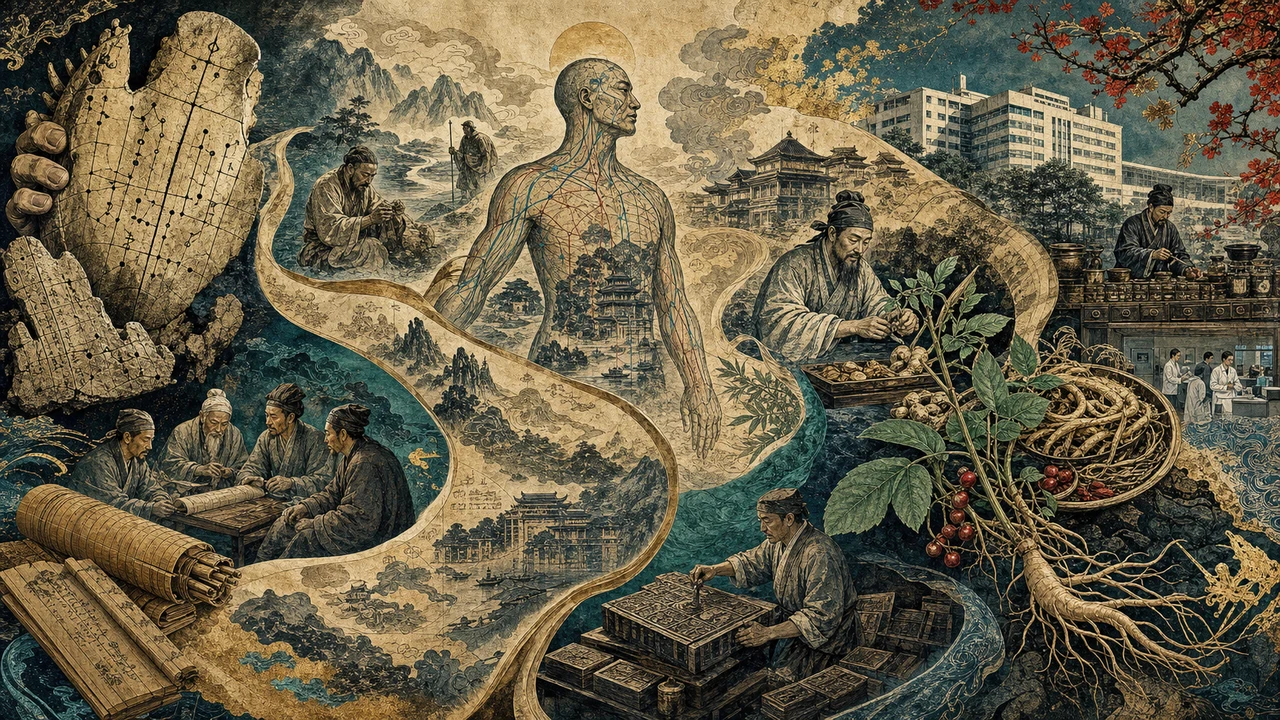
Traditional Chinese Medicine emerged through a long historical process shaped by observation of the body, the use of natural substances, care practices and the progressive organization of knowledge produced during different periods of Chinese history. It has no single date of creation and cannot be attributed to one person.
In this article, you will follow this development from records of the Shang dynasty and the Mawangdui manuscripts to the classical texts, the medical institutions of the great dynasties and the modern standardization carried out in the twentieth century.
Continue reading to understand how dispersed practices became an organized medical system and why contemporary Traditional Chinese Medicine brings together both ancient knowledge and modern processes of teaching and systematization.
Why is there no exact date for the origin of Chinese Medicine?
Chinese Medicine did not emerge on a specific date or through the work of one person. It gradually formed from different care practices, observations of the body, knowledge about natural substances and ways of interpreting disease developed by Chinese communities over many centuries.
What is now called Traditional Chinese Medicine brings together knowledge that originated in distinct historical periods. Some practices appeared long before the classical medical texts, while others were added, modified or reorganized by physicians and scholars from different dynasties. Its formation must therefore be understood as a continuous process.
It is also necessary to distinguish documented history from legendary narratives. Figures such as the emperors Huangdi and Shen Nong occupy a symbolic place in tradition, but there is no evidence that they personally wrote the works attributed to them. Their names helped give authority and antiquity to the teachings being transmitted.
What do records from the Shang dynasty reveal about healing practices?
Among the oldest records related to illness in China are inscriptions made on bones and turtle shells during the Shang dynasty. These objects were used in divination ceremonies in which rulers consulted their ancestors about wars, harvests, dreams, childbirth, weather conditions and illnesses.
The inscriptions show that many illnesses were initially related to the action of ancestors, spirits or supernatural forces. When faced with an illness, people sought to identify which entity had caused the problem and which ritual should be performed. These practices belonged mainly to the religious sphere and did not yet form the medical system developed later.
However, these records also reveal that ancient Chinese people already named ailments, observed affected regions and followed the development of certain problems. Although the interpretation was ritual, recording symptoms and events contributed to a tradition of observation that gradually began to include explanations less dependent on the supernatural.
How did explanations of illness begin to change?
During the final centuries of the first millennium BCE, interpretations began to appear that connected illnesses with observable factors. Climate changes, food, exertion, emotions and internal conditions became part of the explanations, although religious and medical practices continued to coexist for a long period.
Ancient texts mention physicians who sought natural causes for illness. One example is the physician known as Yi He, from the sixth century BCE, later remembered for explaining certain diseases without attributing them directly to the action of gods or demons. This shift helped form a new way of investigating illness.
This transformation did not happen all at once. Healers, priests, herbal specialists and physicians worked in different contexts, sharing or disputing interpretations. Gradually, clinical experience and comparison among cases gained greater importance, allowing explanations to be created that could be taught, recorded and discussed by other practitioners.
What do the Mawangdui manuscripts reveal about ancient medicine?
The Mawangdui medical manuscripts were found in 1973 in a tomb sealed in 168 BCE. These documents constitute one of the most important known collections of Chinese medical literature from the third and second centuries BCE, predating the consolidation of several classical texts.
The texts present knowledge about physical exercises, healthcare, medicinal substances, reproduction, external treatments and pathways described in the body. They show that different therapeutic traditions were already circulating during that period, but had not yet been completely brought together within a single organized theory.
The discovery changed modern understanding of the history of Chinese Medicine. It demonstrated that classical teachings did not appear fully formed but were preceded by varied practices and texts. Comparing these manuscripts with later works reveals how certain ideas were progressively selected, reformulated and integrated.
How did the Huangdi Neijing participate in this development?
The Huangdi Neijing, known as the Yellow Emperor's Inner Classic, was composed from materials produced between the Warring States period and the Qin and Han dynasties. It is not a work written all at once, but a collection of texts created and organized by different authors.
The work uses dialogues between the legendary Yellow Emperor and his advisers to present medical questions and answers. This format does not prove the emperor's authorship, but functions as a literary device. By associating the teachings with an ancestral figure, the compilers reinforced the authority of the knowledge presented.
Its historical importance lies in organizing ideas that had previously appeared in a dispersed form. The text brought together explanations about the body, illnesses, environmental influences, methods of observation and treatment principles, providing a theoretical foundation that would guide countless generations of Chinese physicians.
What was the importance of the Han dynasty to Chinese Medicine?
The Han dynasty, which lasted from 206 BCE to 220 CE, was decisive in the formation of classical medicine. During this period, different forms of knowledge about the body, illness, medicinal substances and treatments were recorded, discussed and organized into more systematic works.
Among the physicians associated with the end of the Han dynasty is Zhang Zhongjing. He is credited with the Shanghan Zabing Lun, which was later divided into texts such as the Shang Han Lun and the Jin Gui Yao Lue. These writings organized clinical observations, manifestations of illness and combinations of medicinal formulas.
The tradition of materia medica, devoted to recording substances used in treatments, was also consolidated during this period. The body of texts formed during and after the Han dynasty provided theoretical and clinical references that physicians in subsequent centuries would comment on, correct and reinterpret.
How did the Sui and Tang dynasties organize medical teaching?
During the Sui and Tang dynasties, medicine underwent a broader process of institutional organization. The government created structures devoted to administration, teaching and the production of medical knowledge. Professional training began to include the systematic study of classical texts, medicines and different areas of practice.
During the Tang dynasty, imperial patronage supported the preparation of medical works and official materia medica. Compilations brought together knowledge that had previously been dispersed, while authors such as Sun Simiao organized formulas, clinical experiences and guidance intended to help physicians address different illnesses.
The period was also important for the international circulation of this knowledge. Monks and travelers helped carry Chinese texts and practices to regions such as Korea and Japan. This exchange did not produce identical copies, as each society adapted the teachings it received to its own medical traditions.
How did the Song, Ming and Qing dynasties expand this legacy?
During the Song dynasty, the government promoted intensive revision and publication of medical works. A specialized department corrected ancient texts, prepared official editions and expanded their distribution. Woodblock printing made books more accessible and encouraged the study of medicine beyond the old family lineages.
The Song dynasty also established institutions such as the Imperial Pharmacy, created in 1076. Initially connected with controlling the medicine market, it began to distribute ready-made preparations and formulas. In the following centuries, physicians continued producing commentaries, clinical reports and new interpretations of classical texts.
During the Ming dynasty, Li Shizhen compiled knowledge about plants, animals and minerals in the Bencao Gangmu, published at the end of the sixteenth century. During the Qing dynasty, new schools deepened the study of epidemic and febrile diseases, showing that the medical tradition continued to be expanded and modified.
When did Traditional Chinese Medicine emerge in its modern form?
Beginning in the nineteenth century, the expansion of Western medicine in China sparked debates about preserving, reforming or replacing Chinese practices. Traditional physicians began defending their knowledge, reorganizing professional institutions and seeking new ways to explain their work in the face of the period's political and scientific transformations.
The form now called Traditional Chinese Medicine was institutionalized mainly from the 1950s onward. The Chinese government promoted the selection and standardization of ancient knowledge, created colleges, hospitals and research centers, and established curricula for the official training of practitioners.
This means that contemporary Traditional Chinese Medicine does not correspond exactly to a practice that remained unchanged for thousands of years. It results from the union of classical texts, clinical experiences, historical schools and modern processes of selection, teaching and standardization carried out throughout the twentieth century.
Frequently Asked Questions
No. Chinese Medicine was gradually formed through care practices, observations of the body, the use of natural substances and knowledge produced in different historical periods.
Inscriptions on bones and turtle shells show religious explanations for illnesses, but they also record ailments, affected regions and the development of certain problems.
They show that different medical practices and ideas were already circulating before the classical texts were consolidated. The discovery confirmed that Chinese Medicine did not appear fully formed, but was organized progressively.
There is no evidence of this authorship. The work brought together material from different authors and used dialogues with the legendary Yellow Emperor as a device for presenting and organizing its teachings.
Its modern form was institutionalized mainly from the 1950s onward, when curricula, colleges, hospitals and official processes of selection and standardization were created.
Deepen your exploration of Chinese Medicine
Learning about the historical formation of Traditional Chinese Medicine helps explain how its concepts, texts and practices were organized over time.
Explore our e-books for clear, structured material about energy, balance and traditions of integrative care.
Explore the e-books
About the author
Prof. Tibério Z has more than 30 years of experience teaching spirituality, metaphysics, holistic therapies and consciousness development.