
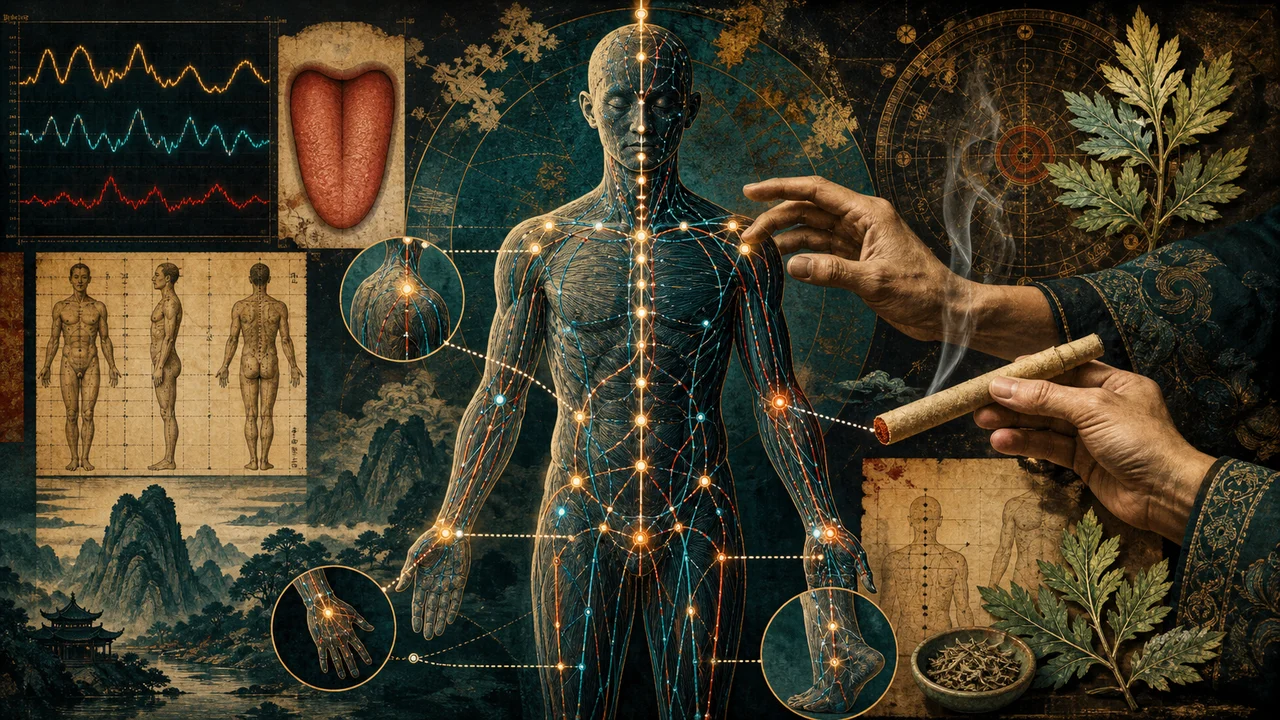
The points used in moxa therapy are chosen based on individual assessment, differentiation of the pattern presented and the treatment objective. Selection may combine local, distal, special and tender points, always considering the moxa modality, body region and safety conditions.
In this article, you will understand which criteria guide this choice, why the pattern must be identified before application, and how meridians, Zang-Fu systems, Ashi points, anatomical references and responses to heat participate in the prescription.
Continue reading to learn about the path that transforms assessment information into a coherent selection of points and to understand why location, individualization and thermal control must be considered together.
Which criteria guide the choice of points?
The points used in moxa therapy are not chosen solely by the name of a disease or the location of a symptom. The practitioner gathers the information obtained during assessment, identifies the pattern presented and establishes a treatment principle. Only then do they define which regions will receive the thermal stimulus.
In traditional practice, selection usually follows three general criteria: points near the affected region, distant points belonging to the related pathway and points chosen according to the signs and identified pattern. These criteria may be used separately, but they are generally combined within the same prescription.
The moxa modality also influences the choice. A point selected for use with a suspended stick may not be suitable for direct application, application over a needle or with a cone. Body area, intended intensity, skin sensitivity and the ability to control heat are part of the clinical decision.
Why should pattern differentiation come first?
In Chinese Medicine, people with a similar complaint may present different patterns. Pain, for example, may be interpreted in relation to Cold, Dampness, deficiency, stagnation or other traditional mechanisms. Point selection seeks to respond to the complete pattern, not only to the place where the person feels discomfort.
This differentiation is especially important in moxa therapy because the technique's primary stimulus is heat. Traditionally, moxa is associated with warming the channels, dispersing Cold and strengthening certain deficiency conditions. Its use must therefore be compatible with the nature of the condition being assessed.
The practitioner also considers duration, intensity, factors that improve or worsen the manifestation, thermal sensations and general condition. This information helps determine not only which points will be warmed, but also which method, duration and intensity may be used during the session.
How are local points and Ashi points chosen?
Local points are those situated in the affected region itself or in nearby areas. They may be selected when the aim is to produce concentrated warming over muscles, joints or other superficial tissues. The extent of the area determines whether a specific point or a broader region will be used.
Besides the classical points, the practitioner may identify Ashi points. They do not necessarily have a name or fixed location and are recognized through tenderness, pain or another response found during palpation. Traditional literature distinguishes among classical points, extraordinary points and Ashi points.
A painful point, however, should not automatically receive heat. Intense redness, lesions, infections, vascular changes or causes that have not yet been investigated may make application inappropriate. Palpation helps locate reactive areas, but it must be accompanied by assessment of the skin and the nature of the problem.
Why can local and distal points be combined?
Distal points are far from the main region of the complaint and are often located on the arms or legs. In traditional theory, they are selected because they belong to a channel related to the affected area or have functions attributed to the pattern identified during assessment.
The combination seeks to act on different levels. Local points direct the stimulus toward the region where the manifestation occurs, while distal points participate in regulating the related pathway or functional system. Studies of acupuncture and moxibustion prescriptions show that this association is used frequently.
There is no rule stating that every session must use both groups. A broad area may receive only local warming, while another condition may require greater attention to distal points. The combination depends on the therapeutic objective, moxa modality and the person's tolerance.
How do meridians and Zang-Fu systems influence the choice?
Classical points are organized primarily along the channels or meridians. When a manifestation follows a certain pathway, the practitioner may select points located on that same channel, both near and far from the affected region. This choice follows the traditional relationship among pathway, functions and body areas.
Zang-Fu systems also participate in selection. A digestive, respiratory or urinary complaint is related not only to the corresponding anatomical region but also to the functional systems involved in the pattern. Points associated with these systems may be combined to form a prescription consistent with the assessment.
This does not mean that warming a point connected with the Liver, Spleen or Kidneys directly treats the anatomical organ with the same name. Meridians and Zang-Fu belong to the functional model of Chinese Medicine and do not automatically correspond to biomedical structures or diagnoses.
What is the role of special points and combinations?
Some points receive special classifications because of their position and the functions attributed to them. These include Source, Sea, Alarm and Back-Shu points. These categories help the practitioner choose locations related to certain systems, regions or movements of Qi within traditional theory.
Research analyzing acupuncture and moxibustion prescriptions shows that some categories appear more frequently in specific conditions. In studies of intestinal disorders, for example, local abdominal points, distal points and special points were combined according to pattern differentiation.
Points may also form pairs or small groups. A principal point represents the central objective, while others complement its action, address associated symptoms or adapt the treatment to individual constitution. Thus, a prescription is formed through relationships among points rather than through a random list.
How is the exact location of each point determined?
After choosing a point, it must be located correctly on the body. Identification uses anatomical references such as bones, joints, tendons, muscles and skin folds. Proportional measurements based on the dimensions of the person's own body may also be used.
The World Health Organization has published a standard to harmonize the location of 361 classical points on the body surface. The document establishes location methods and anatomical descriptions, allowing greater consistency in teaching, practice and research.
The position should not be calculated using an ordinary ruler alone because proportions vary among individuals. After using standardized references, the practitioner may confirm the area through palpation and observation. Correct location is necessary both to direct the stimulus and to avoid sensitive regions.
How are heat-sensitive points identified?
In heat-sensitive moxa therapy, the practitioner does not rely only on a fixed position described on maps. They explore a region with a suspended stick and ask how the stimulus is perceived. The aim is to locate areas that produce thermal responses considered different from ordinary surface warming.
The sensations described include heat that seems to penetrate, expand or follow a certain pathway. Some people report warming in a region distant from the stimulated site. These responses are used to select the point and define where application will remain concentrated.
Sensitization theory proposes that the response of points may change according to the person's condition. However, these sensations are subjective and their mechanisms are still incompletely investigated. They do not demonstrate the existence of an anatomical channel or replace direct observation of temperature and skin.
How is the final prescription individualized safely?
The final prescription brings together principal and complementary points. Principal points correspond to the central objective of the session, while complementary points are added according to associated manifestations and individual characteristics. Points may be removed or replaced when the pattern, tolerance or development of the condition changes.
The choice must consider skin integrity, local circulation, thermal sensitivity, ability to communicate discomfort and proximity to vulnerable structures. The practitioner also determines whether the location will receive a stick, cone, box, moxa over a needle or another modality compatible with the region.
Even a traditionally used point may become inappropriate in the presence of lesions, reduced sensitivity or excessive heat. Safety reviews report burns, allergies, infections and respiratory discomfort related to moxibustion. Therefore, selection, technique and thermal control must be evaluated together.
Frequently Asked Questions
The choice considers individual assessment, the identified pattern, the treatment objective, body region, moxa modality and safety conditions.
People with the same complaint may present different patterns. Because moxa produces heat, its application must be compatible with the nature of the condition and the defined treatment principle.
They are points recognized by tenderness, pain or another response found during palpation. They do not necessarily have a name or fixed location and should not receive heat without assessing the skin and the cause of the discomfort.
Yes. Local points direct the stimulus to the affected region, while distal points participate in regulating the related meridian or functional system. The combination depends on the goal and assessment.
Correct location directs the stimulus and helps avoid sensitive regions. It uses anatomical references, proportional measurements, palpation and observation of the person's own body.
Deepen your understanding of point selection in moxa therapy
Selecting points requires an understanding of pattern differentiation, the relationships between local and distal points, meridian pathways and the moxa modality best suited to each region.
Explore our e-books for clear, structured material on energy, balance and integrative practices.
Explore the e-books
About the author
Prof. Tibério Z has more than 30 years of experience teaching spirituality, metaphysics, holistic therapies and consciousness development.