
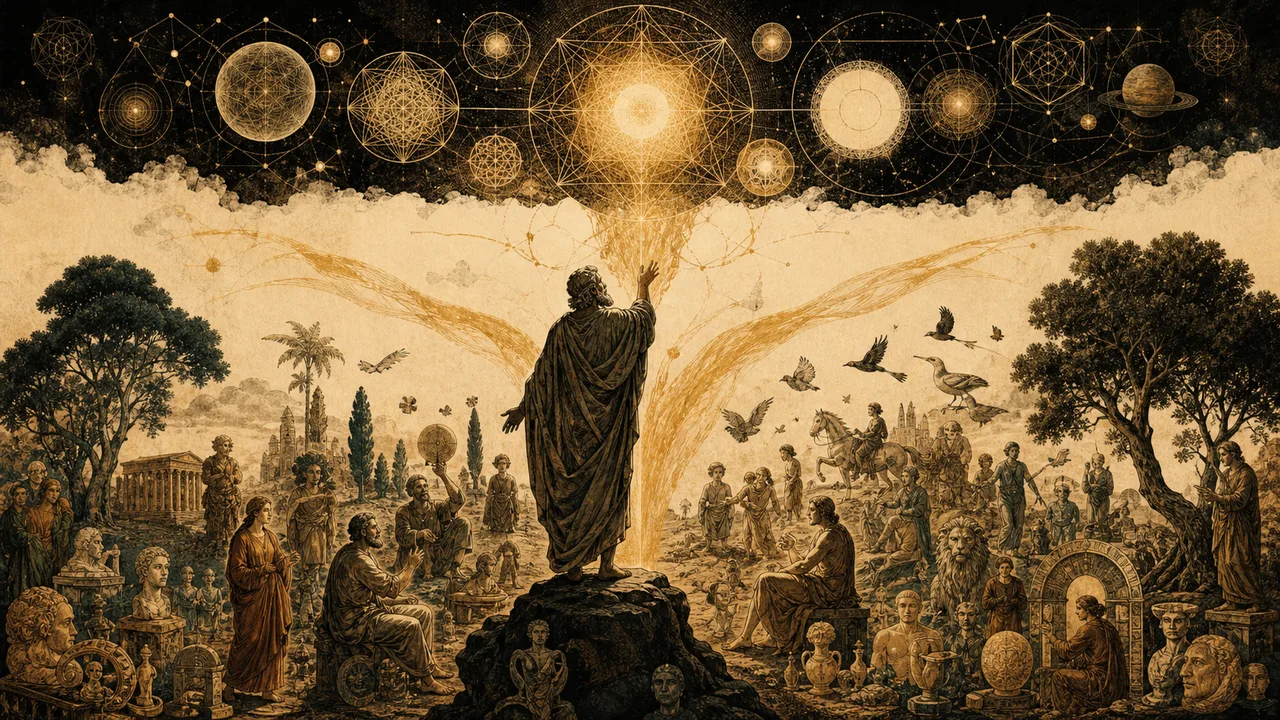
The concept of archetype did not begin with Carl Jung. The word already carried the idea of a first model, prior to the forms we see in the world. Over the centuries, this idea passed through philosophy, religion, the theory of knowledge and the study of cultures before receiving a new place within psychology.
In this article, you will follow this path from the Greek meaning of the word and Plato's Forms to religious prototypes, Kant's a priori structures and the recurring ideas studied in the nineteenth century. Then, we will understand what Jung preserved from this history and what change he made when speaking of archetypes in the psyche.
Continue reading to see that this origin does not form a straight line in which all the authors said the same thing. Each stage changed the question, the location of the model and its function. Understanding these differences helps us use the word archetype in depth without turning it into a simple name for characters or profiles.
Jung did not invent the word archetype
The word archetype entered modern languages through the Latin archetypum, from the Greek archetypon. It brings together the idea of beginning, origin or principle with that of form, mark, type or model. In simple language, it pointed to a first model of which other things could be regarded as images or copies.
When we think of a mold used to produce several pieces, we see part of this ancient meaning. The pieces may receive different colors, materials and finishes, but there is a prior form that guides their production. This comparison does not explain Jung's archetype in full. It reveals the problem contained in the word: how can something primary appear in many concrete forms?
For a long time, archetype could mean a prototype, original pattern or example from which others derived. This use did not concern twelve personalities or characters used by brands. Nor did it automatically describe images from the unconscious. These meanings appeared much later.
Jung knew this history. When explaining his concept, he recalled that the word was already ancient and related to the Platonic use of Idea. His contribution was not to invent the syllables or discover that human beings seek models. It was to transform the location and function of this model.
The archetype stopped being only an original placed before visible things. In Analytical Psychology, it began to indicate an unconscious form that takes part in the way we live human experiences. To understand the magnitude of this change, we need to return to the question Plato asked.
Plato's question about the model and things
We see many different things and still recognize some unity among them. There are beds made of wood, metal, stone, fabric and other materials. They do not have the same size or appearance, but we continue to call all of them beds. What enables us to recognize a common form in such varied objects?
Plato placed questions of this kind at the center of his philosophy. He distinguished the sensible world, which we perceive through the senses and is always changing, from the Forms or Ideas, which would be intelligible, stable and independent of the variations of concrete objects.
A beautiful thing may age, break or cease to be considered beautiful. The Form of Beauty would not undergo these changes. Objects may be almost equal, but Equality itself provides the measure by which we perceive approximation and difference. Sensible things would participate in the Forms without exhausting them.
In the dialogue Timaeus, the ordered world is also related to models or paradigms. What is born and changes is understood in relation to an intelligible order. Therefore, the notion of model was not merely a comparison with manufactured objects. It was part of an explanation about reality, knowledge and order.
This way of thinking created an important foundation for the history of the archetype. A prior model could explain why many different manifestations retained a common relationship. The multiplicity of the world did not need to be a collection without unity.
However, it would be a mistake to say that Plato had already discovered the collective unconscious. Platonic Forms and Jung's archetypes do not occupy the same place. The relationship exists, but it can only be understood when we also see the difference.
Why Plato's Forms are not yet Jung's archetypes
Plato investigated what makes things knowable and what reality belongs to the Forms. His question was philosophical. The model possessed an existence and importance that did not depend only on the individual mind.
Jung began in another field. He was a physician and sought to understand images, fantasies, dreams, emotions and behaviors that arose in psychic life. Instead of asking where the Form of Beauty or Equality exists, he investigated why certain symbolic organizations reappeared in human experience.
Jung himself acknowledged this separation. When commenting on Plato, he explained that he did not wish merely to place a metaphysical model somewhere above the world and call it an archetype. He wanted to investigate what could be observed through manifestations of the psyche.
The continuity lies in the idea of a form prior to particular manifestations. The rupture lies in the location of this form and the way it is studied. In Plato, the discussion belongs to intelligible reality and knowledge. In Jung, the archetype becomes an unconscious disposition that we perceive through its effects.
It is like two maps that use some similar symbols but represent different territories. If we place one over the other carelessly, we lose the particularities of both. The philosophical influence exists, but it does not turn one theory into the other.
This distinction protects history from a common simplification. We do not need to say that every ancient thinker was a psychologist before psychology. We can acknowledge that a question about models crossed the ages and received different answers.
The archetype as prototype in religious antiquity
The idea of a first model also appeared in religious and philosophical texts of antiquity. Jung cited authors such as Philo of Alexandria, Irenaeus and the Corpus Hermeticum to show that the word and its related meanings circulated long before modern psychology.
In these uses, the archetype was connected with the prototype according to which something was formed. The model could be placed in the divine mind, in the order of creation or in a reality prior to manifested things. The question was no longer only how we recognize many similar things, but how the created world expresses a prior order.
Jung offers a simple example taken from the Corpus Hermeticum: the expression “archetypal light.” It indicates a first light, understood as the prototype of the lights that may appear. It is not an original lamp stored somewhere, but a principle prior to concrete manifestations of light.
Philo connected models and creation within a reading that brought Greek philosophy and Jewish tradition together. Irenaeus used the language of archetypes when discussing the origin of things and the models according to which they would be formed. Each author had a distinct concern, and we should not combine them into a single doctrine.
The common point lies in the model's priority. Before the concrete thing, there would be a form, reason or prototype. This idea made it possible to explain why creation possessed order and why the visible could be understood as an expression of something that surpassed it.
We are still far from the archetype as a disposition of the psyche. However, the word preserved two essential parts of its history: a prior pattern exists, and concrete forms do not exhaust it. These parts would be transformed when investigation turned toward the way human beings know and imagine.
How the idea of a model crossed Christian thought
The encounter between Platonism and Christianity allowed the idea of prior models to remain present. Instead of an independent world of Forms, Christian thinkers began speaking of reasons or ideas present in divine knowledge.
Augustine was very important in this transition. For him, ideas were not occasional creations of the human mind. They were permanent reasons connected with divine wisdom, according to which things could be created and understood.
We can use the comparison with a design, provided we do not take it too far. Before building a house, an architect has an organization that guides walls, spaces and functions. The material work expresses this design, although no human drawing is equivalent to the divine idea discussed by Augustine.
At this stage, the archetype still belongs mainly to the problem of creation and the original model. Human interiority appears in relation to truth, but there is no Jungian formulation of collective patterns organizing dreams, emotions and behaviors.
For centuries, the language of exemplar and copy remained alive in philosophy, theology and the arts. A work could be judged by how closely it approached a model. A created being could be understood as a limited expression of a prior reason.
Knowing this continuity prevents the impression that the word disappeared after Plato and reappeared fully formed in Jung. It crossed traditions, translations and debates. At the same time, its long permanence does not mean that it preserved a single meaning.
An important change would occur when the question stopped focusing only on the model of things and began to investigate the human conditions that make experience possible. This is where Kant becomes necessary to understand the path.
Kant shifted the question toward the forms of knowing
Immanuel Kant did not create a theory of archetypes. His importance lies in showing that the mind does not function like a blank sheet that merely receives ready-made information from the world. Experience also depends on forms and categories that take part in the way we know.
Everything we learn begins with experience, but this does not mean that every organization of knowledge comes from it. For Kant, space and time take part in the way phenomena can appear. Categories such as cause and substance help understanding bring together what we perceive.
One possible comparison is a pair of glasses. They do not create the landscape on their own, but they take part in the way it can be seen. The comparison has limits because the structures Kant described are not objects we put on and take off. Even so, it helps us see that knowing is not the passive copying of a ready-made world.
Jung acknowledged the importance of this change. If every experience already encounters structures of knowing, we can ask which prior forms take part in perception, thought and imagination. The model does not need to remain only outside the human being, in a metaphysical world or divine thought.
This does not turn Kantian categories into archetypes. Kant investigated the general conditions of valid knowledge. Jung would investigate unconscious dispositions that manifest in images, emotions and actions. The questions remain different.
Kant's contribution was to open a critical path. Instead of directly asserting that we know models existing beyond experience, he showed that our own capacity to know has an organization. From that point, it became easier to investigate how the mind participates in the form assumed by the lived world.
Recurring ideas entered the study of cultures
In the nineteenth and early twentieth centuries, growing contact among cultures led researchers to compare languages, customs, religions and myths. When we follow these comparisons, we find enormous differences, but also themes and forms that seem to reappear.
Adolf Bastian spoke of elementary ideas. He sought to understand how general forms could appear behind the many particular ideas of peoples. Local manifestations received the history and conditions of each culture, while some themes seemed to have a broader reach.
Henri Hubert and Marcel Mauss worked with categories of imagination in studies connected with religion and society. Hermann Usener investigated forms of thought that helped organize religious images. Jung cited these authors when explaining the intellectual environment in which his concept took shape.
None of them formulated Jung's collective unconscious on their own. Their importance lies in bringing the question closer to real human beings, their cultures and their imagination. The problem of the model began to be observed in myths, rituals, names, images and collective organizations.
This movement also brought a difficulty that we still need to consider. Similar themes could have traveled through trade, war, migration, religion and language. A story present among different peoples does not prove that it arose from a common psychic structure. It may have been transmitted and transformed along the way.
Jung knew this explanation and did not deny it in every case. His claim was more specific: some forms also seemed to arise spontaneously, including when there was no evidence of contact with the corresponding tradition.
It is in this passage that the concept's origin approaches psychology. The question stops being only “where was this story copied from?” and begins to include “what human disposition makes it possible to form similar images in response to similar experiences?”
The decisive change made by Jung
Jung began by using expressions such as primordial image. In 1919, in the essay Instinct and the Unconscious, he introduced the term archetype in its psychological sense. The theory would continue changing and gaining precision over the following decades.
He preserved one part of the ancient idea: there is a form prior to particular manifestations. But he changed its location. The archetype began to belong to the unconscious structure of the psyche, not to a gallery of visible models kept outside the human being.
Jung also changed the way the pattern was found. Instead of beginning only with philosophical arguments, he compared dreams, fantasies, myths, religions, artistic images and material from his practice. He sought movements that appeared in different places and could not be explained solely by personal history.
Imagine a researcher who finds images of passage, symbolic death and rebirth in accounts from people who never studied the same myth. First, the researcher checks whether contact occurred through books, tradition, religion or language. These possibilities cannot be ignored.
When some images arise without this known transmission, the question changes. Perhaps the human psyche has dispositions for organizing certain experiences in similar ways. Separation, maturation, loss and transformation could generate forms that are not exact copies but share a structure.
Jung claimed that his contribution was to show that archetypes do not circulate only through tradition, language and migration. They may also reappear spontaneously. This gave the concept its most important psychological distinction.
The concrete content does not come ready-made. A person does not inherit an entire myth. The pattern encounters culture, memory and experience, and then produces a particular image. In this way, Jung preserved the relationship between model and manifestation but transformed both into parts of an investigation of the psyche.
The origin of the concept is not a straight line
It is tempting to tell this history as though Plato handed an idea to Augustine, who handed it to Kant, who finally handed it to Jung. This path would be easy to remember, but it would erase the most important changes.
Plato addressed the Forms and their relationship with sensible things. Religious authors used models and prototypes to think about creation and divine order. Kant investigated the structures that make knowledge possible. Cultural researchers observed recurring ideas and images. Jung brought the problem into the unconscious dispositions of the psyche.
Each stage preserved some question about priority, form and manifestation. However, the model changed location. It was placed in an intelligible reality, divine thought, the conditions of knowledge, cultural forms and psychic structure.
The method of investigation also changed. A philosopher could construct an argument about reality and knowledge. A theologian related model and creation. An anthropologist compared cultures. Jung brought together historical comparison, observation of images and clinical experience.
These differences do not diminish the influence he received. On the contrary, they reveal the scale of the transformation. Jung did not need to invent the idea of a prior form from nothing. He needed to remove this form from a purely metaphysical use and give it a function within his psychology.
Nor should we treat the antiquity of a word as proof that its modern use is correct. A long history shows that the problem engaged many people. The validity of each formulation depends on the arguments, observations and limitations of the field in which it was constructed.
Therefore, the origin of the concept should be seen as a conversation among eras, not as a chain without ruptures. Authors respond to one another, reuse words and change questions. It is precisely in this change that we can see what Jung added.
What this history teaches about archetypes
Knowing the origin of the concept reveals why we cannot reduce the archetype to a quick list of characters. The word arose in connection with model, form and principle. It entered psychology to explain deep dispositions, not to provide personality labels.
When we call someone a Sage merely because they like studying, we use the word too narrowly. The archetypal question would be to understand how the search for truth organizes images, emotions, choices and relationships, including the possibility of discernment and also the risk of pride.
History also teaches us to respect differences. A Platonic Form is not a Kantian category. A Kantian category is not an elementary idea. An elementary idea is not a Jungian archetype. Bringing concepts together may illuminate a path, but mixing them produces an explanation that sounds profound and explains nothing.
Jung inherited the question about models prior to manifestations. His answer was to place these forms in the collective unconscious and observe them through images that reach consciousness. This change created the concept we study today in Analytical Psychology.
The complete overview of archetypes begins with this precision. Before looking for which character appears in our life, we need to know what the word carries, which problem it attempts to answer and where each author's contribution ends.
Understanding the origin is not about memorizing a sequence of names. It is about perceiving that profound ideas mature when we change the question without erasing previous history. The archetype reached psychology because an ancient search for the model encountered a new search for the forms of the psyche.
Frequently Asked Questions
No. The word predates Jung by a long time and carried the meaning of an original model or first form. Jung gave it a distinct psychological use by relating it to the unconscious and collective dispositions of the psyche.
No. Plato investigated the intelligible Forms and their relationship with sensible things. Jung acknowledged this influence, but he brought the idea of a prior form into psychological investigation, with a different question and method.
Kant showed that the mind takes part in organizing experience through forms and categories that precede any particular experience. He did not formulate archetypes, but he helped shift the question toward the structures of knowing.
Jung introduced the term in its psychological use in 1919, in the essay Instinct and the Unconscious. His formulation continued to develop and gained more precise distinctions in later works.
No. In different periods, the word was connected with a model, prototype, Form or principle of creation. The psychological meaning of a collective unconscious pattern belongs to Jung's development.
Explore the Ultimate Guide to Archetypes
Learning the origin of the concept reveals that archetypes belong to a long search for understanding the models present in reality and consciousness.
In the Ultimate Guide to Archetypes, you can deepen this knowledge and learn to recognize how these patterns manifest in your own journey.
Explore the Ultimate Guide to Archetypes
About the author
Prof. Tibério Z has more than 30 years of experience teaching spirituality, metaphysics, holistic therapies and consciousness development.