
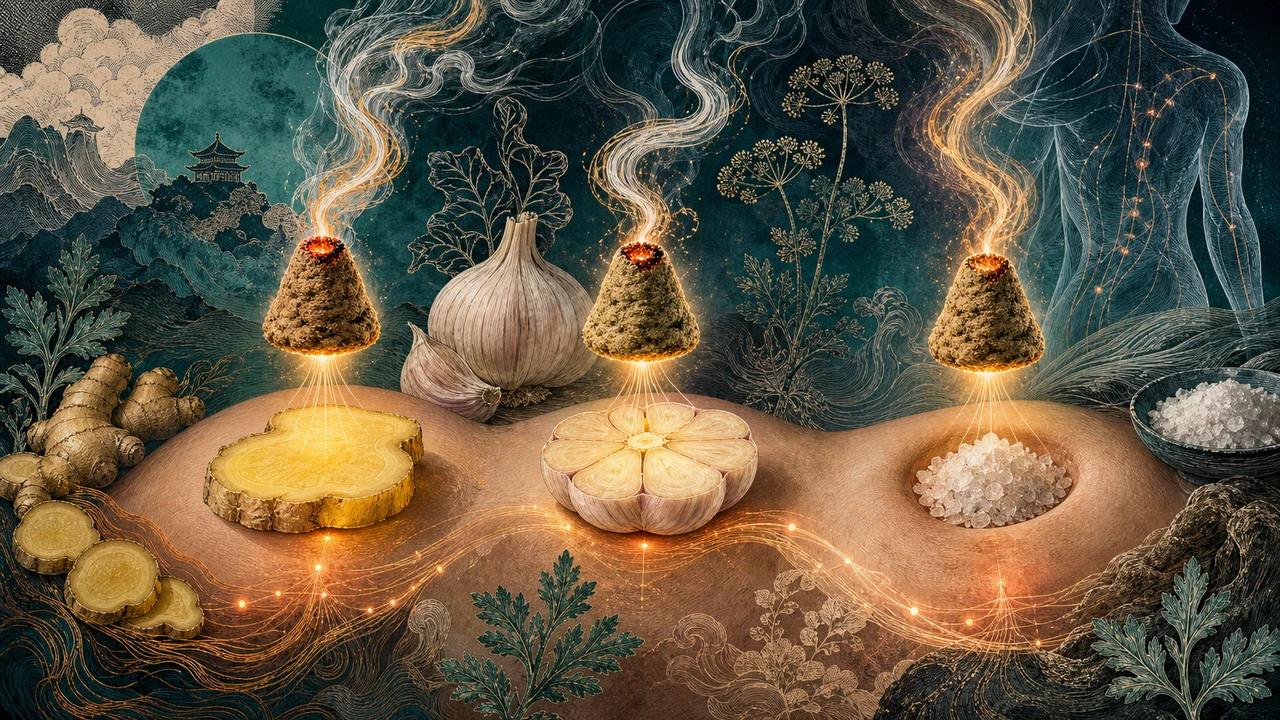
Moxa techniques with ginger, garlic and salt are forms of indirect moxibustion in which an intermediate layer separates the lit cone from the skin and changes the way heat is transferred to the body. Each material produces different warming conditions and requires specific care during application.
In this article, you will understand how these three techniques work, why the thickness and composition of the barrier influence temperature, how Chinese Medicine interprets each method, and which risks and limitations must be considered.
Continue reading to learn the differences among moxa with ginger, garlic and salt and understand why choosing and monitoring the method are essential for responsible application.
What are moxa techniques with intermediate substances?
Moxa techniques with ginger, garlic or salt belong to indirect moxibustion. In them, the lit moxa cone does not rest directly on the skin. An intermediate substance is placed between the burning material and the body, forming a layer that changes the transfer of heat.
These methods are also called separated, partitioned or interposed moxibustion. The name varies according to the translation used. Among the best-known modalities are moxibustion separated by ginger, garlic, salt and preparations made with different plants from the Chinese medical tradition.
The intermediate substance does more than prevent contact with the ember. Its thickness, moisture, density and composition change the speed and intensity with which heat reaches the skin. Therefore, ginger, garlic and salt produce different application conditions even when they support cones of a similar size.
How does the intermediate layer change the warming effect?
The moxa cone produces heat as it burns, while the intermediate layer slows its passage to the body. Some of the energy is transferred by conduction through the material, and another part arrives through radiation and heated air. The final stimulus depends on the combination of these different mechanisms.
A thicker layer generally increases the distance between the ember and the skin, but this does not guarantee a safe temperature. As the cone continues to burn, the intermediate material warms and may transmit high temperatures. Studies show that indirect moxibustion can still produce intense warming at the body surface.
The material may also lose water, dry out or change its structure during the session. These changes modify heat transfer over time. Therefore, practitioners should not determine safety solely by the barrier's initial thickness, but must continually monitor temperature and the person's response.
How does ginger-separated moxibustion work?
In ginger-separated moxibustion, a slice of the fresh rhizome is placed between the skin and the cone. The ginger supports the moxa and prevents the ember from coming into direct contact with the body. The technique is one of the most common forms of indirect moxibustion in clinical and experimental studies.
After the cone is lit, heat gradually passes through the slice. The ginger's natural moisture influences this process and helps distribute warmth across the contact area. The thermal stimulus may continue to increase even when combustion appears stable, requiring observation throughout the application.
Cone size, ginger thickness and the number of applications modify the final intensity. Studies of ginger-separated moxibustion use varied protocols, making it difficult to treat every procedure as a standardized technique with the same dose of heat.
How is ginger understood in Chinese Medicine?
In traditional theory, ginger and moxa are considered warming materials. The combination is used mainly in strategies intended to warm regions and patterns described as Cold or Yang deficiency. This explanation belongs to the functional language of Chinese Medicine and does not represent a measurement of energy added to the body.
The technique appears in research related mainly to menstrual pain, digestive changes, diarrhea and nausea caused by medical treatments. Some studies report favorable results, but the conditions, points, comparisons and methods used vary considerably.
The presence of ginger also adds plant substances to the procedure, but it has not yet been established how much of these components passes through the skin or participates in clinical outcomes. The directly observable effect remains the modification of the thermal stimulus produced between the cone and the body surface.
How does garlic-separated moxibustion work?
In garlic-separated moxibustion, a layer prepared with fresh garlic remains between the cone and the skin. As with ginger, the material supports the moxa and turns a direct application into an indirect one. The technique appears in traditional classifications and in studies that bring together different moxibustion modalities.
Garlic has moisture and a composition different from ginger. As it receives heat, its structure changes and transfers warmth to the area below. Intensity depends on the thickness used, cone size, exposure time and sensitivity of the treated region.
Some historical methods used garlic in regions associated with swelling or localized formations. This does not mean that the technique treats every lump, infection or tumor. Such changes need clinical investigation before any application of heat to avoid delaying proper diagnosis and treatment.
Why does garlic require special care?
Garlic contains substances capable of irritating the skin, especially when it remains in prolonged contact or is combined with heat. Intense redness, burning and blistering may therefore result from both temperature and the irritating action of the material itself.
So-called natural or medicinal moxibustion also uses irritating substances on points to provoke a local reaction. This procedure should not automatically be confused with all garlic-separated moxibustion, but it shows that skin contact with garlic may be intentionally stimulating in certain traditional methods.
People with sensitive skin, allergies, dermatitis, wounds or altered sensation are at greater risk of a reaction. Pain, excessive burning or progressive irritation requires the application to be stopped. Blisters and burns should not be considered unavoidable consequences of an ordinary indirect application.
How does salt-separated moxibustion work?
In salt-separated moxibustion, the mineral forms a layer between the skin and the moxa. The modality is traditionally applied mainly in the navel region, identified in Chinese Medicine as the Shenque point, although research may use variations and combinations with other materials.
Because the navel has a natural hollow, salt can fill the space and form a surface to receive another support or the cone. Some protocols combine salt and ginger, keeping the cone on a slice placed above the mineral. This arrangement increases the distance from combustion and changes thermal distribution.
Salt does not burn like moxa fiber, but it may accumulate and conduct heat. The temperature may remain high even after the cone is removed. Therefore, the technique requires control of quantity, time and the skin's response, without assuming that the mineral layer prevents burns.
How is the salt technique explained by Chinese Medicine?
Within traditional theory, moxibustion over the navel is related to warming the center and strengthening functions associated with Yang. It therefore appears historically connected with conditions described as Cold, weakness, intestinal changes or loss of functional support.
These traditional indications do not mean that salt and moxa have proven effectiveness for every abdominal pain, diarrhea, fainting episode or urinary problem. Clinical studies have evaluated salt-separated moxibustion for specific conditions, but the quality and quantity of evidence still vary.
The umbilical region also requires care because its irregular shape can concentrate heat. Wounds, inflammation, recent surgery, hernias or undiagnosed changes need assessment before any procedure. Severe abdominal pain, fever, vomiting or bleeding requires medical care, not moxa applied at home.
What are the differences, risks and limitations of these techniques?
Ginger is used primarily as a moist, warming slice; garlic adds more evident irritating potential; and salt forms a mineral layer that concentrates and conducts heat, often at the navel. None is merely a neutral barrier because each material changes the stimulus received by the skin.
All three modalities may cause burns, blisters, allergies, irritation, infection and discomfort from smoke. Risk increases when the cone is large, exposure is prolonged, the skin is injured or the person has reduced sensitivity. A review of case reports confirms that moxibustion is not free of adverse events.
Research often groups different techniques under the general name of indirect moxibustion, although ginger, garlic and salt produce distinct stimuli. This lack of standardization makes it difficult to compare results and determine how much of the effects comes from heat, the intermediate substance, the chosen points or the therapeutic context.
Frequently Asked Questions
They are forms of indirect moxibustion in which ginger, garlic, salt or another material remains between the lit cone and the skin, changing the transfer of heat.
A slice of fresh ginger supports the cone and separates the ember from the skin. Its moisture, thickness and exposure time influence the intensity of warming.
Garlic contains substances that may irritate the skin, especially with prolonged contact or warming. Intense burning, progressive redness and blisters require the application to be stopped.
Salt forms a layer that receives and conducts heat, usually in the navel region. It may remain hot even after the cone is removed and does not prevent burns.
No. Each material has its own thickness, moisture, density and composition, so each changes the intensity and distribution of heat in a different way.
Deepen your understanding of moxa therapy techniques
Applying moxa with intermediate substances requires an understanding of the materials, heat control and continuous monitoring of the skin's response.
Explore our e-books for clear, structured material on energy, balance and integrative practices.
Explore the e-books
About the author
Prof. Tibério Z has more than 30 years of experience teaching spirituality, metaphysics, holistic therapies and consciousness development.