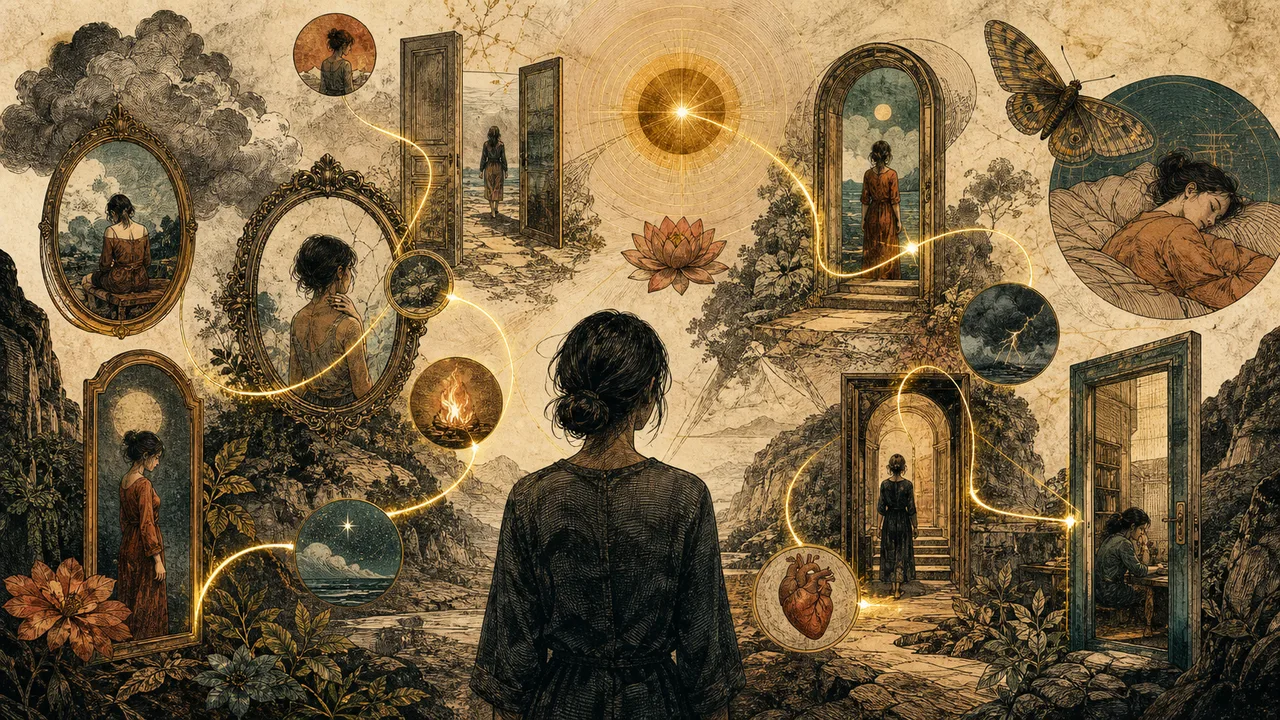
Identifying the archetypes that act in our lives requires observing what repeats. Roles, emotions, dreams, conflicts and relationships begin to point to the same theme. An archetype is not a label we choose, but a force we recognize through the effects it produces.
In this article, you will learn to bring these signs together without depending on tests or ready-made meanings. We will understand how to observe recurring situations, intense reactions, dreams, projections and roles that are difficult to abandon. At the end, we will follow a complete example to see how these elements connect.
Continue reading to discover a simple and profound way of looking at your own patterns. This process is not intended to place you inside a character. It helps you see what is acting behind your choices and restores space for a more conscious relationship with this force.
Identifying an archetype is not choosing a label
Many people begin with the question: what is my archetype? The question seems simple, but it already contains a problem. It suggests that there is a single character capable of summarizing our entire life, as though all we needed to do was find the right name and carry it forever.
An archetype does not work this way. All of us live human experiences connected with care, confrontation, separation, searching, creation, authority and transformation. Each of these situations may activate different forces, and the same force takes different forms according to our history and the phase we are living.
Archetype tests may offer an initial language. You read a character's traits, recognize some qualities and perceive conflicts that were not clear before. The mistake begins when the result is treated as a definitive identity: “I am the Hero,” “I am the Sage” or “I am the Rebel.”
Think of clothing. It reveals something about the way you present yourself at that moment, but it does not contain the whole person. A result also reveals preferences, desires or images with which you identify now. On its own, it cannot reveal the entire unconscious force organizing these choices.
Nor is the archetype necessarily the character we like most. We may choose the Sage because we value knowledge while an unconscious need to save everyone continues to direct our relationships. What we like to think about ourselves and what actually governs us are not always the same.
Therefore, identification begins when we stop looking for a label and start observing a movement. Instead of asking only “which character suits me?” we ask, “which theme keeps returning, what role do I assume and what happens when I try to leave it?”
The archetype appears through the effects it produces
Jung made an essential distinction between the archetype and the archetypal image. The archetype itself belongs to the collective unconscious and cannot be seen directly. It is a possibility for organizing experience. What reaches consciousness has already received a form.
This form may appear as a character, animal, place, object, situation, dream or fantasy. It may also organize emotions and behaviors. The force connected with care, for example, may appear as a mother, house, garden, fertile land or a very intense need to protect someone.
None of these images contains the entire archetype. They are ways through which the force becomes perceptible. The image receives the color of culture, personal history and the moment being lived. Two people may come into contact with a similar theme and dream of completely different scenes.
We can compare this with the wind. We do not see the wind, but we perceive leaves, branches and clouds moving in the same direction. A single leaf does not reveal the whole movement. When several elements respond together, we begin to recognize the force passing through them.
In psychic life, we seek this same convergence. An emotion reappears, a dream insists on the same motif, a role dominates relationships and certain people awaken a fascination that is difficult to explain. Each separate sign allows many interpretations. Together, they begin to reveal a structure.
Identifying an archetype means noticing this trail without confusing it with a single image. The name comes later. First, we observe how the force organizes our attention, emotion, imagination and choices.
Observe the roles that always repeat
A good starting point lies in situations that change in appearance but preserve the same structure. You change jobs and once again become responsible for solving everyone's crisis. You enter another relationship and return to the position of the person who cares, teaches, obeys, conquers or flees.
Knowing the set of archetypes offers names and images for comparing these movements. However, the name must not come before observation. Begin by describing the role in ordinary words: “I am always the one who saves,” “I need to prove that I know,” “I challenge every authority” or “I keep everyone together.”
Then observe the beginning of the scene. What usually happens before you assume this role? Perhaps someone shows insecurity and you take control. Perhaps a rule is presented and you feel an immediate urge to break it. Perhaps someone pulls away and you do everything to prevent the separation.
Also notice how the story ends. Do you feel recognized, exhausted, abandoned or trapped? Do others gain strength or become more dependent? The repetition is not only in the initial action. It includes the outcome that keeps returning even when you promise to act differently.
A repeated behavior does not prove the presence of an archetype on its own. There are habits, family learning, working conditions and conscious choices. The archetypal dimension becomes more likely when the repetition also carries intense emotion, striking images and a sense that something greater has taken command.
The recurring role opens the investigation. It does not close the answer. By recognizing its structure, you find the exact place where you need to observe emotions, dreams, relationships and the side this role leaves hidden.
Intense emotions reveal where a complex has been activated
Some reactions seem larger than the present event. A small criticism awakens deep shame. A delay provokes a feeling of abandonment. The refusal of help produces anger that is difficult to contain. At these moments, the current fact has touched a broader emotional history.
Jung called a group of memories, ideas and images united by a strong emotion a complex. It forms within personal history, but it may organize itself around an archetypal core. Thus, a concrete experience with authority may receive the force of very old images connected with the father, king, judge or tyrant.
When the complex is activated, our freedom diminishes for a few moments. We say something we did not intend, forget a simple piece of information or feel that we have returned to an earlier age. Later we ask, “why did I react this way if the situation was not even that serious?”
Emotion works like a light that has been switched on. It reveals where there is energy, but it does not immediately provide meaning. Anger may appear in a necessary struggle for boundaries or as a defense against one's own fragility. Fear may protect us from a real danger or keep alive a bond with a past experience.
Therefore, record the reaction before interpreting it. What happened? Which emotion arose? Which image passed through your mind? What did you feel like doing? When these answers begin to form the same design in different situations, we find a more reliable path for understanding the pattern.
The complex connects the collective with the personal. The archetype provides a broad human structure; our history gives that structure particular memories, faces and wounds. Ignoring either side produces an incomplete explanation.
Compulsive roles indicate identification with a force
Expressing courage, care, knowledge or nonconformity is part of life. The problem begins when one of these qualities becomes the only way we can recognize our value. We no longer use the role when it is necessary. We need to remain within it.
This fusion is called identification. We confuse a force acting in our life with everything we are. A person does not merely say that they cared for someone; they feel that they need to be everyone's caregiver. They do not recognize that they overcame a difficulty; they need to turn every relationship into a battle.
The clearest sign appears when we try to abandon the role. Someone who always saves may feel useless when they meet a person capable of solving their own problem. Someone who needs to know everything feels threatened when another has a better answer. Someone who lives as a rebel finds oppression even in agreements they helped create.
The initial quality still exists. The caregiver genuinely offers protection, the Hero faces challenges and the Sage seeks understanding. However, the force occupies too much space and stops recognizing timing, boundaries and necessity. It begins to use every situation to repeat the same response.
Observe the absolute statements that appear at these moments: “if I do not do it, no one will,” “I cannot show weakness,” “I need to win,” “no one tells me what to do.” They reveal an identity defended with urgency. An entire life begins to serve the maintenance of a character.
Recognizing identification does not mean abandoning the quality. It means removing the uniform when it does not serve. Courage remains available, but it no longer needs to turn every encounter into combat. Care remains, but it can respect the other person's autonomy.
Dreams reveal images that consciousness did not choose
During the day, we control part of the image we present. We choose words, justify decisions and avoid uncomfortable thoughts. A dream creates scenes without asking the ego for permission. For this reason, it may show the conflict we are experiencing in another way.
Not every dream needs an archetypal explanation. Many revisit recent events, concerns and relationships. The sign of a deeper dimension appears when the image has great force, produces fascination or fear and seems to go beyond what happened the previous day.
The most important thing is to follow a series. An isolated dream allows many interpretations. When a house, bridge, child, forest or mission reappears, we can observe the movement. Does the door remain closed? Has the path changed? Has the figure come closer? Can the dreamer respond now?
First record the scene as it happened. Then write down the emotion felt during the dream and your personal associations with each element. If a dog appeared, ask what relationship you have with dogs, what memory arose and how that animal behaved. Do not begin with a meaning found in a dictionary.
Later dreams also correct our conclusions. We may believe that a tower represents power and discover, in a new scene, that it functions as a prison. Repetition clarifies the theme and prevents us from accepting a pleasant explanation merely because it agrees with what we want.
Dreams do not provide labels. They reveal relationships, movements and conflicts. When their images meet the patterns and emotions of waking life, the hypothesis about the active force gains depth.
Fascination and rejection may conceal a projection
Some people seem to carry everything we admire. They are seen as perfectly wise, courageous, beautiful or spiritual. Others seem to contain only falsehood, weakness, arrogance or malice. The intensity of the reaction indicates that our perception may contain something beyond the facts.
Projection is the process through which an unconscious content appears as though it belonged only to the other person. The real person offers characteristics that serve as a foundation, but our psyche adds an image. Therefore, an ordinary person may acquire an almost divine greatness or a threat far greater than their concrete action.
A positive projection arises when we place all the creativity or courage we do not yet recognize within ourselves upon the other person. We begin to believe that only that person can open paths, bring meaning or save us. If they fail, admiration quickly turns into disappointment and anger.
Negative projection makes the opposite movement. We see in the other person a quality we reject in our own life. The irritation does not prove that we are identical to the person we criticize, but it invites a question: why does this behavior occupy so much space within me, and where does something similar exist, even in another form?
Withdrawing a projection does not mean denying reality. A lie remains a lie, aggression needs a boundary and an admirable person genuinely has qualities. The task is to separate what belongs to the other person from the image we place upon them.
Fascination and rejection reveal where an archetypal image has gained energy. When we recover the projected part, the other person returns to human proportions and a capacity that seemed to exist only outside begins to be recognized within.
A symbol can only be understood within its context
Symbols do not work like words in a fixed code. Dreaming of water does not have a single meaning. We need to know whether it was a glass, river, gentle rain or flood; whether the person drank, crossed, was born or drowned; whether they felt peace, fear or joy.
The context begins in the dreamer's life. What situation are they living? Which memories does the image awaken? Which detail seems most important? The same sea may represent freedom to someone who spent childhood sailing and danger to someone who experienced drowning.
After personal associations, we may compare the image with myths, tales, religions and works of art. This process is called amplification. It expands the symbol's possibilities but does not replace the concrete experience with a cultural explanation.
Imagine that someone dreams of a serpent. A dictionary may offer healing, danger, sexuality, wisdom or transformation. All these possibilities remain empty until we know what the serpent was like, what it did and what relationship the dreamer has with it.
Mythological comparison helps when it illuminates a detail the person has already found in their experience. It hinders when it forces life to fit a ready-made story. In that case, the symbol stops opening a question and serves only to confirm an answer chosen in advance.
The living symbol preserves an element of mystery. We approach its meaning by observing context, emotion and transformation over time. Naming it too quickly may interrupt the very understanding that was beginning.
The rejected part reveals the other side of the pattern
Every dominant role leaves something out. Someone who needs to be strong hides vulnerability. Someone who lives to care loses contact with their own need to receive. Someone who identifies with knowledge avoids situations in which they need to learn or admit that they do not know.
This excluded part belongs to the shadow. It brings together characteristics that do not fit the conscious image we have constructed. Some seem negative, such as envy, anger and the desire for power. Others are valuable qualities that were rejected because they threatened the role accepted by the family or group.
To identify archetypal activity, observe the contrast. Which quality do you display proudly? What cannot appear while you maintain this image? Which type of person provokes contempt precisely because they embody the characteristic you forbid within yourself?
A savior may condemn someone who asks for help while preventing others from solving their own problems. Their shadow contains dependence and exhaustion, but they do not allow these experiences to reach consciousness. The more they deny the need for support, the more they need to find fragile people in order to remain strong.
The other side corrects identification. Courage without vulnerability becomes hardness. Care without boundaries becomes control. Wisdom without openness becomes arrogance. Freedom without commitment becomes escape. The shadow reveals the hidden cost of the quality that has occupied all the space.
Recognizing this cost does not destroy the archetype. The force gains a more complete expression. The Hero learns to receive help, the caregiver allows separation and the Sage returns to asking questions.
The name comes after observation
After learning the signs, the desire to reach a quick conclusion arises. This haste returns us to the initial problem: we choose a name and begin fitting everything into it. The safer path is to record first and interpret later.
For a few weeks, write down five elements whenever a situation produces strong emotion or repetition:
- What happened before the reaction.
- Which emotion arose and how intense it was.
- Which role you assumed.
- Which image, fantasy or dream approached this theme.
- Which consequence appeared for you and for others.
Add a sixth question: what does this role not allow me to be? It helps find the shadow and prevents the investigation from remaining limited to pleasant qualities. If you always need to lead, perhaps you do not allow trust; if you need to please, perhaps you do not allow conflict.
When rereading the record, look for relationships. Does the same role appear at home and at work? Does the emotion repeat before different people? Do dreams reveal the same mission, pursuit, house or passage? Does the outcome end again in exhaustion, dependence or isolation?
Only then formulate a hypothesis: “there is a heroic force organized around the need to prove value” or “a maternal image seems to guide my care and my fear of separation.” The sentence describes an activity. It does not turn the person into the archetype.
A hypothesis remains open. New dreams and experiences may confirm it, reveal another aspect or show that the chosen name was wrong. Correction is part of the process. Self-knowledge is not about getting a label right; it is about learning to observe honestly.
Marcos recognizes the Hero without turning the archetype into an identity
Marcos worked on a team that faced frequent crises. Whenever a deadline was missed, he took on the most difficult tasks, stayed late and found a way out. His colleagues praised his ability, and he felt that he finally had an important place.
The same pattern appeared in other areas. Marcos chose friends with major problems, offered solutions before being asked and entered relationships in which he needed to protect someone. When his help was refused, he became angry and said that people did not recognize those who were truly there for them.
Over several months, he dreamed three times of a tower in flames. In the first dream, he climbed alone to save trapped people. In the second, he carried so many people that he could not use the stairs. In the third, he found the exit but refused to descend while anyone remained inside.
Marcos began recording the crises, the emotion and the role he assumed. He realized that the urgency arose before he assessed whether his intervention was necessary. He also noticed the outcome: he made himself indispensable, others surrendered responsibilities and then everyone felt resentful.
The image of the Hero helped bring these signs together. There was courage, initiative, sacrifice and confrontation with danger. However, personal history was also present. Marcos had learned early that he received attention when he solved family problems. The archetypal core and personal complex were acting together.
His shadow contained fragility, rest and the need for support. He admired strong people but despised colleagues who asked for help. He did not realize that his own request remained trapped inside the tower. Saving everyone prevented him from recognizing the desire to be cared for as well.
Marcos did not conclude, “I am the Hero.” His hypothesis was more precise: a heroic constellation took command when he needed to prove his value. From then on, he began asking whether help had been requested, dividing tasks, allowing colleagues to face difficulties and accepting support before reaching exhaustion.
His courage did not disappear. It stopped requiring a permanent fire. Marcos continued acting in real crises, but he no longer needed to create dependence in order to feel that he mattered.
Recognizing an archetype restores room for choice
The purpose of recognizing an archetype is not to expel it. These forces are part of psychic life and continue organizing images, emotions and responses. What changes is our relationship with them.
When the pattern remains unconscious, we react as though no choice exists. The caregiver needs to care, the Hero needs to fight and the Rebel needs to break away. Then we say that the situation required exactly that, without noticing how often we helped construct the same situation.
Awareness creates a small distance. We can say, “the urge to save has appeared,” “I am placing a great image upon this person” or “my anger reveals that this role has been threatened.” This distance does not eliminate emotion, but it prevents emotion from being immediately confused with truth.
We also learn to choose the appropriate expression. The heroic force may offer courage to face a problem without taking responsibility for everyone's life. Maternal energy may nourish a creation without preventing its growth. The Trickster may reveal a contradiction without turning freedom into cruelty.
No identification is resolved forever. Changes, losses, passions and crises activate new images. Therefore, the process continues through observation, dreams, relationships and the consequences of our choices.
Recognizing an archetype means perceiving that something powerful acts within us without concluding that this something is all we are. When the force receives a place, the other parts also begin to breathe again. In this space, the pattern stops being destiny and begins to participate in a conscious choice.
Frequently Asked Questions
A test may offer characters for reflection, but it does not definitively identify the archetype acting within you. Recognition requires observing patterns, emotions, dreams, projections and changes over time.
No. Various archetypal forces take part in human life and may gain more energy in different phases or situations. Turning one of them into a fixed identity reduces a person's complexity.
We cannot conclude this from an isolated dream. Striking images, deep emotions, unusual motifs and repetitions in a series of dreams help us recognize when an archetypal dimension is present.
An intense emotion shows that a content has gained energy, but it does not determine its origin or name on its own. It needs to be related to the situation, personal history, behaviors and images that appear.
The force does not disappear, but it stops acting in complete secrecy. We can recognize its impulses, excesses and rejected side, creating more space to choose how to express it.
Explore the Ultimate Guide to Archetypes
Identifying archetypes requires observing patterns over time, not merely choosing a character with pleasant qualities.
In the Ultimate Guide to Archetypes, you will learn to recognize these forces in depth and understand how they influence your journey.
Explore the Ultimate Guide to Archetypes
About the author
Prof. Tibério Z has more than 30 years of experience teaching spirituality, metaphysics, holistic therapies and consciousness development.