
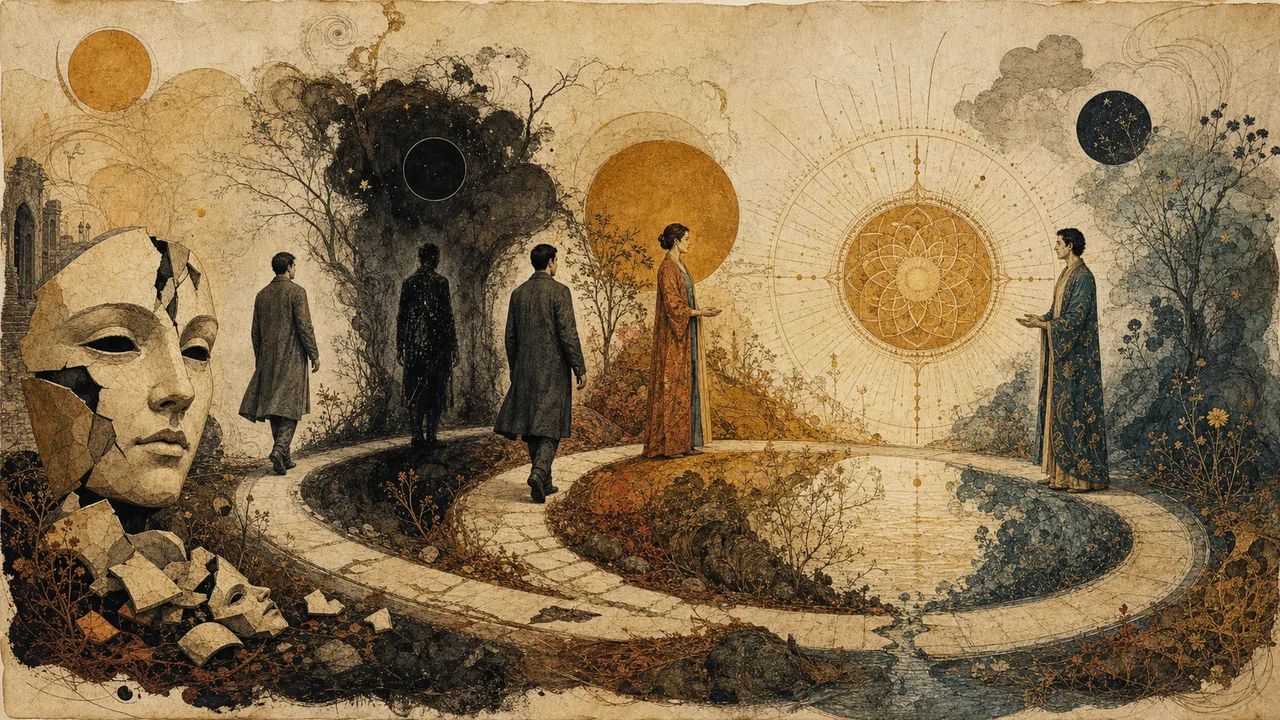
Individuation is the path through which we become a more whole and singular person. In this process, we stop living only through the roles we learned and begin to recognize parts that also belong to us. The ego remains necessary, but it begins to relate to a greater totality.
In this article, you will understand what Carl Gustav Jung called individuation, why it is not individualism and how consciousness encounters what remained hidden. We will also follow a complete example and see why integrating a part does not mean obeying every impulse.
Continue reading to understand how this path appears in conflicts, dreams, choices and relationships. Individuation does not turn us into perfect people; it helps us live with greater truth, responsibility and awareness.
Jung called individuation the path to becoming whole
Carl Gustav Jung used the word individuation to describe the process of becoming a more whole, singular and indivisible unity. This is not about inventing a new personality. It is about developing what already exists as a possibility but has not yet found a conscious way to participate in life.
All of us begin by forming an identity. We learn our name, recognize our desires, choose values and construct a story about who we are. This identity is necessary, but it does not contain everything. There are qualities, needs and conflicts left outside it because they were not accepted by the family, the culture or ourselves.
To individuate is to create a relationship with this life that remained hidden. What was unconscious needs to be recognized, differentiated and placed in dialogue with what we already know. Personality grows when the ego stops representing everything we are on its own.
We can compare the process with working on a piece of wood. The material has its own grain, resistance and possibilities, but no form arises without work. The craftsperson cannot force the wood to become anything at all, and the wood does not transform itself. The work is born from the encounter among nature, consciousness, choice and action.
The same happens with us. There is no closed script determining every step, but neither are we a blank sheet. We have a history, a body, tendencies, limitations and possibilities. Individuation occurs when we respond to this set in our own way instead of merely repeating the form others expected from us.
Jung also related individuation to the Self, the totality that includes consciousness and the unconscious. This does not mean that the ego disappears. The ego observes, chooses and acts, but acknowledges that its explanation of life is not the only force present in the psyche.
Individuation is not individualism
The similarity between the words creates a common confusion. Individualism means placing personal will above bonds, obligations and differences. Individuation develops singularity without turning this singularity into a law for everyone.
Imagine a musician in an orchestra. If the musician only imitates the others, they will never develop their own sound. If they decide to play any melody without listening to the ensemble, they will destroy the music. Their own voice gains value when it finds a true place in relation to the other instruments.
Therefore, individuating does not mean saying, “this is who I am, and it is no one else's concern.” This statement may conceal fear of change, difficulty listening or refusal of responsibility. A personal choice continues to produce effects on family, work and the people who take part in our life.
Jung stated that individual development should broaden relationships, not produce isolation. When we recognize what is ours, we stop requiring other people to carry these parts for us. We also become less dependent on approval because difference no longer seems like a threat to identity.
This understanding allows us to learn about the archetypes that take part in the path of integration without turning them into labels. An archetype does not grant us permission to act without measure. It reveals a deep human force that needs to find conscious expression within a real life.
Being singular and belonging are not opposing movements. We can participate in a community without erasing our consciousness and follow our own path without despising the collective. Individuation seeks precisely a more vital relationship between these two needs.
First, we need to build a life capable of sustaining us
Before entering deep conflicts, we need a consciousness capable of remaining present. Studying, working, caring for the body, forming bonds, tolerating frustrations and fulfilling commitments help build this foundation. Jung called the center that organizes our conscious life the ego.
The Persona also takes part in this construction. It is the role through which we enter the world and are recognized. Teacher, therapist, mother, father, professional, friend and partner are necessary forms of relationship. The problem is not having roles, but believing that one of them represents the entire personality.
We can think of the ego as a vessel. To cross deep waters, it needs structure, direction and the ability to withstand movement. A fragile vessel does not gain freedom by facing a storm; it risks being carried away by the force of the water.
Likewise, contact with intense emotions, dreams and inner images requires discernment. We need to distinguish symbol from fact, desire from decision and inner experience from external command. An ego capable of making this distinction does not block individuation; it allows the process to find a safe form.
Jung emphasized that youth is usually dedicated to forming this foundation. It is the period for finding a place in the world, building relationships and developing capacities. Later, many people discover that success and adaptation no longer answer every question. This transition does not occur at the same age for everyone and does not follow a fixed schedule.
We do not need to despise the life we have built in order to begin looking within. Individuation does not begin by fleeing responsibilities. It begins when we can ask whether the form through which we are living still represents the whole of what we are.
An identity that worked may stop serving us
An identity may organize our life for many years. The responsible person learns to solve problems. The caregiver finds value in protecting. The competent professional gains security through performance. These forms were important and may remain so, but they can occupy too much space.
When only one role receives energy, other parts stop participating. The professional does not know how to rest. The caregiver feels guilty when thinking about herself. The strong person cannot ask for help. Over time, what ensured recognition also begins to produce fatigue and emptiness.
It is common for this change to appear as a crisis of meaning. External life continues to function, but something has lost its meaning. Achievements that once brought satisfaction no longer answer the question “what am I living for?” The mistake would be to treat this crisis as failure or as an order to abandon everything.
A crisis opens a question; it does not provide the answer. Sometimes, what needs to change is the way we live the same work. In other cases, a relationship requires new boundaries. There may also be physical or emotional suffering that needs professional care. Not every discomfort is a sign of individuation.
Notice how the Persona may act at this moment. If someone has always been recognized as a provider, they may interpret any personal need as selfishness. If they have always been a peacemaker, they may feel ashamed of anger. The old identity defends its position because it believes that, without it, all value will be lost.
Individuation begins to advance when we can honor what this role has built while recognizing its limit. We do not need to declare war on the Persona. We need to remove from it the impossible obligation to represent everything.
The unconscious presents what was left out
Excluded parts do not disappear. They appear in emotions that seem too large, recurring dreams, fascinations, lapses, conflicts and rigid judgments. The unconscious finds ways to show what consciousness still cannot recognize directly.
Projection occurs when we see primarily in the other person a force that also acts within us. We may admire someone for a courage we never allowed ourselves to live. We may also condemn a freedom that we desire but learned to call irresponsibility.
Withdrawing a projection does not mean claiming that everything in the other person is our imagination. An actually disrespectful attitude remains disrespectful. The work is to perceive why it gains a certain force and which part of us is connected with the reaction.
Dreams may also present what was left out. An abandoned house, a forgotten child or an interrupted road does not have an automatic translation. The image needs to be related to the moment being lived, the emotions and the dreamer's associations.
The archetypes taking part in this path may give these images great intensity. Therefore, they need to be received with respect and measure. No dream proves that we are chosen, determines a decision or replaces an assessment of reality.
Recognizing the hidden part is only the beginning. If we discover anger, we still need to learn what it protects. If we perceive a desire for change, we need to separate true necessity from impulse. Consciousness receives the message and begins a dialogue; it does not immediately hand command of life over to the unconscious.
Opposites need to produce a new response
Many conflicts of individuation place two important sides face to face. Security and freedom, care and boundaries, duty and desire, reason and feeling seem to require opposing choices. The first reaction is usually to destroy one side to relieve the tension.
If we obey only the old role, the excluded part disappears again. If we obey only the new impulse, we may trade one prison for another. The controlled person begins acting without thinking; someone who lived to please begins rejecting every commitment; the tired professional abandons everything without understanding what they were truly seeking.
Jung called the movement that may arise from the encounter between consciousness and the unconscious the transcendent function. The name does not mean escaping reality or reaching a higher plane. It means moving beyond an opposition that seemed to have no way out through a new attitude.
This response is not a weak agreement in which each side receives a little. It changes the way we see the problem. Freedom may not require abandoning work, but recovering a creative activity and sharing responsibilities. Care may not need to end, but to stop being control.
A symbol may help because it brings together meanings that logic has separated. However, it needs to be lived and tested. An inner understanding gains value when it becomes a schedule, conversation, boundary, creation or choice. Without this passage, we continue merely thinking about change.
Holding the opposites requires time. Anxiety wants an immediate answer, but individuation calls for observation and conscious participation. We listen to what emerges, examine its effects and assume the consequences of the chosen path.
Ricardo finds the life hidden behind success
Ricardo was 46 years old and had built a stable life. He became a manager, supported his family and was always called when someone needed to solve a problem. He felt proud of this history, but began waking up tired and losing interest in achievements that had once seemed important.
He also became irritated with his younger brother, who changed projects and reserved time for creative activities. Ricardo called him irresponsible. He said an adult should choose a path and keep following it even when it no longer held meaning.
During this period, Ricardo repeatedly dreamed of an abandoned workshop. There were rusty tools and pieces of wood covered in dust. At the back of the place, a boy was trying to finish a small table but could not reach the tools placed on a high shelf.
The workshop brought back the memory of an activity Ricardo loved when he was young. He built wooden objects with his grandfather but abandoned everything when he began his career. Creativity seemed incompatible with the image of a serious man and provider that he needed to maintain.
Upon recognizing this part, Ricardo felt like leaving his job. He thought the dream was telling him to trade all his stability for woodworking. This reaction seemed liberating, but it remained extreme: before, only duty had value; now, only desire seemed true.
He decided not to turn the symbol into a command. He began by reserving two evenings a week to work with wood. He talked with his wife about his exhaustion and listened to her fears. At work, he delegated tasks he had kept under his control because he believed no one would do them as well as he did.
The change revealed something beyond creativity. Ricardo realized that he needed to be indispensable in order to feel loved. Solving everything prevented the feeling of depending on someone. The abandoned workshop did not hold only a pastime; it held a more open way of creating, learning and accepting limits.
Over time, his relationship with his brother changed. Ricardo continued to disagree with some choices, but stopped turning him into a symbol of all irresponsibility. The freedom he once saw only in the other person began to find a place in his own life.
Ricardo did not stop being a manager, provider or responsible man. These roles lost the obligation to explain everything. His life became broader because responsibility and creativity found a new relationship.
Becoming more whole changes the way we relate
An inner transformation needs to appear in the way we treat people. If someone claims to be following their own truth but begins disrespecting boundaries and despising every disagreement, they may simply have created a new Persona. The language has changed; the rigidity remains.
When we withdraw a projection, the other person stops carrying a part of our history alone. Ricardo no longer needed to condemn his brother to keep his own desire for freedom hidden. Nor did he need to idealize him as someone who possessed the life he lacked.
This change allows more real relationships. We can love without requiring the other person to confirm our identity, disagree without turning difference into a threat and help without needing to be indispensable. Conflicts do not disappear, but they stop being fueled only by parts we do not know.
Individuation also strengthens boundaries. Someone who recognizes their own need can say “no” before accumulating resentment. Someone who accepts their own fragility can ask for help before collapsing. The relationship gains truth because it depends less on a mask of perfection.
Following our own path does not remove us from the world. It makes us responsible for the way we participate. Work, family, friendship and community stop being merely places of adaptation and become spaces where our consciousness is tested.
The result is not agreeing with everyone. It is being able to remain in relationship without erasing our own difference or denying the other person's difference. The more whole we become, the less we need to control people in order to sustain who we believe we are.
Individuation does not end in a perfect personality
There is no moment when the entire unconscious becomes known. Each stage of life presents new losses, bonds, responsibilities and questions. A part integrated today may reveal another aspect tomorrow. Therefore, individuation is an ongoing process.
We can compare it with a spiral. At certain moments, we return to old themes: fear of rejection, the need for control, difficulty trusting. It seems that we are in the same place, but the new position allows us to see the problem with greater awareness and respond differently.
The process also does not eliminate contradictions. A more whole person still feels fear, anger, desire and insecurity. The difference lies in the relationship with these forces. They can be recognized before they take over action and find more responsible forms of expression.
There is no mandatory sequence of Persona, Shadow, Anima, Animus and Self that functions as a program with completed stages. These names help us understand different experiences, but life does not follow a manual. Each history presents its own order, repetitions and limitations.
Psychological analysis may help us observe dreams, projections, conflicts and choices, but individuation does not belong only to the consulting room. It also occurs at work, in creation, care, spirituality and relationships. When suffering becomes intense or reality becomes difficult to sustain, seeking professional help is part of responsibility.
We do not need to ask whether we have reached the end. We can observe whether there is greater awareness, less projection, a greater ability to sustain differences and choices that truly reach life. These movements do not grant perfection, but they show that the personality has stopped repeating only its familiar form.
Becoming who we are is not discovering a ready-made answer hidden at the bottom of the psyche. It is consciously participating in a life that continues to reveal itself. Individuation invites us to follow this path without abandoning the world, the ego or responsibility for our choices.
Frequently Asked Questions
Individuation is the process through which we become a more whole and singular person. This happens when consciousness stops living only through known roles and begins to recognize, differentiate and integrate parts that also belong to the personality.
Individualism places personal will above bonds and obligations. Individuation develops singularity without breaking our relationship with the world. The more we recognize what is ours, the less we need to project these parts onto others.
No. Development occurs throughout life. Jung emphasized that youth usually requires ego formation and social adaptation, while later phases may call for deeper integration. This division is not a fixed age or a rule that is the same for everyone.
No. Individuation needs to reach real life and assume responsibility for its consequences. Sometimes an external change is necessary, but it should not be treated as an automatic command from a dream, crisis or impulse.
No. The unconscious cannot be known completely, and each stage of life presents new tasks. We can expand awareness and live with greater wholeness, but we do not receive a final state of perfection.
Explore the Ultimate Guide to Archetypes
Individuation reveals how encountering different archetypes can lead to a more whole and truthful life.
In the Ultimate Guide to Archetypes, you will learn to recognize these forces and understand the role each one plays in your process of transformation.
Explore the Ultimate Guide to Archetypes
About the author
Prof. Tibério Z has more than 30 years of experience teaching spirituality, metaphysics, holistic therapies and consciousness development.