
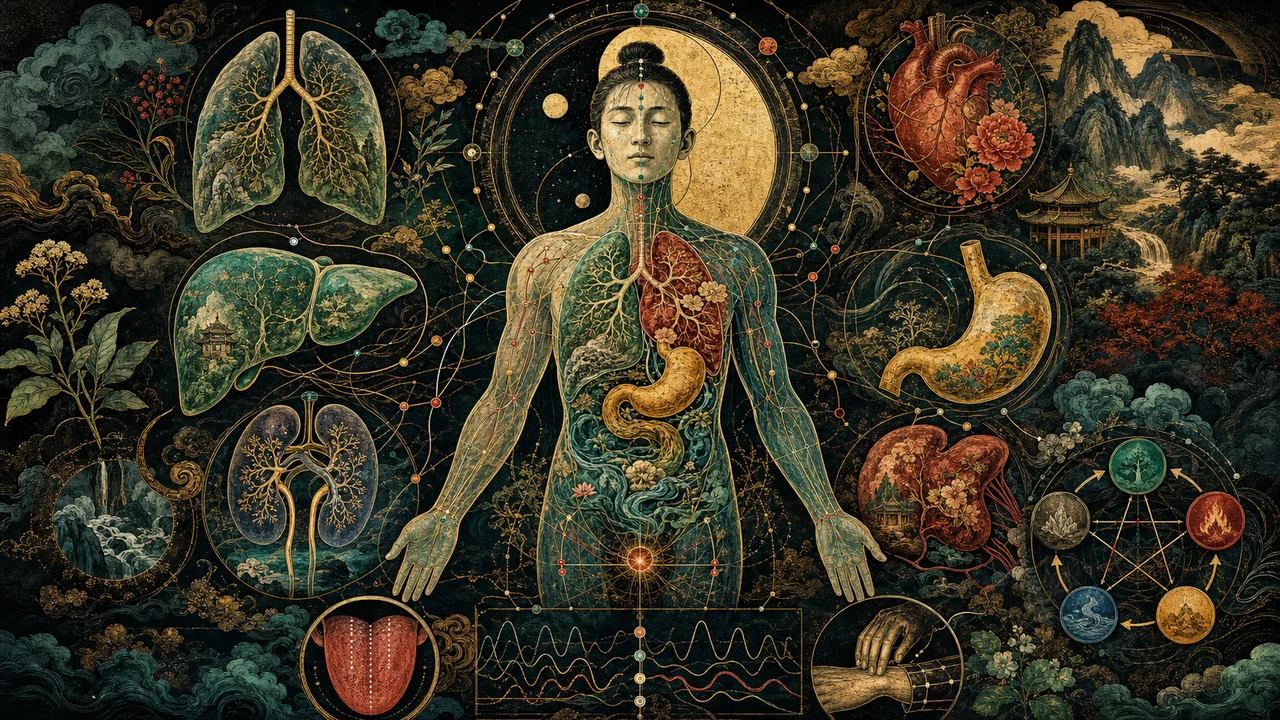
Traditional Chinese Medicine brings together knowledge developed over centuries to understand how the body functions, the causes of disease, and the relationships among health, emotions, habits, and the environment. Its concepts form a system of its own, in which each manifestation is analyzed as part of a set of related processes.
In this article, you will learn about the main foundations of Chinese Medicine, such as Qi, Yin and Yang, vital substances, Zang organs, Fu viscera, the Five Phases, and the Eight Principles. You will also understand the functions attributed to the internal systems and how emotional, climatic, and behavioral factors may contribute to illness.
Continue reading to understand how these concepts connect and form an integrated view of health, illness, and diagnosis in Traditional Chinese Medicine.
What Traditional Chinese Medicine is and how it understands health
Traditional Chinese Medicine is a medical system developed in China from observations of the body, nature, and the changes that occur throughout life. It brings together assessment methods and therapeutic practices such as acupuncture, herbal medicine, moxibustion, massage, body exercises, and guidance related to daily habits.
Its understanding of the body is not limited to anatomical structures. It observes functions, movements, transformations, and relationships among different parts of the body. Sleep, digestion, respiration, disposition, emotions, thermal sensations, and responses to the environment are analyzed as manifestations that may reveal a person's overall condition.
From this perspective, health does not mean only the absence of a diagnosed disease. It corresponds to the ability to keep functions coordinated and adapt to internal and external changes. A healthy body can respond to exertion, climate, diet, and emotional experiences without remaining trapped in a state of disorganization.
How Traditional Chinese Medicine arose
Chinese Medicine did not arise on a specific date and was not created by a single physician. It developed gradually from healing practices, clinical observations, knowledge about natural substances, and interpretations of disease developed by different Chinese communities over many centuries.
Ancient records show that some illnesses were initially related to ancestors, spirits, and supernatural forces. Over time, explanations based on climate, diet, emotions, and internal functioning became more important. This change allowed medical knowledge to be recorded, compared, and transmitted in a more organized way.
Texts such as the Huangdi Neijing helped systematize principles that would guide generations of physicians. During the Han, Tang, Song, Ming, and Qing dynasties, new works, formulas, and schools expanded this knowledge. The form now called Traditional Chinese Medicine was institutionalized mainly from the 1950s onward.
What Qi is in Chinese Medicine
Qi is a concept used to represent the activity that supports the body's movements and transformations. Although it is often translated as vital energy, its meaning is broader. It includes movement, functioning, warming, protection, transformation, and the ability to keep bodily activities coordinated.
Chinese Medicine describes part of Qi as related to the constitution received from the parents and another part as continuously formed after birth. Food, drink, and inhaled air provide resources that undergo internal transformations and contribute to the daily maintenance of bodily functions.
Qi participates in circulation, respiration, digestion, the distribution of fluids, and the support of structures. Its fundamental movements are ascending, descending, entering, and exiting. When these directions remain organized, functions can fulfill their purposes; when they change, different patterns of disharmony may arise.
What Yin and Yang are and how these forces influence health
Yin and Yang are categories used to represent opposing and complementary aspects of the same phenomenon. Yin is related to the interior, rest, conservation, cold, and matter. Yang is associated with the exterior, movement, activity, heat, and expansion. Neither exists completely independently.
These classifications are relative. A region may be considered Yang when compared with another region that is more internal, but it may become Yin in relation to an area that is even more external. Therefore, Yin and Yang are not fixed labels. Their meaning depends on the relationship established, the moment, and the phenomenon analyzed.
Health depends on a dynamic relationship between these two tendencies. This does not mean that Yin and Yang must remain in identical quantities. The body needs to increase activity when there is a demand, reduce movement during rest, and shift from one condition to another according to the needs of each moment.
What the five vital substances of Chinese Medicine are
The five vital substances are Qi, Xue, Jing, Shen, and Jin Ye. They are usually translated as Qi, Blood, Essence, Mind or Spirit, and Body Fluids. Each represents a different aspect of human constitution and functioning, but all remain related.
Xue nourishes and moistens the tissues, while Jing represents the constitutional foundation associated with development and reproduction. Jin Ye corresponds to the body's normal fluids. Jin identifies lighter and more fluid liquids, while Ye indicates those that are denser and remain in deeper regions.
Shen represents consciousness, thought, perception, and emotional expression, while Qi allows movements and transformations to occur. These five categories are not understood as completely separate components. Proper functioning depends on their formation, circulation, preservation, and continuous interaction.
What Shen is and its relationship with the mind and emotions
Shen represents the conscious and psychic dimension of the human being. It is related to thought, perception, attention, memory, communication, and the ability to recognize the environment. For this reason, it may be translated as Mind or Spirit, although neither word fully reproduces its meaning.
In Chinese Medicine, Shen is associated with the Heart. This relationship does not mean that the heart muscle is considered responsible for all brain functions. The traditional Heart represents a broader system related to circulation, consciousness, and the integration of different mental and emotional activities.
The state of Shen may be observed in the clarity of the gaze, coherence of speech, attention, and quality of contact. Emotions are part of its manifestations because they are recognized and experienced by consciousness. Prolonged changes in emotional life can also interfere with the stability, rest, and organization attributed to Shen.
What the Zang organs and Fu viscera are
Zang-Fu is the system used to organize the principal organs and viscera of Chinese Medicine. The Zang are classified as Yin and are related to the production, preservation, and storage of vital substances. The Fu have a Yang nature and receive, transform, transport, or eliminate different contents.
The principal Zang organs are the Heart, Liver, Spleen, Lung, and Kidneys. The Pericardium may also be included in this organization. The Fu viscera are the Small Intestine, Gallbladder, Stomach, Large Intestine, Bladder, and Triple Burner.
These systems do not correspond only to the anatomical organs with the same names. Each brings together bodily functions, tissues, senses, emotions, and external manifestations. Zang and Fu also form functional pairs, such as the Liver and Gallbladder, Spleen and Stomach, and Lung and Large Intestine.
What the functions of the Liver and Gallbladder are in Chinese Medicine
The Liver ensures the free flow of Qi, allowing the body's movements to occur without blockages. This function influences circulation, digestion, the distribution of fluids, and emotional responses. It also stores Blood and participates in its distribution according to activity and rest.
The tendons, eyes, and nails are related to the Liver system. It also stores Hun, a concept associated with imagination, dreams, and the ability to plan. Anger and frustration can modify its flow when they become very intense or persistent.
The Gallbladder stores and releases bile, contributing to the continuity of digestive processes. It is also related to judgment, decision-making, and the courage to put choices into practice. The Liver and Gallbladder work together in the processes of planning, defining a direction, and carrying out an action.
What the functions of the Heart, Pericardium, and Small Intestine are
The Heart governs Blood and the vessels, propelling circulation and allowing the tissues to be nourished. It also houses Shen, participating in consciousness and mental organization. Its condition may be observed in the face, tongue, speech, and different manifestations of conscious presence.
The Pericardium surrounds and protects the Heart. In traditional theory, it prevents certain influences from directly reaching the most central system. It also participates in the circulation of Qi and Blood in the chest and has its own channel, internally related to the Triple Burner.
The Small Intestine receives the contents processed by the Stomach and continues their transformation. Its main function is to separate the clear from the turbid, distinguishing what will be used from what will continue toward elimination. The Heart and Small Intestine form an internal-external pair in the Zang-Fu system.
What the functions of the Spleen and Stomach are in Chinese Medicine
The Spleen governs the transportation and transformation of food and fluids. It participates in extracting the nourishing parts and distributing them throughout the body. Because it contributes to the daily formation of Qi and Blood, it is considered an important basis of the resources acquired after birth.
Spleen Qi moves upward and conducts the clear to the upper regions. This function also helps keep the organs in their positions and Blood within the vessels. The Spleen is also related to the muscles, limbs, mouth, lips, and the capacity for concentration and reflection.
The Stomach receives, temporarily holds, and breaks down food. Its normal movement is downward, sending processed content to the Small Intestine. The Spleen and Stomach act as complementary movements: the Stomach receives and descends, while the Spleen transforms, makes use of, and raises the nourishing components.
What the functions of the Lung and Large Intestine are
The Lung governs respiration and participates in the formation of Qi gathered in the chest. Its activity has two main movements: diffusion and descent. Diffusion distributes Qi and fluids to the surface, while descent conducts these resources to the lower regions and keeps respiration organized.
The Lung also regulates the fluid pathways, governs the skin and body hair, and participates in the distribution of Defensive Qi. It opens into the nose and manifests in the voice. Po, associated with bodily experience and immediate perception, and sadness are traditionally related to this system.
The Large Intestine receives waste from the Small Intestine, conducts this material, and participates in the formation and elimination of feces. Its activity depends on downward movement and adequate moisture. Its relationship with the Lung brings together the processes of respiration, distribution, descent, and elimination.
What the functions of the Kidneys and Bladder are in Chinese Medicine
The Kidneys store Jing, the Essence related to constitution, growth, development, reproduction, and aging. They represent a deep foundation of vitality and participate in the transformations that occur during childhood, puberty, adulthood, and old age.
They also govern water, receive the Qi sent by the Lung, and participate in the depth of inhalation. The bones, marrow, teeth, hair, and ears are associated with the Kidneys. Zhi, related to willpower and the ability to persevere, and fear are part of their traditional correspondences.
The Bladder receives, temporarily stores, and eliminates urine. Its activity depends on Qi transformation and the support provided by the Kidneys. This pair participates in the final stages of fluid circulation, regulating what will be preserved, reused, or conducted out of the body.
What the Triple Burner and Extraordinary Fu organs are
The Triple Burner, called Sanjiao, is a Fu organ that does not correspond to a single anatomical organ. It represents communication among three functional regions of the body and provides passage for the circulation of Qi and fluids. Its activity connects the different processes carried out in the torso.
The Upper Burner mainly includes the Heart and Lung; the Middle involves the Spleen and Stomach; and the Lower brings together the Kidneys, Bladder, and intestines. The Upper distributes, the Middle receives and transforms, and the Lower separates and eliminates. The three areas function as continuous parts of the same process.
The Extraordinary Fu organs are the Brain, Marrow, Bones, Vessels, Gallbladder, and Uterus. They have cavities or structures similar to the viscera, but store essential substances, also bringing them closer to the Zang organs. Their functions are related to preservation, development, circulation, and reproduction.
What the three main causes of disease are in Chinese Medicine
Chinese Medicine organizes the causes of disease into three categories: external, internal, and neither internal nor external. This classification makes it possible to investigate where the factor that initiated or favored illness arose. A single condition may simultaneously involve elements belonging to different categories.
External causes correspond primarily to climatic influences. Wind, Cold, Summer Heat, Dampness, Dryness, and Fire can become pathogenic when they exceed the capacity for adaptation. Internal causes are emotions when their intensity or duration interferes with Qi circulation and the functions of the organs.
Causes that are neither internal nor external include improper diet, excessive work, lack of activity, insufficient rest, trauma, accidents, parasites, toxins, and incorrect treatments. These factors may act rapidly or produce gradual changes, depending on their intensity and frequency and the person's condition.
How emotions can affect the organs and Qi flow
Emotions are considered natural movements of Qi. They are not harmful in themselves, but can contribute to illness when they become excessively intense, repetitive, or prolonged. Chinese Medicine also considers that persistent physical changes can influence the emotional state, creating a reciprocal relationship.
Each emotion produces a tendency of movement. Anger makes Qi rise, joy relaxes it, sadness disperses it, fear conducts it downward, shock disorganizes it, and worry binds it. These directions describe functional effects and not directly measurable physical movements.
Anger and frustration are related to the Liver; joy and excitement to the Heart; worry and excessive thinking to the Spleen; sadness and grief to the Lung; and fear to the Kidneys. These correspondences do not mean that an emotion automatically causes disease, because context, duration, and other manifestations need to be considered.
What external pathogenic factors are in Chinese Medicine
External pathogenic factors are environmental influences that can exceed the body's capacity to adapt. The theory recognizes six main agents: Wind, Cold, Summer Heat, Dampness, Dryness, and Fire. When they are part of the normal conditions of nature, they are called the Six Qi.
Wind causes rapid changes and moving manifestations; Cold contracts and reduces movement; Dampness causes heaviness and slowness; Dryness consumes fluids; Summer Heat appears during periods of high temperatures; and Fire represents an intense, rising, and expansive form of heat.
These factors may act alone or form combinations, such as Wind-Cold, Wind-Heat, and Wind-Dampness. Their action depends on the intensity of exposure and the person's defensive condition. The same climatic conditions can therefore produce different responses in individuals exposed to the same environment.
What the Five Phases are and how the generating and controlling cycles work
The Five Phases are Wood, Fire, Earth, Metal, and Water. They represent phases of transformation, not material substances. Wood expresses growth and expansion; Fire, activity and manifestation; Earth, transformation and support; Metal, contraction and organization; and Water, conservation and depth.
Each phase brings together correspondences with seasons, organs, viscera, tissues, senses, and emotions. Wood relates to the Liver; Fire to the Heart; Earth to the Spleen; Metal to the Lung; and Water to the Kidneys. These associations make it possible to analyze different phenomena through shared functional characteristics.
In the generating cycle, Wood generates Fire, Fire generates Earth, Earth generates Metal, Metal generates Water, and Water generates Wood. In the controlling cycle, Wood controls Earth, Earth controls Water, Water controls Fire, Fire controls Metal, and Metal controls Wood. Generation provides support, while control limits excesses and preserves organization.
How Chinese Medicine differentiates patterns through the Eight Principles
The Eight Principles are Interior, Exterior, Cold, Heat, Deficiency, Excess, Yin, and Yang. They form four pairs used to organize the manifestations presented by the patient. This framework helps identify where the pattern is located, what its nature is, and how the body is reacting.
Exterior indicates more superficial and generally recent manifestations, while Interior represents changes that affect deeper regions or functions. Cold and Heat describe the thermal nature of the pattern. Deficiency indicates insufficient resources or activities in the body, while Excess shows the predominance of a pathogenic factor or obstruction.
Yin and Yang summarize the other classifications. Interior, Cold, and Deficiency have predominantly Yin characteristics, while Exterior, Heat, and Excess tend toward Yang. In practice, the principles may appear in combination, making it possible to describe patterns such as Yang Deficiency, Heat Excess, or Cold in the Interior.
Frequently Asked Questions
Health is the ability to keep functions coordinated and adapt to internal and external changes, such as exertion, climate, diet, and emotional experiences.
Qi represents the activity that supports movements and transformations. It participates in warming, protection, circulation, respiration, digestion, and the coordination of bodily functions.
They are functional systems that organize the Zang organs and Fu viscera. Each brings together bodily activities, tissues, senses, emotions, and external manifestations, going beyond the anatomical organ with the same name.
Emotions are natural, but they can contribute to illness when they are very intense, repetitive, or prolonged. Physical changes can also influence the emotional state.
Interior, Exterior, Cold, Heat, Deficiency, Excess, Yin, and Yang help organize manifestations and identify the location, nature, and general condition of the pattern presented.
Deepen your study of Chinese Medicine
Understanding the foundations of Traditional Chinese Medicine helps you recognize how organs, emotions, vital substances, and external factors are related.
Explore our e-books for clear, organized material that connects these concepts with the foundations and practice of Chinese Medicine.
Explore the e-books
About the author
Prof. Tibério Z has more than 30 years of experience teaching spirituality, metaphysics, holistic therapies and consciousness development.