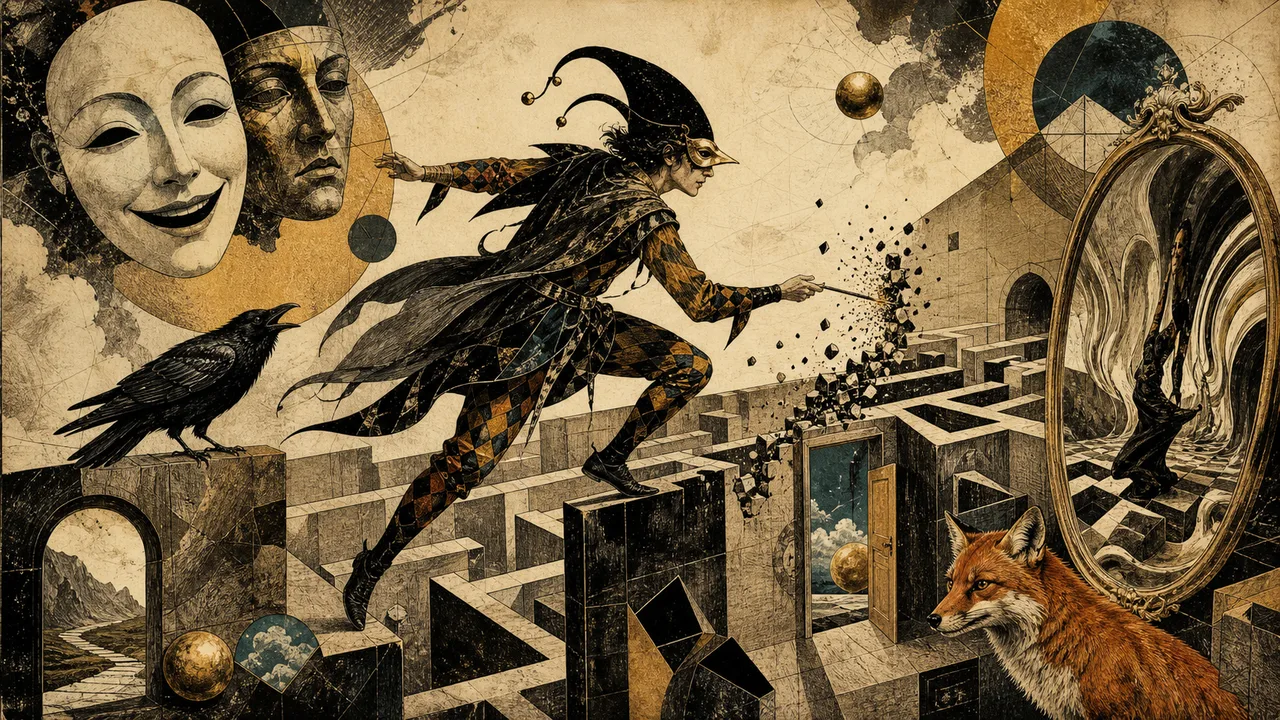
The Trickster archetype represents the force that crosses boundaries, breaks rules, and exposes contradictions hidden by order. It can use intelligence and humor to open a new path, but it can also deceive, hurt, and cause confusion when it acts without consciousness. Its transformation does not occur through rupture alone, but when it learns to recognize the consequences of what it does.
In this article, you will understand where the Trickster comes from, why Jung connected it to the collective shadow, and how it brings together qualities that seem incompatible. We will also follow an example in which a joke reveals a real problem, crosses a boundary, and forces everyone involved to assume their part in the situation.
Continue reading to recognize when breaking a rule frees something that needed to change and when it becomes merely an excuse to act without responsibility. Knowing the Trickster helps us understand humor, self-deception, manipulation, and the changes that begin when an uncomfortable truth can no longer be hidden.
The Trickster goes beyond the funny character
The English word trickster may suggest a deceiver, cheat, or playful character. None of these words alone can show everything this figure represents. The Trickster can make people laugh, play pranks, and dismantle the seriousness of a situation, but it can also steal, lie, cause suffering, and fall into its own trap.
For this reason, it should not be confused with an amusing person who likes telling jokes. Humor is only one of its instruments. Its principal action is crossing a boundary that seemed firm and showing that order was not as complete as everyone imagined.
A family may preserve for years the rule that certain subjects must never be discussed. Everyone notices the discomfort but continues performing harmony. When someone makes a joke that touches precisely this point, the laughter can reveal the tension that existed before the joke.
The Trickster appears at this moment of rupture. It did not necessarily create the problem, but removed the protection that kept it hidden. The revelation can begin a truthful conversation or produce an even greater wound. Everything depends on the degree of consciousness present in the person who broke the boundary and in those who sustained the old order.
It would also be a mistake to turn the Trickster into a hero of freedom. Not every rule is oppressive and not every transgression is liberating. Some boundaries protect intimacy, trust, and collective life. When the Trickster ignores this difference, it acts as if every prohibition existed only to be challenged.
The archetype's value lies precisely in its ambiguity. It forces us to look at what order conceals, but also shows us the danger of a freedom unable to answer for its own acts. The Trickster may open a door; that does not mean it knows where the door leads.
Jung studied a much older figure
Carl Gustav Jung did not create the Trickster. Deceptive, playful, and transgressive figures appear in narratives far older than Analytical Psychology. Each culture has its own stories, with meanings that cannot be placed within a single explanation.
Jung wrote a psychological interpretation of a narrative cycle recorded by anthropologist Paul Radin among the Ho-Chunk people. In older books, these people appear under the name Winnebago. The change in name matters because Ho-Chunk is the form by which the nation itself once again officially identifies.
The cycle presented by Radin follows a figure dominated by immediate desires, with little consciousness of the world or itself. It changes form, deceives other beings, suffers because of its own acts, and slowly learns to act more usefully. It does not begin as a disguised sage. It begins in a raw state in which impulse and action are barely separate.
Jung brought this figure close to other images, such as the festive fool, jester, certain forms of Mercury, and characters that invert order. These parallels do not mean all traditions tell the same story. They reveal the repetition of a human movement: what was below, outside, or behind order enters the scene and reveals its limits.
For Jung, the Trickster preserves traits of a consciousness that is still poorly differentiated. It does not fully understand who it is, what it does, and how its acts affect others. It possesses extraordinary abilities, but often uses them absurdly. It can seem superior in one moment and completely foolish in the next.
This origin helps correct a very common modern reading. The “creative rebel” in a personality classification shows only one part of the Trickster. The ancient figure of the human psyche also carries desire, contradiction, shadow, and transformation. When we remove these parts, only a pleasant character remains and we lose the archetype.
The Trickster unites opposites that do not fit a fixed identity
The Trickster does not remain within a stable identity. It can be human and animal, creator and destroyer, intelligent and naive, strong and vulnerable. These changes are not mere ornaments in the narratives. They show a form of consciousness that has not yet clearly separated what we will later call good and evil, self and other, desire and consequence.
A conscious person can perceive that they have different desires and choose which one should guide their action. The Trickster acts before this organization. It feels hunger and takes food; desires an advantage and prepares a deception; encounters a prohibition and crosses it. The whole world seems to exist for the present impulse.
At the same time, it can find a way out where no one else saw a possibility. Because it does not automatically respect familiar divisions, it combines separated elements and shifts ideas that seemed definitive. The same lack of fixity that generates disorder also allows a discovery.
Imagine a team trapped in a procedure that no longer works. Everyone recognizes the delay, yet no one changes anything because “it has always been done this way.” One person skips a step, solves the problem, and shows that part of the rule has lost its usefulness. At this moment, the transgression has produced knowledge.
But the story changes if this person hides information, takes all the credit, and repeats the breach merely to preserve an advantage. Intelligence remains present but has been placed at the ego's service. The Trickster teaches that creativity and character are not the same thing.
Its opposites should not be resolved by choosing only the pleasant side. The task is to endure the contradiction and ask what it is showing. The force that liberates can also destroy; the irreverence that reveals a lie can also humiliate; the ability to shift positions can also become an inability to make any commitment.
The Trickster lives at boundaries
The Trickster usually appears where two realities meet. It crosses the passage between nature and culture, permitted and forbidden, sacred and ordinary, known and unknown. For this reason, it is part of the archetypes of transformation: its presence announces that an old form can no longer contain everything that is emerging.
A boundary organizes differences and allows us to recognize where something begins and ends. It can be represented by a wall, but it also exists in customs, roles, and agreements. The problem arises when the division becomes so rigid that it prevents any passage or when it is treated as if it did not matter.
The Trickster tests this point. It brings food to a place where no one was allowed to eat, mixes solemn language with everyday words, or allows someone excluded to enter the center of a ceremony. In doing so, it asks without asking: does this boundary still protect something alive, or does it serve only to preserve power?
Its position is uncomfortable because it belongs completely to neither side. It can enter and leave a group, speak the language of the powerful and the marginalized, know the rule and find its flaw. This mobility offers a perception unavailable to those trapped in one position.
Living between boundaries also has a shadow. Someone who never belongs anywhere can avoid bonds, responsibilities, and choices. The person changes roles according to convenience, promises different things to each side, and calls this instability freedom.
A healthy boundary allows passage without erasing difference. We can change our mind without pretending we never defended our previous position. We can question a tradition without despising everything it protected. The Trickster matures when its mobility stops being escape and begins serving a conscious link between separate worlds.
Rupture reveals what order tried to conceal
Every order chooses what it places at the center and what it leaves outside. A family emphasizes certain values and silences certain conflicts. A company creates procedures that organize work but can also conceal privilege. A community defines acceptable behavior and pushes into shadow everything that threatens its image.
The Trickster's rupture brings the excluded element back. Sometimes an inappropriate phrase at the most solemn moment is enough. At other times, an error, leak, reversal of roles, or action arises that no one can fit into custom. For an instant, order loses its appearance of totality.
The effect can be liberating. An unjust rule becomes visible, an authority must explain what it did without accountability, or a person finally admits the feeling everyone perceived. The Trickster removes the decoration and reveals the structure.
Yet exposing a contradiction does not mean understanding the whole problem. Someone can reveal a real lie and use that truth to destroy a person. They can denounce the group's control while seeking only to occupy the controller's place. Rupture reveals something important but does not guarantee a mature response.
We need to observe what happens next. If disorder allows people to talk, correct an injustice, and create a better form, it has participated in a transformation. If it produces only excitement, fear, and new lies, the old problem continues acting under another appearance.
The Trickster opens a crisis. Consciousness decides what to do with it. Without this second movement, breaking the rule can become a spectacle that distracts everyone from what truly needed transformation.
Humor allows us to see what we deny
Humor brings together two things that seemed unrelated and produces surprise. We laugh because the sentence dismantles the habitual explanation and reveals another meaning. For a few seconds, what was serious, rigid, or untouchable loses its authority.
This temporary loss of power can be valuable. A joke reveals a leader's vanity, a rule's inconsistency, or the distance between a group's discourse and its practice. Laughter makes it possible to recognize a truth that might be rejected if it appeared as a direct accusation.
Festivals of inversion and figures of the fool have often fulfilled this function. The small imitated the powerful, elevated language was placed beside the body, and order was turned upside down. For a limited time, what had been repressed could appear.
The Trickster's humor can also be cruel. A person turns someone else's vulnerability into a spectacle, receives the group's approval, and says it was only a joke. Collective laughter does not remove the violence. In some cases, it makes humiliation stronger because it forces the person who suffered to laugh so they will not seem weak.
The difference lies not only in declared intention. We need to observe who has power, who pays the price, and which truth is being revealed. A joke can strike an authority closed to dialogue or attack someone already defenseless. The two situations are not the same.
Conscious humor includes the person making the joke. It recognizes that this person also participates in the contradiction and does not place them above everyone. When laughter serves only to escape every personal examination, the Trickster uses intelligence to remain unconscious.
The Trickster deceives others and also deceives itself
The Trickster's deception seems to confirm its superiority. It perceives another's desire, invents a story, and gains an advantage. For a few moments, it controls the situation. Yet its vision usually stops at the immediate gain.
It does not see the full set of consequences. One lie requires another, the deceived person reacts, and what looked like victory becomes a trap. In many narratives, the Trickster itself suffers because of the plan it created.
This movement appears in ordinary life when someone manipulates a conversation so they never have to admit an error. The person changes the meaning of words, makes the other doubt what happened, and ends the discussion believing they won. The next day, however, they discover that they destroyed part of the trust sustaining the relationship.
Self-deception lies at the center of the problem. The Trickster believes it can remain outside the situation it produced. It quickly sees other people's weaknesses but does not recognize the desire guiding its own action. Its intelligence works to hide from itself what it already perceived in others.
We can also use spiritual, psychological, or moral explanations in this way. We speak about freedom so we do not have to admit fear of commitment. We call aggression sincerity. We say we are provoking transformation when we actually want attention, revenge, or control.
The first lesson occurs when the trap closes. The consequence interrupts the fantasy that we can move all the pieces without being part of the game. The Trickster begins to change when it accepts that its perception can be brilliant while its motivation still remains hidden.
Without consciousness, freedom becomes manipulation
The Trickster's freedom seduces because it promises a life without walls. It shows that many prohibitions were created by people and can be revised. This movement is necessary whenever a rule continues existing only because no one dares question it.
But the absence of every boundary does not produce freedom. It produces a space in which the fastest, most persuasive, or strongest imposes their desire. When every word can change meaning and every commitment can be abandoned, trust disappears.
Manipulation begins when someone knows a rule's weakness and uses that knowledge only for personal benefit. The person presents themselves as the one who will liberate the group, but hides information, creates dependence, and treats any disagreement as lack of courage. The discourse concerns change; the practice continues concentrating power.
The unconscious Trickster also confuses authenticity with discharge. It claims it needs to say everything it feels, at the moment it feels it, without considering the situation of the person listening. Then it gives the other person the task of enduring the impact and calls their reaction resistance.
Consciousness does not mean returning to blind obedience. It means understanding why the boundary exists, what will be lost when it is broken, and who will be responsible for the result. Some rules need to fall. Others need correction. Still others protect something we perceive only after it has been harmed.
Freedom matures when it can answer for what it creates. Whoever ruptures an order must participate in building what follows, repair avoidable damage, and accept that a good intention does not erase a real consequence. Without this, the Trickster exchanges a visible prison for a form of domination harder to recognize.
What we deny returns as projection
Jung connected the Trickster with the collective shadow. The shadow gathers characteristics a person or group does not recognize as its own. The more perfect the image we wish to present, the greater the number of impulses, fears, and interests that may be pushed out of consciousness.
The denied content does not disappear. It returns in dreams, conflicts, fascinations, mistakes, and accusations. A group that considers itself always honest begins finding deceivers everywhere. A person who does not admit their desire to control sees manipulation in every boundary another person establishes.
The Trickster then becomes the figure that carries everything we do not want to assume. We project onto it deceit, sexuality, irreverence, greed, or the desire to break rules. By condemning it, we preserve the fantasy that none of this exists within us.
This mechanism also occurs among families, communities, and peoples. The group chooses someone to occupy the role of the irresponsible, disorderly, or inferior person. The person may genuinely have difficulties, but begins carrying a shadow much greater than their personal history.
Withdrawing a projection does not mean denying facts. A lie remains a lie and manipulation needs to be stopped. The work consists of recognizing why that characteristic produces such an intense reaction and where something similar, even in another proportion, exists within us.
When we assume our own capacity to deceive, we perceive real deception more clearly. We no longer need to prove purity. We can establish clearer boundaries, admit interests, recognize contradictions, and stop using another person as a container for everything rejected from our identity.
Transformation begins when we assume the consequences
Rafael was known as the funny one in his family. At every gathering, he imitated relatives, changed the meaning of phrases, and made everyone laugh about the tensest subjects. His older sister, Ana, had paid a large part of their parents' expenses for years, but no one spoke clearly about sharing the responsibilities.
During a lunch, Rafael invented an auction. He said each child would have a value calculated by the amount of money they gave the family. The first comments produced laughter, until he mentioned a private debt of Ana's that only the two of them knew about. She stood up from the table, humiliated, and left.
The joke had revealed a truth: everyone depended on Ana's effort while performing an equality that did not exist. It had also crossed a boundary. Rafael exposed private information and turned his sister's suffering into an instrument for provoking the others.
In the following days, the family discussed only his behavior. In this way, everyone could condemn the excess and once again avoid dividing the expenses. Rafael also protected himself by saying no one knew how to take a joke. The Trickster had revealed the problem and, at the same time, created confusion that helped hide it.
Change began when Rafael stopped defending his intention. He sought out Ana, acknowledged that the truth about the family did not give him the right to expose the debt, and apologized without demanding that she accept immediately. Then he told the others that the joke had been wrong, but insisted that the financial issue needed to be discussed directly.
The family listed the actual expenses, evaluated what each person could offer, and stopped making demands that had previously appeared only as indirect comments. Ana stopped carrying alone a responsibility that had never been agreed upon. Rafael participated in the organization instead of remaining in the comfortable place of the person who merely reveals the contradiction.
The Trickster did not disappear. Rafael's ability to perceive the absurd and break the silence remained present. What changed was his relationship with this force. He learned that revealing a truth does not authorize any method and that transformation requires remaining after the rupture to care for its consequences.
This is the archetype's central movement. At first, impulse acts as if it were alone in the world. Then it encounters limits, suffers from its own actions, and may recognize a larger reality. Rupture is transformed when it stops serving only immediate desire and begins participating in a consciousness capable of creating, repairing, and choosing.
Frequently asked questions
The Trickster is the archetypal figure that crosses boundaries, breaks rules, and reveals contradictions. It can make room for change, but can also act unconsciously, deceptively, and destructively.
No. The Trickster appears in narratives much older than Jung. He studied this figure psychologically and wrote about a narrative cycle recorded by Paul Radin among the Ho-Chunk people, called Winnebago in older works.
No. Humor is one of its expressions, but the Trickster also brings together impulsiveness, deception, desire, cruelty, intelligence, and lack of consciousness. Reducing it to a creative personality erases its deepest dimension.
Its shadow appears when freedom becomes an excuse to lie, manipulate, humiliate, or flee consequences. The person denounces other people's rules but does not recognize the power they exercise or the harm they cause.
Transformation begins when rupture stops being an impulse without direction and begins serving consciousness. This requires recognizing the contradiction revealed, assuming the consequences, and choosing a change that does not depend on destroying another person.
Explore the Ultimate Guide to Archetypes
The Trickster teaches that breaking a rule can reveal what the established order concealed, but freedom also requires responsibility.
In the Ultimate Guide to Archetypes, you will learn to recognize this movement and balance the forces that produce change in your life.
Explore the Ultimate Guide to Archetypes
About the author
Prof. Tibério Z has more than 30 years of experience teaching spirituality, metaphysics, holistic therapies and consciousness development.