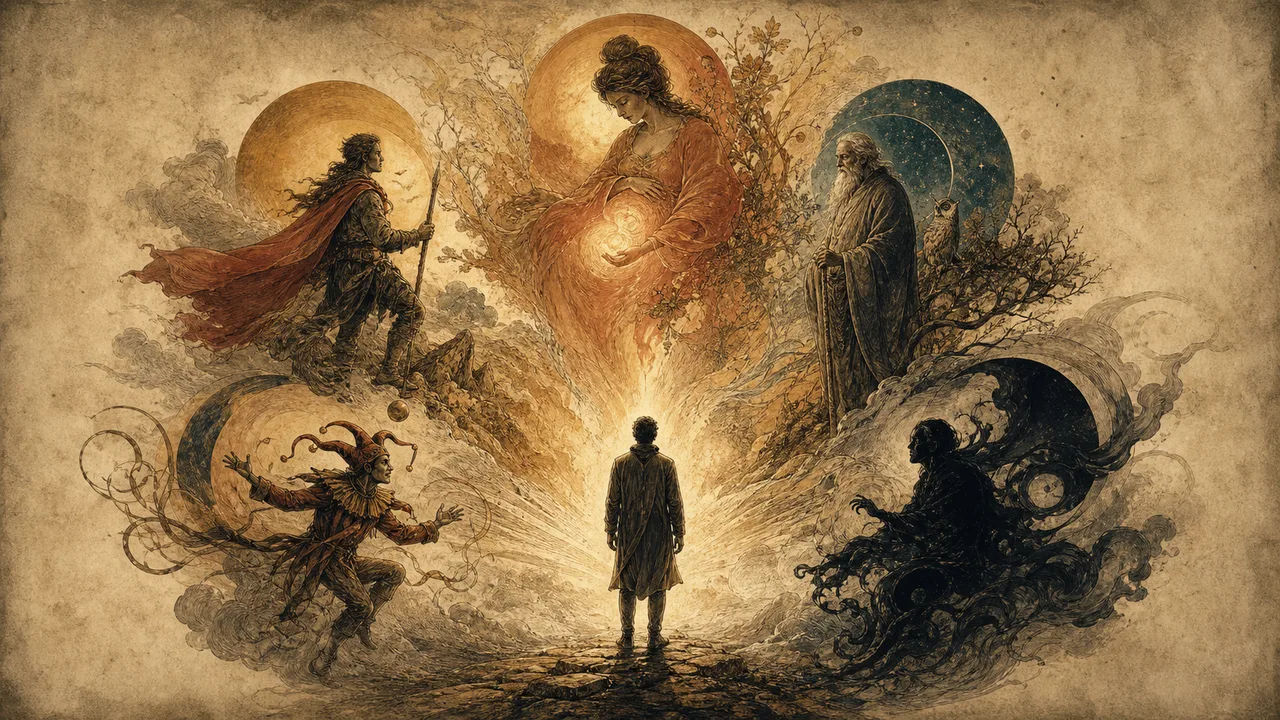
Archetypes are deep forms that help organize human experiences such as care, separation, challenge, transformation, authority and the search for meaning. They are not ready-made characters hidden within us. They are patterns that acquire images, emotions and ways of acting when they encounter our history and the reality we are living.
In this article, you will understand what Carl Jung called an archetype, why this concept cannot be reduced to a personality profile and how an invisible pattern becomes present in life. We will also follow a complete example to see where the archetype influences a decision and where facts, limitations and personal responsibility continue to operate.
Continue reading to learn how to recognize these forces without turning everything into a label. When we understand the difference among the pattern, the image and the person, we can observe our inner life more clearly and make choices with greater awareness.
What Jung called an archetype
The word archetype existed before Carl Gustav Jung, but he was the one who gave it a distinct place within Analytical Psychology. Jung sought to understand why dreams, fantasies, myths and religions among different peoples presented certain similar images even when their histories and customs were not the same.
He realized that one part of our inner world arises from personal experience. It contains memories, feelings, desires and conflicts formed throughout life. However, he also found a deeper layer that would not depend only on what each person had lived. Jung called this layer the collective unconscious and located the archetypes within it.
An archetype is an unconscious form that helps organize fundamental human experiences. Birth, care, loss, danger, union, power, death and transformation did not begin with us. We arrive in a world where these experiences have already been part of human life for countless generations.
This does not mean that we inherit a ready-made story about each experience. We inherit a possibility of perceiving and organizing it. When an important situation occurs, this form encounters our memory, environment and culture. Only then does it acquire a face, a narrative and a particular meaning.
Jung compared this process with the formation of a crystal. The invisible structure guides the way it can form, but does not determine every detail of the concrete crystal. Its size, appearance and growing conditions may vary. The archetype works in a similar way: it provides a basic direction while life gives the form content.
This definition is the starting point for understanding archetypes and their presence in human experience. Without it, we may confuse the concept with characters, labels or lists of characteristics that say little about the real movement of the psyche.
Why an archetype is not a ready-made character
When we hear names such as Hero, Great Mother, Sage or Trickster, it is easy to imagine that there is a collection of complete characters within the mind. One would be courageous, another caring, another intelligent. Then we would only need to discover which one suits us. This idea is simple, but it does not correspond to Jung's concept.
The archetype itself has no face, clothing, voice or predetermined behavior. Nor does it carry a complete story. The name Hero, for example, brings together images connected with facing trials, leaving a known condition and acquiring a new capacity. However, no single Hero manifests in the same way in every person.
A young woman who leaves home to study may experience a passage. So may a man who needs to learn to walk again after an accident. A woman who decides to end a cycle of violence faces another kind of trial. The situations are different, and none of them needs to copy a mythological story to carry an archetypal movement.
Names help us study certain experiences, but they become dangerous when used as boxes. Saying “I am the Hero” may seem like a discovery, yet it may also hide fear, fragility, dependence and the need for help. A whole person never fits inside a single name.
The same applies to the Great Mother. This archetype does not describe all women and does not oblige anyone to care for others or have children. It brings together experiences of origin, protection, nourishment, containment, dependence and transformation. Men, women, families, groups and institutions may express these forces in many ways.
The character is one possible manifestation. The archetype is the deeper pattern that may produce many manifestations. When we make this distinction, we stop looking for ready-made figures within ourselves and begin to observe how certain experiences are actually organizing our life.
How an invisible pattern acquires an image
We do not see an archetype directly. We see the forms it takes when it reaches consciousness. It may appear in a dream image, fantasy, intense emotion, character, place, object or role that we begin to live.
Imagine the experience of care. For one person, it may arise in the image of a mother offering nourishment. For another, in an old house where they always found protection. It may also appear as a garden, school, community, forest or spiritual figure. None of these images is the entire archetype, but they may all express aspects of care, containment and growth.
Personal history takes part in this process. Someone who received protection without freedom may encounter care as both an embrace and a prison. Someone who grew up without support may idealize anyone who offers attention. The collective pattern encounters individual experience and takes on the color of that life.
Culture also provides images. One people may represent wisdom through an old man; another, through a grandmother, animal or deity. The figures change because each culture has its own language, history and ways of giving meaning to the world.
Therefore, an image should not be interpreted through a fixed dictionary. Dreaming of a house does not automatically mean Great Mother. Before naming the image, we need to observe what happens in that place and which emotion accompanies the scene.
Does the house welcome or prevent departure? Is it alive or abandoned? Who can enter, and who remains outside? These answers show that the same figure may carry different movements depending on the experience in which it appears.
The archetypal image is the concrete form we can perceive. The archetype is the deep possibility that takes part in its formation. Confusing the two would be like believing that the wind is the same as the leaf that moves. The leaf reveals the wind, but it does not contain everything the wind is.
Why images change among people and cultures
If archetypes are collective, we might expect them always to appear in the same way. But the collective does not erase the individual. It provides a common foundation that receives different content in each era, family and person.
The experience of authority helps us see this difference. It may appear as a king, queen, boss, teacher, judge, father, grandmother, religious leader or inner voice. In each figure, there is a relationship with order, boundaries, direction and power. Yet the concrete meaning depends on the experience of the person encountering this authority.
For someone who grew up with clear boundaries and respect, authority may represent safety. For someone who experienced control and humiliation, the same position may awaken fear or revolt. The pattern alone does not explain the reaction. Personal history takes part in the image and emotion that arise.
Manifestations also change over time. A figure that represented protection in childhood may come to represent dependence in adult life. An institution admired for years may lose its place when the person develops an understanding of their own. The archetype continues to provide a structure, but consciousness no longer needs to fill it in the same way.
This explains why we should not look for identical images to prove that an archetype exists. What repeats is a basic organization of experience. The details may vary profoundly. Two stories about passage may use different characters, places and conflicts while both reveal the transition from an old condition to another.
Nor should we erase cultural differences in order to find similarities. An image belongs to a people, an era and a history. Understanding its archetypal movement does not authorize us to remove its context. The collective becomes alive precisely when it acquires a concrete form, and every concrete form deserves to be understood in its own place.
How an archetype is set in motion
Archetypes do not act with the same force all the time. Certain situations awaken certain patterns. Jung used the word constellation to describe this moment when a psychic complex is activated and begins gathering energy.
An important change may constellate passage. The arrival of a child may activate images of care, protection, origin and fear of loss. A conflict with an institution may awaken an intense relationship with authority, justice or rebellion. The external situation touches a deep human experience, and the psyche responds.
First comes the event. Then emotions, expectations and images arise and give it meaning. We do not always perceive this sequence. We often believe that we are seeing reality neutrally when we already view people and facts through an inner story.
André received a job offer in another city. The salary was better and the position offered growth, but he would need to leave his home, friends and a routine built over many years. The offer was not only a new job. It began to feel like a call to prove his worth.
The boss who made the invitation acquired special importance. André saw him as someone capable of recognizing potential that no one else had perceived. The unknown city became a territory of trials. A former teacher, with whom he resumed contact, appeared as a figure of guidance.
None of this means that André invented the offer or that the people had no real qualities. The pattern organized the way he perceived the situation. It highlighted some aspects, intensified certain emotions and brought the events together in a narrative of passage.
Recognizing this movement does not eliminate the experience's meaning. It simply enables us to separate layers. There is a concrete offer, with a salary, costs and responsibilities. There is also an inner story of calling, courage and transformation. The two can enter into dialogue without one replacing the other.
How archetypes influence thoughts, emotions and choices
An archetype influences our lives when it guides what receives attention, the meaning we give the facts and the response that seems necessary. It works like a lens: it makes some elements highly visible and leaves others almost hidden.
In André's experience, the lens of passage highlighted courage, growth and challenge. He began to imagine everything he could achieve. At the same time, every doubt seemed like a sign of weakness. Ordinary questions about housing, money and distance began to bother him because they disrupted the image of a grand decision.
His emotion also grew. On some days, he felt enthusiastic and believed the new life would solve all his dissatisfaction. On others, he imagined enormous failures and thought he would lose everything he had built. The intensity was greater than the available information.
The pattern also created expectations about people. André expected his family to acknowledge his courage. When his mother asked about the cost of rent, he heard the question as an attempt to stop him. The concrete concern was placed inside the story of someone who needed to overcome obstacles to follow the calling.
This is how an archetype can take part in thoughts, emotions and relationships. It does not place a command inside the mind, but it organizes experience in such a way that some responses seem obvious. If André did not perceive this organization, he might act only to remain faithful to the character he had begun to live.
Influence does not mean control. André remained capable of seeking information, listening to opinions, acknowledging his fears and deciding. The archetype gave force and meaning to the passage, but it did not calculate the budget, choose the neighborhood or determine whether the offer was genuinely good.
Consciousness grows when we can sustain both dimensions. Inner meaning reveals why the situation touches us so deeply. Facts show the conditions in which we need to act. Ignoring the archetype leaves the intensity without understanding. Ignoring reality turns a powerful image into blind direction.
Archetype is not symbol, stereotype or personality
Some words are used as though they meant the same thing, but each describes a different part. The archetype is the deep form. The archetypal image is the manifestation that reaches consciousness. A symbol is an image capable of bringing together meanings that we still cannot fully explain.
A crown may symbolize authority, power, responsibility or vanity. It is not the archetype of authority and does not have a fixed meaning. The meaning depends on who wears the crown, what happens in the scene and the person's relationship with power.
The character is also not the entire archetype. A king in a story may express order and protection, but also rigidity, pride or fear of losing the throne. Another king may appear as a wounded ruler, unable to care for his own kingdom. A similar figure does not guarantee the same movement.
A stereotype is a rigid formula used to reduce people to a few characteristics. “Every sage is distant,” “every mother sacrifices herself” or “every hero is fearless” are stereotypes. They close off understanding. An archetype, by contrast, has many possibilities and also brings together tensions.
Personality is the singular organization of a person. It includes temperament, history, bonds, values, defenses, choices and many other elements. Various archetypal patterns may take part in this organization at different moments. None of them alone explains who someone is.
Therefore, tests promising to discover “what your archetype is” may serve as an invitation to reflection, but they neither define Jung's theory nor provide a complete identity. The problem begins when the result becomes a verdict: “I am this way because this is my archetype.”
A conscious relationship with archetypes makes the opposite movement. Instead of closing us inside a name, it opens questions. When does this force appear? What does it ask? What does it make possible? What does it leave hidden? What price do we pay when we try to live only one of its sides?
When the archetype takes the place of the person
An archetypal image may carry so much energy that the person identifies with it. Instead of perceiving “I am living an experience of heroism,” they begin to believe “I am the hero and need to act accordingly.” The pattern stops being one part of the experience and tries to occupy the entire identity.
Jung called this exaggeration inflation. The person feels greater, more destined, wiser or more powerful than their reality allows. The opposite may also occur: they feel condemned to be a victim, abandoned or persecuted in every situation. In both cases, the collective image erases differences and limitations.
André began to experience this risk. If he refused the offer, he believed he would prove his cowardice. If he accepted it, he would need to show absolute confidence. He could no longer say that he wanted the opportunity while also having legitimate doubts.
Inflation also altered his view of others. The boss became the authority who recognized his destiny. His mother became the force trying to hold him back. The teacher began to represent the guide who knew the path. Real people began carrying roles larger than themselves.
This process is called projection when we place upon the other person contents that also belong to our inner world. Projection does not necessarily invent every characteristic, but it magnifies some, ignores others and traps the relationship in a narrative. The boss could genuinely admire André, but did not know his entire future. His mother could be worried without wanting to control his life.
We realize that the archetype has occupied too much space when ordinary proportions disappear. We do not accept questions, treat coincidences as commands, feel that a role must be fulfilled at any cost or believe that others can occupy only the function we assign them.
Recognizing identification does not require abandoning change. André did not need to reject the offer to prove he was conscious. He only needed to stop using the decision as a test of personal worth. Courage could take part in his choice without forcing him to portray a perfect hero.
A complete example of archetypal activity
At first, André had a concrete offer and an ordinary doubt. He wanted to grow professionally, but feared losing security and closeness with the people he loved. The event activated a larger experience of passage, in which a familiar stage needs to be left before the next is guaranteed.
The pattern gave meaning to the moment. André stopped seeing only tasks, a contract and a change of address. He felt that his life was calling for movement. This force was important because it broke through a complacency that had bothered him for years.
At the same time, the narrative grew beyond measure. The opportunity became destiny. The boss became the summoner. Doubts became monsters that needed to be defeated. André began to believe that courage meant accepting immediately and that any practical caution diminished the passage's value.
Consequences appeared in his relationships. He argued with his mother, avoided a friend who had pointed out difficulties and hid from himself his fear of being alone. The more he tried to appear decisive, the more he depended on the image of someone who never retreats.
The change began when his teacher asked a simple question: “Do you want this job, or do you want to prove that you are courageous?” André realized that the two things were mixed. The offer could be good, but it did not need to carry the complete answer about who he was.
He then divided the experience into parts. First, he checked the net salary, housing costs, probationary period and possibilities of returning. Then he acknowledged what he was leaving: friends, routine and a sense of mastery over the environment. Finally, he admitted what he wanted to find: learning, autonomy and a life not organized only by fear.
André also reconsidered the people who had entered his inner story. The boss was a professional offering a position, not someone capable of knowing his destiny. His mother had fears and experiences of her own; she was not an enemy of transformation. The teacher offered a useful question, but could not decide for him.
After this separation, André accepted the job. The external choice was the same one he had imagined at the beginning, but his inner position had changed. He did not leave to prove invincibility. He left knowing that he could feel fear, ask for help, revise plans and remain responsible for the consequences.
The archetype did not disappear. The passage continued to give meaning to the change. The difference is that André no longer needed to obey the story blindly. He could receive it as an image of transformation while keeping his feet in reality.
This example shows the complete path. A situation activates the pattern. The pattern brings images and emotions together. The person sees the facts through this organization. When there is awareness, the person can recognize meaning, remove exaggerations and choose. When there is not, the person risks playing a role without noticing the price.
How to recognize a pattern without turning everything into a label
Recognizing archetypes does not mean quickly naming every person, dream or event. It means observing movements that repeat and asking what they are organizing in our experience.
We can begin with intensity. Does the reaction seem larger than the situation? Has an ordinary person been placed in the role of savior, persecutor, perfect master or absolute threat? Has a decision acquired the weight of proving our entire value? These differences in scale may reveal that something collective has been activated.
We can also observe the images. Which story seems to be unfolding? Are we crossing a trial, seeking approval, trying to save someone, protecting something that needs to grow or struggling against an authority? The question is not intended to fit life into a myth. It is intended to perceive the narrative already guiding our feelings.
Next, we need to return to the facts. What did this person actually say and do? Which information confirms our interpretation? What are we ignoring? Which other explanations are possible? This return prevents the archetypal image from becoming the only truth.
Consequences also teach us. Does the pattern expand our capacity or trap us in a role? Does courage help us face a difficulty or prevent us from admitting fear? Does care strengthen the other person or keep them dependent? Does the search for wisdom produce listening or pride? Every archetype has creative and destructive possibilities.
Another important question is what was left out. When we try always to be strong, fragility may need space. When we live only to care, our own life may be abandoned. When we want to have every answer, we may have lost the ability to learn.
We do not need to answer everything at once. Recording dreams, recurring situations, emotions and decisions over time allows us to observe the movement more calmly. The archetype's name should come after the experience, not before it.
The goal is not to say, “I am this.” It is to perceive, “this force is taking part in this moment.” The first sentence closes identity. The second maintains space for other parts of the personality, for facts and for different choices.
What is the purpose of understanding archetypes?
Understanding archetypes helps us recognize why certain experiences carry so much force. A change may touch not only work but a passage. A conflict may involve not only a rule but our entire relationship with authority. Care may awaken protection, fear of loss and a desire to control.
When we do not perceive this dimension, we are carried by it without understanding. We repeat roles, project images onto people and treat intense emotions as proof that our interpretation is correct. The archetype acts, but consciousness does not take part in the conversation.
When we recognize the pattern, we do not begin to control it. We gain the possibility of dialogue. We can ask what this force reveals, which capacity it wants to develop and where it began to become excessive. We can also return to real people what belongs to them and retrieve what we placed upon them.
This knowledge does not replace personal history. Two people may experience a passage and need to make different choices. Nor does it replace reality, responsibility or professional help when there is suffering. The symbol expands meaning, but it cannot solve the concrete conditions of life on its own.
The value of the concept lies precisely in uniting the collective and the singular. We are not the first to face care, loss, power, change or death. These experiences belong to humanity. At the same time, no one lives them with exactly our history, bonds and decisions.
Learning about archetypes means learning to perceive this deep presence without handing it all direction. The image may illuminate the path, reveal a force and show a conflict. We are still the ones who need to look at the facts, recognize limitations and choose how to walk.
Frequently Asked Questions
For Jung, an archetype is an unconscious and collective form that helps organize fundamental human experiences. It does not have a ready-made image. It gains content when it encounters each person's history, culture and consciousness.
No. A character is a visible form that may express an archetypal pattern. Hero, Mother and Sage are names used to study groups of images and experiences, but the archetype itself is broader than any character.
No. Many patterns may take part at different moments of life. Reducing someone to a single archetype turns a profound concept into a personality label.
No. They may influence the way we perceive a situation, intensify certain emotions and create expectations. Consciousness, facts, personal history and our decisions continue to participate in the response.
We can observe recurring images, very intense emotions, roles we assume and inner stories that seem larger than the event. Context and consequences need to be analyzed before giving the pattern any name.
Explore the Ultimate Guide to Archetypes
Understanding what archetypes are opens a path to recognizing the characters, forces and patterns that take part in our choices.
In the Ultimate Guide to Archetypes, you will learn to observe these energies clearly and use them more consciously on your journey.
Explore the Ultimate Guide to Archetypes
About the author
Prof. Tibério Z has more than 30 years of experience teaching spirituality, metaphysics, holistic therapies and consciousness development.