
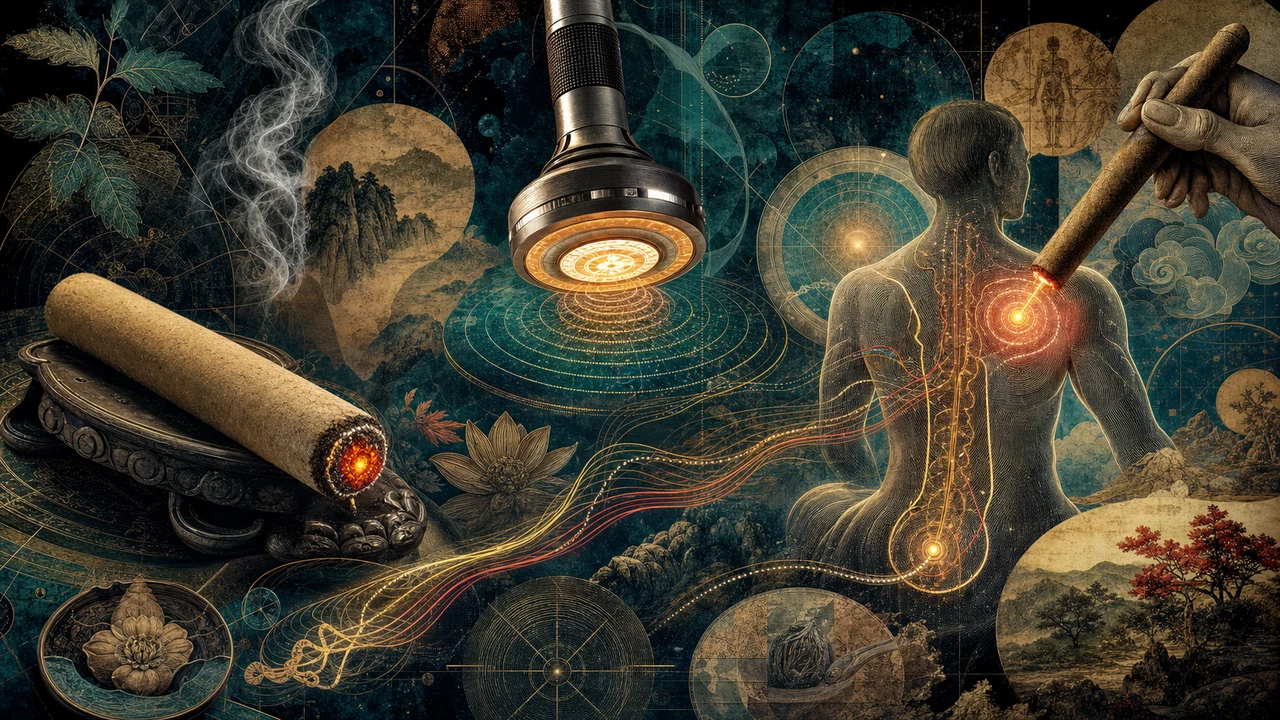
Smokeless moxa, electric moxa and heat-sensitive moxibustion are three modalities that use different sources and criteria to produce or direct therapeutic warming. They differ in the presence of combustion, temperature control, smoke production and the way the application site is chosen.
In this article, you will understand how smokeless sticks, electric devices and the exploration of heat-sensitive points work, as well as the sensations observed, the differences among the methods and the precautions needed during each application.
Continue reading to compare these three modalities and understand how the heat source, the person's response and technical control influence the choice of a responsible application.
What distinguishes these three moxa therapy modalities?
Smokeless moxa, electric moxa and heat-sensitive moxibustion are different ways of producing or directing a thermal stimulus. The first uses a modified combustible material, the second employs an electric device, and the third uses sensations reported by the patient to locate points considered more responsive to heat.
Smokeless moxa may still depend on combustion, although it produces less visible smoke and odor than a traditional stick. Electric moxa replaces the ember with a heating element. The heat-sensitive technique, in turn, is usually performed with a lit stick held at a distance from the skin.
These modalities are not equivalent and do not merely represent commercial names for the same procedure. They differ in the heat source, the presence of mugwort, smoke production, temperature control and the criterion used to select the location and determine the duration of application.
What is so-called smokeless moxa?
Smokeless moxa is a product developed to reduce the smoke and odor produced during moxibustion. It often comes as a dark, rigid stick prepared with carbonized plant material or a modified mugwort formulation instead of the light-colored wool used in traditional moxa.
The term “smokeless” should be understood as a reduction in visible emissions, not a guarantee of the complete absence of gases or particles. Because burning still occurs, the product continues to release heat and combustion residues, although their amount and composition may differ from those observed with a traditional stick.
This modality may be chosen in clinics where traditional smoke causes discomfort, lingering odors or ventilation problems. It may also be more tolerable for some people who are sensitive to the smell of mugwort, but it does not eliminate the need for ventilation or fire-related precautions.
How does smokeless moxa produce heat?
Once lit, the smokeless stick continues burning and is held near the selected region. Heat reaches the skin primarily through thermal radiation and the heated air around the tip. Distance, exposure time and stick movement determine the intensity felt.
Carbonization and changes in composition alter the way the material ignites, burns and emits radiation. Studies comparing traditional products with smokeless versions have found differences in their infrared spectra, showing that substitution does not produce a precisely identical thermal stimulus.
Some carbonized sticks take longer to ignite and may retain intense heat for a considerable time. Therefore, the distance used with traditional moxa should not be repeated automatically. Temperature must be adjusted according to the product, body region and the person's thermal perception.
What is electric moxa?
Electric moxa, electronic moxibustion or electrically heated moxibustion is a modality that uses a device to produce heat over points or regions of the body. Instead of burning a mugwort stick, the device converts electricity into thermal energy through a heating element.
Devices may be portable, plate-shaped, individual applicators or supports attached to the body. Some transfer heat by contact, while others use infrared radiation. Some models also incorporate mugwort-related materials or extracts, although the main stimulus continues to be generated electrically.
Because it does not depend on an open flame, this modality avoids falling ash and reduces problems associated with smoke. However, it does not reproduce every component of traditional moxibustion, because it does not have the same combustion, aroma or necessarily the same pattern of thermal radiation.
How do electric moxa devices control warming?
Electric devices may use sensors, control circuits and timers to raise and maintain the programmed temperature. This feature makes it possible to produce a more constant stimulus than combustion, whose intensity may vary according to distance, ventilation and the condition of the burning material.
An experimental electrical-stimulation system was able to reproduce temperature distributions similar to those of moxibustion at certain tissue depths. Other studies used infrared devices with controlled thermal ranges, seeking to provide warming without flame and with greater potential for standardization.
Electronic control reduces some variations but does not eliminate the risk of thermal injury. Temperature, applicator pressure, application time and skin sensitivity remain important. Reports on electronic devices record adverse events when high temperatures remain applied for unsuitable periods.
What is heat-sensitive moxibustion?
Heat-sensitive moxibustion is a suspended moxibustion modality that seeks to locate areas considered especially responsive to thermal stimulation. Instead of applying moxa only over a predetermined fixed point, the practitioner explores a region until identifying specific sensations reported by the patient.
The technique is based on the theory that certain points may become sensitized during a health condition. When stimulated by heat, they would produce responses different from simple, localized surface warming. These sites may coincide with classical points but can also appear slightly away from their standardized positions.
The expression “heat-sensitive” does not merely mean that the person has delicate skin or feels heat easily. It identifies a specific clinical approach in which a point is recognized by the quality and path of the sensation produced while the area is explored with a moxa stick.
Which sensations identify a heat-sensitive point?
Among the responses described is heat penetration, in which a person feels warmth advancing from the surface toward a deeper region. Expansion may also occur, when the sensation gradually spreads around the stimulated site and extends beyond the small area being heated directly.
Another response is transmission, characterized by the perception of heat following a certain direction or reaching a distant region. Some people report little heat at the surface and a more intense sensation at depth, or perceive warmth far from the point where the stick is being applied.
Nonthermal sensations such as heaviness, pressure, tingling, numbness or discomfort may also occur. These experiences are subjective and depend on the person's report. Research is still investigating their mechanisms and has not demonstrated that they directly correspond to heat passing through an anatomical channel.
How is heat-sensitive moxibustion performed?
The practitioner lights a stick and holds it suspended over a previously selected region, often a few centimeters from the skin. They may use circular or lengthwise movements or gradual approaches to explore the area, asking how heat is perceived and whether the sensation remains local or spreads.
When a response considered characteristic is found, application is concentrated at that location. The distance is adjusted so that the heat remains comfortable without burning. Duration may be guided by the continuity of the reported sensation rather than solely by a fixed time that is the same for everyone.
The practitioner should avoid prompting responses through suggestive questions. In research, patients are advised to spontaneously describe what they perceive. This caution is important because expectations, attention and language may influence how a bodily sensation is recognized and communicated.
How should you choose among smokeless, electric and heat-sensitive moxa?
Smokeless moxa may be chosen when the aim is to retain combustion while reducing odor and visible smoke. Electric moxa facilitates temperature control and does not require an open flame. The heat-sensitive technique is chosen when the therapeutic method prioritizes locating responsive areas during application.
One modality is not automatically superior to the others. The choice depends on environmental ventilation, the person's sensitivity, professional experience, the treated region and the intended type of stimulus. It is also necessary to verify whether the device or material used can produce a stable, controllable temperature.
Clinical evidence still has limitations. There are studies of electric moxa and heat-sensitive moxibustion for specific conditions, but many are preliminary, use small samples or have methodological problems. General reviews conclude that moxibustion results should not be generalized to every technique and disease.
What are the risks and precautions of these modalities?
Smokeless moxa still involves fire and may cause burns, falling ash and fires. Reducing visible smoke also does not mean the complete absence of combustion products. The stick must be used in a ventilated environment and completely extinguished after the session.
Electric moxa avoids a flame but may cause excessive warming when the device remains in place too long, is defective or is used at an unsuitable temperature. People with neuropathies, circulatory changes or reduced sensitivity require special attention because they may not perceive a temperature capable of injuring the skin.
In heat-sensitive moxibustion, a traditional stick continues to produce smoke, embers and high temperatures. Subjective sensations do not replace observing the skin and controlling distance. All three modalities should be applied by trained professionals and do not replace necessary medical examinations, diagnoses or treatments.
Frequently Asked Questions
No. It reduces visible smoke and odor, but combustion may still release gases and particles. The environment continues to require ventilation.
It is a modality that uses a device to transform electricity into heat. It does not require an open flame and may use sensors, temperature controls and timers.
Yes. High temperature, applicator pressure, excessive time, device defects or reduced sensitivity may cause thermal injuries.
It is a suspended technique that explores a region with a moxa stick to locate areas that produce sensations such as penetration, expansion or transmission of heat.
The choice considers ventilation, the person's sensitivity, professional experience, treated region, thermal control and the desired type of stimulus. No modality is always superior to the others.
Deepen your understanding of moxa therapy modalities
Choosing among smokeless sticks, electric devices and heat-sensitive techniques requires an understanding of heat sources, temperature control and the responses presented during application.
Explore our e-books for clear, structured material on energy, balance and integrative practices.
Explore the e-books
About the author
Prof. Tibério Z has more than 30 years of experience teaching spirituality, metaphysics, holistic therapies and consciousness development.