
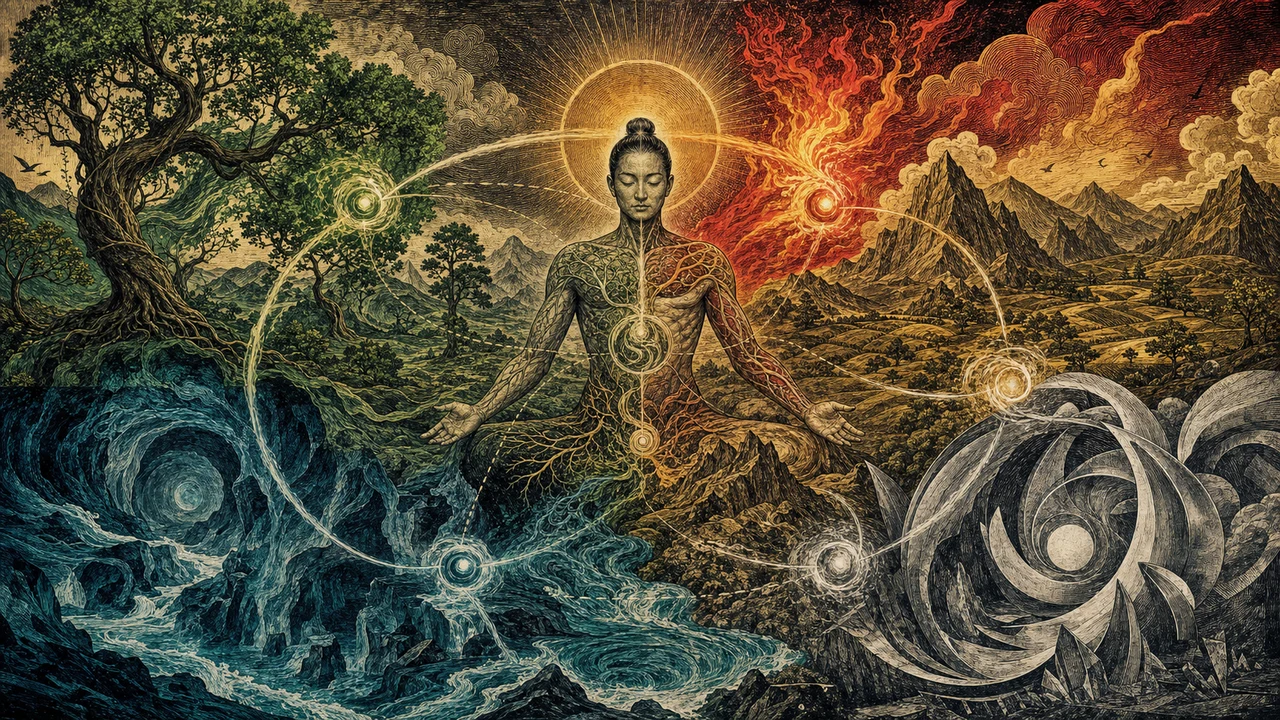
The Five Phases—Wood, Fire, Earth, Metal, and Water—organize cycles of transformation and functional relationships used by Chinese Medicine to understand nature, the body, and its processes.
In this article, you will understand why it is more appropriate to speak of phases rather than elements, what each category represents, and how the generating and controlling cycles maintain the dynamics of the whole.
Continue reading to learn about this theory and see how its five patterns continuously support, regulate, and transform one another.
What the Five Phases are
The Five Phases are Wood, Fire, Earth, Metal, and Water. In Chinese, this theory is called Wu Xing. It organizes natural phenomena and human functions into five related categories, making it possible to observe how different processes arise, grow, transform, contract, and begin their cycles again.
In Traditional Chinese Medicine, these phases are used to classify organs, viscera, tissues, senses, emotions, seasons, and climatic conditions. Each category brings together phenomena that share certain functional characteristics, even when they are physically different. Wood, for example, is related to processes marked by growth, expansion, and direction.
The theory also describes how the five categories influence one another. No phase is observed in complete isolation because each receives support, sustains another, and participates in regulating the whole. This organization makes it possible to interpret the body as a network of relationships in continuous transformation.
Why it is more appropriate to speak of phases rather than elements
The translation “Five Elements” became common in the West, but it can suggest that Wood, Fire, Earth, Metal, and Water are physical substances that make up the body. The term Xing is more closely related to movement, activity, transition, and transformation than to fixed and permanent material.
For this reason, the expression “Five Phases” better represents the dynamic nature of the theory. Wood does not literally mean wood inside the body, just as Metal does not indicate the presence of a metallic substance. Each name functions as an image used to bring together processes that show similar behaviors.
These names were chosen from observations of nature. The growth of plants, expansion of fire, support of earth, contraction of metal, and descent of water offered models for understanding similar movements in other areas. The theory uses analogies, not material equivalences.
What the Wood phase represents
The Wood phase represents birth, growth, expansion, and the ability to follow a direction. Its image is that of a plant breaking through the soil, growing upward, and extending its branches. It is therefore related to processes that need to advance, adapt, and overcome obstacles without losing flexibility.
In the traditional organization, Wood corresponds to spring, wind, the eastern direction, the color green, and the sour flavor. In the body, it is associated with the Liver and Gallbladder, the tendons, eyes, and nails. The emotion related to this phase is anger.
These correspondences do not mean that all phenomena associated with Wood are identical. They are grouped because they share characteristics of growth, mobility, and expansion. Spring, the Liver, and the tendons differ from one another, but within the theory they express aspects related to movement and flexibility.
What the Fire phase represents
The Fire phase represents maximum expansion, warming, activity, and manifestation. Its image corresponds to the flame that rises, illuminates, and spreads heat. It describes the moment when a process reaches great intensity and becomes fully visible after beginning its growth in the Wood phase.
Fire is related to summer, heat, the southern direction, the color red, and the bitter flavor. In the body, it corresponds primarily to the Heart and Small Intestine. The Pericardium and Triple Burner are also included in this category, completing the organization of the systems connected to Fire.
The tongue, vessels, and joy are also associated with this phase. These correspondences highlight characteristics of communication, circulation, consciousness, and expression. Ordinary joy does not represent an imbalance, but it was related to Fire because it tends to express itself outwardly and broaden the interaction between the person and the environment.
What the Earth phase represents
The Earth phase represents support, stability, transformation, and the ability to nourish. Its image is the soil that receives seeds, provides resources, and allows life to develop. In the sequence of the phases, Earth occupies a transitional position, transforming what it received and distributing what can be used.
Earth corresponds to the center, dampness, the color yellow, and the sweet flavor. Some classifications relate it to late summer, while others place it in the transition periods between seasons. In the body, it is associated with the Spleen and Stomach, the muscles, mouth, and lips.
Thought, reflection, and worry are related to the Earth phase. This correspondence brings the processing of food closer to the elaboration of ideas: both involve receiving, selecting, transforming, and assimilating. It is a traditional analogy, not a claim that thought is produced by the anatomical spleen.
What the Metal phase represents
The Metal phase represents contraction, organization, and the definition of limits. Its image is related to a structure that can be shaped but also preserves firmness. After the expansion of Fire and the transformation of Earth, Metal expresses the stage in which resources are selected, concentrated, and preserved.
Metal corresponds to autumn, dryness, the western direction, the color white, and the pungent flavor. In the body, it is related to the Lung and Large Intestine, the skin, body hair, and nose. These correspondences bring together processes connected to exchange, protection, and elimination.
Sadness and grief are the emotions associated with Metal. This relationship is understood through the experience of turning inward and recognizing what needs to be released after a loss. The association does not mean that feeling sadness automatically causes a lung alteration, but describes a functional correspondence in the theory.
What the Water phase represents
The Water phase represents conservation, depth, rest, and potential. Its image corresponds to water that descends, occupies deep regions, and remains stored before nourishing new growth. It describes the stage of greatest contraction in the cycle, in which resources are preserved for future transformations.
Water corresponds to winter, cold, the northern direction, a dark color, and the salty flavor. In the body, it is associated with the Kidneys and Bladder, the bones, marrow, ears, and hair. These relationships highlight conservation, constitution, development, and storage.
Fear is the emotion related to the Water phase. It can lead a person to draw inward and seek protection in the face of a threat. This correspondence does not turn every experience of fear into a Kidney problem, but represents a traditional way of relating security, reserves, support, and the ability to react.
How the generating cycle works
The generating cycle describes how each phase favors the development of the next. Wood generates Fire, Fire generates Earth, Earth generates Metal, Metal generates Water, and Water generates Wood. When the sequence is completed, the last phase provides the conditions for a new cycle to begin.
The relationship is usually explained through images from nature. Wood feeds Fire; the ashes from Fire become part of Earth; Earth contains minerals associated with Metal; Metal symbolically participates in the formation or concentration of Water; and Water nourishes the growth of Wood.
This cycle is also called the mother-child relationship. The phase that generates occupies the position of mother, while the one that receives its influence is called the child. The relationship does not describe literal production, but a sequence of support through which each phase sustains the continuity of the whole.
How the controlling cycle works
The controlling cycle prevents the generating process from producing unlimited growth. Wood controls Earth, Earth controls Water, Water controls Fire, Fire controls Metal, and Metal controls Wood. Each phase regulates another that does not appear immediately after it in the generating cycle.
Traditional images help us understand this relationship: roots penetrate and stabilize Earth; Earth contains or directs Water; Water controls Fire; Fire heats and transforms Metal; and Metal cuts or shapes Wood. Control represents regulation, not destruction.
The generating and controlling cycles need to act together. The first provides support and continuity, while the second establishes limits and preserves organization. If there were only generation, one phase could grow excessively; if there were only control, development would be prevented. Stability depends on cooperation between the two.
Frequently Asked Questions
They are Wood, Fire, Earth, Metal, and Water.
Because the theory describes activities, transitions, and transformations, not fixed physical substances within the body.
Wood represents growth, Fire expansion, Earth transformation, Metal contraction, and Water conservation.
Wood generates Fire, Fire generates Earth, Earth generates Metal, Metal generates Water, and Water generates Wood.
Wood controls Earth, Earth controls Water, Water controls Fire, Fire controls Metal, and Metal controls Wood.
Deepen your study of the Five Phases
Understanding Wood, Fire, Earth, Metal, and Water helps us recognize how different functions support and regulate one another within Chinese Medicine.
Explore our e-books for clear, organized material that connects this and other fundamental theories with the practice of Chinese Medicine.
Explore the e-books
About the author
Prof. Tibério Z has more than 30 years of experience teaching spirituality, metaphysics, holistic therapies and consciousness development.