
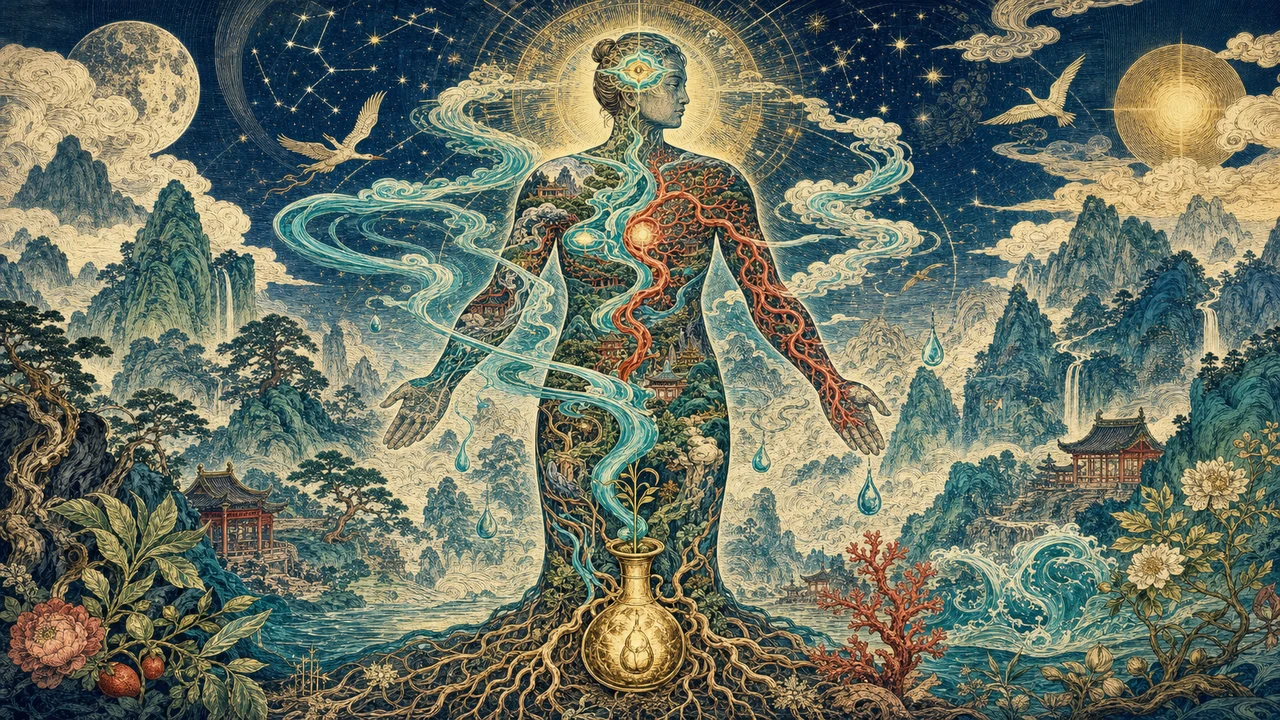
The five vital substances in Chinese Medicine are Jing, Qi, Xue, Jin Ye and Shen, translated as Essence, Qi, Blood, Body Fluids, and Mind or Spirit. They represent interdependent dimensions that sustain constitution, functional activities, nourishment, moistening and consciousness.
In this article, you will understand the role of each substance, the differences between their more material and functional aspects, and the relationships that allow their formation, circulation and preservation. You will also see how these five categories help Chinese Medicine organize its understanding of health.
Continue reading to understand why Jing, Qi, Xue, Jin Ye and Shen do not act in isolation, but form a network of mutual support within the body.
What are the five vital substances?
In Traditional Chinese Medicine, the five vital substances are Jing, Qi, Xue, Jin Ye and Shen. In English, these terms are usually translated as Essence, Qi, Blood, Body Fluids, and Spirit or Mind. Together, they represent different dimensions necessary for human constitution and functioning.
Each substance has its own characteristics. Jing represents the essential foundation of constitution; Qi corresponds primarily to functional activity; Xue nourishes and moistens; Jin Ye encompasses the body's normal fluids; and Shen expresses consciousness, thought, perception and psychic life. These definitions belong to the theoretical model of Chinese Medicine.
Dividing them into five categories facilitates study, but they do not act separately. Chinese Medicine describes processes of formation, circulation, preservation and transformation in which one substance depends on the others. The state of each can therefore be understood only within the relationships it maintains with the whole body.
Why are they called vital substances?
The expression “vital substances” indicates that Jing, Qi, Xue, Jin Ye and Shen participate in maintaining life. Some have more material characteristics, while others describe less concrete activities or manifestations. The category therefore brings together different components that sustain structure, nourishment, function and consciousness.
The term “substance” should not be interpreted only in the chemical or anatomical sense used by modern science. In Chinese medical language, it may also represent a functional foundation recognized through its effects and relationships. Qi and Shen, for example, are not presented as liquids or tissues that can be physically isolated.
This difference explains why translations do not always fully express the original concepts. The World Health Organization itself recognizes the difficulty of transferring Chinese medical terms into other languages without losing their particularities. Words such as Qi, Jing and Shen are therefore often retained alongside their translations.
What distinguishes Jing from the other vital substances?
Jing means Essence and represents the foundation that participates in forming the physical structure and maintaining bodily functions. In traditional theory, it is related to constitution, development, reproduction and the transformations that accompany the different stages of life. Its deepest dimension is associated with the Kidneys.
Chinese Medicine distinguishes innate Jing from acquired Jing. Innate Jing corresponds to constitutional resources received from the parents and present from conception. Acquired Jing is formed after birth through the assimilation of food and drink, contributing to the everyday maintenance of vital activities.
These two dimensions do not represent two completely independent essences. Resources acquired through food help sustain the original constitution, while innate Jing provides a foundation for growth and function. Essence thus brings together constitutional inheritance, development and renewal throughout life.
How does Qi act in the relationship among the substances?
Among the five vital substances, Qi primarily represents the functional capacity that promotes movement and transformation. Its importance within this set lies in allowing the other substances to be produced, distributed, used and preserved. Its relationship with them is therefore not limited to circulating alongside Xue and Jin Ye.
Qi transformation is the process through which Jing, Xue and Jin Ye can be formed and modified during the body's activities. Food and drink, for example, must undergo transformations before their components can be used. Qi represents the activity that makes these functional changes possible.
At the same time, Qi needs the support provided by the other substances. Xue and Jin Ye provide nourishment and moisture, while Jing offers a constitutional foundation for vital activities. This dependence shows that Qi does not act as an autonomous force separate from the body's material dimension.
How does Chinese Medicine understand Xue?
Xue is translated as Blood and corresponds to the red fluid that circulates in the vessels, nourishing and moistening the body. Although it has an evident relationship with the blood recognized by anatomy, its traditional meaning also includes the functions of nourishing, sustaining tissues and supporting certain mental and sensory activities.
In Chinese Medicine, Xue is produced with the participation of essences extracted from food and the activities attributed to different internal systems. Once formed, it must circulate properly to reach the organs, muscles, skin and other structures that depend on its nourishing capacity.
Xue has a particularly close relationship with Qi. The activity of Qi promotes its formation, movement and containment within the vessels. In return, Xue provides a nourishing foundation so functional activities can be maintained. Tradition summarizes this relationship by stating that the two support one another.
How does Jin Ye encompass the body's fluids?
Jin Ye is the general term used to represent the body's normal organic fluids, except for Xue. They are produced from food and drink and undergo processes of transformation, distribution and elimination. Their presence makes it possible to moisten surfaces, nourish tissues and preserve the fluidity of different structures.
Jin corresponds to lighter, thinner and more mobile fluids that circulate closer to the surface. This category may include fluids that moisten the skin, muscles and sensory openings. Ye designates thicker, denser and deeper fluids found mainly in joints, cavities and internal structures.
The distinction between Jin and Ye does not create two completely independent systems. It makes it possible to distinguish consistency, location and manner of distribution. Together, these fluids participate in moistening and nourishment, preventing tissues from losing the flexibility needed for their function within the traditional model.
Why is Shen included among the vital substances?
Shen is translated as Mind or Spirit and represents the conscious and psychic manifestations of life. World Health Organization terminology relates Shen to mentality, consciousness, thought and feelings. It may also designate the vitality perceived in a person's presence, expression and capacity for interaction.
Its inclusion among the vital substances shows that Chinese Medicine does not completely separate bodily function from mental activity. Thinking, perceiving, remembering, feeling and responding to the environment are understood as manifestations that depend on the body's general state and the support provided by the other substances.
Although it is called a vital substance, Shen does not represent physical matter stored in the body. The term describes a functional dimension that can be recognized through consciousness, mental clarity and emotional expression. Its translation as “Spirit” should be understood within this medical and philosophical context.
How do the five substances support one another?
The five substances form a network of relationships. Jing provides a foundation for constitution and the transformations of life. Qi allows these transformations to occur, while Xue and Jin Ye provide nourishment and moisture. Shen manifests through a body supported by these different resources.
Xue and Jin Ye share an origin related to essences extracted from food. Traditional terminology describes a common origin between Blood and body fluids, although each acquires its own characteristics and functions. This closeness helps explain why significant changes in one may interfere with the other.
Jing and Xue are also described as substances of related origin. At the same time, the activity of Qi participates in the formation and transformation of both. Shen depends on the support provided by this whole, demonstrating that constitution, function, nourishment, fluids and consciousness are not studied as disconnected areas.
How do the five substances contribute to understanding health?
Observing the five substances makes it possible to organize different aspects of human functioning. Jing provides information about constitution and development; Qi represents activity and transformation; Xue and Jin Ye show the conditions of nourishment and moistening; Shen expresses a person's mental, emotional and conscious dimension.
Health does not depend on a fixed and identical quantity of these substances in every person. Age, diet, routine and stage of life change the body's needs. What matters within this perspective is the ability to properly form, preserve, move and use each of them.
These categories belong to the traditional model and do not correspond to five directly measurable anatomical structures or biochemical compounds. They function as organizing concepts used in Chinese Medicine assessment. Any therapeutic practice based on this model should have its safety and outcomes examined according to the intervention used.
Frequently Asked Questions
They are Jing, Qi, Xue, Jin Ye and Shen, translated as Essence, Qi, Blood, Body Fluids, and Mind or Spirit.
Because they participate in the structure, nourishment, functioning, moistening and consciousness needed to sustain life.
Jing is the Essence connected with constitution, development, reproduction and the transformations that accompany the stages of life.
Xue is the Blood that nourishes and moistens the body. Jin Ye encompasses the other normal body fluids.
No. They depend on one another to be formed, moved, preserved and used by the body.
Deepen your exploration of the vital substances in Chinese Medicine
Understanding Jing, Qi, Xue, Jin Ye and Shen is essential for interpreting how constitution, activity, nourishment, fluids and consciousness relate to one another in Chinese Medicine.
Explore our e-books for clear, structured material that connects energetic foundations with personal awareness and daily practice.
Explore the e-books
About the author
Prof. Tibério Z has more than 30 years of experience teaching spirituality, metaphysics, holistic therapies and consciousness development.