
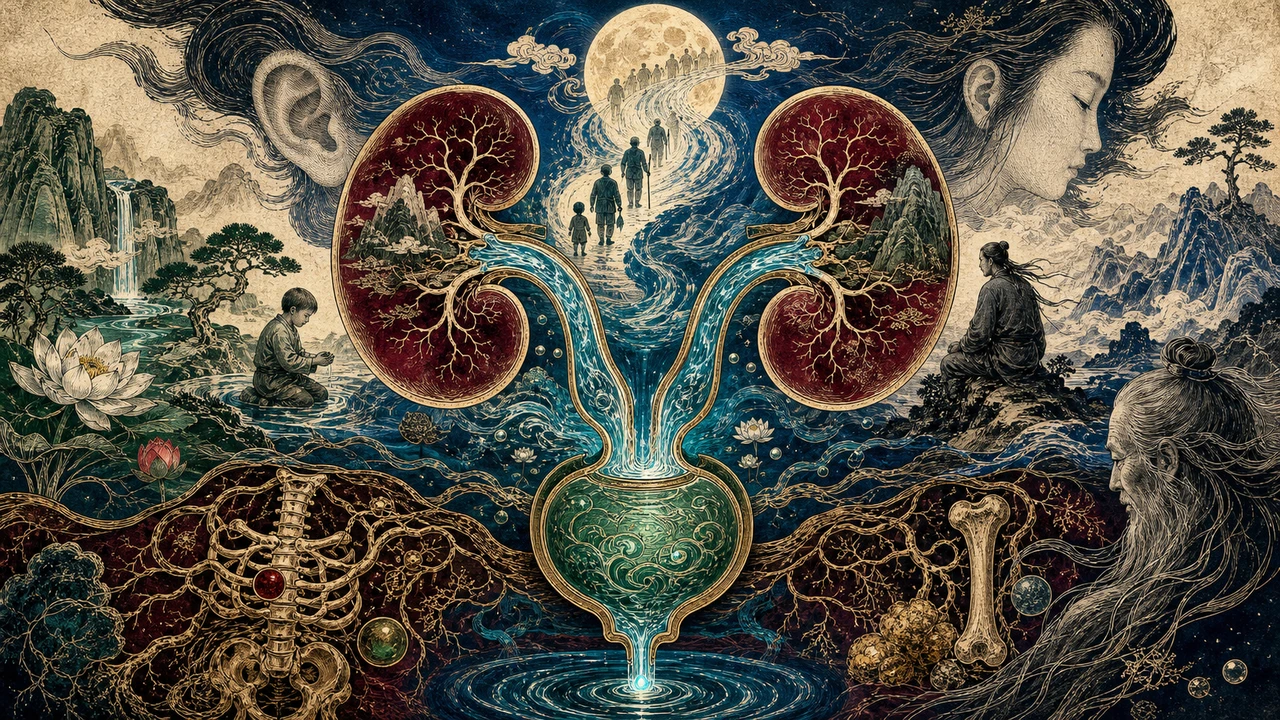
In Chinese Medicine, the Kidneys store Essence, support growth, development, and reproduction, and participate in the transformation of fluids, while the Bladder receives, stores, and eliminates urine. Together, they form a Zang-Fu pair connected to constitution, vitality, and the balance of water in the body.
In this article, you will understand how the Kidneys and Bladder are defined, the meaning of Jing, their relationships with growth, reproduction, respiration, bones, marrow, teeth, hair, ears, willpower, and fear, as well as the role of the Bladder in the transformation and elimination of fluids.
Continue reading to learn about the functions attributed to each system and understand how this pair works in an integrated way within the functional organization of Chinese Medicine.
How the Kidneys and Bladder are understood in Chinese Medicine
In Traditional Chinese Medicine, the Kidneys belong to the Zang organs, while the Bladder belongs to the Fu organs. They form an internal-external pair related to constitution, development, reproduction, body fluids, and the elimination of urine. Their functions are understood in an integrated way within the Zang-Fu system.
The traditional concept of the Kidneys is broader than the anatomical kidneys studied by modern medicine. It brings together functions that biomedicine distributes among the urinary, reproductive, endocrine, nervous, and musculoskeletal systems. Therefore, a Kidney alteration in Chinese Medicine does not necessarily represent a kidney disease identified through tests.
The traditional Bladder is also not limited to the organ that stores urine. It participates in a functional process called Qi transformation, through which fluids are received, temporarily stored, and eliminated. This activity depends on the support of the Kidneys and coordination with other systems responsible for water circulation.
What it means for the Kidneys to store Essence
The primary function attributed to the Kidneys is to store Jing, translated as Essence. Jing represents the basis of the individual constitution and participates in the formation, maintenance, and transformation of the body. Chinese Medicine considers part of this Essence to be received from the parents, while another part is sustained after birth.
Inherited Essence is related to constitutional characteristics present from conception. It provides the foundation for growth, maturation, and reproductive capacity. Acquired Essence depends on the use of food and drink, helping preserve constitutional resources during the activities carried out throughout life.
Storing does not mean keeping Jing completely still or isolated. The Kidneys preserve this foundation and allow it to manifest according to the needs of each stage of life. Essence supports continuous processes, but it is also considered a deep resource that must be preserved to ensure stability and continuity for the body.
How the Kidneys participate in growth, development, and reproduction
In Chinese theory, the Essence stored by the Kidneys guides the changes that accompany birth, childhood, puberty, adulthood, and aging. The development of bones, teeth, hair, and reproductive capacity is related to the way this Essence grows stronger, matures, and later declines.
During childhood, growth depends on the progressive manifestation of Jing. At puberty, Essence participates in sexual maturation and the emergence of reproductive capacity. In adulthood, it supports fertility and constitutional vitality. These relationships belong to the traditional model and do not correspond to a description of modern reproductive hormones.
Aging is understood as a natural process related to the gradual decline of constitutional resources. This does not mean that everyone ages in the same way or that any age-related change is caused exclusively by the Kidneys. Constitution, diet, work, rest, illnesses, and living conditions also influence this process.
What it means for the Kidneys to govern water
Governing water means participating in the transformation, distribution, and elimination of body fluids. The Kidneys help determine which fluids will be preserved, reused, or directed toward the formation of urine. This function depends on the activity attributed to Kidney Qi and its ability to move fluids.
The Kidneys do not perform this activity in isolation. The Lung participates in the distribution and descent of fluids, the Spleen contributes to their transportation, and the Triple Burner organizes the pathways they travel. The Kidneys occupy a deep position, coordinating the final processes of separation, reuse, and excretion.
The expression “governing water” does not mean that the Kidneys of Chinese Medicine are equivalent to kidney function in biomedicine. There is an approximation related to fluids and urine, but the traditional concept includes broader activities. Edema, urinary changes, or persistent thirst need clinical investigation, regardless of the traditional interpretation.
What it means for the Kidneys to receive Qi
Chinese Medicine states that the Lung governs respiration and conducts Qi downward, while the Kidneys receive or grasp this Qi. This function represents the ability to maintain the downward respiratory movement and allow inhalation to reach the deeper regions of the body.
Receiving Qi does not mean that inhaled air physically reaches the anatomical kidneys. The expression describes a functional relationship between the Lung and Kidneys. The Lung controls the entry and exit of air, while the Kidneys provide the foundation that helps sustain the depth and continuity of inhalation.
This relationship explains why respiration can be analyzed not only through the Lung system, but also through the state attributed to the Kidneys. However, shortness of breath, difficulty breathing, or a feeling of suffocation can indicate serious conditions and require medical evaluation. The traditional concept does not replace pulmonary or cardiovascular examinations.
How the Kidneys relate to the bones, marrow, teeth, and hair
The Kidneys are described as responsible for generating marrow and governing the bones. The Essence they store is believed to transform into marrow, which is responsible for nourishing bone structure. Thus, the growth, strength, and renewal of the bones are related to the functional condition of the Kidneys within traditional theory.
The traditional meaning of marrow is broader than the bone marrow of modern anatomy. It includes the material thought to fill the bones, spinal column, and brain, called the “sea of marrow.” This association establishes a relationship among Kidney Essence, bone structure, brain development, and certain mental capacities.
The teeth are considered an extension of the bones, while the hair externally reflects the condition of Essence. Tooth growth, tooth strength, and the quantity and vitality of hair may be observed during an assessment. This does not mean that cavities, hair loss, or osteoporosis are always caused by a Kidney pattern.
What the Kidneys have to do with the ears, lower orifices, and willpower
Chinese Medicine states that the Kidneys open into the ears. This correspondence relates Kidney Essence and Qi to hearing capacity. Hearing, the presence of noises, and other ear manifestations may be observed during an assessment, but none of them can identify a Kidney pattern in isolation.
The Kidneys are also related to the two lower orifices, an expression that may refer to the urinary and anal openings. This association involves the ability to control, preserve, and release urine, feces, and reproductive fluids. Continence and elimination, however, depend on several systems and not only on the Kidneys.
The mental activity associated with the Kidneys is Zhi, generally translated as willpower, determination, or the ability to persevere. Fear is their corresponding emotion. This does not mean that feeling fear causes kidney disease, but that intense or prolonged states can be analyzed in relation to security, firmness, and the ability to sustain decisions.
What the functions of the Bladder are in Chinese Medicine
The Bladder receives and temporarily stores urine before eliminating it. As a Fu organ, it needs to alternate between periods of filling and emptying. Its function depends on the proper passage of fluids to the lower region and the ability to transform them into content that can be excreted.
In Chinese Medicine, the elimination of urine depends on the Qi transformation of the Bladder. This expression describes the activity that allows the urinary pathways to open and close, preserve urine for a certain period, and release it at the appropriate time. The Kidneys provide the support needed for this transformation.
The Bladder also forms part of the water pathways and receives fluids that have already gone through earlier separation processes. It does not produce urine on its own or independently control the entire urinary system. Its activity represents the final stage of storage and excretion within the traditional physiology of fluids.
How the Kidneys and Bladder work together
The Kidneys and Bladder form a pair in which the Kidneys provide the functional foundation and the Bladder performs storage and elimination. The Kidneys participate in the transformation of fluids and the regulation of opening and closing, while the Bladder receives urine and conducts it out of the body.
This partnership shows that urination is not attributed to the Bladder alone. For Chinese Medicine, the formation and elimination of urine depend on the coordinated activity of different systems. The Lung, Spleen, Triple Burner, Kidneys, and Bladder participate in distinct stages of the circulation, transformation, and excretion of fluids.
The Kidneys and Bladder of Chinese Medicine should be understood as traditional functional concepts. Lower back pain, blood in the urine, burning, urinary retention, incontinence, fever, or persistent changes in urine volume require medical evaluation. These signs should not be attributed exclusively to energetic imbalances without proper investigation.
Frequently Asked Questions
It means that the Kidneys preserve Jing, the basis of the individual constitution that participates in growth, maturation, reproduction, and transformations throughout life.
Kidney Essence supports childhood development, sexual maturation, fertility, and constitutional vitality. Its gradual decline also plays a role in the traditional understanding of aging.
It means participating in the transformation, distribution, and elimination of fluids, helping determine what will be preserved, reused, or directed toward urine.
The Bladder receives and temporarily stores urine and participates in its elimination. This activity depends on Qi transformation and the functional support of the Kidneys.
The Kidneys provide the basis for transforming fluids and regulating opening and closing. The Bladder receives urine, holds this content for a period, and then conducts it out of the body.
Deepen your understanding of the Kidneys and Bladder
Understanding this pair helps you recognize how Chinese Medicine relates constitution, Essence, development, reproduction, and the circulation of fluids.
Explore our e-books for clear, organized material that connects the Zang-Fu systems with the foundations and practice of Chinese Medicine.
Explore the e-books
About the author
Prof. Tibério Z has more than 30 years of experience teaching spirituality, metaphysics, holistic therapies and consciousness development.