
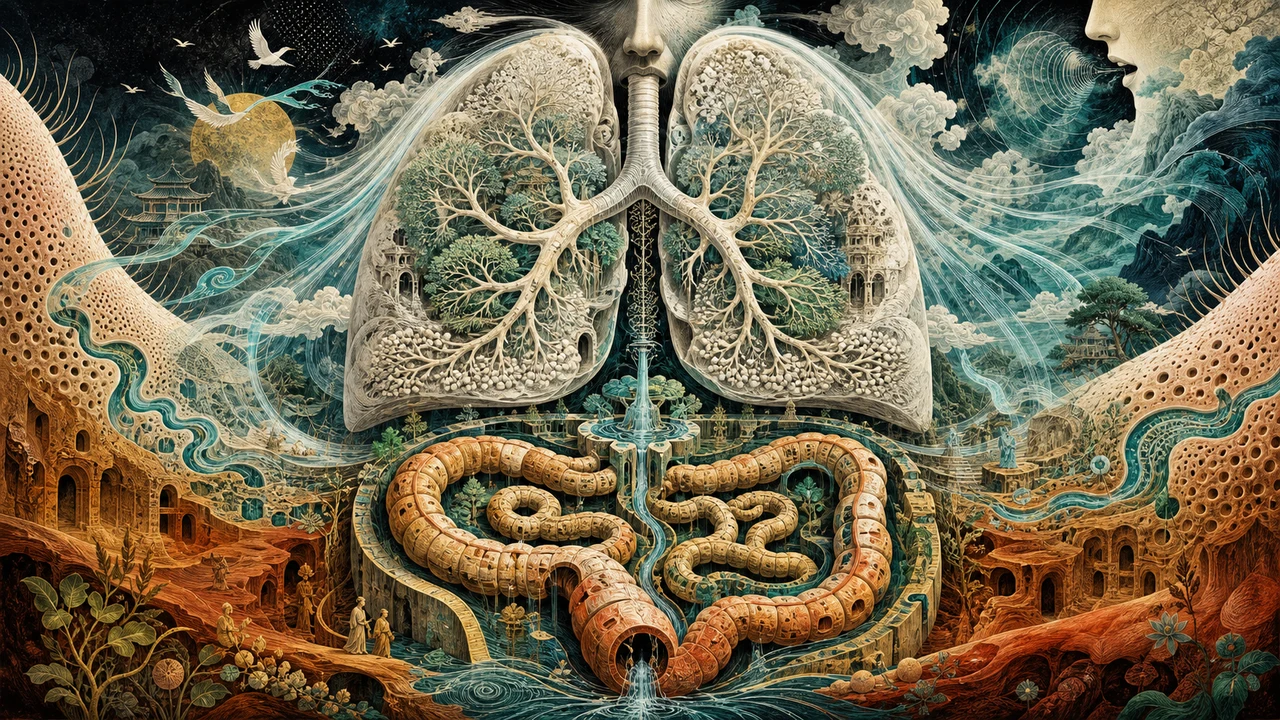
In Chinese Medicine, the Lung governs respiration, participates in the circulation of Qi and fluids, and protects the body's surface, while the Large Intestine receives, conducts, and eliminates waste. Together, they form a Zang-Fu pair associated with downward movements that help organize breathing and evacuation.
In this article, you will understand how the Lung and Large Intestine are defined, how the diffusion and descent of Qi work, the Lung's relationships with fluids, skin, nose, voice, Po, and sadness, as well as the main functions attributed to the Large Intestine.
Continue reading to learn about the functions attributed to each system and understand how this pair connects circulation, protection, respiration, and elimination within the functional organization of Chinese Medicine.
How the Lung and Large Intestine are understood in Chinese Medicine
In Traditional Chinese Medicine, the Lung belongs to the Zang organs and the Large Intestine to the Fu organs. They form an internal-external pair within the Zang-Fu system. Their names represent sets of functions and relationships, not merely the anatomical organs known to modern medicine.
The Lung system includes activities related to respiration, Qi circulation, fluid distribution, and protection of the body's surface. It also corresponds to the skin, body hair, nose, voice, and certain emotional manifestations. These functions form a functional unit within traditional theory.
The Large Intestine relates primarily to receiving waste from the Small Intestine, conducting this material through the intestinal tract, and eliminating it. Its association with the Lung seeks to explain how the downward movements of respiration and evacuation remain coordinated.
What it means for the Lung to govern Qi and respiration
One of the Lung's main functions is governing respiration. This means receiving air from the environment during inhalation and expelling it during exhalation. In traditional terminology, the World Health Organization defines respiration as the intake and release of air necessary for gas exchange.
Governing Qi has a broader meaning. The Lung participates in using inhaled air and forming the Qi gathered in the chest. This resource helps sustain the respiratory rhythm, circulation, and the strength of the voice, allowing the organism to use the component received from the environment.
The quality of respiration is observed through its depth, regularity, rhythm, and ease. Speech also provides information because it depends on air expelled by the lungs. Shortness of breath, a weak voice, or difficulty sustaining the voice may be considered during an assessment of the Lung system.
How the diffusion and descent of Lung Qi work
Diffusion corresponds to the upward and outward movement of Lung Qi. Through this function, resources are distributed toward the surface and different regions of the body. The World Health Organization also uses the terms dispersing or the upward and outward movement of Lung Qi.
Purification and descent correspond to the opposite movement. The Lung guides Qi downward and helps keep its activities directed inward. This function participates in exhalation, sending fluids to the lower regions, and the continuity of the organism's downward movements.
Diffusion and descent need to act together. The first distributes and exteriorizes, while the second gathers and directs downward. These are not two independent types of Qi, but complementary directions assumed by the Lung's activity according to the needs of bodily functioning.
How the Lung participates in fluid circulation
The Lung is traditionally called the upper source of water because it is located in the Upper Burner and participates in regulating fluids. Its function is not to produce all the body's water, but to contribute to its distribution and maintain the pathways through which it circulates.
Through diffusion, part of the fluids is guided to the skin and superficial tissues. Through descent, another part is sent to the lower regions, where it continues to be transformed and eliminated. This dynamic relates the Lung to the functioning of the Kidneys, Bladder, and other systems.
The expression “regulating the water passages” describes the ability to keep the pathway of fluids unobstructed and organized. It belongs to the functional model of Chinese Medicine and does not mean that the anatomical lung replaces the kidneys or is solely responsible for fluid regulation.
The Lung's relationship with the skin, body hair, and protection of the body
In Chinese Medicine, the Lung governs the skin and body hair. This association indicates that its activity contributes to nourishing, moistening, and maintaining the body's surface. The skin is observed as a region of contact and exchange between the organism and the conditions present in the environment.
The Lung also participates in distributing Wei Qi, translated as Defensive Qi. This resource circulates mainly at the surface, between the skin and muscles, helping protect the organism. Its distribution follows the movements of expansion and dispersal attributed to Lung Qi.
The opening and closing of the pores are also related to this function. This makes it possible to adjust perspiration and the interaction between the body's surface and the environment. Changes in the skin, body hair, or perspiration, however, do not demonstrate a Lung problem on their own and need to be evaluated together.
The Lung's relationship with the nose, sense of smell, and voice
Chinese Medicine states that the Lung opens into the nose. This expression indicates that the condition of the system may be reflected in nasal breathing and the sense of smell. The nose is also the main opening through which air enters and leaves during respiration.
The free passage of air through the nose depends on its openness and adequate moisture. Obstruction, dryness, discharge, or changes in the sense of smell may be observed in a traditional assessment. These signs, however, have various causes and do not identify a specific Lung pattern on their own.
The voice depends on the flow of air produced during exhalation. For this reason, the volume, strength, clarity, and endurance of speech may provide information about respiratory activity. Chinese Medicine relates a very weak voice to weakened Qi, although persistent changes also require appropriate medical investigation.
Po and sadness in relation to the Lung
Classical texts describe the Lung as the organ that stores Po, usually translated as Corporeal Soul. The World Health Organization's terminology defines Po as the animating part of the mind, while academic sources confirm its traditional association with the Lung.
Po represents a dimension linked to bodily life and the ability to respond directly to experiences. It should not be confused with Shen or necessarily interpreted as a religious soul separate from the body. Its meaning belongs to the ancient way of relating psychic activity, perception, and bodily existence.
Sadness and grief are the emotions traditionally related to the Lung. These emotions are natural and do not automatically cause disease. The theory considers that very intense or prolonged states may consume Lung Qi, while prolonged respiratory difficulties may also influence the emotional state.
The main functions of the Large Intestine
The Large Intestine receives the turbid part sent by the Small Intestine. In this context, turbid means the material that was not used as a nutritive component and needs to proceed toward elimination. The passage of this content marks one of the final stages of food processing.
Its central function is to transmit and conduct waste downward. The content received travels through the intestine, undergoes changes, and forms the material that will be evacuated. As a Fu organ, the Large Intestine needs to remain in motion, regularly receiving, conducting, and emptying its contents.
Elimination also depends on adequate fluids so that the content can advance. However, the main traditional function of the Large Intestine remains the conduction of solid waste. Persistent changes in intestinal function should not be explained solely through the energetic model without clinical investigation.
How the Lung and Large Intestine work together
The Lung and Large Intestine form an internal-external relationship recorded since the classical texts of Chinese Medicine. This connection also appears in the corresponding channels: the Lung channel has a Yin nature, while the Large Intestine channel has a Yang nature.
Within traditional theory, the descent of Lung Qi helps support the downward movement of the intestines. At the same time, the free elimination of waste favors the continuity of downward movements. In this way, respiration and evacuation are understood as different activities that share a functional direction.
Current research studies communication between the intestines and lungs through the microbiota, immunity, circulation, and metabolic mediators. These studies demonstrate the existence of a gut-lung axis, but do not automatically prove all correspondences formulated by traditional Zang-Fu system theory.
Frequently Asked Questions
The Lung receives and expels air and participates in forming the Qi gathered in the chest. This activity supports respiration, circulation, and the strength of the voice.
Diffusion distributes Qi upward and outward, reaching the surface. Descent guides Qi and fluids downward and inward. The two movements complement each other.
The Lung participates in nourishing and moistening the body's surface, distributes Wei Qi, and relates to the opening of the pores and perspiration.
The Large Intestine receives waste sent by the Small Intestine, conducts this material downward, and participates in forming and eliminating feces.
They share a downward direction. The descent of Lung Qi helps support intestinal movement, while free elimination favors the continuity of downward movements.
Deepen your understanding of the Lung and Large Intestine
Understanding this pair helps us recognize how Chinese Medicine relates breathing, Qi circulation, protection of the body's surface, and elimination.
Explore our e-books for clear, organized material that connects the Zang-Fu systems with the foundations and practice of Chinese Medicine.
Explore the e-books
About the author
Prof. Tibério Z has more than 30 years of experience teaching spirituality, metaphysics, holistic therapies and consciousness development.