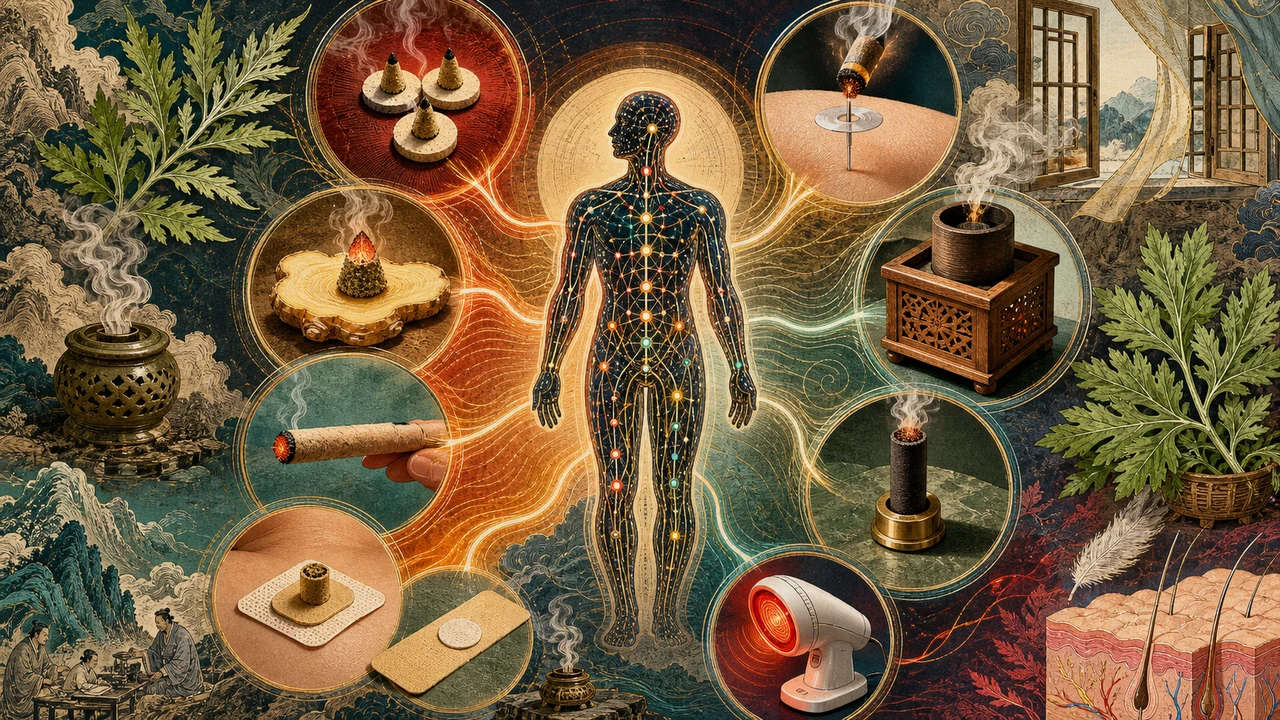
The main types of moxa therapy are direct and indirect moxibustion, performed with cones, grains, sticks, barriers, boxes, supports or in combination with needles. Each modality differs in its contact with the skin, warming area, thermal intensity and required precautions.
In this article, you will learn how these techniques are classified, the differences between scarring and nonscarring applications, how moxa sticks, needle-warming moxibustion and modern devices work, and the criteria used to choose each method.
Continue reading to understand the characteristics, possibilities and risks of each type of moxa therapy and identify why the technique must be chosen and applied precisely.
How are types of moxa therapy classified?
Types of moxa therapy may be classified according to the moxa's contact with the skin, the form of the material, the presence of a barrier and its combined use with needles. The two basic categories are direct and indirect moxibustion, from which different application methods derive.
This classification does not mean that each method belongs exclusively to one group. A cone may be placed directly on the skin or supported on a barrier. A stick is generally used at a distance, while moxa may also be attached to a needle or placed inside a warming box.
Each modality produces a different intensity, warming area and exposure time. Therefore, the results and risks of one type cannot automatically be attributed to the others. The technique must be identified precisely when it is taught, applied or analyzed in clinical research.
What is direct moxibustion?
In direct moxibustion, a small portion of moxa wool is shaped into a cone or grain and placed directly on the chosen point. The material is lit and produces localized heat. The size of the moxa, its degree of compaction and the moment it is removed determine the intensity reached.
This method requires constant attention because there is no distance between combustion and the skin. Even small portions may produce temperatures capable of causing pain, blisters or burns when left burning too long. The person's sensitivity also affects their ability to perceive the heat.
Direct moxibustion appears in Chinese, Japanese and Korean traditions, with differences in size, fiber purity and application duration. In Japanese methods, for example, small amounts of refined moxa may be shaped to dimensions similar to grains or very thin threads.
What is the difference between scarring and nonscarring direct moxibustion?
In scarring direct moxibustion, moxa remains on the skin until it causes an intentional burn followed by the formation of a blister, wound and scar. This method is also known as suppurative moxibustion. It is a historical practice involving intense stimulation, different from gentler thermal applications.
In nonscarring direct moxibustion, the cone is removed before it causes a significant injury. The aim is to produce localized warming without forming a permanent scar. Even so, there is still direct contact, and late removal may cause accidental burns or blisters.
The scarring modality presents greater risks of wounds, infections and permanent marks. It should therefore not be treated as a normal consequence of an ordinary session or performed without specific knowledge. Safety reviews record adverse events related to burns and contamination after improper applications.
What is indirect moxibustion with a barrier?
In indirect moxibustion, there is a separation between the lit moxa and skin. A cone may be placed on a barrier made of paper, a dedicated support or traditionally used substances such as ginger, garlic and salt. The intermediate layer reduces direct contact and changes heat transfer.
Ginger is usually cut into a slice that supports the cone, while garlic may be prepared similarly. Salt is traditionally placed inside the navel before receiving another support and the moxa. Each material changes the distance, moisture, odor and speed with which temperature reaches the skin.
Using a barrier does not eliminate risks. Heat may pass through the material and cause burns if application is too long or intense. In addition, substances placed on the skin may cause irritation or individual reactions, requiring observation throughout the procedure.
How does moxa therapy with a stick work?
A moxa stick is made with compacted mugwort fibers wrapped in paper. Once lit, it is held close to the point or body region without directly touching the skin. The practitioner controls distance and movement to maintain a gradual, tolerable sensation of heat.
The stick may remain relatively stable over a point or be moved around the area. Changing distance, speed and path modifies heat distribution. In this way, the technique may produce a concentrated stimulus in a small location or cover a larger body region.
This modality is indirect because combustion remains away from the skin. Although it offers greater control than direct contact, it still requires vigilance. Ash may fall, the lit tip may come too close, and people with reduced sensitivity may not recognize an excessive temperature.
What is needle-warming moxibustion?
In needle-warming moxibustion, also called a warming needle, a portion of moxa is attached to the handle of a previously inserted acupuncture needle. The moxa is lit and warms the region around the point, combining the needle's mechanical stimulus with the thermal stimulus of combustion.
Heat is not transmitted only through the needle. Some thermal energy reaches the skin through radiation and the heated air around the moxa. The amount of material, distance to the skin and type of needle may change the temperature produced during application.
This method must use protection to prevent embers or ash from falling on the patient. It also requires needle stability and combustion control. Because it simultaneously involves fire and needle insertion, it combines the safety precautions required by both practices.
How do moxa boxes, moxa supports and adhesive moxa work?
In box moxa therapy, moxa is lit inside a container placed over a certain body region. The box keeps the material away from the skin and distributes heat across a larger area. This method is often used when the aim is to warm several nearby points or an extensive region.
Individual supports keep small cylinders or cones elevated above the point. Some devices have an adhesive base, pedestal and protection to prevent direct contact. These formats facilitate localized application but still depend on observing temperature, device stability and application time.
Boxes, supports and adhesive moxa belong to the indirect category because they create separation between combustion and skin. Device form affects ventilation and thermal concentration. Visually similar products may therefore generate different temperatures and should not be used without understanding their instructions.
What are smokeless moxa and modern devices?
So-called smokeless moxa is usually produced with previously carbonized mugwort compacted into sticks. It releases less visible smoke than traditional wool but does not reproduce precisely the same combustion. Temperature, burning speed, odor and emission composition may present important differences.
There are also electric devices, infrared heaters and thermal instruments designed to reproduce part of the moxibustion stimulus without burning the plant. These resources avoid an open flame and reduce smoke exposure but use a heat source different from traditional moxa.
Specialized modalities such as heat-sensitive moxibustion, Thunder-Fire moxa and applications along the Du Mai also appear in contemporary research and practice. They have their own materials, movements and application areas and therefore should not be treated as simple variations equivalent to an ordinary stick.
How is the type of moxa therapy chosen?
The choice depends on the area to be warmed, intended intensity, the technique mastered by the practitioner and the person's condition. A stick allows continuous adjustment of distance, while cones produce more localized stimuli. Boxes cover larger areas, and needle-warming moxibustion combines heat with needling.
Skin sensitivity, age, ability to communicate, local circulation, presence of lesions and tolerance of smoke must also be considered. People with reduced thermal perception require special care because they may not recognize a dangerous rise in temperature before a burn occurs.
No type is automatically superior to the others. The modalities produce different stimuli, and clinical evidence varies according to the condition, points, time and method used. Moxa therapy should be applied by a trained practitioner and must not replace necessary medical assessments or treatments.
Frequently Asked Questions
The basic categories are direct and indirect moxibustion, performed with cones, grains, sticks, barriers, boxes, supports or needles.
It is an application in which a small portion of moxa is placed directly on the chosen point and lit.
No. Heat may pass through the barrier and cause injuries when the application is too intense or prolonged.
The lit stick is held close to the skin and moved by the practitioner to control distance and distribute heat.
The choice considers the area, desired intensity, the technique mastered by the practitioner, skin sensitivity and the person's condition.
Deepen your exploration of moxa therapy types
Learning the differences among direct and indirect moxibustion and applications with sticks, barriers, boxes or needles helps clarify the intensity, warming area and precautions of each method.
Explore our e-books for clear, structured material on energy, balance and integrative practices.
Explore the e-books
About the author
Prof. Tibério Z has more than 30 years of experience teaching spirituality, metaphysics, holistic therapies and consciousness development.